I finished reading Lady Magdalen by Robin Jenkins, which is about Magdalen Carnegie, who at a young age married James Graham, Earl of Montrose and later Marquis of Montrose. Montrose became a supporter of Charles I and eventually was hanged, drawn, and quartered. (The novel, however, ends sometime before his ultimate downfall and death.) I confess I had not heard of Montrose before I read this novel, as my knowledge of 17th-century Scottish history is next to nonexistent, but he seems to have led a fascinating life. There's even a society devoted to him.
Lady Magadalen, however, focuses mainly on Magdalen, who--according to Jenkins, anyway--bore Montrose four sons and lived quietly at home while Montrose traveled about and involved himself in politics and war. Gentle, peace-loving Magdalen is rather neglected by Montrose, who comes home from time to time, makes a snide remark to her, feels bad about it and apologizes, fathers another son, and leaves home again. Though obedient to Montrose, Magdalen is not a dishrag; she has decided opinions about honor and the folly of war, which she expresses to Montrose. She's universally beloved by all of her servants and most of those beneath her social station, and she displays a great deal of quiet courage when men come to destroy Montrose's castle, Montrose's loyalty to the king having made himself many enemies. She could quite easily be insufferable, but she's not, perhaps because she possesses a sense of humor and a strong moral code without being priggish. The people Magdalen interacts with in her daily life--ministers, doctors, teachers, servants--are vividly and interestingly portrayed, and Jenkins has a nice ear for dialogue. The quality of the writing is excellent: an unfussy prose that is spare without feeling barren.
Nonetheless, I found this novel somewhat unsatisfying. A Scottish writer, Jenkins assumes that his readers are familiar with Montrose's history, and most of them may well be, but this novel does little to enlighten those who aren't. For instance, Montrose brings a Bible home to Magdalen, who suspects that it has been given to Montrose by a lover, but as she never asks him about it and neither Montrose nor Jenkins ever clears up the matter, the reader is left hanging.
The Big Messages of this novel also got in the way of my enjoying it completely. One overarching theme is that females are inherently more noble and honorable than males, which should come as a large surprise to anyone who has spent time in a junior-high-school or high-school girls' locker room. (As Jenkins is a man, he was presumably denied this enlightening opportunity.) One chapter ends: "Was there a way other than James's participation in controversies and wars and Francis's white-handed aloofness among his paintings? Yes, there was. A way where the horrors and miseries of war had to be endured though no blow was struck, and where, though debating chamber and battlefield were far away, their consequences had to be bravely tholed and patiently remedied. The way of women."
Which brings us to Jenkins's other Big Message: War is hell. Agreed, but Jenkins doesn't content himself with showing us that, as he does most effectively in scenes where Magdalen cares for wounded, maimed soldiers and when the news is broken of the deaths of various young teenagers, including Magdalen's eldest son. Too often, Jenkins resorts to lectures of the sort above, and they frequently take the form of gender stereotypes, albeit politically correct ones: Man as lover of war, Woman as lover of peace. This wouldn't be so bad in itself, but Jenkins's characterizations suffer as a result. We're told at one point, "Under [Magdalen's] influence, [Montrose] could have written poetry that would have earned him more lasting fame than military victories," but we have seen very little of Montrose as poet. (For that matter, Magdalen, though appreciative of sculpture and painting, shows no particular interest in poetry, even Montrose's.) It's difficult to believe, however, that Montrose's military career was motivated merely by an overabundance of testosterone: the possibility that Montrose might have been acting out of convictions that were as genuine as those of Magdalen seems to have been discounted entirely by Jenkins.
All in all, this is a novel worth reading for its portrait of a young woman exhibiting grace under pressure, but one that left me with a sense that the men in Magdalen's life had been short-changed here.
Saturday, May 13, 2006
Wednesday, May 10, 2006
Picky, Picky
Over the weekend, I went to the university library and grabbed a few historical novels, secure in the knowledge that if I didn't like them, I wouldn't have wasted a cent.
This is a good thing, because except in the case of one novel, I haven't warmed to any of them--two by Philip Lindsay and one by Rosemary Hawley Jarman--enough to read more than a few pages. Though I enjoyed Philip Lindsay's Royal Scandal, the writing in the two other ones is a little too fusty to be engaging--with the exception of this memorable passage from the dedication of Lindsay's 1952 novel about Jane Shore, The Merry Mistress: "The portraits of Jane so often reproduced cannot, I deeply regret, be accepted, and sadly do I discard the charming painting in Eton College showing her firm, hard-nippled breasts, as it appears to me to be of a later date."
Well, that line woke me up. I trust Mr. Lindsay took a cold bath afterward.
Lindsay's other book (about Anne Boleyn), though with a dedication that disappointingly does not contain similar mammary passages, looks a tad more interesting, and I may get to it sooner or later. In the meantime, my fourth book from my library excursion, Lady Magdalen by Robin Jenkins, is somewhat more interesting, and I'm getting through it at a brisk pace. It's about the wife of James Graham, Earl of Montrose, about whom I know nothing, so there's no issues of historical accuracy to bog me down. It's written well, though Magdalen strikes me as being a little too enlightened--religious without being tied to dogma, averse to war and blood sports, and instantly accepting of her neighbor's scandalous Italian sculptures--but perhaps she was that way in real life. In any case, I'm going to keep telling myself that until some more books come in.
This is a good thing, because except in the case of one novel, I haven't warmed to any of them--two by Philip Lindsay and one by Rosemary Hawley Jarman--enough to read more than a few pages. Though I enjoyed Philip Lindsay's Royal Scandal, the writing in the two other ones is a little too fusty to be engaging--with the exception of this memorable passage from the dedication of Lindsay's 1952 novel about Jane Shore, The Merry Mistress: "The portraits of Jane so often reproduced cannot, I deeply regret, be accepted, and sadly do I discard the charming painting in Eton College showing her firm, hard-nippled breasts, as it appears to me to be of a later date."
Well, that line woke me up. I trust Mr. Lindsay took a cold bath afterward.
Lindsay's other book (about Anne Boleyn), though with a dedication that disappointingly does not contain similar mammary passages, looks a tad more interesting, and I may get to it sooner or later. In the meantime, my fourth book from my library excursion, Lady Magdalen by Robin Jenkins, is somewhat more interesting, and I'm getting through it at a brisk pace. It's about the wife of James Graham, Earl of Montrose, about whom I know nothing, so there's no issues of historical accuracy to bog me down. It's written well, though Magdalen strikes me as being a little too enlightened--religious without being tied to dogma, averse to war and blood sports, and instantly accepting of her neighbor's scandalous Italian sculptures--but perhaps she was that way in real life. In any case, I'm going to keep telling myself that until some more books come in.
Sunday, May 07, 2006
Another Book About Richard III, Plus a Not-So-Scruffy Dog

So what does my cairn terrier, Boswell, have to do with Richard III? Nothing, except that he went to the groomer the other day, and he looks so pretty, I wanted to post his picture before he reverts to his usual scruffy self.
Anyway, now that Isabella of France is not commandeering my computer, I thought I'd mention The Seventh Son, a historical novel by Reay Tannahill about Richard III, a figure without whom historical novelists would surely be lost. I'm happy to report I enjoyed this one better than most about this king.
Tannahill's novel picks up shortly after the battle of Tewkesbury, with Richard and his brother George fighting over the Warwick inheritance, and ends at Bosworth. It's written in a sardonic, somewhat emotionally detached style that may be off-putting to some readers but which I liked.
Richard III is portrayed by Tannahill as neither a villain nor a saint, but something in between--in other words, as a fallible human being. He marries Anne for her lands, not for love, but he's a faithful husband who eventually comes to love his wife and is devastated by her death. Though he governs fairly, he has a ruthless streak and has no qualms about taking the lands of the Countess of Oxford or about his mother-in-law's dispossession. He makes mistakes: Richard's act of executing Hastings without trial on very flimsy grounds engenders distrust and hostility that haunt Richard throughout his reign, ultimately leading to his defeat at Bosworth.
Anne Neville is attractively portrayed as a resilient young woman with a backbone and opinions of her own. The episode where she works as a kitchen maid, pure melodrama in the hands of some novelists, is almost farcical here--Anne, seeing Richard come to rescue her, does not swoon or burst into tears of relief, but tidies her hair. She has a sense of humor, which Richard does not always appreciate. ("'Two more bastards?'" she asks when Richard, having already invited his out-of-wedlock children to spend Christmas at court, proposes to invite his nieces as well.) Her death scene is moving without being maudlin.
The Woodvilles are their usual villainous selves, but at least they're villains with a sense of style. ("'Dear me. I will have to think of something else,'" says Elizabeth Woodville when Richard tells her he always checks his food for poison.) With a few exceptions, such as Richard's friend Francis Lovell, a major character with a well developed personality, most of the other characters are sketched in, but they're vivid sketches. I liked this sentence in particular, uttered by Edward IV's womanizing friend about Jane Shore: "'Lovely woman,' sighed Lord Hastings, doggy-eyed."
For those of us who like author's notes, Tannahill provides a long one, including a section on further reading.
So, a cute doggy picture and another book about Richard III. What more could one ask for in blogland?
Isabella of France Gets Tagged
Isabella of France was tagged by Alianore and Gabriele Campbell for the "Me Too" meme. (There was some talk about Hugh le Despenser the younger joining in, but he was too busy relieving widows of their unwanted lands to join in right away. Isn't it sweet of him to take on that responsibility for them?)
I am: Isabella of France, consort to Stupid Edward II
I want: heads and other assorted body parts to roll.
I wish: that the person who told my father, “The Prince of Wales will be a perfect match for the girl,” had kept his big mouth shut.
I hate: my husband’s "good friend" Hugh le Despenser and his father Hugh le Despenser. I don’t even like to hear the words “dispense,” or “dispensation.”
I miss: my French servants that Stupid Edward sent packing.
I fear: that Stupid Edward might change his mind and not let me go to France to negotiate for him.
I hear: Roger Mortimer might be stopping by once I get to France.
I wonder: what Roger Mortimer looks like naked.
I regret: not having a peek while he was at the Tower.
I am not: going to keep thinking about that hunky Roger Mortimer.
I dance: perfectly when I have a decent partner like some people I could think of.
I sing: beautifully when there’s someone listening attentively instead of thinking about his darling Hugh.
I cry: whenever I think of Stupid Edward giving my wedding jewels to Piers Gaveston.
I am not always: the meek little wife Stupid Edward thinks I am.
I made: Papa do something about my brothers’ unfaithful wives and their paramours.
I write: letters to my brother Charlie about Stupid Edward.
I confuse: those damned Despensers by calling, “Hugh!” and seeing which one looks up. It’s really quite fun.
I need: a man like you-know-who around.
I should: just send him a letter telling him to visit me in France. After all, I am the Queen.
I start: to chortle when I think of all the fun things Roger and I could do together if we could just get my son Ned to France, and a little money, and some ships, and some followers, and . . .
I finish: what I start, thank you very much.
I tag: Well, it might be fun to see what Nest of Deheubarth has to say for herself. And we’d be honored if Geoffrey Chaucer stopped by.
I am: Isabella of France, consort to Stupid Edward II
I want: heads and other assorted body parts to roll.
I wish: that the person who told my father, “The Prince of Wales will be a perfect match for the girl,” had kept his big mouth shut.
I hate: my husband’s "good friend" Hugh le Despenser and his father Hugh le Despenser. I don’t even like to hear the words “dispense,” or “dispensation.”
I miss: my French servants that Stupid Edward sent packing.
I fear: that Stupid Edward might change his mind and not let me go to France to negotiate for him.
I hear: Roger Mortimer might be stopping by once I get to France.
I wonder: what Roger Mortimer looks like naked.
I regret: not having a peek while he was at the Tower.
I am not: going to keep thinking about that hunky Roger Mortimer.
I dance: perfectly when I have a decent partner like some people I could think of.
I sing: beautifully when there’s someone listening attentively instead of thinking about his darling Hugh.
I cry: whenever I think of Stupid Edward giving my wedding jewels to Piers Gaveston.
I am not always: the meek little wife Stupid Edward thinks I am.
I made: Papa do something about my brothers’ unfaithful wives and their paramours.
I write: letters to my brother Charlie about Stupid Edward.
I confuse: those damned Despensers by calling, “Hugh!” and seeing which one looks up. It’s really quite fun.
I need: a man like you-know-who around.
I should: just send him a letter telling him to visit me in France. After all, I am the Queen.
I start: to chortle when I think of all the fun things Roger and I could do together if we could just get my son Ned to France, and a little money, and some ships, and some followers, and . . .
I finish: what I start, thank you very much.
I tag: Well, it might be fun to see what Nest of Deheubarth has to say for herself. And we’d be honored if Geoffrey Chaucer stopped by.
Wednesday, May 03, 2006
A Frolic and a Detour
Though this blog was intended to deal mainly with historical fiction, I've got to make an exception when a new Anne Tyler novel comes out. Yesterday, her newest, Digging to America, appeared in bookstores, and I duly grabbed a copy and read it within a day.
I'm not sure how familiar readers outside the USA are with Tyler. Suffice it to say that her novels fall into that vast category known as "mainstream fiction." Her books, though beautifully written, aren't full of the stylistic tricks and angst that would put them in "literary fiction," as I see it at least.
Digging to America tells of two couples, Brad and Bitsy, who would be called a white-bread American couple except that Bitsy would not dream of eating white bread, and Sami and Ziba, an Iranian-American couple, who meet in 1997 at the airport where both couples are picking up adopted baby girls from Korea. The couples, or at least the wives, become good friends, and they and their large extended families get together over the ensuing years to celebrate the anniversary of their daughters' arrival as well as other sundry events. Eventually, Bitsy's slightly eccentric, newly widowed father takes a romantic interest in Sami's reserved, long-widowed mother, and the little plot there is grows out of this.
With Tyler's novels, however, one doesn't read for the plot so much as for the characterizations and Tyler's wonderful eye for detail, and this novel displays these talents amply. As with so many of Tyler's novels, the point of view shifts from chapter to chapter, and Tyler draws male characters as deftly as female ones, aging characters as deftly as young children. Indeed, my favorite chapter, devoted to a party Bitsy hosts to break her second adopted daughter of her pacifier habit, is told from the point of view of the older adopted daughter, young Jin-Ho.
Unfortunately, however, I can't put this up at the top of the list of my favorite Anne Tyler novels. Pondering it, I think it's because although I found the unlikely romance between Dave and Maryam to be engrossing, it doesn't develop until relatively late in the novel, by which time we've developed an interest in the other characters as well, especially Sami and Bitsy, who have each been given a turn as the focus for a chapter. They get overshadowed when the romance takes center stage, and I felt a little cheated when the spotlight moved off them. Perhaps the novel would have been more effective if it had stuck to the points of view of Dave and Maryam, or if it had taken the story of the families' relations to each other a little further in time (this would have added pages, of course, but I've no objection to a longer Tyler novel).
Buy this one? Sure--but if you want Tyler at her best, try the Pulitzer-Prize-winning Breathing Lessons, perhaps, or my personal favorite, Saint Maybe.
Now that I've got my Tyler fix, I'm reading Reay Tannahill's novel about Richard III, The Seventh Son, and will be blogging about it in due course.
I'm not sure how familiar readers outside the USA are with Tyler. Suffice it to say that her novels fall into that vast category known as "mainstream fiction." Her books, though beautifully written, aren't full of the stylistic tricks and angst that would put them in "literary fiction," as I see it at least.
Digging to America tells of two couples, Brad and Bitsy, who would be called a white-bread American couple except that Bitsy would not dream of eating white bread, and Sami and Ziba, an Iranian-American couple, who meet in 1997 at the airport where both couples are picking up adopted baby girls from Korea. The couples, or at least the wives, become good friends, and they and their large extended families get together over the ensuing years to celebrate the anniversary of their daughters' arrival as well as other sundry events. Eventually, Bitsy's slightly eccentric, newly widowed father takes a romantic interest in Sami's reserved, long-widowed mother, and the little plot there is grows out of this.
With Tyler's novels, however, one doesn't read for the plot so much as for the characterizations and Tyler's wonderful eye for detail, and this novel displays these talents amply. As with so many of Tyler's novels, the point of view shifts from chapter to chapter, and Tyler draws male characters as deftly as female ones, aging characters as deftly as young children. Indeed, my favorite chapter, devoted to a party Bitsy hosts to break her second adopted daughter of her pacifier habit, is told from the point of view of the older adopted daughter, young Jin-Ho.
Unfortunately, however, I can't put this up at the top of the list of my favorite Anne Tyler novels. Pondering it, I think it's because although I found the unlikely romance between Dave and Maryam to be engrossing, it doesn't develop until relatively late in the novel, by which time we've developed an interest in the other characters as well, especially Sami and Bitsy, who have each been given a turn as the focus for a chapter. They get overshadowed when the romance takes center stage, and I felt a little cheated when the spotlight moved off them. Perhaps the novel would have been more effective if it had stuck to the points of view of Dave and Maryam, or if it had taken the story of the families' relations to each other a little further in time (this would have added pages, of course, but I've no objection to a longer Tyler novel).
Buy this one? Sure--but if you want Tyler at her best, try the Pulitzer-Prize-winning Breathing Lessons, perhaps, or my personal favorite, Saint Maybe.
Now that I've got my Tyler fix, I'm reading Reay Tannahill's novel about Richard III, The Seventh Son, and will be blogging about it in due course.
Sunday, April 30, 2006
A Refreshing Look at a King's Favorite
I finished The Lord of Misrule by Eve Trevaskis today, about Edward II and Piers Gaveston, told in the third person mainly from the viewpoint of Gaveston. I can't add much to Sarah Johnson's recent review of it except to point out that I found it historically accurate and carefully researched, the more so because Trevaskis wrote the book in 1972 and did not have the advantage of consulting the studies of Gaveston by Pierre Chaplais and J. S. Hamilton that appeared subsequently.
It's hard to get a handle on Edward II's character from this book; neither the author nor even Gaveston appears to know quite what to think of him. Gaveston, however, is well drawn as a person with conflicting impulses who sometimes stirs up trouble despite his better judgment. In too many novels, he's caricatured as a monster of greedy opportunism and as a fop; here he's depicted as witty, brave, loyal, and loving. His relationship with his young wife, Margaret, though not portrayed in depth, is particularly refreshing. Too often, Margaret is a pathetic figure in novels about Edward II, a bone tossed to Gaveston whom Gaveston treats with just as little respect. Here she's a lively girl with a backbone who gradually develops a sexual attraction to (and for) Gaveston; the chapter where she and Gaveston finally consummate their marriage is well done.
As Sarah Johnson pointed out, the politics behind the goings-on here remain very much in the background, which will likely be confusing to those readers who aren't familiar with Edward II's reign. The ending, foreshadowing the future, was interestingly handled; it's a pity that Trevaskis' next novel, King's Wake, jumps over the latter part of Edward II's reign to begin with the events following his deposition.
All in all, this is a sympathetic portrayal of a historical character who's often been depicted one-dimensionally by novelists. (For another view of the king's favorite, narrated by the king himself, try Chris Hunt's novel Gaveston, reviewed on Alianor's blog.) Meanwhile, I'm off to see what Betty King makes of another controversial figure, Margaret of Anjou.
It's hard to get a handle on Edward II's character from this book; neither the author nor even Gaveston appears to know quite what to think of him. Gaveston, however, is well drawn as a person with conflicting impulses who sometimes stirs up trouble despite his better judgment. In too many novels, he's caricatured as a monster of greedy opportunism and as a fop; here he's depicted as witty, brave, loyal, and loving. His relationship with his young wife, Margaret, though not portrayed in depth, is particularly refreshing. Too often, Margaret is a pathetic figure in novels about Edward II, a bone tossed to Gaveston whom Gaveston treats with just as little respect. Here she's a lively girl with a backbone who gradually develops a sexual attraction to (and for) Gaveston; the chapter where she and Gaveston finally consummate their marriage is well done.
As Sarah Johnson pointed out, the politics behind the goings-on here remain very much in the background, which will likely be confusing to those readers who aren't familiar with Edward II's reign. The ending, foreshadowing the future, was interestingly handled; it's a pity that Trevaskis' next novel, King's Wake, jumps over the latter part of Edward II's reign to begin with the events following his deposition.
All in all, this is a sympathetic portrayal of a historical character who's often been depicted one-dimensionally by novelists. (For another view of the king's favorite, narrated by the king himself, try Chris Hunt's novel Gaveston, reviewed on Alianor's blog.) Meanwhile, I'm off to see what Betty King makes of another controversial figure, Margaret of Anjou.
Thursday, April 27, 2006
Three (Give or Take a Few) Strikes and You're Out
Today I settled down for my lunchtime reading with Sweet Passion’s Pain by Karen Harper. Because it’s about Joan “the Fair Maid of Kent,” wife to the Black Prince and mother of Richard II, it interested me, despite the cheesy title. (Published in the 1980’s, the book’s being reissued this year with the title The First Princess of Wales.)
In the opening scene, young, unmarried Joan is getting ready to leave her childhood home at Liddell Manor to go to the court of Edward III. We know she’s unmarried because she tells her nurse, spirited girl that she is, that she has “no intention of wedding for years and years yet.” Two pages later, we find out the date this scene is taking place: May 1344.
Big problem. Joan of Kent was married to William de Montacute in 1340/41; before that, she might well have been married to Thomas Holland, who convinced the Pope of that when he got the Montacute marriage annulled in 1349. In any case, Joan certainly wasn’t single in 1344.
So I turn a few pages, heart sinking, and meet Edmund, Joan’s bossy twenty-three-year-old brother. Joan did have a brother named Edmund, but he died in 1331, as a young child. As this hasn’t been billed as a ghost story, this is not promising either. I skip back a page, where an astrologer has been droning on about Joan’s birth date, and notice that he says that Joan was born “the summer her father died.” Well, a posthumous child was born to the executed Edmund, Earl of Kent, but it wasn’t Joan but her younger brother John. Little Joan, in fact, is said to have been one of the sponsors at his baptism because the family was in prison at the time and no adults were able to fill the role. (Lest you be wondering, I’ve picked up these details in doing research for my own novel-in-progress. Joan is the sister-in-law of my heroine, Elizabeth de Montacute.)
OK, time to skim ahead a little in Sweet Passion’s Pain. Joan of Kent’s mother, Margaret, was in poor health when mother and daughter parted, and sure enough, five months later Joan is summoned to Margaret’s deathbed. It’s a moving scene, but a tad early: We’re still in 1344, it seems, and the historical Margaret didn’t die until 1349.
Finally, it’s 1347, and Joan is at last getting married to William de Montacute, the man whom history indicates she had married in 1341.
Check, please.
Now, I’m not unpityingly picky in terms of historical accuracy. I’ve made mistakes in that area myself, for one thing. And if someone’s eating the wrong food, wearing the wrong armor, dancing the wrong dance, or donning the wrong headdress, it doesn’t bother me, unless the novel contains just one anachronism after another. But I do like to have people in a novel be born, marry, and die on the same dates that history says they did, if history gives definite dates and they’re accessible to a researcher who’s not a professional historian. When the people in question are minor characters, I can go on reading if the crucial dates are wrong, though not with much pleasure; when they’re major characters, I simply can’t—unless the novel is so bad in other respects that it’s perversely fun to read.
So, blog readers, would this be a deal breaker for you? Or would you slog on anyway? What type of inaccuracies make you slam a historical novel shut?
While you’re pondering this, I’m off to find another novel. (In the meantime, if you’re interested in reading about Joan of Kent, you might try Juliet Dymoke’s Lady of the Garter, published in 1979, a few years before the Harper novel was published. Not only does an aging, overweight Queen Isabella make a few appearances in it, Dymoke gets Joan of Kent’s dates straight.)
In the opening scene, young, unmarried Joan is getting ready to leave her childhood home at Liddell Manor to go to the court of Edward III. We know she’s unmarried because she tells her nurse, spirited girl that she is, that she has “no intention of wedding for years and years yet.” Two pages later, we find out the date this scene is taking place: May 1344.
Big problem. Joan of Kent was married to William de Montacute in 1340/41; before that, she might well have been married to Thomas Holland, who convinced the Pope of that when he got the Montacute marriage annulled in 1349. In any case, Joan certainly wasn’t single in 1344.
So I turn a few pages, heart sinking, and meet Edmund, Joan’s bossy twenty-three-year-old brother. Joan did have a brother named Edmund, but he died in 1331, as a young child. As this hasn’t been billed as a ghost story, this is not promising either. I skip back a page, where an astrologer has been droning on about Joan’s birth date, and notice that he says that Joan was born “the summer her father died.” Well, a posthumous child was born to the executed Edmund, Earl of Kent, but it wasn’t Joan but her younger brother John. Little Joan, in fact, is said to have been one of the sponsors at his baptism because the family was in prison at the time and no adults were able to fill the role. (Lest you be wondering, I’ve picked up these details in doing research for my own novel-in-progress. Joan is the sister-in-law of my heroine, Elizabeth de Montacute.)
OK, time to skim ahead a little in Sweet Passion’s Pain. Joan of Kent’s mother, Margaret, was in poor health when mother and daughter parted, and sure enough, five months later Joan is summoned to Margaret’s deathbed. It’s a moving scene, but a tad early: We’re still in 1344, it seems, and the historical Margaret didn’t die until 1349.
Finally, it’s 1347, and Joan is at last getting married to William de Montacute, the man whom history indicates she had married in 1341.
Check, please.
Now, I’m not unpityingly picky in terms of historical accuracy. I’ve made mistakes in that area myself, for one thing. And if someone’s eating the wrong food, wearing the wrong armor, dancing the wrong dance, or donning the wrong headdress, it doesn’t bother me, unless the novel contains just one anachronism after another. But I do like to have people in a novel be born, marry, and die on the same dates that history says they did, if history gives definite dates and they’re accessible to a researcher who’s not a professional historian. When the people in question are minor characters, I can go on reading if the crucial dates are wrong, though not with much pleasure; when they’re major characters, I simply can’t—unless the novel is so bad in other respects that it’s perversely fun to read.
So, blog readers, would this be a deal breaker for you? Or would you slog on anyway? What type of inaccuracies make you slam a historical novel shut?
While you’re pondering this, I’m off to find another novel. (In the meantime, if you’re interested in reading about Joan of Kent, you might try Juliet Dymoke’s Lady of the Garter, published in 1979, a few years before the Harper novel was published. Not only does an aging, overweight Queen Isabella make a few appearances in it, Dymoke gets Joan of Kent’s dates straight.)
Wednesday, April 26, 2006
My Mailbox Runneth Over
My mailbox has been full of historical fiction lately, putting me in the pleasant position of having too many books to choose from. One of the first I chose to read was Wendy J. Dunn's Dear Heart, How Like You This?, a novel about Anne Boleyn told by poet and diplomat Thomas Wyatt.
I've been thinking of reading this for quite a while, but something kept scaring me off--perhaps the Amazon reviewer who noted Wyatt's habit of using "Verily" to start his sentences. Verily, Wyatt does say "Verily" quite a bit, but this isn't particularly bothersome once one gets into the rhythm of the book.
Dear Heart tells the very familiar story of Anne Boleyn's rise and fall through the eyes of Wyatt, her devoted childhood companion who loves Anne hopelessly. Wyatt nonetheless takes a fairly clear-eyed, albeit partisan, view of her character and her situation, and he's sensitive enough to feel compassion for Catherine of Aragon and Princess Mary as well. He's a likable narrator, whose lovesickness doesn't stop him from making pointed observations from time to time, and for all his poetic sensitivity he has his hard edges--at one point he beats his unfaithful wife, though of course he feels guilty about it. I was disappointed, in fact, that the novel ended shortly after the death of Anne Boleyn, having wanted to spend more time in Wyatt's company. The scenes between him and his aging father--evidently a very interesting character in his own day--are quite moving.
So what about Anne? In Dunn's version of events, Anne, determined to take revenge for the forced parting of herself and Henry Percy, sets out to break the king's heart, only to find herself unable to break away from the king without risking her own life and those of her family. That's all quite credible, and Anne, recognizing the role that her own folly has played in her fate, courageously accepts it. Unfortunately, in Wyatt's sympathetic company Anne tends to become lachrymose and hysterical, and too prone to reminiscing about her childhood. Though we see glimpses of the considerable charm and wit that she must have possessed, those qualities are somewhat muted here.
All in all, though, this is one of the most enjoyable novels about Anne Boleyn I've read. I was sorry to see it end.
I've been thinking of reading this for quite a while, but something kept scaring me off--perhaps the Amazon reviewer who noted Wyatt's habit of using "Verily" to start his sentences. Verily, Wyatt does say "Verily" quite a bit, but this isn't particularly bothersome once one gets into the rhythm of the book.
Dear Heart tells the very familiar story of Anne Boleyn's rise and fall through the eyes of Wyatt, her devoted childhood companion who loves Anne hopelessly. Wyatt nonetheless takes a fairly clear-eyed, albeit partisan, view of her character and her situation, and he's sensitive enough to feel compassion for Catherine of Aragon and Princess Mary as well. He's a likable narrator, whose lovesickness doesn't stop him from making pointed observations from time to time, and for all his poetic sensitivity he has his hard edges--at one point he beats his unfaithful wife, though of course he feels guilty about it. I was disappointed, in fact, that the novel ended shortly after the death of Anne Boleyn, having wanted to spend more time in Wyatt's company. The scenes between him and his aging father--evidently a very interesting character in his own day--are quite moving.
So what about Anne? In Dunn's version of events, Anne, determined to take revenge for the forced parting of herself and Henry Percy, sets out to break the king's heart, only to find herself unable to break away from the king without risking her own life and those of her family. That's all quite credible, and Anne, recognizing the role that her own folly has played in her fate, courageously accepts it. Unfortunately, in Wyatt's sympathetic company Anne tends to become lachrymose and hysterical, and too prone to reminiscing about her childhood. Though we see glimpses of the considerable charm and wit that she must have possessed, those qualities are somewhat muted here.
All in all, though, this is one of the most enjoyable novels about Anne Boleyn I've read. I was sorry to see it end.
Tuesday, April 25, 2006
Some Thoughts from William Styron
One of my fondest college memories is hearing William Styron speak about his then-recent historical novel, Sophie's Choice, and having my copy autographed later that same night. Anyway, while Googling tonight I ran into this post by blogger Erika Dreifus on a talk by Geraldine Brooks, which in turn led me to an interesting 1992 article by Styron in American Heritage in which he discusses the controversy that erupted around his early novel, The Confessions of Nat Turner.
Styron has several interesting observations to make, especially this one: "While it may be satisfying and advantageous for historians to feast on rich archival material, the writer of historical fiction is better off when past events have left him with short rations." He goes on to point out that even historians have had a difficult time arriving at the historical truth about Nat Turner, whom he terms "a fascinating subject for speculation." One could parallel his case with those figures so often speculated about by historical novelists: Richard III and Anne Boleyn--with the difference being that Styron wrote his novel about Nat Turner during the racially tense days of the 1960's, whereas the author who chooses a medieval monarch for his subject generally risks little more than the possibility of a few snide Amazon reviews.
Anyway, Stryon's article is well worth a read. I'll shut up for the night and let you get on with it.
Styron has several interesting observations to make, especially this one: "While it may be satisfying and advantageous for historians to feast on rich archival material, the writer of historical fiction is better off when past events have left him with short rations." He goes on to point out that even historians have had a difficult time arriving at the historical truth about Nat Turner, whom he terms "a fascinating subject for speculation." One could parallel his case with those figures so often speculated about by historical novelists: Richard III and Anne Boleyn--with the difference being that Styron wrote his novel about Nat Turner during the racially tense days of the 1960's, whereas the author who chooses a medieval monarch for his subject generally risks little more than the possibility of a few snide Amazon reviews.
Anyway, Stryon's article is well worth a read. I'll shut up for the night and let you get on with it.
Sunday, April 23, 2006
Quiz Day
Yesterday, I went to a used bookstore and returned with a copy of Fatal Majesty by Reay Tannahil. I'm kicking myself today for not buying The Marriage of Meggotta by Edith Pargeter, but have just remedied that situation through my faithful pickpocket Amazon. When I came home, a copy of Sweet Passion's Pain by Karen Harper was waiting patiently in my mailbox for me, with a 1980's cover as silly as promised in Sarah Johnson's blog. (It's about Joan "the Fair Maid of Kent," and from my skim last night appears to be fairly good, though with more about Joan's nipples than I really need to know.)
More historical novels are on the way, so I'll have lots to blog about in days to come.
In the meantime, having seen the link on Stephanie's blog, I took this "Which Jane Austen character Are You?" quiz courtesy of Quiz Farm. I scored, just as every intelligent young woman should, as Elizabeth Bennet. (Actually, I've always thought of myself more as Anne Elliot, but she wasn't on the quiz that I could tell.)
This is the second online quiz of this sort I've taken. On the last one, concerning people from Edward II's reign, I scored as the Earl of Kent. Sadly, the quiz no longer seems to be available online, but you can read more about the ill-fated earl on Alianor's blog.
Being in the quiz mood now (and, let's face it, at an obvious loss for something else to post about today), I took the Which Wife of Henry VIII Are You? quiz (link in the sidebar) and came out as Katherine Parr. Not a huge surprise there, and at least I get to keep my head, which I didn't as the Earl of Kent.
I then finished off my quizzing journey by taking the What Dickens Character Are You? quiz. (No sidebar link because my attempt to post it got Blogger mad at me.) Rather to my surprise, I turned out as Walter Gay, which was rather depressing, because he marries Florence Dombey, and I've never liked Florence Dombey. She's one of the few Dickens characters I don't like, as a matter of fact. Bummer.
Obviously, Mrs. Jellyby wasn't among the possible text results.
More historical novels are on the way, so I'll have lots to blog about in days to come.
In the meantime, having seen the link on Stephanie's blog, I took this "Which Jane Austen character Are You?" quiz courtesy of Quiz Farm. I scored, just as every intelligent young woman should, as Elizabeth Bennet. (Actually, I've always thought of myself more as Anne Elliot, but she wasn't on the quiz that I could tell.)
This is the second online quiz of this sort I've taken. On the last one, concerning people from Edward II's reign, I scored as the Earl of Kent. Sadly, the quiz no longer seems to be available online, but you can read more about the ill-fated earl on Alianor's blog.
Being in the quiz mood now (and, let's face it, at an obvious loss for something else to post about today), I took the Which Wife of Henry VIII Are You? quiz (link in the sidebar) and came out as Katherine Parr. Not a huge surprise there, and at least I get to keep my head, which I didn't as the Earl of Kent.
I then finished off my quizzing journey by taking the What Dickens Character Are You? quiz. (No sidebar link because my attempt to post it got Blogger mad at me.) Rather to my surprise, I turned out as Walter Gay, which was rather depressing, because he marries Florence Dombey, and I've never liked Florence Dombey. She's one of the few Dickens characters I don't like, as a matter of fact. Bummer.
Obviously, Mrs. Jellyby wasn't among the possible text results.
Tuesday, April 18, 2006
The First, and Possibly Last, Post in Which I Mention a Hedgehog
Like my new blog colors? I thought the old ones were a bit hard on the eyes.
Over the weekend, my daughter watched the movie Mean Girls, about high school cliques, and we adults were allowed to join in. It's a funny movie. Anyway, one of the clique leaders had a habit of saying "Shut up!" to express incredulity.
So as I'm doing yet another post on Jean Plaidy, I'll pause to allow the blog reader a moment in which to say, "Shut up!" and I'll assume that he or she couldn't possibly mean it literally.
[Pause]
This Plaidy novel is called The Third George. Like some of Plaidy's works about the Plantagenets, it doesn't focus so much on the title character as on the goings-on of his reign, at home and nationwide. There's a lot of such goings-on here-—political infighting, family scandals, the American Revolution, the Gordon riots, George's declining mental health, the Prince Regent's predilection for actresses—-but especially toward the end of the novel, all of the episodes feel strung together, without a unifying theme. This approach is echoed in the novel's point of view, which jumps around madly in all directions. We spend time inside the heads of Charlotte, George, Sarah Lenox, assorted politicians, George's mother and siblings, and even Fanny Burney, but just when we're getting to know a character and to take an interest in him or her, it's time for a new point of view.
The dialogue is mostly expository. "'I fear,' said George, 'that this scandal of the Grosvenors and Caroline Matilda's tragedy has upset you far more than anything ever has before, eh?'" is a typical example. The liveliest dialogue, as a matter of fact, is not an actual dialogue at all but an episode where Sarah Lenox tells her troubles to her pet hedgehog, Sukey. I would have liked to have seen more of Sarah and Sukey, actually, but Sukey makes only the one appearance and Sarah only a couple of others. Pity.
So should you read this historical novel? Well, it's interesting enough if, like me, you don't know much about George III's family—it got me Googling to find out more, at least. For the Prince Regent, however, I think I'd just stick to Blackadder.
And no more Plaidy reviews for a while. I promise.
Over the weekend, my daughter watched the movie Mean Girls, about high school cliques, and we adults were allowed to join in. It's a funny movie. Anyway, one of the clique leaders had a habit of saying "Shut up!" to express incredulity.
So as I'm doing yet another post on Jean Plaidy, I'll pause to allow the blog reader a moment in which to say, "Shut up!" and I'll assume that he or she couldn't possibly mean it literally.
[Pause]
This Plaidy novel is called The Third George. Like some of Plaidy's works about the Plantagenets, it doesn't focus so much on the title character as on the goings-on of his reign, at home and nationwide. There's a lot of such goings-on here-—political infighting, family scandals, the American Revolution, the Gordon riots, George's declining mental health, the Prince Regent's predilection for actresses—-but especially toward the end of the novel, all of the episodes feel strung together, without a unifying theme. This approach is echoed in the novel's point of view, which jumps around madly in all directions. We spend time inside the heads of Charlotte, George, Sarah Lenox, assorted politicians, George's mother and siblings, and even Fanny Burney, but just when we're getting to know a character and to take an interest in him or her, it's time for a new point of view.
The dialogue is mostly expository. "'I fear,' said George, 'that this scandal of the Grosvenors and Caroline Matilda's tragedy has upset you far more than anything ever has before, eh?'" is a typical example. The liveliest dialogue, as a matter of fact, is not an actual dialogue at all but an episode where Sarah Lenox tells her troubles to her pet hedgehog, Sukey. I would have liked to have seen more of Sarah and Sukey, actually, but Sukey makes only the one appearance and Sarah only a couple of others. Pity.
So should you read this historical novel? Well, it's interesting enough if, like me, you don't know much about George III's family—it got me Googling to find out more, at least. For the Prince Regent, however, I think I'd just stick to Blackadder.
And no more Plaidy reviews for a while. I promise.
Monday, April 17, 2006
The Writer's Promo and The Queen's Confession
Promotional bit first: My first book signing will be at Brightleaf Books in Smithfield, North Carolina, on Friday, June 23! (Time to be arranged.) This gives me two months to perfect a signature that actually looks like “Susan Higginbotham” instead of the mark of a highly dysfunctional two-year-old, so please come to admire my handiwork. If you don’t happen to live near Smithfield, North Carolina, don’t let that deter you—you’ve two months to make your arrangements, and Smithfield is on the way to North Carolina’s beaches, which are sandy (as opposed to rocky), clean, and WARM (a big incentive for you folks from colder climates). So start planning, ladies and gentlemen of the blogsphere.
I myself went to the beach this weekend and succeeded both in sunburning my feet and in finishing The Queen’s Confession, Victoria Holt’s novel about Marie Antoinette. I was very impressed by this one. It’s written in the first person by the queen, who bluntly acknowledges her failings and records her regrets about what she might have done differently.
One of the most well written episodes in the novel is that in which Marie Antoinette attempts to escape France incognito in a lavishly equipped, outsized vehicle known as a berlin. We share the queen’s frustration and regret that she chose such a conspicuous, high-status vehicle, especially when she tells us that her brother-in-law picked a shabby carriage for his own (ultimately successful) escape. Our frustration mounts as the party of escapees makes blunder after blunder, such as missing connections and stopping to let the royal children stretch their legs. At the same time, though, even as we readers know the attempt is doomed, we find ourselves hoping, against all logic, that it succeeds after all.
My only real dissatisfaction with this novel came from the limitations the first-person narration imposed. (One of these days, when I’m feeling more ruminative, I’ll post about first-person narration versus third-person narration in historical fiction. Comments welcome in the meantime.) I would have liked to have read more about what was going on outside Marie Antoinette’s chambers, to learn more of what was taking place in the minds of the people around her. All in all, though, this is a historical novel well worth reading.
I myself went to the beach this weekend and succeeded both in sunburning my feet and in finishing The Queen’s Confession, Victoria Holt’s novel about Marie Antoinette. I was very impressed by this one. It’s written in the first person by the queen, who bluntly acknowledges her failings and records her regrets about what she might have done differently.
One of the most well written episodes in the novel is that in which Marie Antoinette attempts to escape France incognito in a lavishly equipped, outsized vehicle known as a berlin. We share the queen’s frustration and regret that she chose such a conspicuous, high-status vehicle, especially when she tells us that her brother-in-law picked a shabby carriage for his own (ultimately successful) escape. Our frustration mounts as the party of escapees makes blunder after blunder, such as missing connections and stopping to let the royal children stretch their legs. At the same time, though, even as we readers know the attempt is doomed, we find ourselves hoping, against all logic, that it succeeds after all.
My only real dissatisfaction with this novel came from the limitations the first-person narration imposed. (One of these days, when I’m feeling more ruminative, I’ll post about first-person narration versus third-person narration in historical fiction. Comments welcome in the meantime.) I would have liked to have read more about what was going on outside Marie Antoinette’s chambers, to learn more of what was taking place in the minds of the people around her. All in all, though, this is a historical novel well worth reading.
Friday, April 14, 2006
Another Paperback Historical Fiction Treasure
This beauty will soon be in my hands, God and Amazon willing, but I thought I'd leave it with you for the Easter holiday to feast your eyes upon (better than an Easter ham). It's called Ride East! Ride West! by Anne Powers and is set during the Hundred Years' War, evidently a time when material for women's clothing was in short supply if the cover is to be believed.
Powers also wrote a historical novel called Royal Bondage, the cover of which I have not seen but the design possibilities of which will supply me with hours of pleasant speculation on the way to the beach.
Happy Easter!
Powers also wrote a historical novel called Royal Bondage, the cover of which I have not seen but the design possibilities of which will supply me with hours of pleasant speculation on the way to the beach.
Happy Easter!
Thursday, April 13, 2006
Out of Print and In My Hands
I’m in the middle of The Queen’s Confession, a novel about Marie Antoinette that’s narrated in the first person by the queen, as the title indicates. It’s by Victoria Holt, who of course is also Jean Plaidy, who is also Philippa Carr. Most of the Holt and Carr books fall under the category of romantic suspense, as far as I can tell, which isn’t my thing at all, but The Queen’s Confession is mainstream historical fiction, more like Jean Plaidy’s novels. So far, it’s very good, with much more in-depth characterization than Carolly Erickson used in her recent Marie Antoinette novel, The Hidden Diary of Marie Antoinette. I found the latter readable but lacking in depth, which surprised me because I enjoyed Erickson’s biography of the queen, To the Scaffold.
I’ll post more on the Holt book when I’ve finished it, but this seemed a good time to note that as readers of this blog may have figured out by now, when I read historical fiction, I’m more likely to pick up something that’s old or out-of-print than current fiction. This is mainly because I choose historical fiction based on my own idiosyncratic criteria: generally, it has to be about historical figures I’m interested in, these figures have to play a major part in the novel, and it has to be “straight” historical fiction rather than historical romance, though I’ve been known to read the latter if the historical element is sufficiently strong and the main characters more than beautiful puppets. If a novel meets those criteria, I’m likely to read it, though I have my limits. If Eleanor of Aquitaine sounds like Erica Jong, that’s a deal-breaker for me.
There are a number of current writers who meet my criteria, which I emphasize are purely a matter of personal taste. Unfortunately, they can write only so fast, so, as I said before, I find myself gravitating toward older books, many of which are no longer available except as used books or in public libraries. This is a shame, because although some of these older books are written in a mannered style that hasn’t aged well, many of them, like the novels of Margaret Campbell Barnes, are as good as anything being written today, and in some cases better. Perhaps publishers will recognize this, as they have in the case of some of Jean Plaidy’s books, and begin reissuing them.
I’ll post more on the Holt book when I’ve finished it, but this seemed a good time to note that as readers of this blog may have figured out by now, when I read historical fiction, I’m more likely to pick up something that’s old or out-of-print than current fiction. This is mainly because I choose historical fiction based on my own idiosyncratic criteria: generally, it has to be about historical figures I’m interested in, these figures have to play a major part in the novel, and it has to be “straight” historical fiction rather than historical romance, though I’ve been known to read the latter if the historical element is sufficiently strong and the main characters more than beautiful puppets. If a novel meets those criteria, I’m likely to read it, though I have my limits. If Eleanor of Aquitaine sounds like Erica Jong, that’s a deal-breaker for me.
There are a number of current writers who meet my criteria, which I emphasize are purely a matter of personal taste. Unfortunately, they can write only so fast, so, as I said before, I find myself gravitating toward older books, many of which are no longer available except as used books or in public libraries. This is a shame, because although some of these older books are written in a mannered style that hasn’t aged well, many of them, like the novels of Margaret Campbell Barnes, are as good as anything being written today, and in some cases better. Perhaps publishers will recognize this, as they have in the case of some of Jean Plaidy’s books, and begin reissuing them.
Monday, April 10, 2006
Short Post Re: Short Words in a Long Book
Not having gotten far enough in anything I’m reading to post about it, I thought I’d direct your attention to a very strange 1898 book, History of England in Words of One Syllable, which I saw in a flea market some time ago and had to buy for its sheer dottiness. It is by Mrs. Helen W. Pierson, and Mrs. Pierson’s ghost would probably be very upset if I omitted the “Mrs.” on subsequent references to her, so I won’t.
This was part of a series entitled “Burt’s One Syllable Histories,” of which Mrs. Pierson was but one of several authors. There were volumes on the United States, Germany, Russia, Ireland, and Japan, among others. “Each Volume Profusely Illustrated,” the publisher promised.
Now, Mrs. Pierson was allowed a little leeway by her publisher. As she could hardly write a history without using any proper nouns of more than one syllable, they do appear in the book, broken down like this: “Now Rich-ard, Duke of Glou-ces-ter, of whom you have heard . . .” But except for proper nouns, and the words “History” and “Syllable” in the title, Mrs. Pierson heroically follows her editorial guidelines for 243 pages, from the Druids to the death of William Gladstone. For instance, she disposes of Cath-a-rine How-ard thusly: “In a few months the king found out that she was not so good as he had thought, and he made short work with her—-her head was cut off.” Even innocuous prepositions like “about” or “without” are ruthlessly omitted.
This book must have been hell, sheer hell to write. I would not want to have to do what Mrs. Pier-son did for long at all. It would drive me mad. Just think—each word a short one but for names and places. And I do not know who was meant to read this book. Folks who could not read well? Tots? But if a child was of the age to read or hear of things that took place in Eng-land, would he not know many words of more than one part?
Just to write this has made me weak. I must go to bed now.
This was part of a series entitled “Burt’s One Syllable Histories,” of which Mrs. Pierson was but one of several authors. There were volumes on the United States, Germany, Russia, Ireland, and Japan, among others. “Each Volume Profusely Illustrated,” the publisher promised.
Now, Mrs. Pierson was allowed a little leeway by her publisher. As she could hardly write a history without using any proper nouns of more than one syllable, they do appear in the book, broken down like this: “Now Rich-ard, Duke of Glou-ces-ter, of whom you have heard . . .” But except for proper nouns, and the words “History” and “Syllable” in the title, Mrs. Pierson heroically follows her editorial guidelines for 243 pages, from the Druids to the death of William Gladstone. For instance, she disposes of Cath-a-rine How-ard thusly: “In a few months the king found out that she was not so good as he had thought, and he made short work with her—-her head was cut off.” Even innocuous prepositions like “about” or “without” are ruthlessly omitted.
This book must have been hell, sheer hell to write. I would not want to have to do what Mrs. Pier-son did for long at all. It would drive me mad. Just think—each word a short one but for names and places. And I do not know who was meant to read this book. Folks who could not read well? Tots? But if a child was of the age to read or hear of things that took place in Eng-land, would he not know many words of more than one part?
Just to write this has made me weak. I must go to bed now.
Friday, April 07, 2006
Philip Lindsay's "Royal Scandal"
I finished Royal Scandal today, the priceless cover of which I posted on my previous blog (“The most reckless love in the wickedest court in history!” we are promised). Fortunately (or unfortunately, depending upon your perspective), the novel doesn’t live up to its sensational cover.
Originally published in 1933 with the clunky title of Here Comes the King, this historical novel by Philip Lindsay covers the familiar story of Katherine Howard’s disastrous marriage to Henry VIII. Unlike most novels dealing with Katherine Howard, this doesn’t begin with Katherine’s childhood and her youthful romantic escapades, but starts with her marriage to Henry VIII. The central character is Thomas Culpeper, here a Sydney Carton–like figure who’s shattered when Katherine marries the king. Culpeper is much better drawn here than in other novels in which he appears. His rape of a young woman, which is usually ignored or glossed over by other novelists, plays an important role here, though Culpeper is redeemed in the reader’s eyes by the guilt he feels over the episode.
The other male characters here are well drawn as well. Francis Dereham, who turns up about halfway through the novel and aids the young lovers despite his realization that doing so will doom all three, is vividly rendered, along with his sidekick Damport. Will Sommers, the jester who gloomily watches the trio destroy themselves, has an almost Shakespearean quality, and his jests are actually funny. His interplay with Henry VIII is often quite moving. Henry VIII himself is not the terrifying monster he is in many novels, but a sad, lonely man.
The women aren’t quite as convincing. Katherine’s abrupt change from indifference toward Culpeper to heedless infatuation isn’t sufficiently explained. Though her sultry, come-hither pose graces the cover, all in all, she’s a wan character whose main attraction, physical beauty, doesn’t seem enough to justify the risks Culpeper and Dereham take for her. Her confidant Jane Rochford is also disappointingly rendered. She of all the people in the novel should know the risks she takes in aiding and abetting the lovers, but she’s never given a clear motive—revenge, living vicariously, general mischief-making, or what have you—for getting so fatally involved in their affair.
This novel is not for someone who expects things to move quickly. Most of the action takes place over a short period, the king’s northward progress, and at times the slow pace, as the author describes the scenery and unpacks the king’s luggage, can be maddening. Will Sommers’ Greek-chorus-like appearances may also be annoying to some readers. All in all, though, this is a well-structured, character-driven novel that surpasses most others I’ve read about Katherine Howard.
Originally published in 1933 with the clunky title of Here Comes the King, this historical novel by Philip Lindsay covers the familiar story of Katherine Howard’s disastrous marriage to Henry VIII. Unlike most novels dealing with Katherine Howard, this doesn’t begin with Katherine’s childhood and her youthful romantic escapades, but starts with her marriage to Henry VIII. The central character is Thomas Culpeper, here a Sydney Carton–like figure who’s shattered when Katherine marries the king. Culpeper is much better drawn here than in other novels in which he appears. His rape of a young woman, which is usually ignored or glossed over by other novelists, plays an important role here, though Culpeper is redeemed in the reader’s eyes by the guilt he feels over the episode.
The other male characters here are well drawn as well. Francis Dereham, who turns up about halfway through the novel and aids the young lovers despite his realization that doing so will doom all three, is vividly rendered, along with his sidekick Damport. Will Sommers, the jester who gloomily watches the trio destroy themselves, has an almost Shakespearean quality, and his jests are actually funny. His interplay with Henry VIII is often quite moving. Henry VIII himself is not the terrifying monster he is in many novels, but a sad, lonely man.
The women aren’t quite as convincing. Katherine’s abrupt change from indifference toward Culpeper to heedless infatuation isn’t sufficiently explained. Though her sultry, come-hither pose graces the cover, all in all, she’s a wan character whose main attraction, physical beauty, doesn’t seem enough to justify the risks Culpeper and Dereham take for her. Her confidant Jane Rochford is also disappointingly rendered. She of all the people in the novel should know the risks she takes in aiding and abetting the lovers, but she’s never given a clear motive—revenge, living vicariously, general mischief-making, or what have you—for getting so fatally involved in their affair.
This novel is not for someone who expects things to move quickly. Most of the action takes place over a short period, the king’s northward progress, and at times the slow pace, as the author describes the scenery and unpacks the king’s luggage, can be maddening. Will Sommers’ Greek-chorus-like appearances may also be annoying to some readers. All in all, though, this is a well-structured, character-driven novel that surpasses most others I’ve read about Katherine Howard.
Monday, April 03, 2006
35 Cents of Fun
As everyone who has picked up a new historical novel in the last few years has noticed, the cover-art trend is to depict a person, most often a woman, in such a way that her face is partially or fully obscured or her head missing altogether.* These “headless woman” covers look classy, so much so that as blogger Sarah Johnson points out, they’ve made it onto a classic: the new translation of War and Peace. The alternative these days is to use an image from an art gallery. These covers look even more classy; the only drawback being, as Sarah Johnson has also pointed out, that the same painting often ends up gracing several historical novels.
But classy and pretty as these covers are, they have one huge drawback as far as I’m concerned. They’re no fun. This cover is.
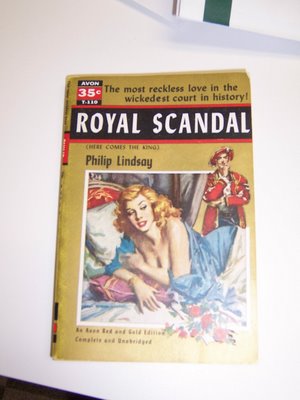
I don’t know what I like about this "Avon Red and Gold Edition" best--Katherine Howard’s permanent wave (Henry VIII did spoil the girl), the caption “(Here Comes the King)” (evidently the novel's original title, but here looking like an admonition to the recumbent Katherine), the fact that Katherine looks about twice as old as she was, her teasingly exposed bosom, or the 35-cent cover price. All I know is that when I saw this gem on eBay, I knew that I had to have it and that anyone who tried to snipe it away from me would have to look to God for forgiveness, not to me.
I've been too busy admiring my new acquisition to read it (and the typeface inside is woefully tiny), but the novel itself looks quite decent, as well researched and well written as anything I've seen recently on Katherine Howard. It doesn't quite live up, though, to the delirious copy on the back jacket: "Her mouth was a kissing mouth, the upper lip drawn in a trifle, demurely, the lower lip heavy, full-blooded: the mouth of a lover . . . soft as a petal, trembling . . ." But then, what could?
Now if I could just get hold of the novels advertised in the back of Royal Scandal, especially Queen's Caprice, a novel that promises to tell in its "untamed splendor . . . the story of the fabulous, lush and amorous Mary, Queen of Scots, who ruled a nation of half-wild clansmen from a throne of passion."
____________________________
*Promotional footnote: The Traitor’s Wife, in case a dog-eared copy does not grace your nightstand already, does not have a cover featuring a headless woman. It does, however, feature a lot of beheadings. Maybe even a throne of passion.
But classy and pretty as these covers are, they have one huge drawback as far as I’m concerned. They’re no fun. This cover is.
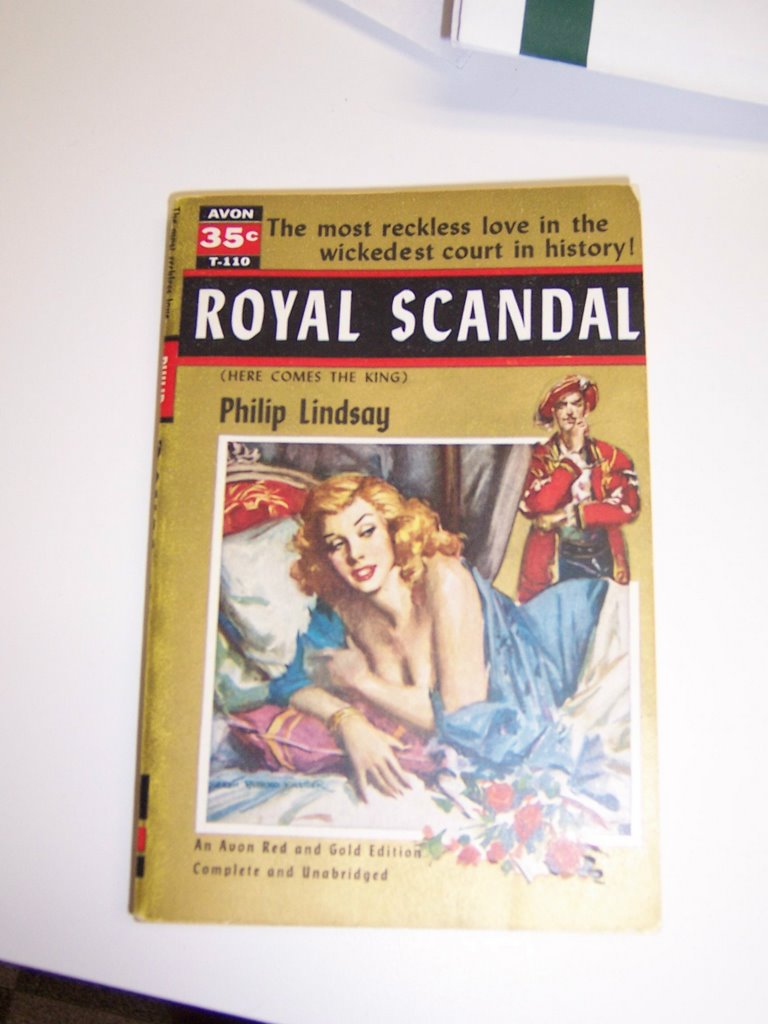
I don’t know what I like about this "Avon Red and Gold Edition" best--Katherine Howard’s permanent wave (Henry VIII did spoil the girl), the caption “(Here Comes the King)” (evidently the novel's original title, but here looking like an admonition to the recumbent Katherine), the fact that Katherine looks about twice as old as she was, her teasingly exposed bosom, or the 35-cent cover price. All I know is that when I saw this gem on eBay, I knew that I had to have it and that anyone who tried to snipe it away from me would have to look to God for forgiveness, not to me.
I've been too busy admiring my new acquisition to read it (and the typeface inside is woefully tiny), but the novel itself looks quite decent, as well researched and well written as anything I've seen recently on Katherine Howard. It doesn't quite live up, though, to the delirious copy on the back jacket: "Her mouth was a kissing mouth, the upper lip drawn in a trifle, demurely, the lower lip heavy, full-blooded: the mouth of a lover . . . soft as a petal, trembling . . ." But then, what could?
Now if I could just get hold of the novels advertised in the back of Royal Scandal, especially Queen's Caprice, a novel that promises to tell in its "untamed splendor . . . the story of the fabulous, lush and amorous Mary, Queen of Scots, who ruled a nation of half-wild clansmen from a throne of passion."
____________________________
*Promotional footnote: The Traitor’s Wife, in case a dog-eared copy does not grace your nightstand already, does not have a cover featuring a headless woman. It does, however, feature a lot of beheadings. Maybe even a throne of passion.
Saturday, April 01, 2006
I Become a Full-Time Historical Fiction Writer
I’m still reeling from the news that I hit it big in the North Carolina State Lottery. Now, of course, I will be able to achieve my longtime goal of writing full-time, not to mention having an office with real walls to do so in. While I’m waiting for the contractors to show up to take some measurements, here’s a list of just some of the upcoming historical novels I’m planning. Agents: contact me by e-mail only, please.
Braveheart: The Sequel
Humiliated by her and her lover Roger Mortimer’s fall from power, Queen Isabella is stunned to receive a disguised visitor at Castle Rising—her first and only real love, William Wallace, who explains that another man offered to be hung, drawn, and quartered in his place so that Wallace could be reunited with Isabella. Isabella snaps, “Took you long enough, Kilt Boy,” but forgives him for his delay after a session of passionate lovemaking. They live happily for the rest of their lives, passing the days by making fun of Edward II’s loss at Bannockburn and marveling at how well their son Edward III turned out.
Where the Sun in Splendour Doesn’t Shine
Recognizing his suppressed homoerotic feelings for Edward IV only after his friend’s untimely death, William Hastings summons the Duke of Buckingham to London and begins a torrid love affair with him. When Hastings abruptly decides he likes Jane Shore better after all, Buckingham persuades Richard III to have Hastings executed. Later, when Richard III refuses Buckingham’s own advances, Buckingham rebels. The Princes in the Tower, meanwhile, escape and begin new lives as traveling players. They begin to write their own plays, which years later find their way into the hands of a rustic from Stratford-upon-Avon.
The Secret Dairy of Anne Boleyn
Fed up with the artificiality of court life, Anne establishes a little farm where she can retreat in times of stress and milk her cows. When she invites a group of muscular male courtiers to join her, Henry VIII mishears the phrase “bring in the hay” as “roll in the hay.” Disaster ensues.
I do believe I hear the contractors at the door now.
Braveheart: The Sequel
Humiliated by her and her lover Roger Mortimer’s fall from power, Queen Isabella is stunned to receive a disguised visitor at Castle Rising—her first and only real love, William Wallace, who explains that another man offered to be hung, drawn, and quartered in his place so that Wallace could be reunited with Isabella. Isabella snaps, “Took you long enough, Kilt Boy,” but forgives him for his delay after a session of passionate lovemaking. They live happily for the rest of their lives, passing the days by making fun of Edward II’s loss at Bannockburn and marveling at how well their son Edward III turned out.
Where the Sun in Splendour Doesn’t Shine
Recognizing his suppressed homoerotic feelings for Edward IV only after his friend’s untimely death, William Hastings summons the Duke of Buckingham to London and begins a torrid love affair with him. When Hastings abruptly decides he likes Jane Shore better after all, Buckingham persuades Richard III to have Hastings executed. Later, when Richard III refuses Buckingham’s own advances, Buckingham rebels. The Princes in the Tower, meanwhile, escape and begin new lives as traveling players. They begin to write their own plays, which years later find their way into the hands of a rustic from Stratford-upon-Avon.
The Secret Dairy of Anne Boleyn
Fed up with the artificiality of court life, Anne establishes a little farm where she can retreat in times of stress and milk her cows. When she invites a group of muscular male courtiers to join her, Henry VIII mishears the phrase “bring in the hay” as “roll in the hay.” Disaster ensues.
I do believe I hear the contractors at the door now.
Thursday, March 30, 2006
Gambling Fever, Meeting the Press, and John Guy
Exciting day for us in the state of North Carolina today--we now have a state lottery! For now, all we have are the tickets that you scratch and match; we'll get the big-boy random drawings later. I'm not a high-stakes gambler by any means; one or two $1 tickets is pretty much my limit. But a million bucks or two would let me do some pretty serious damage on Amazon!
I sent a press release out last week to a couple of local papers announcing my finaling in the ForeWord Magazine awards, and one of their reporters called me today and asked me a few questions for an article. My first interview! Hope I didn't sound like too much of a ditz. I have a much easier time writing than talking about writing.
I haven't had much of a chance to read this week, and none of the historical novels I have on hand has really grabbed me, so I decided to read John Guy's biography of Mary, Queen of Scots. I very seldom read nonfiction books straight through; I tend more to dip into them and read whatever catches my fancy. I'm trying to turn over a new leaf with this one and read from it front to back. Anyway, I'm very impressed so far. Guy writes well, and his portrait of Mary promises to be a balanced and well researched one.
I sent a press release out last week to a couple of local papers announcing my finaling in the ForeWord Magazine awards, and one of their reporters called me today and asked me a few questions for an article. My first interview! Hope I didn't sound like too much of a ditz. I have a much easier time writing than talking about writing.
I haven't had much of a chance to read this week, and none of the historical novels I have on hand has really grabbed me, so I decided to read John Guy's biography of Mary, Queen of Scots. I very seldom read nonfiction books straight through; I tend more to dip into them and read whatever catches my fancy. I'm trying to turn over a new leaf with this one and read from it front to back. Anyway, I'm very impressed so far. Guy writes well, and his portrait of Mary promises to be a balanced and well researched one.
Saturday, March 25, 2006
Nonhistorical and Historical Characters: Should They Mingle?
Finished reading Katherine Howard, a 1969 novel by Jessica Smith, yesterday. Like the other historical novels I’ve read about this foolish but intriguing young queen, it was somewhat disappointing, though I admittedly didn’t have huge hopes for it. Though the author often commented that Katherine was a featherhead, she didn’t come up with any motivation for what even a featherhead must have been able to realize was self-destructive behavior.
Toward the end of the novel, a minor, entirely fictional character, Clarissa, who is one of Katherine’s ladies-in-waiting, plays a prominent part in the novel. She’s allowed to see Culpepper and Derham in their cells (rather improbably, since both men have recently been tortured); she arranges for Katherine to talk with both her grandmother and Lady Rochford before she dies; and she tries to intercede with Henry VIII on Katherine’s behalf. For some reason, Henry VIII takes a shine to her (not that sort of shine, fortunately) and following Katherine’s execution, he awards a soldier who has been taking Clarissa on her rounds a pension, on the condition that he marry Clarissa. Thus, the novel ends on a comparatively happy note.
Which brings me to my point (about time, you might say). On Carla Nayland's blog, Alianor and Carla each expressed doubts about purely fictional characters who play major roles in novels that also feature historical characters. I myself can tolerate someone like Clarissa, who interacts with historical characters but doesn’t have an effect on their actions (though I think the novel would have been stronger without her). As my fellow bloggers noted, they can be a useful plot device.
Some such characters, however, come close to crossing the line into actively influencing the historical ones. In Sharon Penman’s When Christ and His Saints Slept and Time and Chance, the Empress Maude has a fictional out-of-wedlock brother, Ranulf, who stays loyal to Maude throughout and who just about everyone holds in the highest esteem. Henry II, Ranulf’s nephew, also has a high opinion of Ranulf, and the two are close until Ranulf fails to talk Henry out of blinding a group of Welsh hostages. Ranulf, who has a wife in Wales who also happens to be blind, then angrily leaves England, but the two men are reconciled toward the end of the novel.
Penman always provides the reader with an author’s note, and in both books I've been discussing, she duly acknowledges Ranulf’s purely fictional nature and the fact that at one point she gives him credit for the military exploits of another man. So if the reader is left with the impression that Ranulf was a living, breathing historical figure, that’s the reader’s fault and not Penman’s. These two are books that I like a great deal, as a matter of fact. Still, I found the scene where Ranulf tries to persuade Henry not to blind the hostages, and the following scene where Henry broods over the conversation with Ranulf, a little off-putting. One could argue that Henry would have been brooding over his decision anyway, even without Ranulf’s pricking his conscience, and Penman carefully avoids suggesting that the only reason Henry is brooding is because of Ranulf’s objections. But the fact remains I would have preferred that one of the historical characters did the objecting or that Henry’s conscience got pricked without the assistance of Ranulf.
So, dear blog readers, what do you think?
Toward the end of the novel, a minor, entirely fictional character, Clarissa, who is one of Katherine’s ladies-in-waiting, plays a prominent part in the novel. She’s allowed to see Culpepper and Derham in their cells (rather improbably, since both men have recently been tortured); she arranges for Katherine to talk with both her grandmother and Lady Rochford before she dies; and she tries to intercede with Henry VIII on Katherine’s behalf. For some reason, Henry VIII takes a shine to her (not that sort of shine, fortunately) and following Katherine’s execution, he awards a soldier who has been taking Clarissa on her rounds a pension, on the condition that he marry Clarissa. Thus, the novel ends on a comparatively happy note.
Which brings me to my point (about time, you might say). On Carla Nayland's blog, Alianor and Carla each expressed doubts about purely fictional characters who play major roles in novels that also feature historical characters. I myself can tolerate someone like Clarissa, who interacts with historical characters but doesn’t have an effect on their actions (though I think the novel would have been stronger without her). As my fellow bloggers noted, they can be a useful plot device.
Some such characters, however, come close to crossing the line into actively influencing the historical ones. In Sharon Penman’s When Christ and His Saints Slept and Time and Chance, the Empress Maude has a fictional out-of-wedlock brother, Ranulf, who stays loyal to Maude throughout and who just about everyone holds in the highest esteem. Henry II, Ranulf’s nephew, also has a high opinion of Ranulf, and the two are close until Ranulf fails to talk Henry out of blinding a group of Welsh hostages. Ranulf, who has a wife in Wales who also happens to be blind, then angrily leaves England, but the two men are reconciled toward the end of the novel.
Penman always provides the reader with an author’s note, and in both books I've been discussing, she duly acknowledges Ranulf’s purely fictional nature and the fact that at one point she gives him credit for the military exploits of another man. So if the reader is left with the impression that Ranulf was a living, breathing historical figure, that’s the reader’s fault and not Penman’s. These two are books that I like a great deal, as a matter of fact. Still, I found the scene where Ranulf tries to persuade Henry not to blind the hostages, and the following scene where Henry broods over the conversation with Ranulf, a little off-putting. One could argue that Henry would have been brooding over his decision anyway, even without Ranulf’s pricking his conscience, and Penman carefully avoids suggesting that the only reason Henry is brooding is because of Ranulf’s objections. But the fact remains I would have preferred that one of the historical characters did the objecting or that Henry’s conscience got pricked without the assistance of Ranulf.
So, dear blog readers, what do you think?
Tuesday, March 21, 2006
Jean Plaidy, Mary Queen of Scots, and a Message to Promote Marital Harmony
I finished Jean Plaidy’s Royal Road to Fotheringay today. This is the second novel about Mary Queen of Scots I’ve read, the first being Margaret George’s. I didn’t finish George’s book. I’m not sure why. It’s not that I disliked what I did read of it; in fact, I rather liked the scene where the Scots teach the Frenchified Mary and her companions how to play golf. Perhaps it was just the sheer length I found overwhelming; moreover, it’s not an easy book to read in short stretches and with kid-related distractions. One of these days I’ll get back to it.
Plaidy’s novel is much shorter. It covers Mary’s life up through her marriage to Bothwell and her subsequent capture, then in less than twenty pages covers the last twenty years of her life. (Plaidy wrote another book covering the latter period, which I understand is to be reissued later this year.) Consequently, the ending of Royal Road feels rather abrupt, to say the least. Otherwise, it’s pretty good. Mary’s character is well developed in particular. The dialogue is a bit on the wooden side, but not as petrified as it is in some of Plaidy’s later novels.
Reading the Plaidy book made me curious to read more about Mary. I have an old mass-market copy of Antonia Fraser’s biography of her (there’s a jacket photo of Fraser that makes her look something like Emma Peel), but my eyes have grown spoiled by trade paperbacks, and this old paperback is particularly cheaply produced—yellowed pages and gutters so tiny you can barely read the text nearby. Rather than subject myself to such punishment, I went looking for the trade paperback in the local library and ended up with John Guy’s more recent biography.
What’s next on the reading front? I’ve got an old (but readable) paperback copy of a novel by Jessica Smith about Katherine Howard. And hubby had better BUY ME IAN MORTIMER’S THE PERFECT KING FOR OUR ANNIVERSARY. ALL YOU HAVE TO DO IS GO TO AMAZON.CO.UK AND PRESS THE LITTLE SHOPPING CART SYMBOL. THAT’S ALL! JUST LIKE AMAZON USA EXCEPT THAT EVERYTHING’S IN POUNDS.
Sometimes you just can’t be subtle with ‘em.
Plaidy’s novel is much shorter. It covers Mary’s life up through her marriage to Bothwell and her subsequent capture, then in less than twenty pages covers the last twenty years of her life. (Plaidy wrote another book covering the latter period, which I understand is to be reissued later this year.) Consequently, the ending of Royal Road feels rather abrupt, to say the least. Otherwise, it’s pretty good. Mary’s character is well developed in particular. The dialogue is a bit on the wooden side, but not as petrified as it is in some of Plaidy’s later novels.
Reading the Plaidy book made me curious to read more about Mary. I have an old mass-market copy of Antonia Fraser’s biography of her (there’s a jacket photo of Fraser that makes her look something like Emma Peel), but my eyes have grown spoiled by trade paperbacks, and this old paperback is particularly cheaply produced—yellowed pages and gutters so tiny you can barely read the text nearby. Rather than subject myself to such punishment, I went looking for the trade paperback in the local library and ended up with John Guy’s more recent biography.
What’s next on the reading front? I’ve got an old (but readable) paperback copy of a novel by Jessica Smith about Katherine Howard. And hubby had better BUY ME IAN MORTIMER’S THE PERFECT KING FOR OUR ANNIVERSARY. ALL YOU HAVE TO DO IS GO TO AMAZON.CO.UK AND PRESS THE LITTLE SHOPPING CART SYMBOL. THAT’S ALL! JUST LIKE AMAZON USA EXCEPT THAT EVERYTHING’S IN POUNDS.
Sometimes you just can’t be subtle with ‘em.
Wednesday, March 15, 2006
In Which I Soundly Administer Myself a Good Pat on the Back
C'mon, I don't often get the chance to do this!
I'm delighted to announce that The Traitor's Wife: A Novel of the Reign of Edward II (that's my baby), has been named one of 15 finalists in the Historical Fiction category of ForeWord Magazine's 2005 Book of the Year Awards. The awards were established to reward "excellence in publishing from independent presses."
According to the ForeWord website, 604 finalists in 55 categories were chosen from 1,540 book submissions. Winners will be announced in Washington, D.C., on May 19, 2006.
OK, back-patting's over!
I'm delighted to announce that The Traitor's Wife: A Novel of the Reign of Edward II (that's my baby), has been named one of 15 finalists in the Historical Fiction category of ForeWord Magazine's 2005 Book of the Year Awards. The awards were established to reward "excellence in publishing from independent presses."
According to the ForeWord website, 604 finalists in 55 categories were chosen from 1,540 book submissions. Winners will be announced in Washington, D.C., on May 19, 2006.
OK, back-patting's over!
Tuesday, March 14, 2006
The Da Vinci Code trial
Up until recently, I hadn't been following the lawsuit filed in the UK against Dan Brown's publishers, but it may be worth watching closely. For those of you who haven't been keeping up all along, two of the three authors of a nonfiction book, Holy Blood, Holy Grail, claim that in his novel The Da Vinci Code, Brown used the "architecture" of Holy Blood--namely, its argument that Jesus married Mary Magdalene, that the couple had children, and that there was a conspiracy to keep this secret--in creating his work of fiction. Brown did apparently use Holy Blood as one of his sources, and a character in the novel even mentions the nonfiction work.
I haven't read The Da Vinci Code, and probably won't be doing so, not on ideological grounds but because the whole thing sounds sort of silly to me. Moreover, it's a thriller, and I don't read thrillers--riding on the expressway surrounded by SUV's being driven by people who are chatting on their cell phones while traveling 75 miles per hour is enough thrill for me, thank you.
But whatever one thinks of the merits, literary or otherwise, of The Da Vinci Code, the outcome of this trial will be of interest to writers of historical fiction, at least to those who bother to do research. If a novelist uses a nonfiction writer's conclusion--particularly a new or a controversial conclusion--as a jumping-off point for his own work, will he be exposing himself to liability? What if the conclusion is only a small component of the fictional work? What if the conclusion is the meat and bones of the fictional work? Will the novelist have to pay nonfiction writers for the right to use the fruits of their research? What about nonfiction writers who build on the foundation of research of others?
Lots to ponder here.
I haven't read The Da Vinci Code, and probably won't be doing so, not on ideological grounds but because the whole thing sounds sort of silly to me. Moreover, it's a thriller, and I don't read thrillers--riding on the expressway surrounded by SUV's being driven by people who are chatting on their cell phones while traveling 75 miles per hour is enough thrill for me, thank you.
But whatever one thinks of the merits, literary or otherwise, of The Da Vinci Code, the outcome of this trial will be of interest to writers of historical fiction, at least to those who bother to do research. If a novelist uses a nonfiction writer's conclusion--particularly a new or a controversial conclusion--as a jumping-off point for his own work, will he be exposing himself to liability? What if the conclusion is only a small component of the fictional work? What if the conclusion is the meat and bones of the fictional work? Will the novelist have to pay nonfiction writers for the right to use the fruits of their research? What about nonfiction writers who build on the foundation of research of others?
Lots to ponder here.
Saturday, March 11, 2006
A Divine Sign?
A couple of weeks ago, the computer on which I do most of my novel-writing suddenly refused to start up properly. I consulted a local geek (that's what computer guys seem to like to be called these days), who diagnosed it as having a corrupt profile, but had no idea why, even after consulting other geeks. Nothing like playing Stump the Geeks with one's computer.
My computer was finally returned to me last night, but whatever caused my profile to become corrupted also made all of my Microsoft Word files disappear, including the novel I'm working on. I had a couple of chapters saved on a diskette (the humble diskette gets too little respect these days, but I'm grateful to it), but all of my latest work was lost. Rather than curse and throw small objects (all right, in addition to cursing and throwing small objects), I decided to take this as a Divine Sign that it was time to rework the chapter in question.
In the future, though, I would appreciate more subtle Divine Signs, especially as this one also requires me to do all of my income taxes over again. Just a thought.
While also restoring my website files (do you get the idea that the last day was not a delightful one for me?), I came across my oldest postings from a previous incarnation of this blog. As with my expose of James Frey, I can't find the post in which I came up with a plan for peace in the Middle East, but here's the others:
THURSDAY, OCTOBER 27, 2005
More on Barnes, a new P. D. James, and book-discarding regret
While I was using the Amazon listings to add some titles to my library with Library Thing, I noticed that P. D. James has a new book scheduled for November. Something else to look forward to!
I'm still reading through Barnes's The Passionate Brood, and I'm beginning to think it should have been called The Whiny Brood. Everyone bickers and complains (sometimes in scenes that extend over two chapters), and after a while this gets quite tedious. I'll still probably make it through this one (I have to do something while waiting for my kids, and this old mass market paperback fits snugly in my purse), but I'm actively looking around for something else. Think I'll try Mary Lancaster's An Endless Exile--I've seen excerpts from it, and it looks interesting. I've also been debating whether to spring for Robin Maxwell's To the Tower Born. It looked good, but not quite good enough for me to buy the hardback, and our public library hasn't bought a copy. Maybe if I'm feeling flush . . .
Ever suffer from book-discarding regret? I gave away some of my novels on Richard III to a person who had lost hers in Hurricane Katrina, and I soon regretted it--the person later posted some remarks on a list I belong to that made it sound as if writing historical novels was just one step up intellectually from playing Go Fish. (I resisted the temptatation to ask her why, then, she had so many of the things.) There were a couple of books in the pile that hadn't done a thing for me, but there were a couple others that I liked in a way and disliked in other ways, and now I wish I had 'em back! In fact, I keep forgetting they aren't in my garage anymore. And have you noticed that when you give a book away, that's when you suddenly need to look up a quote from it? I've done that with some books I bought for various literature classes that I gave to the library or to Goodwill because they were just taking up space--same thing with some of my clothes, as a matter of fact (well, no, I've never had to look up quotes from my clothes, and I've never given my old clothes to the library, but you get the general idea).
POSTED BY BOSWELLBAXTER AT 11:08 PM 0 COMMENTS
TUESDAY, OCTOBER 25, 2005
Margaret Campbell Barnes
Margaret Campbell Barnes was, I gather, fairly big in the 1940's as a writer of historical fiction. Being interested in anything on the reign of Edward II, I picked up her Isabel the Fair a couple of years ago and liked it. Since then, I've read a few other things by her, the latest being The Passionate Brood, mostly about Richard the Lionhearted (and about Robin Hood, who turns out to have been a foster brother to Richard). I have serious doubts about Barnes's historical accuracy in places, and it's a pity she chose to kill off Henry II offstage, but Barnes excels at character studies. (Though sometimes she overdoes the analysis, particularly the self-analysis--there's a few places in Isabel the Fair, for instance, where it appears that Gaveston has taken a college psychology class.) Moreover, since she wrote in the 1940's, she didn't have the easy out of having her characters jump into bed together whenever they ran out of things to say to each other--something I've seen in a lot of modern historical novels. Pick one of her books up--they're still pretty easy to find secondhand, some with splendidly cheesy covers evidently geared toward the romance novel readership.
POSTED BY BOSWELLBAXTER AT 11:36 PM 0 COMMENTS
Clamb?
Ooh, those lucky Brits, getting to see the new Bleak House miniseries! I've consoled myself for having to wait by paying some visits to the BBC's website, and I've noticed that the director has added a new character to the book--Tulkinghorn's clerk, a Mr. Clamb. Great name, and Tulkinghorn probably does need a clerk, so I guess I can live with that. At least other characters don't seem to have been left out--judging from the cast list, even people like the Badgers and Mr. Turveydrop made their way in. This ought to be fun.
Gotta go work.
POSTED BY BOSWELLBAXTER AT 8:56 AM 0 COMMENTS
MONDAY, OCTOBER 24, 2005
Fun with Library Thing
As you can see by looking to the right, I've added a random list of books in my library to my blog, having noticed them on a couple of other blogs and thought it would be fun to have. I've been enjoying entering the books and seeing what pops up on my blog! As will soon become apparent, I have my favorites--Charles Dickens, Jane Austen, Charlotte Bronte, and Elizabeth Gaskell are well represented in my library, as are living writers like Anne Tyler and P. D. James. I've yet, alas, to get my Barbie-collecting books in the system.
This list is courtesy of Library Thing, which allows people to create a database of books in their personal libraries (or books they say are in their personal libraries, no one's checking!). It's nowhere near complete--I'm pretty much just working from memory right now or entering the books that happen to be nearest at hand.
Now if someone will invent a program that will allow me to find a book when I'm looking for it! Dorothy Parker once said that she shelved her books by "Good" and "Crap," but as I've moved a lot and am chronically short of space, I've long since discarded most of the crap. Right now my system is mainly hardbacks in the living room and paperbacks in the garage, but one day I hope to refine that--probably the same day I get my own little office to write in. (Dream on, sister.)
POSTED BY BOSWELLBAXTER AT 2:13 PM 0 COMMENTS
Arlene Okerlund's book on Elizabeth Woodville
Elizabeth Woodville is one of those queens who can't catch a break with historical novelists. Either she's a witch (as in Rosemary Jarman's vastly overrated We Speak No Treason--one of the few novels about the Wars of the Roses I could not bring myself to finish) or a vicious schemer (as in Sandra Worth's sentimental novel about Richard III). Even Sharon Penman, who's more objective than most Ricardian novelists, presents her largely unsympathetically.
That's why it's been refreshing to read Arlene Okerlund's biography Elizabeth Wydeville: The Slandered Queen. It's a sympathetic, yet objective study of the queen as well as her family (who fare even worse at the hands of novelists than Elizabeth herself). It also has the merit of being readable. Perhaps some novelist will follow suit and depict this queen as a complex human being instead of a caricature.
POSTED BY BOSWELLBAXTER AT 12:04 AM 0 COMMENTS
WEDNESDAY, OCTOBER 19, 2005
Edward II in Fiction
Someone on a mailing list I belong to mentioned the Alison Weir book on Queen Isabella and said that someone should write a novel about her. Naturally, I couldn't resist pointing out that I had written a novel in which she appears, and that there's a slew of books out there in which she is the main or a major character. Want a list of them? Wait no longer! Just check out the "Edward II in Fiction" page on my website, www.susanhigginbotham.com or www.thetraitorswife.com!
POSTED BY BOSWELLBAXTER AT 12:48 AM 0 COMMENTS
SATURDAY, OCTOBER 15, 2005
Alison Weir's latest on Queen Isabella
[Note from 3/10/2006: Alianor in her blog has since reviewed this much more thoroughly]
Finally drove down to the bookstore yesterday in my shiny new used van (there's nothing like a transmission going to get Mom new wheels) and picked up Alison Weir's latest biography, Queen Isabella: Treachery, Adultery, and Murder in Medieval England. Lots going on here, as you can tell from the subtitle!
Truth be told, I had picked up a proof copy of the British version of the book a couple of months ago (Ebay is a wondrous thing), but had refrained from writing much about it in the hopes that the errors I found would have been corrected when the book was published. They weren't.
The errors weren't major ones by any means, but they're bothersome, and they have the unfortunate effect of making Isabella look rather nicer than she was. For instance, Queen Isabella's archenemy was Hugh le Despenser the younger, whom she had hung, drawn, and quartered (nasty business). Weir gets that right, of course. But her account of what happened to his family is quite wrong, even though the primary documents are there in plain English even for a nonhistorian like myself to see. Weir writes that Hugh's eldest son was pardoned a few months after his father's death. This is true, but what she fails to mention is that despite the pardon, he was imprisoned and stayed that way for four years, getting out only after Isabella was removed from power and her lover Roger Mortimer executed. She also writes that Hugh's young daughters (none of the children was over 18 when their father died) were sent to stay in convents while their mother was imprisoned and that three of them later became nuns. In fact, the three girls who became nuns had no choice in the matter--Isabella forced them to take the veil just six weeks after their father's death.
Minor details, true. But the impression one gets from Weir is that Isabella was merciful in her treatment of her enemy's family, when in fact she was quite mean-spirited, forcing a young man into prison and little girls to become nuns because of their father's misdeeds.
The most controversial aspect of Weir's book, however, will probably be her agreement with the theory that Edward II was not killed by his queen and her lover, but escaped and lived the rest of his life as a hermit on the Continent. This theory has gained popularity lately, and has been argued most recently by Paul Doherty and Ian Mortimer. Weir, however, doesn't argue her theory very convincingly, which is unfortunate, because her sympathetic assessment of Isabella hinges in great part on her belief that Isabella was not a murderess, merely an adulteress who was driven into her lover's arms by her husband's shortcomings.
So is this book worth reading? Definitely--it's a thorough account of Isabella's life; its treatment of Edward II, who's often caricatured even by historians as a swishy misogynist, is relatively evenhanded; and it's quite readable. Just take it with a grain of salt in places.
POSTED BY BOSWELLBAXTER AT 12:17 AM 0 COMMENTS
WEDNESDAY, OCTOBER 12, 2005
My minivan strikes again
I had every intention of buying Alison Weir's new book on Queen Isabella today (the very same one who appears in The Traitor's Wife) and blogging on that, but my minivan would have no part of it. It started letting out these screeching noises and acting most peculiar (well, more peculiar than usual). We took it to the garage where it spends much of its time and they gave us the cheery news that its transmission is going.
This is obviously its childish revenge for us looking at new minivans (well, used ones that were built within this millennium, at least) the other day. But we may just have the last laugh if we can trade it in . . .
Just ran a spellcheck and discovered that the online dictionary didn't know the word "blogging." Time to get with the program, folks!
POSTED BY BOSWELLBAXTER AT 12:14 AM 0 COMMENTS
TUESDAY, OCTOBER 11, 2005
P. D. James's The Murder Room
I watched Part I of the television adaptation of P. D. James's The Murder Room last night. When I read the novel, I didn't find it to be P. D. James at her best--in fact, I'd forgotten whodunit! So watching the show last night was more entertaining than usual, since I didn't remember a lot of the action or characters. (Usually when I'm watching a TV adaptation, I keep thinking, "Why did they leave that out?" "That's not what she did," and so forth.)
But I have a bad habit when I read novels--I peek at the ending long before I've gotten very far in the beginning of the novel. (I don't know what I would have done in the days of serial publication where I would have had to wait a month for the next installment.) So having forgotten how the book ended, I naturally had to dig out my copy and find out who the murderer was. (Don't worry. I'm not telling!) So now I know--and I probably won't enjoy the next episode as much as I did this one.
POSTED BY BOSWELLBAXTER AT 12:00 AM 0 COMMENTS
FRIDAY, OCTOBER 07, 2005
Looking forward to the BBC Bleak House
I've been looking forward excitedly to the BBC's upcoming adaptation of Bleak House, and today I was pleased to learn that it will be broadcast in the States beginning in January 2006! That's fast, considering how long it takes some things to get over here. I don't know which station is carrying it in the US, but I hope it's not BBC America. When BBC America broadcast Our Mutual Friend over here a few years back, following the PBS broadcast, the BBC America version chopped the episodes quite brutally for commercial breaks.
Anyway, back to my reading blog! My husband and I couldn't resist the opportunity to buy four books for a buck from a book club, and one of the ones I selected was Miri Rubin's The Hollow Crown: A History of Britain in the Late Middle Ages. It's quite readable.
POSTED BY BOSWELLBAXTER AT 12:06 AM
WEDNESDAY, OCTOBER 05, 2005
Richard III
Ever go to one of those job interviews where the interviewer asked, "What is your greatest weakness?" Needless to say, no one ever answers, "Stealing from the petty cash by the coffee machine," or "Sexually harassing my subordinates." Instead, one comes up with, "I just tend to get too involved with my work," or the like.
This reminds me of recent novels on Richard III, where the king's few faults are all of this sort--not real faults, but excesses of virtue. Now, the facts we know about Richard III are open to varying interpretations, so if a writer wants to paint him as a sympathetic character, I've no trouble with that. But why paint him as a saint? And why villify everyone else who isn't Richard III? In the most recent novels I've read about the king, he's a brave soldier, a devoted friend, a considerate lover, a good son, and a loyal brother--while nearly everyone else around him is self-seeking, corrupt, greedy, lecherous, and scheming. But the known facts about Richard III--for example, his execution of Hastings without trial, his haste to have his brother's children declared bastards without bothering to submit the issue to the ecclesiastical courts where it belonged--show him to be a much more complicated character. Just for once, I'd like to see a novel that reflected this reality.
POSTED BY BOSWELLBAXTER AT 12:33 AM 0 COMMENTS
Welcome to my reading blog (I hope!)
Well, I think I figured my blogging out!
I can't imagine anyone being interested in what I eat for dinner each night (though if you are, Tuesday is usually sausage pizza night). Instead, I thought I'd post on different things that I'm reading.
As I said in an earlier post that got wiped out with my blogging experiments, since reading Sandra Gulland's trilogy about Josephine Bonaparte, I've become somewhat interested in the French Revolution. Because of this, I picked up Carolly Erickson's new novel, The Hidden Diary of Marie Antoinette. Though I found it very well written and (as far as I could tell) well researched, I was a little disappointed. There are a few well drawn characters, but most of the historical figures are merely sketched in, even those who were important to Marie Antoinette. This leads to some odd moments. For instance, when the Princess Lamballe's severed head and genitals are paraded in front of the queen by the mob, this ought to be as horrifying to the reader as it is to the queen, but as the princess has appeared only a few times in the novel, and then only to say the equivalent of "Please pass the salt," one feels only a detached sense of disgust at the mob. Erickson does a lot better at bringing these events to life in her biography To the Scaffold.
Time to see if this posts right!
POSTED BY BOSWELLBAXTER AT 12:15 AM 0 COMMENTS
TUESDAY, OCTOBER 04, 2005
Trying to figure this out
Well, I'm trying to figure out how to post my blogs! We'll see if this works.
My computer was finally returned to me last night, but whatever caused my profile to become corrupted also made all of my Microsoft Word files disappear, including the novel I'm working on. I had a couple of chapters saved on a diskette (the humble diskette gets too little respect these days, but I'm grateful to it), but all of my latest work was lost. Rather than curse and throw small objects (all right, in addition to cursing and throwing small objects), I decided to take this as a Divine Sign that it was time to rework the chapter in question.
In the future, though, I would appreciate more subtle Divine Signs, especially as this one also requires me to do all of my income taxes over again. Just a thought.
While also restoring my website files (do you get the idea that the last day was not a delightful one for me?), I came across my oldest postings from a previous incarnation of this blog. As with my expose of James Frey, I can't find the post in which I came up with a plan for peace in the Middle East, but here's the others:
THURSDAY, OCTOBER 27, 2005
More on Barnes, a new P. D. James, and book-discarding regret
While I was using the Amazon listings to add some titles to my library with Library Thing, I noticed that P. D. James has a new book scheduled for November. Something else to look forward to!
I'm still reading through Barnes's The Passionate Brood, and I'm beginning to think it should have been called The Whiny Brood. Everyone bickers and complains (sometimes in scenes that extend over two chapters), and after a while this gets quite tedious. I'll still probably make it through this one (I have to do something while waiting for my kids, and this old mass market paperback fits snugly in my purse), but I'm actively looking around for something else. Think I'll try Mary Lancaster's An Endless Exile--I've seen excerpts from it, and it looks interesting. I've also been debating whether to spring for Robin Maxwell's To the Tower Born. It looked good, but not quite good enough for me to buy the hardback, and our public library hasn't bought a copy. Maybe if I'm feeling flush . . .
Ever suffer from book-discarding regret? I gave away some of my novels on Richard III to a person who had lost hers in Hurricane Katrina, and I soon regretted it--the person later posted some remarks on a list I belong to that made it sound as if writing historical novels was just one step up intellectually from playing Go Fish. (I resisted the temptatation to ask her why, then, she had so many of the things.) There were a couple of books in the pile that hadn't done a thing for me, but there were a couple others that I liked in a way and disliked in other ways, and now I wish I had 'em back! In fact, I keep forgetting they aren't in my garage anymore. And have you noticed that when you give a book away, that's when you suddenly need to look up a quote from it? I've done that with some books I bought for various literature classes that I gave to the library or to Goodwill because they were just taking up space--same thing with some of my clothes, as a matter of fact (well, no, I've never had to look up quotes from my clothes, and I've never given my old clothes to the library, but you get the general idea).
POSTED BY BOSWELLBAXTER AT 11:08 PM 0 COMMENTS
TUESDAY, OCTOBER 25, 2005
Margaret Campbell Barnes
Margaret Campbell Barnes was, I gather, fairly big in the 1940's as a writer of historical fiction. Being interested in anything on the reign of Edward II, I picked up her Isabel the Fair a couple of years ago and liked it. Since then, I've read a few other things by her, the latest being The Passionate Brood, mostly about Richard the Lionhearted (and about Robin Hood, who turns out to have been a foster brother to Richard). I have serious doubts about Barnes's historical accuracy in places, and it's a pity she chose to kill off Henry II offstage, but Barnes excels at character studies. (Though sometimes she overdoes the analysis, particularly the self-analysis--there's a few places in Isabel the Fair, for instance, where it appears that Gaveston has taken a college psychology class.) Moreover, since she wrote in the 1940's, she didn't have the easy out of having her characters jump into bed together whenever they ran out of things to say to each other--something I've seen in a lot of modern historical novels. Pick one of her books up--they're still pretty easy to find secondhand, some with splendidly cheesy covers evidently geared toward the romance novel readership.
POSTED BY BOSWELLBAXTER AT 11:36 PM 0 COMMENTS
Clamb?
Ooh, those lucky Brits, getting to see the new Bleak House miniseries! I've consoled myself for having to wait by paying some visits to the BBC's website, and I've noticed that the director has added a new character to the book--Tulkinghorn's clerk, a Mr. Clamb. Great name, and Tulkinghorn probably does need a clerk, so I guess I can live with that. At least other characters don't seem to have been left out--judging from the cast list, even people like the Badgers and Mr. Turveydrop made their way in. This ought to be fun.
Gotta go work.
POSTED BY BOSWELLBAXTER AT 8:56 AM 0 COMMENTS
MONDAY, OCTOBER 24, 2005
Fun with Library Thing
As you can see by looking to the right, I've added a random list of books in my library to my blog, having noticed them on a couple of other blogs and thought it would be fun to have. I've been enjoying entering the books and seeing what pops up on my blog! As will soon become apparent, I have my favorites--Charles Dickens, Jane Austen, Charlotte Bronte, and Elizabeth Gaskell are well represented in my library, as are living writers like Anne Tyler and P. D. James. I've yet, alas, to get my Barbie-collecting books in the system.
This list is courtesy of Library Thing, which allows people to create a database of books in their personal libraries (or books they say are in their personal libraries, no one's checking!). It's nowhere near complete--I'm pretty much just working from memory right now or entering the books that happen to be nearest at hand.
Now if someone will invent a program that will allow me to find a book when I'm looking for it! Dorothy Parker once said that she shelved her books by "Good" and "Crap," but as I've moved a lot and am chronically short of space, I've long since discarded most of the crap. Right now my system is mainly hardbacks in the living room and paperbacks in the garage, but one day I hope to refine that--probably the same day I get my own little office to write in. (Dream on, sister.)
POSTED BY BOSWELLBAXTER AT 2:13 PM 0 COMMENTS
Arlene Okerlund's book on Elizabeth Woodville
Elizabeth Woodville is one of those queens who can't catch a break with historical novelists. Either she's a witch (as in Rosemary Jarman's vastly overrated We Speak No Treason--one of the few novels about the Wars of the Roses I could not bring myself to finish) or a vicious schemer (as in Sandra Worth's sentimental novel about Richard III). Even Sharon Penman, who's more objective than most Ricardian novelists, presents her largely unsympathetically.
That's why it's been refreshing to read Arlene Okerlund's biography Elizabeth Wydeville: The Slandered Queen. It's a sympathetic, yet objective study of the queen as well as her family (who fare even worse at the hands of novelists than Elizabeth herself). It also has the merit of being readable. Perhaps some novelist will follow suit and depict this queen as a complex human being instead of a caricature.
POSTED BY BOSWELLBAXTER AT 12:04 AM 0 COMMENTS
WEDNESDAY, OCTOBER 19, 2005
Edward II in Fiction
Someone on a mailing list I belong to mentioned the Alison Weir book on Queen Isabella and said that someone should write a novel about her. Naturally, I couldn't resist pointing out that I had written a novel in which she appears, and that there's a slew of books out there in which she is the main or a major character. Want a list of them? Wait no longer! Just check out the "Edward II in Fiction" page on my website, www.susanhigginbotham.com or www.thetraitorswife.com!
POSTED BY BOSWELLBAXTER AT 12:48 AM 0 COMMENTS
SATURDAY, OCTOBER 15, 2005
Alison Weir's latest on Queen Isabella
[Note from 3/10/2006: Alianor in her blog has since reviewed this much more thoroughly]
Finally drove down to the bookstore yesterday in my shiny new used van (there's nothing like a transmission going to get Mom new wheels) and picked up Alison Weir's latest biography, Queen Isabella: Treachery, Adultery, and Murder in Medieval England. Lots going on here, as you can tell from the subtitle!
Truth be told, I had picked up a proof copy of the British version of the book a couple of months ago (Ebay is a wondrous thing), but had refrained from writing much about it in the hopes that the errors I found would have been corrected when the book was published. They weren't.
The errors weren't major ones by any means, but they're bothersome, and they have the unfortunate effect of making Isabella look rather nicer than she was. For instance, Queen Isabella's archenemy was Hugh le Despenser the younger, whom she had hung, drawn, and quartered (nasty business). Weir gets that right, of course. But her account of what happened to his family is quite wrong, even though the primary documents are there in plain English even for a nonhistorian like myself to see. Weir writes that Hugh's eldest son was pardoned a few months after his father's death. This is true, but what she fails to mention is that despite the pardon, he was imprisoned and stayed that way for four years, getting out only after Isabella was removed from power and her lover Roger Mortimer executed. She also writes that Hugh's young daughters (none of the children was over 18 when their father died) were sent to stay in convents while their mother was imprisoned and that three of them later became nuns. In fact, the three girls who became nuns had no choice in the matter--Isabella forced them to take the veil just six weeks after their father's death.
Minor details, true. But the impression one gets from Weir is that Isabella was merciful in her treatment of her enemy's family, when in fact she was quite mean-spirited, forcing a young man into prison and little girls to become nuns because of their father's misdeeds.
The most controversial aspect of Weir's book, however, will probably be her agreement with the theory that Edward II was not killed by his queen and her lover, but escaped and lived the rest of his life as a hermit on the Continent. This theory has gained popularity lately, and has been argued most recently by Paul Doherty and Ian Mortimer. Weir, however, doesn't argue her theory very convincingly, which is unfortunate, because her sympathetic assessment of Isabella hinges in great part on her belief that Isabella was not a murderess, merely an adulteress who was driven into her lover's arms by her husband's shortcomings.
So is this book worth reading? Definitely--it's a thorough account of Isabella's life; its treatment of Edward II, who's often caricatured even by historians as a swishy misogynist, is relatively evenhanded; and it's quite readable. Just take it with a grain of salt in places.
POSTED BY BOSWELLBAXTER AT 12:17 AM 0 COMMENTS
WEDNESDAY, OCTOBER 12, 2005
My minivan strikes again
I had every intention of buying Alison Weir's new book on Queen Isabella today (the very same one who appears in The Traitor's Wife) and blogging on that, but my minivan would have no part of it. It started letting out these screeching noises and acting most peculiar (well, more peculiar than usual). We took it to the garage where it spends much of its time and they gave us the cheery news that its transmission is going.
This is obviously its childish revenge for us looking at new minivans (well, used ones that were built within this millennium, at least) the other day. But we may just have the last laugh if we can trade it in . . .
Just ran a spellcheck and discovered that the online dictionary didn't know the word "blogging." Time to get with the program, folks!
POSTED BY BOSWELLBAXTER AT 12:14 AM 0 COMMENTS
TUESDAY, OCTOBER 11, 2005
P. D. James's The Murder Room
I watched Part I of the television adaptation of P. D. James's The Murder Room last night. When I read the novel, I didn't find it to be P. D. James at her best--in fact, I'd forgotten whodunit! So watching the show last night was more entertaining than usual, since I didn't remember a lot of the action or characters. (Usually when I'm watching a TV adaptation, I keep thinking, "Why did they leave that out?" "That's not what she did," and so forth.)
But I have a bad habit when I read novels--I peek at the ending long before I've gotten very far in the beginning of the novel. (I don't know what I would have done in the days of serial publication where I would have had to wait a month for the next installment.) So having forgotten how the book ended, I naturally had to dig out my copy and find out who the murderer was. (Don't worry. I'm not telling!) So now I know--and I probably won't enjoy the next episode as much as I did this one.
POSTED BY BOSWELLBAXTER AT 12:00 AM 0 COMMENTS
FRIDAY, OCTOBER 07, 2005
Looking forward to the BBC Bleak House
I've been looking forward excitedly to the BBC's upcoming adaptation of Bleak House, and today I was pleased to learn that it will be broadcast in the States beginning in January 2006! That's fast, considering how long it takes some things to get over here. I don't know which station is carrying it in the US, but I hope it's not BBC America. When BBC America broadcast Our Mutual Friend over here a few years back, following the PBS broadcast, the BBC America version chopped the episodes quite brutally for commercial breaks.
Anyway, back to my reading blog! My husband and I couldn't resist the opportunity to buy four books for a buck from a book club, and one of the ones I selected was Miri Rubin's The Hollow Crown: A History of Britain in the Late Middle Ages. It's quite readable.
POSTED BY BOSWELLBAXTER AT 12:06 AM
WEDNESDAY, OCTOBER 05, 2005
Richard III
Ever go to one of those job interviews where the interviewer asked, "What is your greatest weakness?" Needless to say, no one ever answers, "Stealing from the petty cash by the coffee machine," or "Sexually harassing my subordinates." Instead, one comes up with, "I just tend to get too involved with my work," or the like.
This reminds me of recent novels on Richard III, where the king's few faults are all of this sort--not real faults, but excesses of virtue. Now, the facts we know about Richard III are open to varying interpretations, so if a writer wants to paint him as a sympathetic character, I've no trouble with that. But why paint him as a saint? And why villify everyone else who isn't Richard III? In the most recent novels I've read about the king, he's a brave soldier, a devoted friend, a considerate lover, a good son, and a loyal brother--while nearly everyone else around him is self-seeking, corrupt, greedy, lecherous, and scheming. But the known facts about Richard III--for example, his execution of Hastings without trial, his haste to have his brother's children declared bastards without bothering to submit the issue to the ecclesiastical courts where it belonged--show him to be a much more complicated character. Just for once, I'd like to see a novel that reflected this reality.
POSTED BY BOSWELLBAXTER AT 12:33 AM 0 COMMENTS
Welcome to my reading blog (I hope!)
Well, I think I figured my blogging out!
I can't imagine anyone being interested in what I eat for dinner each night (though if you are, Tuesday is usually sausage pizza night). Instead, I thought I'd post on different things that I'm reading.
As I said in an earlier post that got wiped out with my blogging experiments, since reading Sandra Gulland's trilogy about Josephine Bonaparte, I've become somewhat interested in the French Revolution. Because of this, I picked up Carolly Erickson's new novel, The Hidden Diary of Marie Antoinette. Though I found it very well written and (as far as I could tell) well researched, I was a little disappointed. There are a few well drawn characters, but most of the historical figures are merely sketched in, even those who were important to Marie Antoinette. This leads to some odd moments. For instance, when the Princess Lamballe's severed head and genitals are paraded in front of the queen by the mob, this ought to be as horrifying to the reader as it is to the queen, but as the princess has appeared only a few times in the novel, and then only to say the equivalent of "Please pass the salt," one feels only a detached sense of disgust at the mob. Erickson does a lot better at bringing these events to life in her biography To the Scaffold.
Time to see if this posts right!
POSTED BY BOSWELLBAXTER AT 12:15 AM 0 COMMENTS
TUESDAY, OCTOBER 04, 2005
Trying to figure this out
Well, I'm trying to figure out how to post my blogs! We'll see if this works.
Wednesday, March 08, 2006
Historical Accuracy in Historical Fiction
Both on this blog and on other sites I've visited, the question of historical accuracy in historical fiction has come up. As I said in one of my earlier blog posts, I think it's the reader's ultimate responsibility to check the accuracy of what he reads. Historical fiction, after all, is exactly that--fiction.
By saying that, however, I don't mean to let writers off the hook, because I think that a writer of historical fiction has a responsibility not to distort known facts to suit her purposes—or at least if she does, to let the reader know what has been done. To me, it's an ethical obligation. That's not to say that it's an obligation that should be forced upon novelists--it couldn't be without imposing some degree of censorship, and that's certainly not what I or any other sane author or reader wants.
Ideally, the marketplace would reward those novelists and other storytellers who adhere to this ethical code (and, by the same token, penalize those who don't give a flip for accuracy). More often than not, it doesn't. The historical inaccuracies of Braveheart, for example, have been pointed out countless times, and I doubt its producers have lost a penny as a result. (Hey, they even got my penny--through ratings figures--the other night.) And readers, of course, don't always appreciate accuracy. Take a look at the Amazon reader reviews for Virginia Henley's historical romance The Marriage Prize. Several readers gave Henley two- or one-star ratings simply because she followed history in killing off Simon de Montfort. Of course, romantic fiction has a convention where one doesn't kill off the hero, but Montfort wasn't the hero of this particular novel.
There's a core of readers who both want accuracy and appreciate it, however, and I'm one of them. How to make our voices heard? Post--on our blogs, on Amazon, anywhere. Praise an author when he makes an effort to be accurate, criticize him when he deliberately distorts and leaves the reader in the dark that he's done so.
If nothing else, do this: Buy Mr. Accuracy's books new, buy Mr. Inaccuracy's books used.
That'll show 'em.
By saying that, however, I don't mean to let writers off the hook, because I think that a writer of historical fiction has a responsibility not to distort known facts to suit her purposes—or at least if she does, to let the reader know what has been done. To me, it's an ethical obligation. That's not to say that it's an obligation that should be forced upon novelists--it couldn't be without imposing some degree of censorship, and that's certainly not what I or any other sane author or reader wants.
Ideally, the marketplace would reward those novelists and other storytellers who adhere to this ethical code (and, by the same token, penalize those who don't give a flip for accuracy). More often than not, it doesn't. The historical inaccuracies of Braveheart, for example, have been pointed out countless times, and I doubt its producers have lost a penny as a result. (Hey, they even got my penny--through ratings figures--the other night.) And readers, of course, don't always appreciate accuracy. Take a look at the Amazon reader reviews for Virginia Henley's historical romance The Marriage Prize. Several readers gave Henley two- or one-star ratings simply because she followed history in killing off Simon de Montfort. Of course, romantic fiction has a convention where one doesn't kill off the hero, but Montfort wasn't the hero of this particular novel.
There's a core of readers who both want accuracy and appreciate it, however, and I'm one of them. How to make our voices heard? Post--on our blogs, on Amazon, anywhere. Praise an author when he makes an effort to be accurate, criticize him when he deliberately distorts and leaves the reader in the dark that he's done so.
If nothing else, do this: Buy Mr. Accuracy's books new, buy Mr. Inaccuracy's books used.
That'll show 'em.
Saturday, March 04, 2006
At Last, I Sit Through Half of Braveheart
The other night, my husband channel-surfed and landed on Braveheart, which I missed seeing at the time it was released (a) because it wasn't anything that interested me then and (b) because it came out when I was in law school, a time in which I was blissfully oblivious to all around me but the continuing saga of Blackacre and John Doe's valiant attempts to preserve it for his male heirs. (Now there's a movie someone needs to make: Blackacre.)
Once I became interested in the reign of Edward II, however, I did have some interest in seeing Braveheart, though this quickly evaporated when I found out how historically inaccurate it was. Nonetheless, I was curious enough to come into the living room the other night to see the last half of the movie. So here at last, is my report.
I can't see why the moviemakers bothered creating a love interest between "Princess Isabella" and William Wallace--it didn't add much to the story except to give Isabella a chance to whisper a spiteful farewell to the dying Edward I about Edward II not being the father of the child she was carrying. She could have done the same thing by whispering, "Longshanks, when I get the chance I'm going to bump your son off the throne, and it's not going to be pretty."
Gory as this movie was supposed to be, I thought Mel Gibson stayed remarkably well-groomed during his execution and the prelude to it. When the crowd threw rubbish at him, for instance, it didn't seem to mar his appearance in the slightest.
My favorite part, however, was the very end, when Robert Bruce at the Battle of Bannockburn gives an inspirational message to his troops while the English army facing him patiently wait for the Scots to start the battle. How gentlemanly of them.
Still, I'll have to admit the whole thing was pretty moving--it made me feel a twinge of Scottish patriotism, even though the only true Scotsman in our family is our cairn terrier. But it would have been a much better movie if all the nonsense had been left out.
Once I became interested in the reign of Edward II, however, I did have some interest in seeing Braveheart, though this quickly evaporated when I found out how historically inaccurate it was. Nonetheless, I was curious enough to come into the living room the other night to see the last half of the movie. So here at last, is my report.
I can't see why the moviemakers bothered creating a love interest between "Princess Isabella" and William Wallace--it didn't add much to the story except to give Isabella a chance to whisper a spiteful farewell to the dying Edward I about Edward II not being the father of the child she was carrying. She could have done the same thing by whispering, "Longshanks, when I get the chance I'm going to bump your son off the throne, and it's not going to be pretty."
Gory as this movie was supposed to be, I thought Mel Gibson stayed remarkably well-groomed during his execution and the prelude to it. When the crowd threw rubbish at him, for instance, it didn't seem to mar his appearance in the slightest.
My favorite part, however, was the very end, when Robert Bruce at the Battle of Bannockburn gives an inspirational message to his troops while the English army facing him patiently wait for the Scots to start the battle. How gentlemanly of them.
Still, I'll have to admit the whole thing was pretty moving--it made me feel a twinge of Scottish patriotism, even though the only true Scotsman in our family is our cairn terrier. But it would have been a much better movie if all the nonsense had been left out.
Friday, March 03, 2006
Back Bloggin', and Been Reading Jean Plaidy
Well, I'm back, having spent the last few days at the hospital where my daughter was having surgery. I'm sure she'll be blogging about the subject soon.
I took the precaution of bringing several books with me, including Jean Plaidy's In the Shadow of the Crown and Murder Most Royal. The first, about "Bloody" Mary, I found somewhat disappointing, mainly, I think, because it spent comparatively little time on Mary's life as queen.
I was very impressed, though, by Murder Most Royal, which from its original copyright date of 1949 must have been one of Plaidy's earliest novels. In many of Plaidy's novels, particularly the later ones, I get the sense that she's writing straight from notes or reference materials, with very little time spent on developing character and with dialogue that is little more than exposition. This novel, by contrast, develops character at a leisurely pace and has characters who speak to each other instead of to the reader. I also liked the way Plaidy interspersed episodes from Anne Boleyn's life with those of Catharine Howard's life.
Next on the list? Well, I've got another Plaidy, and I've also picked up Karen Harper's novel about Mary Boleyn.
I took the precaution of bringing several books with me, including Jean Plaidy's In the Shadow of the Crown and Murder Most Royal. The first, about "Bloody" Mary, I found somewhat disappointing, mainly, I think, because it spent comparatively little time on Mary's life as queen.
I was very impressed, though, by Murder Most Royal, which from its original copyright date of 1949 must have been one of Plaidy's earliest novels. In many of Plaidy's novels, particularly the later ones, I get the sense that she's writing straight from notes or reference materials, with very little time spent on developing character and with dialogue that is little more than exposition. This novel, by contrast, develops character at a leisurely pace and has characters who speak to each other instead of to the reader. I also liked the way Plaidy interspersed episodes from Anne Boleyn's life with those of Catharine Howard's life.
Next on the list? Well, I've got another Plaidy, and I've also picked up Karen Harper's novel about Mary Boleyn.
Wednesday, March 01, 2006
Where Am I?
Family obligations have kept me offline for the past couple of days and probably will until the weekend at least, but I'll be back posting soon--I've had plenty of time to read!
Saturday, February 25, 2006
Ten More Rules for Writing Historical Fiction
A series of rules for writing various sorts of historical fiction has been circulating in the blogsphere. Here's a link to the original list, created by Alan Fisk and posted on Sarah Cuthbertson's blog: Sarah's Bookarama: The All-Purpose Rules for Writing Historical Fiction/Writing Ripping Yarns
The list is quite amusing, as are some of the other lists that followed in its wake, several of which can be seen on the same blog.
As I've got time on my hands now that there's no more figure skating/pratfalling to watch on the Olympics, I've come up with Ten More Rules for Writing Historical Fiction:
1. No matter how prevalent the practice at the time or how wealthy or high-born the heroine is, she must be shocked and appalled at the idea of having a marriage arranged for her.
2. If a woman is beautiful and a man handsome, their first sexual encounter must be ecstatic and multi-orgasmic for both, no matter how inexperienced, intoxicated, or tired one or both parties are or how inhospitable the setting is. Any children born of the encounter will be wild and free, like Nature herself.
3. If one party to a sexual encounter is ordinary-looking or plain, the result must be tepid at best and miserable at worst. Any children born of the encounter will be dull or just plain mean.
4. If both parties to a sexual encounter are ordinary-looking or plain, you've mistakenly picked up a work of highly experimental literary fiction, which should be read only by Ph.D.'s in English and only then with extreme caution.
5. If an older man marries a beautiful younger woman, he cannot possibly fulfill her sexual needs, a fact of which she must become well aware when a handsome man of her own age appears, thereby triggering Rule 2 above.
6. If Richard III is the hero of the novel, he must have been deeply affected by the deaths of his father and his brother Edmund; however, his siblings, particularly Clarence, must have been virtually untouched emotionally by the same events.
7. Elizabeth Woodville must be grasping, scheming, and totally without heart, even in the rare novel where Richard III is not the hero.
8. When a messenger appears, the recipient must ask, "Have you news?" evidently in the belief that a mud-splattered person riding a lathered horse and waving a letter in his hand might be there merely to make a social call.
9. Midwives must be earthy, warm-hearted founts of wisdom. Physicians must be stiff, cold-hearted quacks.
10. If a female character has visions, she must be psychic. If a male character has visions, he must be psychotic.
Wednesday, February 22, 2006
Fan Fiction versus Historical Fiction
I posed this question on a group I belong to, but got no response, so I thought I'd post it here in hopes of getting one.
There are many novels featuring characters who first appeared in classic novels. Jane Austen's works, particularly Pride and Prejudice, seem to have spawned the most progeny. John Updike tried his hand at this in Gertrude and Claudius, which ends immediately before the action of Hamlet begins, and Sidney Carton in A Tale of Two Cities has his own book, A Far Better Rest, by Susanne Alleyn. I've enjoyed the Updike and Alleyn books, and I've also enjoyed some of Joan Aiken's Jane Austen sequels. In fact, I've tried my own hand at this with Romeo and Juliet. (My short novel, which I'm shopping around, concerns Mercutio's life before his fatal duel with Tybalt. Inquiries are welcome--just don't overload my in box, please.)
So are these novels historical novels or fan fiction? They seem to meet the criteria for fan fiction, as stated in Wikipedia: "written by people who enjoy a film, novel, television show or other media work, using the characters and situations developed in it and developing new plots in which to use these characters." Yet somehow I can't picture John Updike saying to himself, "Well, I guess I'll check Amazon to see how my Shakespeare fan fiction is selling today." Is the difference just in the quality of writing? Or is it just having a publisher's ISBN number that transforms a work from fan fiction into historical fiction? I'm curious to hear what others think.
(While you're at it, Mr. Updike, could you write another Rabbit book? Pretty please? Even if you have to call it Rabbit Remembered Redux.)
There are many novels featuring characters who first appeared in classic novels. Jane Austen's works, particularly Pride and Prejudice, seem to have spawned the most progeny. John Updike tried his hand at this in Gertrude and Claudius, which ends immediately before the action of Hamlet begins, and Sidney Carton in A Tale of Two Cities has his own book, A Far Better Rest, by Susanne Alleyn. I've enjoyed the Updike and Alleyn books, and I've also enjoyed some of Joan Aiken's Jane Austen sequels. In fact, I've tried my own hand at this with Romeo and Juliet. (My short novel, which I'm shopping around, concerns Mercutio's life before his fatal duel with Tybalt. Inquiries are welcome--just don't overload my in box, please.)
So are these novels historical novels or fan fiction? They seem to meet the criteria for fan fiction, as stated in Wikipedia: "written by people who enjoy a film, novel, television show or other media work, using the characters and situations developed in it and developing new plots in which to use these characters." Yet somehow I can't picture John Updike saying to himself, "Well, I guess I'll check Amazon to see how my Shakespeare fan fiction is selling today." Is the difference just in the quality of writing? Or is it just having a publisher's ISBN number that transforms a work from fan fiction into historical fiction? I'm curious to hear what others think.
(While you're at it, Mr. Updike, could you write another Rabbit book? Pretty please? Even if you have to call it Rabbit Remembered Redux.)
Saturday, February 18, 2006
Chuggin' Along with Plaidy
Still chugging along with Jean Plaidy's In the Shadow of the Crown, about Queen Mary. (I was interrupted for a couple of days by my reading of another novel for review purposes. Can't discuss it until the official review is posted elsewhere.) The first few chapters in the Plaidy went by fairly slowly, mainly, I think, because Mary was too young to participate in any of the action but just had to recap what had been happening around her. Now that she can talk back, I think things will be a bit more interesting.
I've been tweaking both my Squidoo lenses. If you're interested in historical fiction generally, but not in my book in particular (that's me you hear gnashing teeth and muttering darkly, but never mind), check out my Reading Historical Fiction lens, which contains links of broad interest, not those centering on particular writers or publishers. If you're interested in both historical fiction generally and my book, check out both lenses, then have a great weekend! You deserve it, bud.
I've been tweaking both my Squidoo lenses. If you're interested in historical fiction generally, but not in my book in particular (that's me you hear gnashing teeth and muttering darkly, but never mind), check out my Reading Historical Fiction lens, which contains links of broad interest, not those centering on particular writers or publishers. If you're interested in both historical fiction generally and my book, check out both lenses, then have a great weekend! You deserve it, bud.
Tuesday, February 14, 2006
Finished Marrying Mozart
Finished Marrying Mozart today. It was enjoyable reading, but on the whole it was a little disappointing. It was the story of the four Weber sisters, one of whom becomes Mozart's wife at the end of the novel. After the girls' father dies, the sisters leave home one by one, mainly, supposedly, because of their mother, who has delusions that the girls can land rich husbands and schemes accordingly. Most of her scheming is so ineffectual, however, that it's hard for the reader to feel much anger at the mother or to understand why the sisters feel so much antipathy toward her. She remains a very shadowy character on the whole. Likewise, I didn't feel that I knew the sisters well enough. When they had various crises—dumping a fiancé, running off from home, getting involved with a married man—I didn't get the sense that there was anything in that particular sister's character that brought her to such a pass; rather, it seemed that any of the other sisters could have been in the same situation had she been at the right (wrong?) time and place. Mozart himself is a bit underdrawn—he shows some promise in one scene when he gets angry at his fiancée because she has let someone measure her leg (horrors!), but after only a few sentences his anger sputters out. He's such a nice guy, in fact, that when one sister tries to get him to run off with her on the eve of his wedding to another, there's no suspense because the reader doesn't believe for an instant that he would be such a cad.
There are some nice parts about the book too, mind you, particularly the scenes between Mozart and Sophie and between the sisters in the first half of the book when they are all living together. Perhaps that's one of the problems here—the author is good at depicting family life, especially the way four high-strung adolescent girls interact, but where there's no family life to depict anymore, she falters.
Anyway, I'm back to Jean Plaidy with In the Shadow of the Crown (Bloody Mary).
There are some nice parts about the book too, mind you, particularly the scenes between Mozart and Sophie and between the sisters in the first half of the book when they are all living together. Perhaps that's one of the problems here—the author is good at depicting family life, especially the way four high-strung adolescent girls interact, but where there's no family life to depict anymore, she falters.
Anyway, I'm back to Jean Plaidy with In the Shadow of the Crown (Bloody Mary).
Saturday, February 11, 2006
February Is the Cruelest Month
Why? Because it's Girl Scout cookie month.
I am a temperate person in most respects, but I have a weakness for Girl Scout cookies—or, to be more specific, the Trefoils. The rest I have no liking for, but the Trefoils I can polish off at the rate of a box a day (two if I'm not careful).
And there's no avoiding them. If the only opportunity I had to buy cookies was when the Girl Scouts came door-to-door selling them, I'd be fine because I'd buy my quota and then be done with it for the year, but it doesn't work that way here in the suburbs. You go to the shopping mall, there's a troop there with a table full of cookies (and they're never out of my flavor). You go to the pizza place, there's a troop there. You go to the grocery store, there's a troop there—every single day. So far, they've left my other haunts, the library and Barnes and Noble, alone, but I'm sure that won't last forever.
So you might say, just walk on past the Girl Scouts, with their tempting array of cookies. But while walking the dog tonight (and incidentally burning off at least one cookie), I realized that I should not do that. You see, selling these cookies helps to build these girls' self-esteem. Conversely, not selling them can only hurt their self-esteem, right? So if I walk past these girls staring so hopefully at me, I might well be planting the seeds for disaster. Her self-confidence shattered, one of these sweet little girls drifts away from the Girl Scouts, into the wrong crowd, into a teenage pregnancy, on to marriage to a creep and a life wasted watching bad daytime television. And all because I didn't buy a lousy box of Trefoils.
No, no, I can't take the guilt. I'm buying two more boxes tomorrow.

Above: The Cruel Face of Temptation
I am a temperate person in most respects, but I have a weakness for Girl Scout cookies—or, to be more specific, the Trefoils. The rest I have no liking for, but the Trefoils I can polish off at the rate of a box a day (two if I'm not careful).
And there's no avoiding them. If the only opportunity I had to buy cookies was when the Girl Scouts came door-to-door selling them, I'd be fine because I'd buy my quota and then be done with it for the year, but it doesn't work that way here in the suburbs. You go to the shopping mall, there's a troop there with a table full of cookies (and they're never out of my flavor). You go to the pizza place, there's a troop there. You go to the grocery store, there's a troop there—every single day. So far, they've left my other haunts, the library and Barnes and Noble, alone, but I'm sure that won't last forever.
So you might say, just walk on past the Girl Scouts, with their tempting array of cookies. But while walking the dog tonight (and incidentally burning off at least one cookie), I realized that I should not do that. You see, selling these cookies helps to build these girls' self-esteem. Conversely, not selling them can only hurt their self-esteem, right? So if I walk past these girls staring so hopefully at me, I might well be planting the seeds for disaster. Her self-confidence shattered, one of these sweet little girls drifts away from the Girl Scouts, into the wrong crowd, into a teenage pregnancy, on to marriage to a creep and a life wasted watching bad daytime television. And all because I didn't buy a lousy box of Trefoils.
No, no, I can't take the guilt. I'm buying two more boxes tomorrow.

Above: The Cruel Face of Temptation
Friday, February 10, 2006
Moving on to Mozart, with Some Musing on the Side
Finished the Plaidy book on Katharine of Aragon. It ends, of course, unhappily, with Katharine dead after having lived in very reduced circumstances and with Anne Boleyn's neck in considerable danger. All in all, I thought it was one of Plaidy's better efforts. I'm looking forward to reading Murder Most Royal (I think that's the title), about Anne Boleyn and Katharine Howard, as well as her book about Bloody Mary.
But that's for later, for now I've started Marrying Mozart by Stephanie Cowell. So far, I'm captivated by it. I know next to nothing about Mozart (except that I like his music), so I'm in no position to judge the book's accuracy, but as far as I can tell it seems well researched. It certainly has nicely delineated characters.
One of the fascinating things about historical fiction to me is how differently authors can interpret the same set of facts. Anne Boleyn is an extremely unsympathetic character in the Plaidy book I just read, scheming and vindictive, but I've seen other novels in which she is treated very gently—some, indeed, where she comes across as nearly a martyr. Plaidy herself wrote a novel narrated by Anne herself (the usual let-me-set-down-my-story-before-the-French-swordsman-arrives premise), in which she comes off rather well, considering, and Margaret George in her novel about Henry VIII manages the almost impossible feat of making Henry VIII sympathetic and even likable. Different strokes for the same folks—that's what keeps me reading!
But that's for later, for now I've started Marrying Mozart by Stephanie Cowell. So far, I'm captivated by it. I know next to nothing about Mozart (except that I like his music), so I'm in no position to judge the book's accuracy, but as far as I can tell it seems well researched. It certainly has nicely delineated characters.
One of the fascinating things about historical fiction to me is how differently authors can interpret the same set of facts. Anne Boleyn is an extremely unsympathetic character in the Plaidy book I just read, scheming and vindictive, but I've seen other novels in which she is treated very gently—some, indeed, where she comes across as nearly a martyr. Plaidy herself wrote a novel narrated by Anne herself (the usual let-me-set-down-my-story-before-the-French-swordsman-arrives premise), in which she comes off rather well, considering, and Margaret George in her novel about Henry VIII manages the almost impossible feat of making Henry VIII sympathetic and even likable. Different strokes for the same folks—that's what keeps me reading!
Tuesday, February 07, 2006
Squidoo, Amazon, and Really Nothing Whatsoever to Do with Historical Fiction
I love finding new things to play with on the Internet, especially when some clever person's done all of the formatting for me and all I have to do is input text! A couple of days ago, someone on a list I belong to mentioned a site called Squidoo. It allows users to create a "lens"--not so much a website or a blog as a gateway into a website or a blog. Anyway, you can see my two Squidoo lenses here. One, of course, is devoted to my novel (Mom can only make so many telephone calls to her friends, you know, especially for a novel that opens with two guys in bed together), and the other is aimed at readers of historical fiction. So check 'em out on the right side of your screen!
Amazon is also adding some gizmos. It has an Author Connect feature now, which I have signed up for but seem to be about the millionth person in line for. I just noticed that Amazon has Wikis now for book pages, so I added one for mine. Problem is, Wikis can be edited by any Amazon customer who comes along, which is an attraction for nutcases and for people with way too much time on their hands. (One such person has added snotty little Wikis to J. K. Rowling's Amazon pages--that'll show her!) It'll be interesting to see how all of these features pan out.
By the way, I spent way too much time debating whether to capitalize "with" in this blog title.
Amazon is also adding some gizmos. It has an Author Connect feature now, which I have signed up for but seem to be about the millionth person in line for. I just noticed that Amazon has Wikis now for book pages, so I added one for mine. Problem is, Wikis can be edited by any Amazon customer who comes along, which is an attraction for nutcases and for people with way too much time on their hands. (One such person has added snotty little Wikis to J. K. Rowling's Amazon pages--that'll show her!) It'll be interesting to see how all of these features pan out.
By the way, I spent way too much time debating whether to capitalize "with" in this blog title.


Monday, February 06, 2006
Slow but Steady
Rather slow on the reading front at the moment--I'm still going through the Jean Plaidy. This is a reissue in one volume of three books about Katharine of Aragon that were originally published separately, and I've finished books 1 and 2. I think putting them all together works much better than having them separate, especially for book 2, which ended rather abruptly, not so much because the action (the birth of Henry Fitzroy) was particularly dramatic but because the author had reached her allotted word count. Anyway, I've enjoyed it so far. Plaidy's writing style can be pedestrian, but this is far better than some of her other novels I've read, and the length of these books allowed her to delve more into character and motivation than she usually does.
I've got Marrying Mozart to start on next, and I also remembered that I have a book about William Marshall by L. Christian Balling called Champion that I never got around to reading. It looks as if it'd be fun to read. On the nonfiction front, I've been debating whether to buy Michael Hicks' new book on Anne Neville. No kind soul has posted a review of it on Amazon yet. Hicks can be awfully dry, though, so I may just sit tight and hope the university library orders a copy.
I've got Marrying Mozart to start on next, and I also remembered that I have a book about William Marshall by L. Christian Balling called Champion that I never got around to reading. It looks as if it'd be fun to read. On the nonfiction front, I've been debating whether to buy Michael Hicks' new book on Anne Neville. No kind soul has posted a review of it on Amazon yet. Hicks can be awfully dry, though, so I may just sit tight and hope the university library orders a copy.
Thursday, February 02, 2006
Recycling
Before they get swallowed up into cyberspace, here's some posts from a previous incarnation of this blog. Strangely enough, I couldn't find the post in which I unmasked James Frey months before Smoking Gun did. Ah, well--they'll have to get the credit, then.
Thursday, November 03, 2005
Starting to Read a New Book, Familiar Name on Amazon, and a Review at Last
I received a new historical novel (not a new one, actually, since it was published in 1972) by Jean Stubbs called The Unknown Welshman. (As you can tell, my taste in historical novels runs toward the late medieval). Haven't started reading it yet, as it requires more concentration than my kids would allow today, but it looks interesting--a book about the Wars of the Roses from Henry VII's point of view instead of the Yorkists for a change. I'm not particularly pro-Lancastrian, but I do get tired of the usual Good Yorkists, Bad Lancastrians that seems to be the guiding trend in current novels set during this period. So it'll be interesting to see a change in perspective.
Strange thing happened today while I was looking over the Amazon reviews for a book (not this one or mine). I saw a name that looked quite familiar and realized that it was one of my ex-boyfriends! I haven't seen the guy in nearly 25 years, and I don't intend to look him up now, but I naturally had to Google him to see what else he was up to. Learned quite a lot. Recently I'd Googled a couple of female high school friends whom I'd lost touch with and hadn't come up with anything, so it was interesting to see someone who had left an electronic trail behind him, so to speak. Probably wouldn't be a very good idea to send him a copy of The Traitor's Wife to review, I guess.
Speaking of which, I finally got a Kirkus Discoveries review for The Traitor's Wife. It wasn't a boffo review, but it wasn't a crawl-under-the-covers-and-stay-there-for-a-week one either. The reviewer found it entertaining but "melodramatic at times." Well, so was the history during this period! But it's still nice to have an objective review from a professional. You can read the whole thing, melodrama and all, on the "Reviews" page of my website. (Technically, it should be called "Review" but I have high hopes of more to come.)
Sunday, November 13, 2005
Charming, discerning mystery person recommends The Traitor's Wife!
Ah, ego-surfing--a terrible thing and something I suspect everyone with a book published does too much (that and checking one's Amazon ranking). But I just got a very pleasant surprise tonight--someone, a stranger to me but obviously a very discerning, lovely, and well-read person, recommended reading my novel, The Traitor's Wife. (And no, it's not my mother--she's computer-illiterate [note from present: not anymore!] and prefers regency romances anyway.)
http://chat.dailymail.co.uk/dailymail/threadnonInd.jsp?forum=333&thread=9689109&message=10922716
As for the other novels recommended by our mystery person, I can tell you I've read several of them and found them all well written and researched.
Got three paperbacks to choose from for next week's reading--one about Richard III, one about Katherine Howard (Henry VIII's fifth wife), and the other about Hereward the Wake (about whom I know almost nothing). Decisions, decisions . . .
Monday, November 28, 2005
P. D. James's The Lighthouse
I started P. D. James's The Lighthouse a few days ago, and although I'm finding it enjoyable, I don't think it's James at her best. Some of the characters feel like reworkings of former ones, and the most compelling personality, unfortunately, is the murder victim, who has a fine old time alienating almost everyone around him until he's bumped off. It would also have been nice to spend a bit more time getting to know the murderer (OK, I peeked) and the other suspects instead of spending so much time with Dalgleish and his fellow investigators. (And isn't it time Kate got over being illegitimate and growing up in public housing? At least James is finally giving the poor woman a love life.) Still, it's well worth the read--I just wouldn't put everything else on hold to get to it.
Lots of historical fiction on my to-buy list! I'm looking forward to the new Philippa Gregory about Catherine of Aragon, though I'm not sure why. I couldn't get past the first few pages of her last novel, The Virgin Queen, and I thought that The Other Boleyn Girl, with the hideously deformed fetus, the brother-sister incest, and the supposed homosexuality of Anne's brother George was oversensationalized (and if Gregory wanted to sex things up, why did she ignore Mary Boleyn's reputedly lusty stay in France?). I'll probably have to do some serious skimming before buying it.
Saturday, December 03, 2005
Back to Historical Fiction!
Got my P. D. James fix, and now I have a couple of new historical novels in the house to read. I tend to look off the beaten path for my historical fiction reading--most new novels by the big publishing houses tend not to appeal to me for some reason or the other. So I find most of what I read online and used. Last week while browsing through Amazon, I was pleased to find a novel about Henry VIII's fifth wife (divorced, beheaded, died, divorced, beheaded, survived) called Lies and Lust in the Tudor Court by Margaret Doner. Not much is written about this queen, Katherine Howard, especially when compared to her relative and predecessor Anne Boleyn, so it's always nice to run across something new.
Also in my mailbox today (I love a mailbox full of books) was an old paperback novel by Maureen Peters, Elizabeth the Beloved, about Henry VII's queen. I liked Peters' book about Queen Isabella, and this one looks as if it'll be entertaining too. I'll keep ya posted!
Thursday, November 03, 2005
Starting to Read a New Book, Familiar Name on Amazon, and a Review at Last
I received a new historical novel (not a new one, actually, since it was published in 1972) by Jean Stubbs called The Unknown Welshman. (As you can tell, my taste in historical novels runs toward the late medieval). Haven't started reading it yet, as it requires more concentration than my kids would allow today, but it looks interesting--a book about the Wars of the Roses from Henry VII's point of view instead of the Yorkists for a change. I'm not particularly pro-Lancastrian, but I do get tired of the usual Good Yorkists, Bad Lancastrians that seems to be the guiding trend in current novels set during this period. So it'll be interesting to see a change in perspective.
Strange thing happened today while I was looking over the Amazon reviews for a book (not this one or mine). I saw a name that looked quite familiar and realized that it was one of my ex-boyfriends! I haven't seen the guy in nearly 25 years, and I don't intend to look him up now, but I naturally had to Google him to see what else he was up to. Learned quite a lot. Recently I'd Googled a couple of female high school friends whom I'd lost touch with and hadn't come up with anything, so it was interesting to see someone who had left an electronic trail behind him, so to speak. Probably wouldn't be a very good idea to send him a copy of The Traitor's Wife to review, I guess.
Speaking of which, I finally got a Kirkus Discoveries review for The Traitor's Wife. It wasn't a boffo review, but it wasn't a crawl-under-the-covers-and-stay-there-for-a-week one either. The reviewer found it entertaining but "melodramatic at times." Well, so was the history during this period! But it's still nice to have an objective review from a professional. You can read the whole thing, melodrama and all, on the "Reviews" page of my website. (Technically, it should be called "Review" but I have high hopes of more to come.)
Sunday, November 13, 2005
Charming, discerning mystery person recommends The Traitor's Wife!
Ah, ego-surfing--a terrible thing and something I suspect everyone with a book published does too much (that and checking one's Amazon ranking). But I just got a very pleasant surprise tonight--someone, a stranger to me but obviously a very discerning, lovely, and well-read person, recommended reading my novel, The Traitor's Wife. (And no, it's not my mother--she's computer-illiterate [note from present: not anymore!] and prefers regency romances anyway.)
http://chat.dailymail.co.uk/dailymail/threadnonInd.jsp?forum=333&thread=9689109&message=10922716
As for the other novels recommended by our mystery person, I can tell you I've read several of them and found them all well written and researched.
Got three paperbacks to choose from for next week's reading--one about Richard III, one about Katherine Howard (Henry VIII's fifth wife), and the other about Hereward the Wake (about whom I know almost nothing). Decisions, decisions . . .
Monday, November 28, 2005
P. D. James's The Lighthouse
I started P. D. James's The Lighthouse a few days ago, and although I'm finding it enjoyable, I don't think it's James at her best. Some of the characters feel like reworkings of former ones, and the most compelling personality, unfortunately, is the murder victim, who has a fine old time alienating almost everyone around him until he's bumped off. It would also have been nice to spend a bit more time getting to know the murderer (OK, I peeked) and the other suspects instead of spending so much time with Dalgleish and his fellow investigators. (And isn't it time Kate got over being illegitimate and growing up in public housing? At least James is finally giving the poor woman a love life.) Still, it's well worth the read--I just wouldn't put everything else on hold to get to it.
Lots of historical fiction on my to-buy list! I'm looking forward to the new Philippa Gregory about Catherine of Aragon, though I'm not sure why. I couldn't get past the first few pages of her last novel, The Virgin Queen, and I thought that The Other Boleyn Girl, with the hideously deformed fetus, the brother-sister incest, and the supposed homosexuality of Anne's brother George was oversensationalized (and if Gregory wanted to sex things up, why did she ignore Mary Boleyn's reputedly lusty stay in France?). I'll probably have to do some serious skimming before buying it.
Saturday, December 03, 2005
Back to Historical Fiction!
Got my P. D. James fix, and now I have a couple of new historical novels in the house to read. I tend to look off the beaten path for my historical fiction reading--most new novels by the big publishing houses tend not to appeal to me for some reason or the other. So I find most of what I read online and used. Last week while browsing through Amazon, I was pleased to find a novel about Henry VIII's fifth wife (divorced, beheaded, died, divorced, beheaded, survived) called Lies and Lust in the Tudor Court by Margaret Doner. Not much is written about this queen, Katherine Howard, especially when compared to her relative and predecessor Anne Boleyn, so it's always nice to run across something new.
Also in my mailbox today (I love a mailbox full of books) was an old paperback novel by Maureen Peters, Elizabeth the Beloved, about Henry VII's queen. I liked Peters' book about Queen Isabella, and this one looks as if it'll be entertaining too. I'll keep ya posted!
Subscribe to:
Posts (Atom)