I'm not sure I can remember a sillier election season than this one. (Or maybe I'm just repressing bad memories.) Hot on the heels of Fred Head, blasting his opponent as a pornographer for having written a romance novel years before, now comes George Allen, Republican Senator from Virginia, attacking his Democratic opponent, James Webb. Not for his position on the war in Iraq, or on the economy, or on any issue that the United States Senate might actually concern itself with. No, James Webb is a bad boy for having written novels that contain sex scenes that are supposedly demeaning toward women. Wailed Kay James, Allen's former cabinet secretary, "What type of mind commits these thoughts to paper – in such graphic detail?"
Let's see. Romance novelists, historical novelists, literary novelists, science fiction novelists, fantasy novelists, chick lit novelists, military novelists . . . Have I left anyone out?
I haven't read Webb's books, some of which are set during World War II and Vietnam and which have been critically praised by those on both sides of the political fence, but Allen seems to have lifted some graphic sexual passages out of context in the hope that unsophisticated voters will assume that having a male character watch a stripper do unseemly acts with a banana means that Webb regards all women as potential strippers. Either that, or Allen is so culturally limited that he has no idea that novelists don't necessarily endorse everything their characters do or say. In that respect, it could be a lot worse for James Webb.
He could have written murder mysteries.
Saturday, October 28, 2006


Friday, October 27, 2006
A Sad Day at Bristol
Today marks the 680th anniversary of the death of Hugh le Despenser the elder, Earl of Winchester, who was put to death at Bristol on October 27, 1326, by Queen Isabella and Roger Mortimer following their invasion of England. It was a sad end for a man who had been a loyal servant to the crown since the days of Edward I and who had been one of the godfathers to Edward III.
Hugh the elder had been sent to Bristol to hold the town against Queen Isabella's troops. Edward II and Hugh le Despenser had fled to Wales, where they were on the day of Hugh the elder's execution. In Bristol, Hugh the elder resisted the queen's besieging troops for eight days, but finally surrendered on October 26 and was promptly arrested.
The next day, Hugh the elder was tried, if it could be called that, by Roger Mortimer, Henry, Earl of Lancaster, and the Earls of Norfolk and Kent (Edward II's half-brothers), among others. He had been among those who presided over the trial and execution of Thomas, Earl of Lancaster, in 1322, and his role in this proceeding was prominent in the charges against him, which also included accusations of robbery and treason and of depriving the prelates of the Church of their franchises. Hugh the elder had participated in some of his son's land-grabs and could be justly accused of robbery on those grounds, but the charge of treason surely required some mental gymnastics to justify, given Winchester's unbroken record of loyalty to Edward II and his father. Nonetheless, he was sentenced to be drawn through the town, hung, and beheaded. He was to be hung in a surcoat emblazoned with his coat of arms.
According to one chronicler, Isabella pleaded to spare the life of the elder Despenser, who was sixty-five (not ninety as reported by Froissart). Though several historians have accepted this claim at face value, it seems highly unlikely; as queen, Isabella would have hardly needed to plea to the men who were acting in her name.
Edward II's young daughters, Eleanor and Joan, were at Bristol Castle with Hugh the elder and were reunited with Queen Isabella upon its surrender. The girls had been in the care of Isabel de Hastings, one of Winchester's daughters. Presumably she had accompanied her charges to Bristol and thus too was at the castle at the time of her father's capture. According to Froissart, the young girls watched the execution from the castle window.
The sentence was carried out immediately after the trial. Hugh the elder's head was sent to Winchester, the seat of his earldom, on a spear. One source says that his body was rehung and remained on the gallows for three days, after which it was fed to dogs.
Hugh the elder had been sent to Bristol to hold the town against Queen Isabella's troops. Edward II and Hugh le Despenser had fled to Wales, where they were on the day of Hugh the elder's execution. In Bristol, Hugh the elder resisted the queen's besieging troops for eight days, but finally surrendered on October 26 and was promptly arrested.
The next day, Hugh the elder was tried, if it could be called that, by Roger Mortimer, Henry, Earl of Lancaster, and the Earls of Norfolk and Kent (Edward II's half-brothers), among others. He had been among those who presided over the trial and execution of Thomas, Earl of Lancaster, in 1322, and his role in this proceeding was prominent in the charges against him, which also included accusations of robbery and treason and of depriving the prelates of the Church of their franchises. Hugh the elder had participated in some of his son's land-grabs and could be justly accused of robbery on those grounds, but the charge of treason surely required some mental gymnastics to justify, given Winchester's unbroken record of loyalty to Edward II and his father. Nonetheless, he was sentenced to be drawn through the town, hung, and beheaded. He was to be hung in a surcoat emblazoned with his coat of arms.
According to one chronicler, Isabella pleaded to spare the life of the elder Despenser, who was sixty-five (not ninety as reported by Froissart). Though several historians have accepted this claim at face value, it seems highly unlikely; as queen, Isabella would have hardly needed to plea to the men who were acting in her name.
Edward II's young daughters, Eleanor and Joan, were at Bristol Castle with Hugh the elder and were reunited with Queen Isabella upon its surrender. The girls had been in the care of Isabel de Hastings, one of Winchester's daughters. Presumably she had accompanied her charges to Bristol and thus too was at the castle at the time of her father's capture. According to Froissart, the young girls watched the execution from the castle window.
The sentence was carried out immediately after the trial. Hugh the elder's head was sent to Winchester, the seat of his earldom, on a spear. One source says that his body was rehung and remained on the gallows for three days, after which it was fed to dogs.
Thursday, October 26, 2006
Spicing Up the Texas State Comptroller's Office
Bloggers who are more au courant than I am (that is, most bloggers) have already hit upon this one, but in case you haven't heard, a romance novel has become an issue in the Texas race for State Comptroller. Seems that years ago, the Republican candidate, Susan Combs, wrote a steamy romance novel, A Perfect Match. The Democratic candidate, Fred Head, noting that Combs is an advocate of abstinence education, has seized upon this, deeming the novel "pornography" and declaring on his website that Combs is "a two faced, hypocrite who was obviously more concerned with her literary career and seeing her name in print than the morals of the young People of Texas who are exposed to her 222 page book, A Perfect Match, which has her name at the top of every other page."
(As pointed out here, Mr. Head evidently hasn't heard of his near namesake, running heads. And "Fred Head"? Sounds like a character in a porno film to me.)
Moving on, however, a glance at the State Comptroller's website shows that some mighty dull books are published there. If Ms. Combs does get elected (and if Mr. Head can't think of any better campaign issues, I daresay she probably will), there's an opportunity for her to spice things up by combining her old avocation with her new career.
Take, for instance, this publication, "Auditing Fundamentals":
Now let's add some spice by naming the auditor "Kirk" and the taxpayer "Fawn":
Kirk strode into the meeting room, his rippling muscles barely showing the effort of carrying the taxpayer books and records he bore under one tanned arm. Then he stopped.
Sitting at the table, her skirt hiked high over her luscious thighs, was the most beautiful taxpayer he had ever seen.
Fawn's silk blouse barely concealed her ample breasts as she gazed down at her itemized deduction form. Kirk followed her sapphire-blue eyes to the line that read "Filing Status." She was single.
Single. Available. And soon she would be his. He knew it in his aching groin. This would be a good audit. Good for them both.
She parted her full, lush, red lips, showing blindingly white teeth.
"Educate and assist me," Fawn purred.
(As pointed out here, Mr. Head evidently hasn't heard of his near namesake, running heads. And "Fred Head"? Sounds like a character in a porno film to me.)
Moving on, however, a glance at the State Comptroller's website shows that some mighty dull books are published there. If Ms. Combs does get elected (and if Mr. Head can't think of any better campaign issues, I daresay she probably will), there's an opportunity for her to spice things up by combining her old avocation with her new career.
Take, for instance, this publication, "Auditing Fundamentals":
The entrance conference is a meeting between the auditor and the taxpayer or taxpayer's designated representative, prior to beginning the examination of the taxpayer's books and records. This is generally the first face-to-face meeting between the taxpayer or representative and the auditor.
The entrance conference is the foundation of a good audit and generally sets the tone of the auditor's dealings with the taxpayer. The taxpayer should be left with the impression that the auditor will be honest and fair, flexible and interested in serving the taxpayer, and willing to educate and assist the taxpayer.
Now let's add some spice by naming the auditor "Kirk" and the taxpayer "Fawn":
Kirk strode into the meeting room, his rippling muscles barely showing the effort of carrying the taxpayer books and records he bore under one tanned arm. Then he stopped.
Sitting at the table, her skirt hiked high over her luscious thighs, was the most beautiful taxpayer he had ever seen.
Fawn's silk blouse barely concealed her ample breasts as she gazed down at her itemized deduction form. Kirk followed her sapphire-blue eyes to the line that read "Filing Status." She was single.
Single. Available. And soon she would be his. He knew it in his aching groin. This would be a good audit. Good for them both.
She parted her full, lush, red lips, showing blindingly white teeth.
"Educate and assist me," Fawn purred.
Wednesday, October 25, 2006
Divorce, Medieval Style
As I mentioned in my last post, I’ve been reading The Well in the Desert, a historical novel by a Victorian writer, Emily Sarah Holt, available online through Google Books. The unsubtle religious message of the book makes it pretty unreadable today except as a curiosity (even readers of modern inspirational fiction, I suspect, would find its lay-it-on-with-a-trowel style off-putting). Nonetheless, it tells a medieval story that has its echoes in our modern world: that of the unhappy marriage of Richard Fitzalan, son of Edmund Fitzalan, Earl of Arundel, to Isabella le Despenser, daughter of Hugh le Despenser the younger.
Though Edmund Fitzalan had sided against Edward II in the past and had been among those who approved the execution of Piers Gaveston, by the 1320’s he had become loyal to the king. As Hugh le Despenser the younger was the king’s closest friend and advisor, it must have seemed an eminently wise step for Arundel to marry his son to Despenser’s daughter. Hugh for his part must have been pleased with the marriage; as Richard Fitzalan was an oldest son (younger sons would not do for Hugh), Hugh could anticipate that his daughter would someday become Countess of Arundel.
The marriage took place on February 9, 1321 at Havering-atte-Bower, a royal manor. Edward II paid for the cloth to be held over the heads of the couple as they knelt at the altar and supplied the money thrown at the door of the king’s chapel. A papal petition brought years later stated that Richard was seven years old at the time; Isabella, eight. This must have been the bright spot in what was otherwise a grim year for the Despenser family, as Hugh the younger’s land-grabbing would bring England near to civil war in the next few months and lead to the temporary exile of Hugh and his father.
Though the Despensers were soon back in England, the wheel of fortune’s next spin, in 1326, was a fatal one. That year, Queen Isabella and her lover, Roger Mortimer, invaded England with the express intent of destroying the Despensers and their allies. The Earl of Arundel, on extremely vague charges, was the first to go. His main offenses seem to have been his familial connection with Hugh the younger and his continued loyalty to Edward II. Slight as these were, they cost him his head on November 17, 1326. A week later, Hugh the younger was hung, beheaded, and quartered. His widow, Eleanor de Clare, was made a prisoner in the Tower of London, along with some of her children. Arundel’s widow was more fortunate: though Arundel’s estates were seized by the crown, the countess and her sons were given some Despenser lands to live upon; presumably Richard, and probably Isabella, lived with them. In 1327, Richard and Isabella’s son, Edmund Arundel, was born. With his grandfathers both dead, one grandmother in prison, and his other grandmother dependent on the good graces of Queen Isabella and Roger Mortimer, one suspects that the celebrations of the birth were subdued at best.
Toward the end of the Isabella and Mortimer regime, Richard had either fled to France or been put into prison for plotting against Mortimer, depending on which historian one reads. With Mortimer’s downfall, however, he was restored to the family earldom and regained many of the lands forfeited by his father. By the time of his death in 1376 he had become stunningly wealthy, with over 60,000 pounds in cash to his name.
His eldest son would enjoy none of this wealth. In December 1344, Richard Fitzalan succeeded in having his marriage to Isabella annulled on the ground that the couple had expressly renounced their vows at puberty but had been “forced by blows to cohabit, so that a son was born.” If the Pope or his deputy had any doubts as to why Richard had waited seventeen years after the birth of that son before attempting to secure an annulment ("Well, I kept meaning to get around to it, but . . ."), he kept them to himself. Tardy as he had been in getting out of his first marriage, Richard was no slouch in getting into his second marriage, for in February 1345 he married Eleanor, the daughter of Henry, Earl of Lancaster. Eleanor was a widow with whom Richard apparently had been having an affair; the two had gone on pilgrimage together earlier in 1344. Edward III was among the wedding guests. The king had supported the annulment and the remarriage; the Lancasters were far more powerful than the Despensers, and Richard Fitzalan had become a financier to the crown.
Meanwhile, Richard and Isabella’s son, Edmund, had been bastardized by his parents’ annulment. Though Richard had provided six manors for his former wife to live on, and the annulment indicates that some unspecified provision was to be made for Edmund, nothing indicates what it was. Edmund was knighted, however, and by 1347 had married Sibyl, a daughter of the deceased William de Montacute, Earl of Salisbury. Perhaps Richard Fitzalan had a hand in arranging this advantageous marriage, but it is just as likely that Edmund’s uncle Hugh le Despenser, who had been married to Sibyl’s sister Elizabeth since 1341, made the connection.
Edmund, however, was not disposed to take his disinheritance quietly. In 1347, Edmund, then twenty, complained to the Pope that the annulment had been surreptitiously obtained. Edmund was allowed to take an oath despite of his nonage, and the proceedings were commenced, but to no avail.
Little is heard of Isabella and Edmund after this. Isabella is noted as giving fish to her aunt Elizabeth de Burgh in 1351-52. Edmund and Sibyl, who had two daughters, received papal indults in 1364. An “Aymund de Arundellis” was sent by the Pope in 1368 “to communicate to King Edward the present state of the Roman church in Italy.” Probably Edmund was in the retinue of his cousin Edward le Despenser, who had gone to Italy with Edward III’s son Lionel.
Richard Fitzalan died in 1376, having had a number of children by his second wife. His heir to the earldom was Edmund Arundel’s younger half-brother, Richard. In November 1377, the new earl complained that Edmund Arundel and his servants had broken his closes and houses at High Rothyng, Ouesham, Childescanefeld, Yenge Margarets, and Wolfhampton, fished at High Rothyng, taken fish, money, and goods, and assaulted his servants. These manors were the ones that had been granted for life to Edmund’s mother, Isabella, following the annulment; perhaps Isabella had died and Edmund was trying to claim them for himself. The result was a stay in the Tower of London for Edmund Arundel. He was released after three men, including John de Montacute, his brother-in-law, and Guy de Bryan, who had married Elizabeth de Montacute after Hugh le Despenser’s death, stood mainprise for him.
Edmund Arundel disappears from the records after this. He presumably died before 1382, when a lawsuit involving land in Sussex was brought by his heirs against the Earl of Arundel, who prevailed.
Reading the story of the Arundel marriage, it’s hard not to think of the parallel in many modern divorces, where the divorcing spouse in search of a trophy mate casts off not only the other spouse but the children of the marriage. One wishes that Isabella le Despenser and her son had had the benefit of the person who for some twenty-first-century women has become their knight in shining armor: a high-priced divorce lawyer.
Though Edmund Fitzalan had sided against Edward II in the past and had been among those who approved the execution of Piers Gaveston, by the 1320’s he had become loyal to the king. As Hugh le Despenser the younger was the king’s closest friend and advisor, it must have seemed an eminently wise step for Arundel to marry his son to Despenser’s daughter. Hugh for his part must have been pleased with the marriage; as Richard Fitzalan was an oldest son (younger sons would not do for Hugh), Hugh could anticipate that his daughter would someday become Countess of Arundel.
The marriage took place on February 9, 1321 at Havering-atte-Bower, a royal manor. Edward II paid for the cloth to be held over the heads of the couple as they knelt at the altar and supplied the money thrown at the door of the king’s chapel. A papal petition brought years later stated that Richard was seven years old at the time; Isabella, eight. This must have been the bright spot in what was otherwise a grim year for the Despenser family, as Hugh the younger’s land-grabbing would bring England near to civil war in the next few months and lead to the temporary exile of Hugh and his father.
Though the Despensers were soon back in England, the wheel of fortune’s next spin, in 1326, was a fatal one. That year, Queen Isabella and her lover, Roger Mortimer, invaded England with the express intent of destroying the Despensers and their allies. The Earl of Arundel, on extremely vague charges, was the first to go. His main offenses seem to have been his familial connection with Hugh the younger and his continued loyalty to Edward II. Slight as these were, they cost him his head on November 17, 1326. A week later, Hugh the younger was hung, beheaded, and quartered. His widow, Eleanor de Clare, was made a prisoner in the Tower of London, along with some of her children. Arundel’s widow was more fortunate: though Arundel’s estates were seized by the crown, the countess and her sons were given some Despenser lands to live upon; presumably Richard, and probably Isabella, lived with them. In 1327, Richard and Isabella’s son, Edmund Arundel, was born. With his grandfathers both dead, one grandmother in prison, and his other grandmother dependent on the good graces of Queen Isabella and Roger Mortimer, one suspects that the celebrations of the birth were subdued at best.
Toward the end of the Isabella and Mortimer regime, Richard had either fled to France or been put into prison for plotting against Mortimer, depending on which historian one reads. With Mortimer’s downfall, however, he was restored to the family earldom and regained many of the lands forfeited by his father. By the time of his death in 1376 he had become stunningly wealthy, with over 60,000 pounds in cash to his name.
His eldest son would enjoy none of this wealth. In December 1344, Richard Fitzalan succeeded in having his marriage to Isabella annulled on the ground that the couple had expressly renounced their vows at puberty but had been “forced by blows to cohabit, so that a son was born.” If the Pope or his deputy had any doubts as to why Richard had waited seventeen years after the birth of that son before attempting to secure an annulment ("Well, I kept meaning to get around to it, but . . ."), he kept them to himself. Tardy as he had been in getting out of his first marriage, Richard was no slouch in getting into his second marriage, for in February 1345 he married Eleanor, the daughter of Henry, Earl of Lancaster. Eleanor was a widow with whom Richard apparently had been having an affair; the two had gone on pilgrimage together earlier in 1344. Edward III was among the wedding guests. The king had supported the annulment and the remarriage; the Lancasters were far more powerful than the Despensers, and Richard Fitzalan had become a financier to the crown.
Meanwhile, Richard and Isabella’s son, Edmund, had been bastardized by his parents’ annulment. Though Richard had provided six manors for his former wife to live on, and the annulment indicates that some unspecified provision was to be made for Edmund, nothing indicates what it was. Edmund was knighted, however, and by 1347 had married Sibyl, a daughter of the deceased William de Montacute, Earl of Salisbury. Perhaps Richard Fitzalan had a hand in arranging this advantageous marriage, but it is just as likely that Edmund’s uncle Hugh le Despenser, who had been married to Sibyl’s sister Elizabeth since 1341, made the connection.
Edmund, however, was not disposed to take his disinheritance quietly. In 1347, Edmund, then twenty, complained to the Pope that the annulment had been surreptitiously obtained. Edmund was allowed to take an oath despite of his nonage, and the proceedings were commenced, but to no avail.
Little is heard of Isabella and Edmund after this. Isabella is noted as giving fish to her aunt Elizabeth de Burgh in 1351-52. Edmund and Sibyl, who had two daughters, received papal indults in 1364. An “Aymund de Arundellis” was sent by the Pope in 1368 “to communicate to King Edward the present state of the Roman church in Italy.” Probably Edmund was in the retinue of his cousin Edward le Despenser, who had gone to Italy with Edward III’s son Lionel.
Richard Fitzalan died in 1376, having had a number of children by his second wife. His heir to the earldom was Edmund Arundel’s younger half-brother, Richard. In November 1377, the new earl complained that Edmund Arundel and his servants had broken his closes and houses at High Rothyng, Ouesham, Childescanefeld, Yenge Margarets, and Wolfhampton, fished at High Rothyng, taken fish, money, and goods, and assaulted his servants. These manors were the ones that had been granted for life to Edmund’s mother, Isabella, following the annulment; perhaps Isabella had died and Edmund was trying to claim them for himself. The result was a stay in the Tower of London for Edmund Arundel. He was released after three men, including John de Montacute, his brother-in-law, and Guy de Bryan, who had married Elizabeth de Montacute after Hugh le Despenser’s death, stood mainprise for him.
Edmund Arundel disappears from the records after this. He presumably died before 1382, when a lawsuit involving land in Sussex was brought by his heirs against the Earl of Arundel, who prevailed.
Reading the story of the Arundel marriage, it’s hard not to think of the parallel in many modern divorces, where the divorcing spouse in search of a trophy mate casts off not only the other spouse but the children of the marriage. One wishes that Isabella le Despenser and her son had had the benefit of the person who for some twenty-first-century women has become their knight in shining armor: a high-priced divorce lawyer.
Monday, October 23, 2006
Fun with Google Downloads
Someone on a list I belong to mentioned that Agnes Strickland's Lives of the Queens of England was downloadable from Google Books, and sure 'nuf, it is--at least one volume, anyway. Strickland isn't always reliable, but her accounts are a good jumping-off place. One hopes that soon more volumes will follow.
I also was excited to see (OK, I excite easily) to find that I could download a volume of Lives of the Princesses of England by Mary Anne Everett Green. Green is quite useful, even today. For those of you who like really old England, there's Lives of the Queens of England before the Norman Conquest by Matthew Hall; how reliable he is I have no idea.
Some volumes of the Close and Patent Rolls are also downloadable now. There's lots more, depending on your taste.
There's been some controversy about Google Books, as you probably know, but I for one think it's wonderful that these public-domain books are being made available to the public. The downside? You'll spend too much time looking through the things when you should be doing something else. I, for instance, got sidetracked by a Emily Sarah Holt novel called The Well in the Desert, which isn't available for download yet but which can be read in full. I didn't read the whole thing, but it evidently deals with the annulment by Richard Fitzalan of his marriage to Isabel le Despenser in the 1340's. I always thought Fitzalan was a cad, and Holt certainly does, making him a wife-beater to boot.
Off to do some more Googling.
I also was excited to see (OK, I excite easily) to find that I could download a volume of Lives of the Princesses of England by Mary Anne Everett Green. Green is quite useful, even today. For those of you who like really old England, there's Lives of the Queens of England before the Norman Conquest by Matthew Hall; how reliable he is I have no idea.
Some volumes of the Close and Patent Rolls are also downloadable now. There's lots more, depending on your taste.
There's been some controversy about Google Books, as you probably know, but I for one think it's wonderful that these public-domain books are being made available to the public. The downside? You'll spend too much time looking through the things when you should be doing something else. I, for instance, got sidetracked by a Emily Sarah Holt novel called The Well in the Desert, which isn't available for download yet but which can be read in full. I didn't read the whole thing, but it evidently deals with the annulment by Richard Fitzalan of his marriage to Isabel le Despenser in the 1340's. I always thought Fitzalan was a cad, and Holt certainly does, making him a wife-beater to boot.
Off to do some more Googling.
Friday, October 20, 2006
A Good Night's Work at Nottingham Castle
On the evening of October 19, 1330, William de Montacute (also spelled Montagu or Montague) and a couple of dozen men entered Nottingham Castle through an underground passageway. Their quarry: Roger Mortimer, Earl of March, who with Queen Isabella was the effective ruler of England at the time.
The reign of Isabella and Mortimer had been a perfect illustration of the line from the Who song “Won’t Get Fooled Again”: “Meet the new boss, same as the old boss.” Isabella and Mortimer had proven to be as greedy for land and power as had been Hugh le Despenser the younger, whom they had executed in 1326. They had quickly alienated their former allies, most notably Henry, Earl of Lancaster, by shutting them out of decision-making during the young king’s minority. They had forced Edward III to agree to the execution of his own uncle, Edmund, Earl of Kent, earlier in 1330. Stupidly, instead of growing more deferential to the young king as he matured and gradually ceding power to him, Mortimer had grown more insolent in his behavior toward Edward III, even saying that his own orders were to be obeyed over those of the king. By October 1330, Edward III and his circle of loyal friends had had enough.
After a struggle in which a couple of Mortimer’s men died, Mortimer was seized and arrested. Edward III, as he proclaimed on October 20, 1330, would hereafter rule on his own. Mortimer was taken to the Tower of London, from which he had escaped in 1323. In November 1330, he was dragged to Tyburn, stripped of the black tunic he had worn at Edward II’s funeral, and hung.
William de Montacute remained a close friend of Edward III for the rest of his days (the story that Edward III attempted to seduce, or raped, his friend’s wife is regarded these days as a French slander). He was made Earl of Salisbury by Edward III in 1337. In January 1344, when Edward III formally announced his intention to form a Round Table of 300 knights, William de Montacute played a prominent part in the ceremony. The Round Table project never came to fruition; if it had, Montacute would not have lived to see it, for just days after the announcement, he was fatally injured while jousting at Windsor. He died on January 30, 1344, and was buried at Bisham Priory. He was about forty-three years old.
Medieval families often mended old wounds with Montague-Capulet marriages, and the Montacute/Montague family, appropriately enough, was a fertile source of these. William de Montacute’s eldest son, another William, married Joan of Kent, daughter of the Earl of Kent who had been executed in 1330. (Unfortunately, Joan of Kent had already secretly married Thomas Holland, or so they said, and the marriage with Montacute was dissolved in 1349.) Elizabeth de Montacute married Hugh le Despenser, eldest son of Hugh le Despenser the younger. Sybil de Montacute married Edmund Fitzalan, whose paternal grandfather (Edmund Fitzalan, the Earl of Arundel) and maternal grandfather (Hugh le Despenser the younger) had been executed within days of each other by Isabella and Mortimer. Philippa de Montacute married Roger Mortimer, namesake and grandson of the man her father had seized in 1330. He gained Edward III’s favor and eventually became the second Earl of March.
William de Montacute is a major character in Juliet Dymoke’s historical novel The Lion of Mortimer, and his daughter Elizabeth is the heroine of my own work-in-progress. Ian Mortimer in his biographies of Roger Mortimer and Edward III provides a gripping account of the coup at Nottingham.
So raise a glass (as it’s morning, I’m raising a can of Coca-Cola), to William de Montacute, first Earl of Salisbury, friend of Edward III and nemesis of Roger Mortimer.
The reign of Isabella and Mortimer had been a perfect illustration of the line from the Who song “Won’t Get Fooled Again”: “Meet the new boss, same as the old boss.” Isabella and Mortimer had proven to be as greedy for land and power as had been Hugh le Despenser the younger, whom they had executed in 1326. They had quickly alienated their former allies, most notably Henry, Earl of Lancaster, by shutting them out of decision-making during the young king’s minority. They had forced Edward III to agree to the execution of his own uncle, Edmund, Earl of Kent, earlier in 1330. Stupidly, instead of growing more deferential to the young king as he matured and gradually ceding power to him, Mortimer had grown more insolent in his behavior toward Edward III, even saying that his own orders were to be obeyed over those of the king. By October 1330, Edward III and his circle of loyal friends had had enough.
After a struggle in which a couple of Mortimer’s men died, Mortimer was seized and arrested. Edward III, as he proclaimed on October 20, 1330, would hereafter rule on his own. Mortimer was taken to the Tower of London, from which he had escaped in 1323. In November 1330, he was dragged to Tyburn, stripped of the black tunic he had worn at Edward II’s funeral, and hung.
William de Montacute remained a close friend of Edward III for the rest of his days (the story that Edward III attempted to seduce, or raped, his friend’s wife is regarded these days as a French slander). He was made Earl of Salisbury by Edward III in 1337. In January 1344, when Edward III formally announced his intention to form a Round Table of 300 knights, William de Montacute played a prominent part in the ceremony. The Round Table project never came to fruition; if it had, Montacute would not have lived to see it, for just days after the announcement, he was fatally injured while jousting at Windsor. He died on January 30, 1344, and was buried at Bisham Priory. He was about forty-three years old.
Medieval families often mended old wounds with Montague-Capulet marriages, and the Montacute/Montague family, appropriately enough, was a fertile source of these. William de Montacute’s eldest son, another William, married Joan of Kent, daughter of the Earl of Kent who had been executed in 1330. (Unfortunately, Joan of Kent had already secretly married Thomas Holland, or so they said, and the marriage with Montacute was dissolved in 1349.) Elizabeth de Montacute married Hugh le Despenser, eldest son of Hugh le Despenser the younger. Sybil de Montacute married Edmund Fitzalan, whose paternal grandfather (Edmund Fitzalan, the Earl of Arundel) and maternal grandfather (Hugh le Despenser the younger) had been executed within days of each other by Isabella and Mortimer. Philippa de Montacute married Roger Mortimer, namesake and grandson of the man her father had seized in 1330. He gained Edward III’s favor and eventually became the second Earl of March.
William de Montacute is a major character in Juliet Dymoke’s historical novel The Lion of Mortimer, and his daughter Elizabeth is the heroine of my own work-in-progress. Ian Mortimer in his biographies of Roger Mortimer and Edward III provides a gripping account of the coup at Nottingham.
So raise a glass (as it’s morning, I’m raising a can of Coca-Cola), to William de Montacute, first Earl of Salisbury, friend of Edward III and nemesis of Roger Mortimer.
Wednesday, October 18, 2006
You Bastards!
While inputting my latest acquisition, The Bastard King by Jean Plaidy, into Library Thing, I took a side trip to Amazon and noticed that there are quite a few variations on this theme. Namely:
King's Bastard (Charlotte Denis)
The King's Bastard (Hebe Elsna)
The Bastard King : Book One Scepter of Mercy (Dan Chernenko)
Bastard Prince (Katherine Kurtz)
The Queen's Bastard (Robin Maxwell)
Bastard Princess (Claudia Edwards)
Wife to the Bastard (Hilda Lewis)
So how'd all of these bastards come about? Here's a couple of possibilities:
One Night With a Prince (Sabrina Jeffries)
In the Prince's Bed (Sabrina Jeffries--I sense a theme here)
To Pleasure a Prince (Sabrina Jeffries--yessir, there's a theme)
And for the ladies:
The Princess and Her Pirate (Lois Greiman)
And the always popular standby:
My Devilish Scotsman (Jen Holling)
Sweet dreams, y'all.
King's Bastard (Charlotte Denis)
The King's Bastard (Hebe Elsna)
The Bastard King : Book One Scepter of Mercy (Dan Chernenko)
Bastard Prince (Katherine Kurtz)
The Queen's Bastard (Robin Maxwell)
Bastard Princess (Claudia Edwards)
Wife to the Bastard (Hilda Lewis)
So how'd all of these bastards come about? Here's a couple of possibilities:
One Night With a Prince (Sabrina Jeffries)
In the Prince's Bed (Sabrina Jeffries--I sense a theme here)
To Pleasure a Prince (Sabrina Jeffries--yessir, there's a theme)
And for the ladies:
The Princess and Her Pirate (Lois Greiman)
And the always popular standby:
My Devilish Scotsman (Jen Holling)
Sweet dreams, y'all.
Sunday, October 15, 2006
Another Author for My Good List: Jane Lane
For a change of pace, I picked up The Severed Crown by Jane Lane (Elaine Dakers), a historical novel about the last months of Charles I. Jane Lane was quite a prolific writer, though I’ve read only one other novel by her, A Secret Chronicle about Edward II (of course). My copy of The Severed Crown is a 1972 American edition; whether there was an earlier UK edition I don’t know.
When I finished The Severed Crown, one of my first thoughts was whether it could get published today. There’s not much action, and there’s no love interest--indeed, there are no major female characters in the novel, unless one counts Queen Henrietta Maria, who writes a couple of letters. The novel is told in the form of letters, extracts from memoirs, and recollections. What action there is consists of Charles I’s moves from place to place and discussions. So if you like action and/or romance, this isn’t the novel for you.
Nonetheless, I enjoyed it thoroughly, perhaps all the more so because some of my recent reads have been so dismal. The story of the king’s last days is told through the eyes of a variety of characters, all with different political and religious beliefs and each with a distinct voice and personality, though most are there more as reporters/observers than as actors. It’s not a neutral look at the action--Lane seems to be very much on the side of the king--but of course novelists are much more free to take sides than are historians or biographers.
One problem, especially for readers in the United States: Lane gives very little background information, so those who don’t know anything about the events leading up to the king’s execution will be at quite a loss, and those like me who knew very little about them will probably miss things in the novel that a more knowledgeable person would pick up.
As with any novel I’ve enjoyed, this one’s got me looking for more novels about the English Civil War, and more by Jane Lane as well.
When I finished The Severed Crown, one of my first thoughts was whether it could get published today. There’s not much action, and there’s no love interest--indeed, there are no major female characters in the novel, unless one counts Queen Henrietta Maria, who writes a couple of letters. The novel is told in the form of letters, extracts from memoirs, and recollections. What action there is consists of Charles I’s moves from place to place and discussions. So if you like action and/or romance, this isn’t the novel for you.
Nonetheless, I enjoyed it thoroughly, perhaps all the more so because some of my recent reads have been so dismal. The story of the king’s last days is told through the eyes of a variety of characters, all with different political and religious beliefs and each with a distinct voice and personality, though most are there more as reporters/observers than as actors. It’s not a neutral look at the action--Lane seems to be very much on the side of the king--but of course novelists are much more free to take sides than are historians or biographers.
One problem, especially for readers in the United States: Lane gives very little background information, so those who don’t know anything about the events leading up to the king’s execution will be at quite a loss, and those like me who knew very little about them will probably miss things in the novel that a more knowledgeable person would pick up.
As with any novel I’ve enjoyed, this one’s got me looking for more novels about the English Civil War, and more by Jane Lane as well.
Tuesday, October 10, 2006
Not Up to Parr
This just isn't Katherine Parr's month, at least for me. After reading (or skimming) Her Royal Destiny, which did have the courtesy to advertise itself unashamedly as a bodice-ripper, I bought Carolly Erickson's second historical novel, The Last Wife of Henry VIII, this weekend.
The verdict? It's great historical fiction--if you don't know much about Katherine Parr.
Actually, this novel starts out very promisingly by getting the age of Katherine Parr's first husband right. (Erickson correctly depcits him as a young man, not as an old one.) From there, though, it's downhill. First there's the episode where Katherine Parr almost single-handedly quells the revolt in the North. ("'Here is the lady who saved the North for the crown,'" a pleased Henry VIII announces.) Then there's Katherine's sister-in-law, Anne Bourchier, who's tortured for heresy in front of Katherine and who dies of her injuries. I can't tell whether Erickson is confusing her with Anne Askew or is just taking wild poetic license; in any case, Anne Bourchier lived into Elizabeth I's reign and apparently died of old age. Finally, there's the dramatic ending, where poor Katherine gives birth during a siege, complete with cannon fire, while Thomas Seymour runs off.
Nary an author's note in sight.
Oh, and there's even shades of Braveheart: Henry VIII scares young Katherine by threatening to revive the droit de seigneur with her.
The sad thing is, Erickson writes quite well. Her characterizations are strong--I especially liked those of Katherine's wise-cracking brother and of her sweet-natured, bumbling second husband--and the novel's a page-turner. I would have enjoyed it thoroughly if I could have forgotten all I knew about Katherine Parr or if I didn't give a flip about historical accuracy.
Next on the reading list? I dunno, but I do have a copy of Prophecy for the Queen by Dilys Gater, which whatever its merits or demerits at least is in great big type.
The verdict? It's great historical fiction--if you don't know much about Katherine Parr.
Actually, this novel starts out very promisingly by getting the age of Katherine Parr's first husband right. (Erickson correctly depcits him as a young man, not as an old one.) From there, though, it's downhill. First there's the episode where Katherine Parr almost single-handedly quells the revolt in the North. ("'Here is the lady who saved the North for the crown,'" a pleased Henry VIII announces.) Then there's Katherine's sister-in-law, Anne Bourchier, who's tortured for heresy in front of Katherine and who dies of her injuries. I can't tell whether Erickson is confusing her with Anne Askew or is just taking wild poetic license; in any case, Anne Bourchier lived into Elizabeth I's reign and apparently died of old age. Finally, there's the dramatic ending, where poor Katherine gives birth during a siege, complete with cannon fire, while Thomas Seymour runs off.
Nary an author's note in sight.
Oh, and there's even shades of Braveheart: Henry VIII scares young Katherine by threatening to revive the droit de seigneur with her.
The sad thing is, Erickson writes quite well. Her characterizations are strong--I especially liked those of Katherine's wise-cracking brother and of her sweet-natured, bumbling second husband--and the novel's a page-turner. I would have enjoyed it thoroughly if I could have forgotten all I knew about Katherine Parr or if I didn't give a flip about historical accuracy.
Next on the reading list? I dunno, but I do have a copy of Prophecy for the Queen by Dilys Gater, which whatever its merits or demerits at least is in great big type.
Sunday, October 08, 2006
C'mon Guys, Fess Up
Inspired by Sarah, I was looking through my library on Library Thing today to see how many books I share with other folks. The winner? The Catcher in the Rye, which as of today 4,441 members shared. (According to today's stats, Library Thing has 88,185 members who have catalogued 1,258,309 unique works.) Obviously, lots of people on Library Thing, like Holden Caulfield, don't care for phonies; this is number 10 on Library Thing's top 25 books.
Taking a more scientic tack, I looked at the list of shared books on Library Thing's Historical Fiction group, which has 243 members. Today's results for "Most commonly shared books (weighted)":
When I looked for historical fiction on my own shelf that I share with other users, the top novel was Gone With the Wind, shared by 1,081 members. After that, the next shared book in my library was The Crimson Petal and the White, shared by 563 members.
It seems that I have some seriously obscure tastes, for I'm the only person who lists Prophecy for a Queen by Dilys Gater. Also owned only by yours truly are certain novels by Juliet Dymoke, Maureen Peters, Margaret Campbell Barnes, and Brenda Honeyman.
Three very intelligent, discerning people on Library Thing (plus me, of course) have a copy of my own novel. You rock, guys!
Bernard Cornwell's The Winter King is shared by 175 people; only six claim his Crackdown. I expected more people to own Sharon Penman's books: 168 listed Here Be Dragons, while only 39 had Prince of Darkness. She did better than the wildly prolific Jean Plaidy, though: only 52 listed The Lady in the Tower, the top Plaidy book on Library Thing. Of course, some of Plaidy's books appear under different titles, but I was still surprised to see how many of her books were owned by fewer than ten people.
What does all of this prove? (1) it's Sunday and I have some free time on my hands and (2) more readers of historical fiction need to get to Library Thing and get their libraries listed. I bet your shelves are just bulging with Penmans, Plaidys, and even Peters. It's time to come clean about it.
Taking a more scientic tack, I looked at the list of shared books on Library Thing's Historical Fiction group, which has 243 members. Today's results for "Most commonly shared books (weighted)":
Jonathan Strange & Mr Norrell by Susanna Clarke (80), Harry Potter and the sorcerer's stone by J.K. Rowling (95), Harry Potter and the Chamber of Secrets by J.K. Rowling (90), Harry Potter and the goblet of fire by J.K. Rowling (86), Harry Potter and the prisoner of Azkaban by J.K. Rowling (85), Harry Potter and the Order of the Phoenix by J.K. Rowling (86), The hobbit, or, There and back again by J.R.R. Tolkien (76), Girl with a pearl earring by Tracy Chevalier (50), Harry Potter and the Half-Blood Prince by J.K. Rowling (84), The Silmarillion by J.R.R. Tolkien (60)
When I looked for historical fiction on my own shelf that I share with other users, the top novel was Gone With the Wind, shared by 1,081 members. After that, the next shared book in my library was The Crimson Petal and the White, shared by 563 members.
It seems that I have some seriously obscure tastes, for I'm the only person who lists Prophecy for a Queen by Dilys Gater. Also owned only by yours truly are certain novels by Juliet Dymoke, Maureen Peters, Margaret Campbell Barnes, and Brenda Honeyman.
Three very intelligent, discerning people on Library Thing (plus me, of course) have a copy of my own novel. You rock, guys!
Bernard Cornwell's The Winter King is shared by 175 people; only six claim his Crackdown. I expected more people to own Sharon Penman's books: 168 listed Here Be Dragons, while only 39 had Prince of Darkness. She did better than the wildly prolific Jean Plaidy, though: only 52 listed The Lady in the Tower, the top Plaidy book on Library Thing. Of course, some of Plaidy's books appear under different titles, but I was still surprised to see how many of her books were owned by fewer than ten people.
What does all of this prove? (1) it's Sunday and I have some free time on my hands and (2) more readers of historical fiction need to get to Library Thing and get their libraries listed. I bet your shelves are just bulging with Penmans, Plaidys, and even Peters. It's time to come clean about it.
Friday, October 06, 2006
Some More Plaidy As I'm Sitting Here
I’m going to chat about one more Plaidy, and then I promise, I’ll stop for a while.
Mind you, I did try for some variety by reading a novel about Katherine Howard, which I’ll leave nameless. It wasn’t badly written at all, but in the fifty pages I managed, Katherine Howard was for the most part either having sex (albeit short of intercourse), talking about sex, or, in her more pensive moments, thinking about having sex. This got tedious after a while, to put it mildly, and a skim through the rest of the book indicated that things weren’t likely to improve. So rather than introduce Mr. Book to Mr. Wall, I switched back to Regent’s Daughter.
Regent’s Daughter, as I mentioned in an earlier post, is a novel about Charlotte, daughter of George IV and his estranged wife, Caroline. Charlotte died when she was only twenty-one, following the birth of a stillborn boy. Because of that, this novel is a bit different from Plaidy’s other historical novels in that most of it takes place during Charlotte’s childhood and teenage years. In following her growth from a rebellious child to a happily married woman, the novel has almost a bildungsroman feel about it, except that the unfortunate Charlotte dies just as she reaches maturity, physically and emotionally.
Unlike some of the other novels in the Georgian series, most of the events are seen from Charlotte’s point of view, though there’s an occasional switch to the Prince Regent’s point of view and that of a few other characters. This concentration on Charlotte helps add depth to the book that tends to be lacking in some of the other books in the series, which flit from character to character and sometimes read like narrative histories with a little dialogue thrown in now and then.
I thought Plaidy did a good job in particular of showing Charlotte’s troubled relationships with her parents, who as portrayed here are different in many ways but alike in being self-centered and self-dramatizing. It was also a nice touch for Plaidy to show Charlotte’s grandmother and namesake, Queen Charlotte, softening toward her granddaughter later in the book, although I would have liked to have seen the relationship between the two women explored in more depth.
Plaidy has her usual tendency to repeat herself, though I didn’t find it as annoying here as I have in some of her other novels. All in all, I’d say this isn’t one of her best novels, but it’s certainly one of her better ones.
As I was writing this last night, a fire broke out at a chemical plant in our town, leading to the evacuation of half the town. My half is still in their homes, but no one here’s really going anywhere today.
Mind you, I did try for some variety by reading a novel about Katherine Howard, which I’ll leave nameless. It wasn’t badly written at all, but in the fifty pages I managed, Katherine Howard was for the most part either having sex (albeit short of intercourse), talking about sex, or, in her more pensive moments, thinking about having sex. This got tedious after a while, to put it mildly, and a skim through the rest of the book indicated that things weren’t likely to improve. So rather than introduce Mr. Book to Mr. Wall, I switched back to Regent’s Daughter.
Regent’s Daughter, as I mentioned in an earlier post, is a novel about Charlotte, daughter of George IV and his estranged wife, Caroline. Charlotte died when she was only twenty-one, following the birth of a stillborn boy. Because of that, this novel is a bit different from Plaidy’s other historical novels in that most of it takes place during Charlotte’s childhood and teenage years. In following her growth from a rebellious child to a happily married woman, the novel has almost a bildungsroman feel about it, except that the unfortunate Charlotte dies just as she reaches maturity, physically and emotionally.
Unlike some of the other novels in the Georgian series, most of the events are seen from Charlotte’s point of view, though there’s an occasional switch to the Prince Regent’s point of view and that of a few other characters. This concentration on Charlotte helps add depth to the book that tends to be lacking in some of the other books in the series, which flit from character to character and sometimes read like narrative histories with a little dialogue thrown in now and then.
I thought Plaidy did a good job in particular of showing Charlotte’s troubled relationships with her parents, who as portrayed here are different in many ways but alike in being self-centered and self-dramatizing. It was also a nice touch for Plaidy to show Charlotte’s grandmother and namesake, Queen Charlotte, softening toward her granddaughter later in the book, although I would have liked to have seen the relationship between the two women explored in more depth.
Plaidy has her usual tendency to repeat herself, though I didn’t find it as annoying here as I have in some of her other novels. All in all, I’d say this isn’t one of her best novels, but it’s certainly one of her better ones.
As I was writing this last night, a fire broke out at a chemical plant in our town, leading to the evacuation of half the town. My half is still in their homes, but no one here’s really going anywhere today.
Sunday, October 01, 2006
Sunday/Monday Musings
I gave into Blogger's wishes and upgraded to Beta Blogger. I'm not sure I like it--I tried leaving a comment on someone else's moderated blog and I'm not sure if it let me.
Reading-wise, I've been in an eighteenth and nineteenth century mood these days. I'm reading Regent's Daughter by Jean Plaidy, a historical novel about George IV's daughter Charlotte, who died shortly after childbirth. It's a little slow-paced, and sometimes it gets repetitious, but I think Plaidy does a good job of depicting Charlotte's loneliness and her frustration of being a pawn of her warring parents.
I'm also reading some nonfiction. If I'm reading solely for my own pleasure, I seldom read biographies and histories straight through; instead, I read here and there and not straight from front to back. Three books I'm working through in this fashion are Queen of Fashion: What Marie Antoinette Wore to the Revolution by Catherine Weber, Marie Antoinette: The Journey by Antonia Fraser, and George IV: Inspiration of the Regency by Steve Parissien (published in the UK as George IV: The Grand Entertainment). Based on reading them in bits and snatches, I'd highly recommend all three. The Fraser book, of course, is a biography of Marie Antoinette and is very well written, while the Weber book is a fascinating look at the queen's reign in the context of fashion and the role it played in the public's perception of her. The George IV book doesn't purport to be an in-depth biography of the king, but examines the image he attempted to create of himself versus the one that the public held of him. Though the American title suggests otherwise, it's an unsparing look at the king's failings, but a fair one, and an absorbing one.
Here in the States, the television series "Monarchy" has been running. Last week's segment was about the English Civil War, a period I know very little about. I've been looking for some good nonfiction or historical fiction (of course) about it, so I'm open to suggestions.
Reading-wise, I've been in an eighteenth and nineteenth century mood these days. I'm reading Regent's Daughter by Jean Plaidy, a historical novel about George IV's daughter Charlotte, who died shortly after childbirth. It's a little slow-paced, and sometimes it gets repetitious, but I think Plaidy does a good job of depicting Charlotte's loneliness and her frustration of being a pawn of her warring parents.
I'm also reading some nonfiction. If I'm reading solely for my own pleasure, I seldom read biographies and histories straight through; instead, I read here and there and not straight from front to back. Three books I'm working through in this fashion are Queen of Fashion: What Marie Antoinette Wore to the Revolution by Catherine Weber, Marie Antoinette: The Journey by Antonia Fraser, and George IV: Inspiration of the Regency by Steve Parissien (published in the UK as George IV: The Grand Entertainment). Based on reading them in bits and snatches, I'd highly recommend all three. The Fraser book, of course, is a biography of Marie Antoinette and is very well written, while the Weber book is a fascinating look at the queen's reign in the context of fashion and the role it played in the public's perception of her. The George IV book doesn't purport to be an in-depth biography of the king, but examines the image he attempted to create of himself versus the one that the public held of him. Though the American title suggests otherwise, it's an unsparing look at the king's failings, but a fair one, and an absorbing one.
Here in the States, the television series "Monarchy" has been running. Last week's segment was about the English Civil War, a period I know very little about. I've been looking for some good nonfiction or historical fiction (of course) about it, so I'm open to suggestions.
Thursday, September 28, 2006
Her Royal Cleav-- Er, Destiny
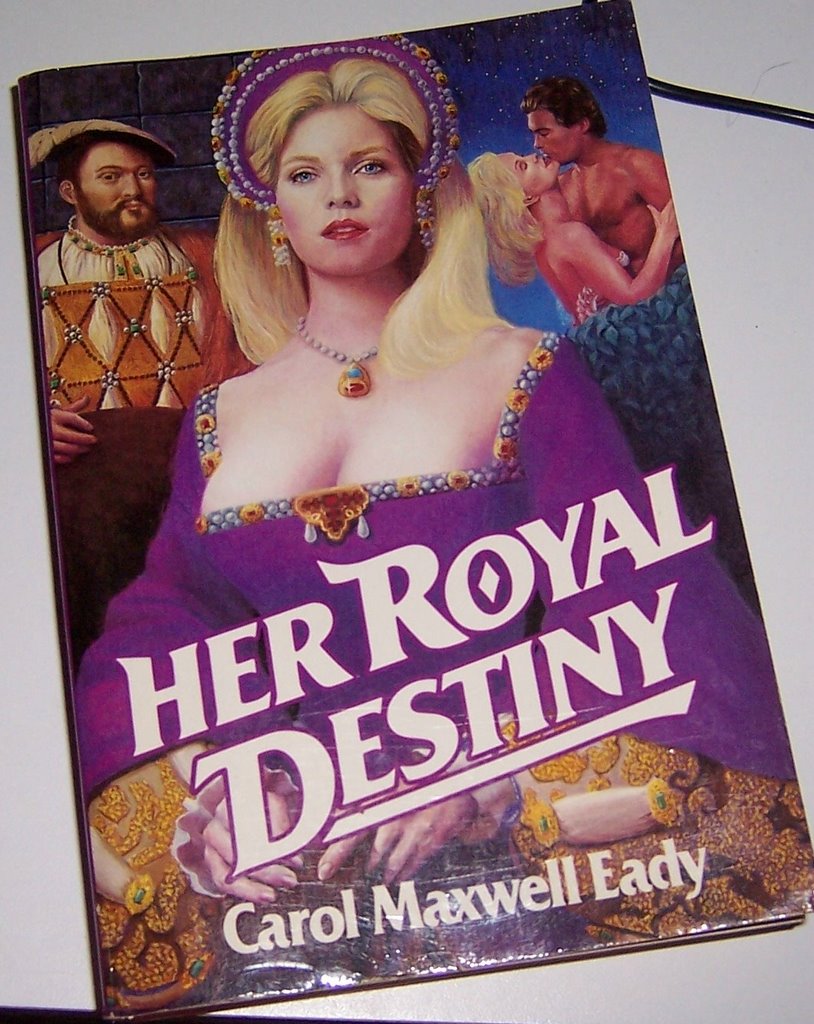
I spotted this 1985 historical novel on eBay and knew that it was my duty as a blogger to share it with the Internet public.
Because Henry VIII is on the cover, it has to be about one of his wives, but which one? Katherine Howard, you're thinking? No, no--this blond bombshell is none other than Katherine Parr. She looks a wee bit different from her portrait on the right sidebar of this blog, doesn't she?
One would assume that the hunk Katy is embracing is Thomas Seymour, but a skim through the novel indicates that this isn't necessarily so, since Eady's Katherine has adulterous dalliances not only with Seymour, but with her stepson. Nonetheless, Katherine retains her historical interest in religion, so that on one page she tells her stepson, "'I will confess to you that sometimes the fact we have to be so secret in our new faith frightens me,'" while on another she utters the time-honored, "'Take me, take me.'"
Katherine also has a knack with herbs, a fact that apparently was of some concern to the publisher's legal staff, for the copyright page of this novel contains a "Cautionary Notice" advising the reader, "The herbs, spices, and remedies listed throughout the book are for historical interest only and are not for contemporary use in the form given."
Buying this novel solely for its cover, I haven't read it straight through, but if one can overlook what seems to be a lot of ahistorical bonking (Katherine is also given an out-of-wedlock child--and it's not Seymour's or the stepson's), it doesn't seem to be all that bad.
Just don't do anything silly with those herbs.
Tuesday, September 26, 2006
And Now for Something Completely Different
No, I'm not springing another Plaidy on you--I'm going way back in time. Biblical times, namely, with Two Women of Galilee by Mary Rourke, a journalist with a degree from the Yale Divinity School.
Normally, I don't go for biblical fiction, but Sarah reviewed this in the Historical Novels Review, and it looked interesting. So when I went to a spanking-new library over the weekend and saw three spanking-new copies of this book on the shelf, it seemed a good idea to read it. (Not to mention inhaling that spanking-new-book smell.)
Preliminaries out of the way, this novel is about Joanna, mentioned in the Gospel of Luke as one of Jesus' followers and as the wife of Herod's steward Chuza. The daughter of parents who abandoned Judaism to follow the more profitable path of ingratiating themselves with the Romans, Joanna is rich and well-connected, but has been consumptive since girlhood. When she hears of a man from Nazareth who heals the sick, she travels to his mother's house to arrange a private meeting, intending only to get her cure and be done with the matter. Needless to say, that is not how things work out.
The difficulty in writing religious fiction, I suspect, is the constraint an author feels with dealing with holy figures. Jesus makes a number of appearances here but seldom speaks to Joanna, the narrator; the treatment of him is reverent and somewhat distant. (A different approach, I imagine, would make many readers, including this one, uncomfortable.) Mary is treated with similar respect, though in a somewhat more down-to-earth manner; she's the mother of Christ, but also a typical mother who worries about her son. Still, to make this work as historical fiction, an ordinary, flawed human being is needed, and fortunately, Joanna fits the bill quite nicely.
This brings me to my only real complaint about this novel. I found Joanna a fascinating character, particularly in her relationships with her husband, her slaves, and the Roman officials and their wives, and I would have liked to have seen the relationships and people explored in more depth. Chuza, for instance, is given an intriguing history as a son who tried to defend his battered mother against his father, but his character remains underdeveloped. This is one novel, I think, that could have stood to be about 100 pages longer, at least if the author had spent the extra space in fleshing out the people in it.
As it is, though, the novel moves at a fast pace, and there are some compelling, moving scenes that, along with the character of Joanna, made this an enjoyable read. I'm looking forward to seeing what Rourke will produce next.
Normally, I don't go for biblical fiction, but Sarah reviewed this in the Historical Novels Review, and it looked interesting. So when I went to a spanking-new library over the weekend and saw three spanking-new copies of this book on the shelf, it seemed a good idea to read it. (Not to mention inhaling that spanking-new-book smell.)
Preliminaries out of the way, this novel is about Joanna, mentioned in the Gospel of Luke as one of Jesus' followers and as the wife of Herod's steward Chuza. The daughter of parents who abandoned Judaism to follow the more profitable path of ingratiating themselves with the Romans, Joanna is rich and well-connected, but has been consumptive since girlhood. When she hears of a man from Nazareth who heals the sick, she travels to his mother's house to arrange a private meeting, intending only to get her cure and be done with the matter. Needless to say, that is not how things work out.
The difficulty in writing religious fiction, I suspect, is the constraint an author feels with dealing with holy figures. Jesus makes a number of appearances here but seldom speaks to Joanna, the narrator; the treatment of him is reverent and somewhat distant. (A different approach, I imagine, would make many readers, including this one, uncomfortable.) Mary is treated with similar respect, though in a somewhat more down-to-earth manner; she's the mother of Christ, but also a typical mother who worries about her son. Still, to make this work as historical fiction, an ordinary, flawed human being is needed, and fortunately, Joanna fits the bill quite nicely.
This brings me to my only real complaint about this novel. I found Joanna a fascinating character, particularly in her relationships with her husband, her slaves, and the Roman officials and their wives, and I would have liked to have seen the relationships and people explored in more depth. Chuza, for instance, is given an intriguing history as a son who tried to defend his battered mother against his father, but his character remains underdeveloped. This is one novel, I think, that could have stood to be about 100 pages longer, at least if the author had spent the extra space in fleshing out the people in it.
As it is, though, the novel moves at a fast pace, and there are some compelling, moving scenes that, along with the character of Joanna, made this an enjoyable read. I'm looking forward to seeing what Rourke will produce next.
Sunday, September 24, 2006
I Thought This Was a Pretty Reasonable Choice . . .


What Jane Austen gentleman is for you?

Mr. Ferrars. Sense and Sensibility's Edward Ferrars is soft spoken, but he is firm in his decisions and will always make good on his promises, even if he's changed his mind. His good nature might lead him into the wrong situations sometimes, but he's not as naive as you might think.
Take this quiz!

Quizilla |
Join
| Make A Quiz | More Quizzes | Grab Code
Thursday, September 21, 2006
Yup, It's Another Cover . . .
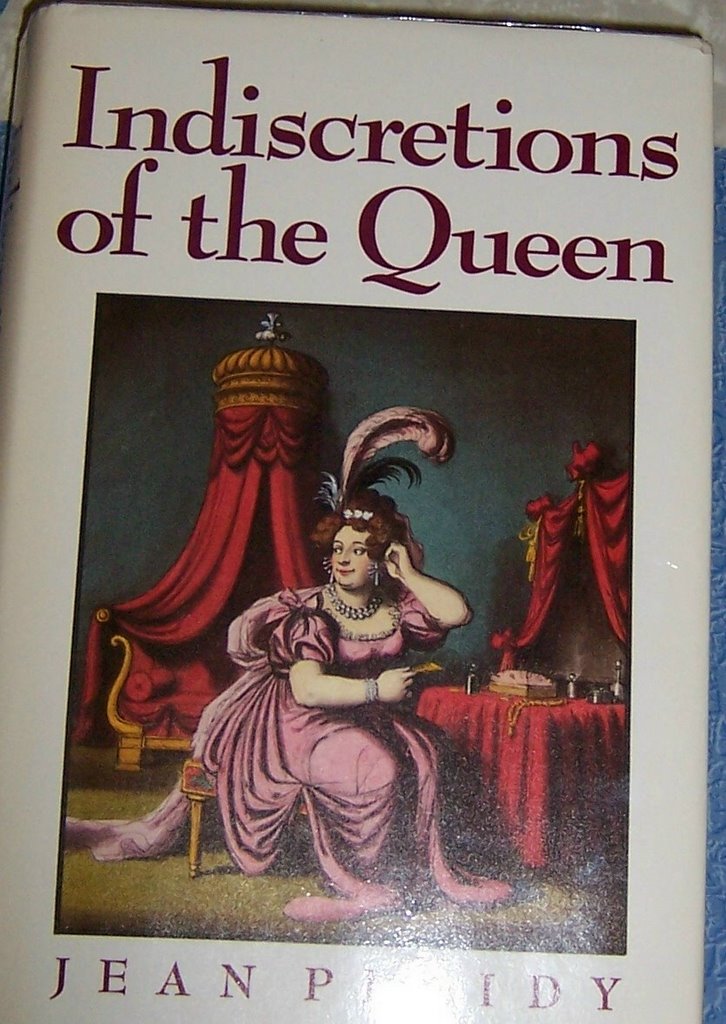
But it's a fun one, isn't it? Philip Gough is the cover artist, and this appears on a 1988 edition of Indiscretions of the Queen, a Jean Plaidy novel about George IV's wife, Caroline of Brunswick, who died only weeks after George IV was crowned. Caroline was evidently quite the character--headstrong, flamboyant, impulsive, brash, and not overly fastidious in matters of bathing. I think the cover does a good job at suggesting Caroline's idiosyncratic personality while not making Caroline look ridiculous or repulsive.
So does the book, for that matter. When we first meet her, Caroline is rather unappealing, displaying behavior that borders on obnoxiousness, but as the story develops we see her good traits, especially her courage, generosity of spirit, and lack of self-pity, and we start to root for her and to think that she deserved a far better hand than she was dealt. Plaidy does an excellent job with this rather unconventional heroine, making her a refreshing change from the often interchangeable beauties who populate so much historical fiction. I'm looking forward to tracking down The Regent's Daughter, Plaidy's novel about Caroline's daughter, Charlotte, who promises to be another off-kilter royal.
Tuesday, September 19, 2006
Avast! Let 'em eat cake!
As someone at work mentioned, today is Talk Like a Pirate Day. Unfortunately, my cold seems to have destroyed my pirate-talking brain cells, so all I can do to observe the day is to place Cotton's Talking Parrot (courtesy of the merchandising folks at Pirates of the Caribbean) near my computer and let him watch while I type.
Thanks to hubby (who owns said parrot and who does have socks with little pirate flags on them), I saw this Chronicle of Higher Education article by Camille Paglia about Marie Antoinette, who has been much in the media lately. Paglia briefly discusses two historical novels about the queen, one by Carolly Erickson and the other by Sena Jeter Naslund. It's an interesting article, but I don't agree with Paglia's patronizing dismissal of the Naslund book as one that because of its "lavish settings and heightened emotions" will offer "pleasure and instruction to loyal readers of historical romances." It's hardly a historical romance, for one thing, nor is it full of descriptions of dresses and buildings, as this would imply. And it doesn't exonerate Marie Antoinette of all fault, as Paglia claims; though it's sympathetic to her, her shortcomings are quite apparent.
Parrot is saying it's time to get back to work, or I'm going to have to walk the plank.
Thanks to hubby (who owns said parrot and who does have socks with little pirate flags on them), I saw this Chronicle of Higher Education article by Camille Paglia about Marie Antoinette, who has been much in the media lately. Paglia briefly discusses two historical novels about the queen, one by Carolly Erickson and the other by Sena Jeter Naslund. It's an interesting article, but I don't agree with Paglia's patronizing dismissal of the Naslund book as one that because of its "lavish settings and heightened emotions" will offer "pleasure and instruction to loyal readers of historical romances." It's hardly a historical romance, for one thing, nor is it full of descriptions of dresses and buildings, as this would imply. And it doesn't exonerate Marie Antoinette of all fault, as Paglia claims; though it's sympathetic to her, her shortcomings are quite apparent.
Parrot is saying it's time to get back to work, or I'm going to have to walk the plank.
Monday, September 18, 2006
I Hab a Bab Cold, and More One-Letter Memes
If you're the man, woman, or adorable little child (I strongly suspect the latter) who gave me another cold, I'm looking for you. And it isn't going to be pretty--that is, if I can stop sneezing long enough to sneak up on you.
My IQ goes down markedly when I have a cold, even before I take any of the cold medication that sends me off into another sphere. While I can still put a coherent thought together, though, can you think of any historical fiction featuring a run-of-the-mill cold or flu? Most illnesses tend to be of the dramatic, widow-and-orphan-making type. I can think of one novel featuring a minor ailment: Reay Tannahill's Fatal Majesty, where Mary, Queen of Scots and one of her ministers, Lethington, share a scene shivering and coughing with what seems to be a Tudor-era variety of the flu while discussing the latest machination of Queen Elizabeth, only to be interrupted by the "revoltingly healthy" James. Quite amusing--and a clever way of giving life to what would otherwise be just a routine update-the-reader scene.
Anyway, feel free to stop by and share your thoughts. Even if you're revoltingly healthy like James.
By the way, here's a few more change-one-letter titles:
The Bunne in Splendor. Whether they follow the white rose or the red rose, Edward IV's female subjects are united in one sentiment--the new king has a nice posterior.
The Queen's Foot. Mary Tudor's court is taken aback when the queen loses all interest in religion and suddenly begins obsessing over fabulously expensive shoes.
The Virgin's Loser. Robert Dudley is in agony. How can he tell the queen that the expensive horse she has given him has yet to win a race?
The Lost Boleyn. Born without a good sense of direction, George Boleyn never can figure out where he is--and his constant refusal to ask for directions may be the last straw for his wife, Jane.
My IQ goes down markedly when I have a cold, even before I take any of the cold medication that sends me off into another sphere. While I can still put a coherent thought together, though, can you think of any historical fiction featuring a run-of-the-mill cold or flu? Most illnesses tend to be of the dramatic, widow-and-orphan-making type. I can think of one novel featuring a minor ailment: Reay Tannahill's Fatal Majesty, where Mary, Queen of Scots and one of her ministers, Lethington, share a scene shivering and coughing with what seems to be a Tudor-era variety of the flu while discussing the latest machination of Queen Elizabeth, only to be interrupted by the "revoltingly healthy" James. Quite amusing--and a clever way of giving life to what would otherwise be just a routine update-the-reader scene.
Anyway, feel free to stop by and share your thoughts. Even if you're revoltingly healthy like James.
By the way, here's a few more change-one-letter titles:
The Bunne in Splendor. Whether they follow the white rose or the red rose, Edward IV's female subjects are united in one sentiment--the new king has a nice posterior.
The Queen's Foot. Mary Tudor's court is taken aback when the queen loses all interest in religion and suddenly begins obsessing over fabulously expensive shoes.
The Virgin's Loser. Robert Dudley is in agony. How can he tell the queen that the expensive horse she has given him has yet to win a race?
The Lost Boleyn. Born without a good sense of direction, George Boleyn never can figure out where he is--and his constant refusal to ask for directions may be the last straw for his wife, Jane.
Friday, September 15, 2006
Change One Letter Meme
I couldn't resist this meme, courtesy of Sarah: Change one letter in the title of a historical novel and add a plot. Here are some results from me, with the more obscure real titles in parenthesis:
St. Thomas's Ewe. The rise and fall of Thomas More, seen by his favorite sheep. (St. Thomas's Eve)
Wine to the Kingmaker. With more and more guests coming into the Earl of Warwick's great hall every day, his devoted butler struggles to keep everyone happy. (Wife to the Kingmaker)
The Crimson Pedal and the White. In Victorian England, a bicycle maker rebels against monochrome machines and produces his own colorful creation.
King's Bake. Having scandalized his subjects with his love for water sports and thatching, King Edward II courts further trouble when he turns to cooking. (King's Wake)
Gone With the Wine. The cruel Yankees rob Tara's cellar.
The Virgin's Loner. Elizabeth I can't understand why fun-loving Robert Dudley is suddenly spending so much time by himself.
A Pride of Rings. William Marshal's wife gives him some jewelry for their anniversary, and he really, really likes it. (A Pride of Kings)
Catherine. During a midlife crisis, Katherine Swynford scandalizes the nobility by changing the spelling of her name.
Lady of the Barter. Joan, the Fair Maid of Kent, goes to the marketplace and discovers that she has a real talent for haggling.
The Traitor's Wide. Imprisoned in the Tower of London for her husband's misdeeds, Eleanor de Clare finds that the food is a lot better than she expected. (Oh, c'mon, you can guess the original)
St. Thomas's Ewe. The rise and fall of Thomas More, seen by his favorite sheep. (St. Thomas's Eve)
Wine to the Kingmaker. With more and more guests coming into the Earl of Warwick's great hall every day, his devoted butler struggles to keep everyone happy. (Wife to the Kingmaker)
The Crimson Pedal and the White. In Victorian England, a bicycle maker rebels against monochrome machines and produces his own colorful creation.
King's Bake. Having scandalized his subjects with his love for water sports and thatching, King Edward II courts further trouble when he turns to cooking. (King's Wake)
Gone With the Wine. The cruel Yankees rob Tara's cellar.
The Virgin's Loner. Elizabeth I can't understand why fun-loving Robert Dudley is suddenly spending so much time by himself.
A Pride of Rings. William Marshal's wife gives him some jewelry for their anniversary, and he really, really likes it. (A Pride of Kings)
Catherine. During a midlife crisis, Katherine Swynford scandalizes the nobility by changing the spelling of her name.
Lady of the Barter. Joan, the Fair Maid of Kent, goes to the marketplace and discovers that she has a real talent for haggling.
The Traitor's Wide. Imprisoned in the Tower of London for her husband's misdeeds, Eleanor de Clare finds that the food is a lot better than she expected. (Oh, c'mon, you can guess the original)
Another Plaidy to My Credit, This Time with Toads
I polished off Jean Plaidy’s Sweet Lass of Richmond Hill today. It’s a vast improvement over Diane Haeger’s The Secret Wife of King George IV, and also an improvement over Plaidy’s The Third George, reviewed by me in April. (Blogger's having a snit, or I'd post the link.)
Like the Haeger book, this tells the story of Maria Fitzherbert’s marriage to Prince George—or part of the story, anyway, as the novel ends immediately before George’s marriage to Caroline. Though the viewpoint shifts between various characters, the focus is mainly on George and his misadventures, at least until the last third or so of the book, when it shifts to the dysfunctional royal family as a whole. (So dysfunctional and featherbrained is this bunch, in fact, that I found myself longing for the Plantagenets, who seem like a breath of sanity by comparison.)
Plaidy’s prose is a little less stiff than usual, perhaps because with George III talking to trees, a Madam von Schwellenburg talking to her pet toads (“’Herr Prince vos up to no goot’”), and everyone taking snuff, it’s hard not to have a little authorial fun. My only real complaint, in fact, was with the abrupt ending. I’ll have to wait until the next book in the series, Indiscretions of the Queen, which naturally is not available in my local library, to see whether George ever comes back to Maria and whether Queen Charlotte ever throws her snuffbox at Prince George. So bring it on, Amazon!
Speaking of Plaidy, I see that her early Plantagenet novels are being reissued, with stylish new covers. I especially like the one for The Prince of Darkness. Despite the fact that King John is the main character, the cover depicts a rather worried-looking woman, presumably in flight from Nasty John. There’s also a nice headless man cover of Richard the Lionhearted and a new headless woman cover for Murder Most Royal; this, of course, is about Katherine Howard and Anne Boleyn and thus is most apt.
Trying to decide what to read next. I checked out Helen of Troy but couldn’t get myself in the mood for it; I think I’ll wait for the paperback. I started Hilary Mantel’s A Greater Place of Safety (the French Revolution from the revolutionaries’ side) but don’t know whether I’m going to be up for 750 pages of people who thus far haven’t proven very likable. But there’s plenty on the shelf, so I’m sure something will find me.
Like the Haeger book, this tells the story of Maria Fitzherbert’s marriage to Prince George—or part of the story, anyway, as the novel ends immediately before George’s marriage to Caroline. Though the viewpoint shifts between various characters, the focus is mainly on George and his misadventures, at least until the last third or so of the book, when it shifts to the dysfunctional royal family as a whole. (So dysfunctional and featherbrained is this bunch, in fact, that I found myself longing for the Plantagenets, who seem like a breath of sanity by comparison.)
Plaidy’s prose is a little less stiff than usual, perhaps because with George III talking to trees, a Madam von Schwellenburg talking to her pet toads (“’Herr Prince vos up to no goot’”), and everyone taking snuff, it’s hard not to have a little authorial fun. My only real complaint, in fact, was with the abrupt ending. I’ll have to wait until the next book in the series, Indiscretions of the Queen, which naturally is not available in my local library, to see whether George ever comes back to Maria and whether Queen Charlotte ever throws her snuffbox at Prince George. So bring it on, Amazon!
Speaking of Plaidy, I see that her early Plantagenet novels are being reissued, with stylish new covers. I especially like the one for The Prince of Darkness. Despite the fact that King John is the main character, the cover depicts a rather worried-looking woman, presumably in flight from Nasty John. There’s also a nice headless man cover of Richard the Lionhearted and a new headless woman cover for Murder Most Royal; this, of course, is about Katherine Howard and Anne Boleyn and thus is most apt.
Trying to decide what to read next. I checked out Helen of Troy but couldn’t get myself in the mood for it; I think I’ll wait for the paperback. I started Hilary Mantel’s A Greater Place of Safety (the French Revolution from the revolutionaries’ side) but don’t know whether I’m going to be up for 750 pages of people who thus far haven’t proven very likable. But there’s plenty on the shelf, so I’m sure something will find me.
Wednesday, September 13, 2006
But Will I Need a Doctor's Note for Work?
Which Medieval Plague Do You Have?

Congratulations! You have The Plague! The ABSOLUTE premier disease of the Middle Ages, you probably caught this by the bite of an infected flea or from someone with the pneumonic form. You are suffering from swellings called buboes, in the lymph nodes of the neck, armpits and groin. These are going to become very painful as they fill up with blood and pus. Your headache is going to get much worse, your temperature will become unbearable and you will soon be delirious. Vomiting and diarrhea will accompany all of this. More bad news is that there is a 75% mortality rate. The good news is, if you live, jobs are going to be much more plentiful!
Take this quiz!
Quizilla |
Join
| Make A Quiz | More Quizzes | Grab Code
Monday, September 11, 2006
New Old Books, and More
I was pleased to see this weekend that Tempus Publishing is reissuing some out-of-print novels by Hilda Lewis (Harlot Queen, Wife to Charles II, Wife to the Bastard), Norah Lofts (The Concubine, The King's Pleasure, and Eleanor the Queen), and Rosemary Hawley Jarman (We Speak No Treason). I could do without another copy of We Speak No Treason, frankly--there are few scenes in historical fiction as interminable to me as the one where the Maiden goes to a fair and meets a poet who goes on, and on, and on, for pages about her beauty--but it's nice to see some of these older novels back in print.
Can't let today's date go by without remembering the anniversary. To this day, I never look at a picture of the present New York skyline without thinking that if I just blink my eyes a few times, it'll be back to the way it used to be.
Can't let today's date go by without remembering the anniversary. To this day, I never look at a picture of the present New York skyline without thinking that if I just blink my eyes a few times, it'll be back to the way it used to be.
Saturday, September 09, 2006
Tales of Two Wives
Taking a break from medieval/Tudor times, I read—or, in the case of one book, started to read—two novels about two famous wives: Juliet Waldron’s Mozart’s Wife and Diane Haeger’s The Secret Wife of King George IV. (Isn’t it nice when the titles save the trouble of an explanation?)
The good news first: I found Mozart’s Wife, published in 2004, to be absorbing and well-written. It follows Konstanze’s life as she grows from a naive young girl to a capable, shrewd woman, her marriage as it disintegrates under the pressures of too many bills, infant mortality, and infidelity.
Konstanze is the narrator here, and her voice is a refreshing one: informal, earthy without becoming coarse, candid, un-self-pitying, and wry. She and Mozart are highly flawed but likable people, who never forfeit our sympathies even as they act appallingly toward each other and toward others. That’s very difficult for an author to pull off, and Waldron does it admirably.
Waldron has a nice eye for detail. As a mistress of Mozart’s departs the cramped household, she is accompanied by her cats: “Her calico Mutzie and tiger Murr followed, tails up, for all the world like a couple of well-behaved dogs out for a walk.”
The book does feel a little disjointed in spots. For instance, Konstanze spends much of Chapter 20 fussing over an impending visit from Leopold, Mozart’s difficult father, but the visit is never depicted; when we next hear of Leopold two chapters later, the matter seems to have been forgotten. Did something get cut? I also felt that too little emphasis was placed on Mozart’s Masonic ties, considering the crucial role they later assumed in Waldron’s explanation of his death and obscure burial.
All in all, though, I enjoyed this book thoroughly. Waldron also has one of the nicer websites I've seen for a historical novelist; check it out here.
I can’t say I derived the same enjoyment from The Secret Wife of King George IV, Diane Haeger’s 2001 novel about Maria Fitzherbert. In fact, I didn’t finish it; the novel is 373 pages long, and I managed to read only to page 105.
What stopped me? For one thing, the action in these pages revolves around Maria, who as depicted by Haeger is simply not very interesting. We learn that she has “ivory shoulders,” “pale gold hair,” and eyes as “deep as melting chocolate,” and that this combination has the effect of making men fall instantly in love with her, but we learn almost nothing about what lies behind Maria’s beautiful exterior. We’re told that she wants to marry for love, having been married twice for advantage, and that her Catholic beliefs keep her from agreeing to become George’s mistress, but other than that, it’s 105 pages of ivory shoulders, gold hair, deep brown eyes, and lots of costume changes. This is fine if one’s flipping through Vogue magazine, but when one’s reading a historical novel, it’s tedious.
To make matters worse, this part of the novel is taken up with Maria and George’s budding romance, and though we’re told that all sorts of sparks are flying between the couple, they never ignite for the reader. The couple meet, George makes an advance, Maria refuses it. Gossip ensues. The couple meet again. George makes another advance. Maria refuses it. More gossip ensues. And so forth. The dialogue between the couple is of the “unhand me, sir” variety: “'I cannot hear this! Please, Your Highness, do not continue!'” The prose sometimes approaches the ludicrous: “He was dangerous, wild, and totally forbidden. He was also masculine and wholly male.”
No girlie men here.
Frustratingly, there are signs that Haeger could have done a lot better. In a couple of scenes where George was talking to his father or to his old nurse or to a female friend, he became a genuinely interesting character, generous yet riddled with insecurities and anger, about whom I wanted to know more. Unfortunately, in a matter of pages, he was back to yammering, “'I want you. . . . I want all of you,'” to Maria. Perhaps things might have improved once he and Maria married (at least, surely, in the dialogue department), but with a pile of other books screaming for my attention, it just didn’t seem worth the effort to find out.
The Secret Wife of George IV did encourage me, at least, to have the library send over Jean Plaidy’s take on the same marriage: The Sweet Lass of Richmond Hill. With that and Margaret George’s Helen of Troy on the way, I should be able to keep myself out of trouble for a while.
The good news first: I found Mozart’s Wife, published in 2004, to be absorbing and well-written. It follows Konstanze’s life as she grows from a naive young girl to a capable, shrewd woman, her marriage as it disintegrates under the pressures of too many bills, infant mortality, and infidelity.
Konstanze is the narrator here, and her voice is a refreshing one: informal, earthy without becoming coarse, candid, un-self-pitying, and wry. She and Mozart are highly flawed but likable people, who never forfeit our sympathies even as they act appallingly toward each other and toward others. That’s very difficult for an author to pull off, and Waldron does it admirably.
Waldron has a nice eye for detail. As a mistress of Mozart’s departs the cramped household, she is accompanied by her cats: “Her calico Mutzie and tiger Murr followed, tails up, for all the world like a couple of well-behaved dogs out for a walk.”
The book does feel a little disjointed in spots. For instance, Konstanze spends much of Chapter 20 fussing over an impending visit from Leopold, Mozart’s difficult father, but the visit is never depicted; when we next hear of Leopold two chapters later, the matter seems to have been forgotten. Did something get cut? I also felt that too little emphasis was placed on Mozart’s Masonic ties, considering the crucial role they later assumed in Waldron’s explanation of his death and obscure burial.
All in all, though, I enjoyed this book thoroughly. Waldron also has one of the nicer websites I've seen for a historical novelist; check it out here.
I can’t say I derived the same enjoyment from The Secret Wife of King George IV, Diane Haeger’s 2001 novel about Maria Fitzherbert. In fact, I didn’t finish it; the novel is 373 pages long, and I managed to read only to page 105.
What stopped me? For one thing, the action in these pages revolves around Maria, who as depicted by Haeger is simply not very interesting. We learn that she has “ivory shoulders,” “pale gold hair,” and eyes as “deep as melting chocolate,” and that this combination has the effect of making men fall instantly in love with her, but we learn almost nothing about what lies behind Maria’s beautiful exterior. We’re told that she wants to marry for love, having been married twice for advantage, and that her Catholic beliefs keep her from agreeing to become George’s mistress, but other than that, it’s 105 pages of ivory shoulders, gold hair, deep brown eyes, and lots of costume changes. This is fine if one’s flipping through Vogue magazine, but when one’s reading a historical novel, it’s tedious.
To make matters worse, this part of the novel is taken up with Maria and George’s budding romance, and though we’re told that all sorts of sparks are flying between the couple, they never ignite for the reader. The couple meet, George makes an advance, Maria refuses it. Gossip ensues. The couple meet again. George makes another advance. Maria refuses it. More gossip ensues. And so forth. The dialogue between the couple is of the “unhand me, sir” variety: “'I cannot hear this! Please, Your Highness, do not continue!'” The prose sometimes approaches the ludicrous: “He was dangerous, wild, and totally forbidden. He was also masculine and wholly male.”
No girlie men here.
Frustratingly, there are signs that Haeger could have done a lot better. In a couple of scenes where George was talking to his father or to his old nurse or to a female friend, he became a genuinely interesting character, generous yet riddled with insecurities and anger, about whom I wanted to know more. Unfortunately, in a matter of pages, he was back to yammering, “'I want you. . . . I want all of you,'” to Maria. Perhaps things might have improved once he and Maria married (at least, surely, in the dialogue department), but with a pile of other books screaming for my attention, it just didn’t seem worth the effort to find out.
The Secret Wife of George IV did encourage me, at least, to have the library send over Jean Plaidy’s take on the same marriage: The Sweet Lass of Richmond Hill. With that and Margaret George’s Helen of Troy on the way, I should be able to keep myself out of trouble for a while.
Wednesday, September 06, 2006
Whole Lot of Tweaking Going On
I've been fooling around with my website, trying to give it a more "historical fiction" feel than it had before and to make it easier on the eyes. Please take a look--I'd love to hear what you think!
Monday, September 04, 2006
Beach Reading: Margaret George and Mary, Queen of Scots
There’s nothing like the beach to get some reading done. Find a book that one doesn’t mind getting a little sandy, slather the kids in sunscreen, slather oneself in sunscreen, drag a chair out to the sand, send the kids out into the ocean, glance up every half hour or so to make sure no one’s being carried out to sea, go for a dip when it really gets hot, and just watch the pages fly by.
Occupied thusly this weekend, I managed to finish not only two short books I was reading for review purposes, but Margaret George’s 1992 historical novel, Mary Queen of Scotland and the Isles.
This is a very long book—it takes Mary literally from the cradle to the grave. Nonetheless, it reads quickly and holds the reader’s attention; I seldom found myself skimming.
Most of the novel is told by a third-person narrator, although there are some long stretches of journal-writing by Mary in the last fifth or so. Though Mary’s viewpoint is the predominant one, the narrator occasionally travels to Elizabeth I’s court and into the minds of various other characters as well, including Darnley, Bothwell, and sundry ill-fated spies.
Certainly the outstanding quality of this historical novel is George’s ability to draw characters. Mary herself is depicted sympathetically without ever being idealized; at crucial times in her life, there’s almost always someone to tell her that she's making a mistake, and she listens to them far too seldom. More important, George avoids making caricatures of figures such as Darnley and John Knox. The latter is especially well rounded; harsh as he is on the pulpit, we also see glimpses of him as a loving husband and father.
George has a nice eye for small detail, as when Mary on the last evening of her life prays, only to be distracted by her dog thumping his tail. “It was that everyday sound, the summation of all the everyday things she was leaving, that brought tears to her eyes.”
I did have some reservations here and there. One of the few parts of the novel I found myself skimming was that detailing the love affair between Mary and Bothwell, where the dialogue takes on a decidedly hackneyed tone. When Bothwell uttered the line, “'Put your arms around me, and whatever happens, do not let go,'” I found myself anticipating the couple’s impending separation not at all with regret. Earlier, a three-way sex scene between Darnley, Riccio, and a prostitute struck me as gratuitous, since it had no influence on later events and didn’t enlighten us about the characters of those involved, except to show that Riccio could rise to an occasion, so to speak. But these are minor quibbles and didn’t spoil what I thought was an excellent read.
It’s interesting, by the way, to compare this novel to Reay Tannahill’s Fatal Majesty. The novels take entirely different views of such issues as the authenticity of the Casket Letters and of the circumstances behind the marriage of Mary and Bothwell, yet as I was reading each novel, I was convinced by the case each author made, even while being aware of the possibility of a different interpretation.
So if you’ve waited 14 years to read this novel, like I did, go ahead and read it—don’t make it 15 years.
What to read next? All sorts of things await, thanks to the benevolence of eBay, Amazon, PaperbackSwap, and the U.S. mail, not to mention the library sale the other day.
Occupied thusly this weekend, I managed to finish not only two short books I was reading for review purposes, but Margaret George’s 1992 historical novel, Mary Queen of Scotland and the Isles.
This is a very long book—it takes Mary literally from the cradle to the grave. Nonetheless, it reads quickly and holds the reader’s attention; I seldom found myself skimming.
Most of the novel is told by a third-person narrator, although there are some long stretches of journal-writing by Mary in the last fifth or so. Though Mary’s viewpoint is the predominant one, the narrator occasionally travels to Elizabeth I’s court and into the minds of various other characters as well, including Darnley, Bothwell, and sundry ill-fated spies.
Certainly the outstanding quality of this historical novel is George’s ability to draw characters. Mary herself is depicted sympathetically without ever being idealized; at crucial times in her life, there’s almost always someone to tell her that she's making a mistake, and she listens to them far too seldom. More important, George avoids making caricatures of figures such as Darnley and John Knox. The latter is especially well rounded; harsh as he is on the pulpit, we also see glimpses of him as a loving husband and father.
George has a nice eye for small detail, as when Mary on the last evening of her life prays, only to be distracted by her dog thumping his tail. “It was that everyday sound, the summation of all the everyday things she was leaving, that brought tears to her eyes.”
I did have some reservations here and there. One of the few parts of the novel I found myself skimming was that detailing the love affair between Mary and Bothwell, where the dialogue takes on a decidedly hackneyed tone. When Bothwell uttered the line, “'Put your arms around me, and whatever happens, do not let go,'” I found myself anticipating the couple’s impending separation not at all with regret. Earlier, a three-way sex scene between Darnley, Riccio, and a prostitute struck me as gratuitous, since it had no influence on later events and didn’t enlighten us about the characters of those involved, except to show that Riccio could rise to an occasion, so to speak. But these are minor quibbles and didn’t spoil what I thought was an excellent read.
It’s interesting, by the way, to compare this novel to Reay Tannahill’s Fatal Majesty. The novels take entirely different views of such issues as the authenticity of the Casket Letters and of the circumstances behind the marriage of Mary and Bothwell, yet as I was reading each novel, I was convinced by the case each author made, even while being aware of the possibility of a different interpretation.
So if you’ve waited 14 years to read this novel, like I did, go ahead and read it—don’t make it 15 years.
What to read next? All sorts of things await, thanks to the benevolence of eBay, Amazon, PaperbackSwap, and the U.S. mail, not to mention the library sale the other day.
Saturday, September 02, 2006
This 'n' That
A couple of pre-Labor Day thoughts:
Check out Pauline Montagna's The Romance of History, an ezine discussing historical romance and historical fiction. There's an essay by Pauline about Regency romances, an article by Francis A. Miniter about James Clavell's Shogun, and a couple of reviews by yours truly.
I've got myself a Myspace site up now, having browsed over there a few times to see what the fuss was all about. Myspace is quite entertaining, though heavy on the ads, and it's fun seeing who shows up there. (Shakespeare, Richard III, and Henry VIII's wives all have profiles there. So far, only Shakespeare has visited my page, but I've hopes that the rest of the gang will follow.)
Check out Pauline Montagna's The Romance of History, an ezine discussing historical romance and historical fiction. There's an essay by Pauline about Regency romances, an article by Francis A. Miniter about James Clavell's Shogun, and a couple of reviews by yours truly.
I've got myself a Myspace site up now, having browsed over there a few times to see what the fuss was all about. Myspace is quite entertaining, though heavy on the ads, and it's fun seeing who shows up there. (Shakespeare, Richard III, and Henry VIII's wives all have profiles there. So far, only Shakespeare has visited my page, but I've hopes that the rest of the gang will follow.)
Thursday, August 31, 2006
Different Strokes for Different Folks, and How Many Folks Would You Like?
Today a fellow by the deceptively friendly name of "Bob" left me a one-star review on my Amazon page. In a nutshell, Bob thought there were too many characters, too many facts, not enough action, and not enough descriptions of medieval castles and homes.
Bob, bless his heart, is entitled to his opinion, and I only wish he'd posted it before I went shopping today so I could have consoled myself with an extra pair of jeans. As it is, it's given me a chance to indulge in some Teddy Grahams (cinnamon graham cookies shaped like teddy bears, for you folks across the pond) without guilt.
My Southern graciousness toward Bob did wear a little thin here, though:
Cute, very cute. But Bob, a few short minutes of Googling might have cleared up this difficulty for you. Edward II's homosexuality isn't a fact--no one knows whether he had sexual relations with his male favorites or not--but it's very far from being a figment of my lurid, politically correct imagination. Suggestions that Edward II was involved in sexual relations with men date back to the fourteenth century, well before my time, thank you very much, and I'm merely following in a long line of writers, both historians and novelists, who have depicted his relationships as homosexual. (The only respect in which I differ from other novelists, as far as I know, is that I depict him as having heterosexual relationships outside of marriage as well--a depiction that is borne out historically by his acknowledged out-of-wedlock son, Adam, and near-contemporary rumors that he had been having an affair with his niece.)
Just to set the record straight, so to speak.
Anyway, speaking of long novels with a lot of characters, I'm reading Margaret George's Mary Queen of Scotland and the Isles and am enjoying it thoroughly. For my own part, when a historical novel takes place over a long period of time and involves complex events, I'd rather have it be a long novel with many characters than a short one with just a few characters. Sharon Penman's The Sunne in Splendour (1459 to 1492; long) and Juliet Dymoke's The Sun in Splendor (from around 1464 to 1489; short), for instance, both cover the Wars of the Roses and Richard III's fall and include some of the same events. They take very different approaches, with Penman telling the story through the viewpoint of many characters and Dymoke telling it through one, that of a woman who knows most of the major players but who is often at the periphery of events. I find Penman's approach more satisfying, and Dymoke's novel, though readable and agreeable, strikes me as skimpy by comparison. It's a matter of taste, I guess--what's yours?
Bob, bless his heart, is entitled to his opinion, and I only wish he'd posted it before I went shopping today so I could have consoled myself with an extra pair of jeans. As it is, it's given me a chance to indulge in some Teddy Grahams (cinnamon graham cookies shaped like teddy bears, for you folks across the pond) without guilt.
My Southern graciousness toward Bob did wear a little thin here, though:
Whether the homosexuality of Edward II is a fact or a figment of the author's imagination I don't know. Nor whether its use here is more than an attempt to meet to what some consider the "correct" tone of the present times.
Which makes me wonder: Will some author next come up with... "Washington & Lafayete, A Story of Forbidden Love?"
Cute, very cute. But Bob, a few short minutes of Googling might have cleared up this difficulty for you. Edward II's homosexuality isn't a fact--no one knows whether he had sexual relations with his male favorites or not--but it's very far from being a figment of my lurid, politically correct imagination. Suggestions that Edward II was involved in sexual relations with men date back to the fourteenth century, well before my time, thank you very much, and I'm merely following in a long line of writers, both historians and novelists, who have depicted his relationships as homosexual. (The only respect in which I differ from other novelists, as far as I know, is that I depict him as having heterosexual relationships outside of marriage as well--a depiction that is borne out historically by his acknowledged out-of-wedlock son, Adam, and near-contemporary rumors that he had been having an affair with his niece.)
Just to set the record straight, so to speak.
Anyway, speaking of long novels with a lot of characters, I'm reading Margaret George's Mary Queen of Scotland and the Isles and am enjoying it thoroughly. For my own part, when a historical novel takes place over a long period of time and involves complex events, I'd rather have it be a long novel with many characters than a short one with just a few characters. Sharon Penman's The Sunne in Splendour (1459 to 1492; long) and Juliet Dymoke's The Sun in Splendor (from around 1464 to 1489; short), for instance, both cover the Wars of the Roses and Richard III's fall and include some of the same events. They take very different approaches, with Penman telling the story through the viewpoint of many characters and Dymoke telling it through one, that of a woman who knows most of the major players but who is often at the periphery of events. I find Penman's approach more satisfying, and Dymoke's novel, though readable and agreeable, strikes me as skimpy by comparison. It's a matter of taste, I guess--what's yours?
Tuesday, August 29, 2006
I Am Woman, Hear Me Rant
I really was going to do some work on my novel in progress last night. Honestly. Then I saw this article in The New York Times, and my rant switch came on. (If you can't get to it--the article, that is, not my rant switch--try using Bugmenot.com.) The gist of it is that thanks to Ellen Archer and Pamela G. Dorman, publisher Hyperion is starting a new imprint called Voice. According to the Times's Motoko Rich, "Voice is specifically focusing on women from their mid-30’s and older and will have a resolutely anti-chick-lit bent." Rich adds that 10 professional women will meet twice a year "[t]o help Voice pinpoint what women want."
Well, I'm sure some highly paid consultant has told the women who came up with this idea otherwise, but judging from how much of it is in bookstores, what quite a few women want is chick lit. My own tastes don't run toward it, but I don't see it as something that women need to be saved from reading, any more than we need to be saved from reading romance novels or historical fiction or any other type of genre fiction. The fact that the saviors riding to our rescue are other women doesn't make me one iota more grateful for their intervention. It seems I ought to be grateful, though, because Dorman is quoted as saying, “'People are overwhelmed by choice, and what they want is someone who is self-selecting for them.'”
So what have the folks at Hyperion self-selected for all of us women over 35 to read instead of all that chick lit being written, edited, published, and read by so many misguided women? First on the platter is The Feminine Mistake by Leslie Bennetts. "Ms. Bennetts argues that women who 'opt out' of careers to raise children forfeit the financial, intellectual, emotional and even medical benefits of working outside the home."
Well, I'm going to save Hyperion a little market research now. I'm over 35. I'm a woman. But I'm not going to be buying The Feminine Mistake, because frankly, I think the last thing the publishing world needs is another book by a woman telling other women that there's something wrong with them because they choose to live lives that are not exactly like hers.
Now, what am I going to do with the money I save by not buying Bennetts' book? After resting up a while (that choice is just so overwhelming), I'm going to go to the bookstore and look for a book that has a great big shoe on it. Or a great big purse. Or a great big shoe and a great big purse. And I'm going to buy it. Then for good measure, I'm going to find a book with a hunky, barechested guy wearing a kilt on its cover. The boldest, most plaid, most manly kilt there is. And I'm going to buy it. Because I don't like being told by women how to spend my hard-earned book money any more than I like being told by men how to spend it.
As the chick lit ladies know, shopping can be such fun.
Well, I'm sure some highly paid consultant has told the women who came up with this idea otherwise, but judging from how much of it is in bookstores, what quite a few women want is chick lit. My own tastes don't run toward it, but I don't see it as something that women need to be saved from reading, any more than we need to be saved from reading romance novels or historical fiction or any other type of genre fiction. The fact that the saviors riding to our rescue are other women doesn't make me one iota more grateful for their intervention. It seems I ought to be grateful, though, because Dorman is quoted as saying, “'People are overwhelmed by choice, and what they want is someone who is self-selecting for them.'”
So what have the folks at Hyperion self-selected for all of us women over 35 to read instead of all that chick lit being written, edited, published, and read by so many misguided women? First on the platter is The Feminine Mistake by Leslie Bennetts. "Ms. Bennetts argues that women who 'opt out' of careers to raise children forfeit the financial, intellectual, emotional and even medical benefits of working outside the home."
Well, I'm going to save Hyperion a little market research now. I'm over 35. I'm a woman. But I'm not going to be buying The Feminine Mistake, because frankly, I think the last thing the publishing world needs is another book by a woman telling other women that there's something wrong with them because they choose to live lives that are not exactly like hers.
Now, what am I going to do with the money I save by not buying Bennetts' book? After resting up a while (that choice is just so overwhelming), I'm going to go to the bookstore and look for a book that has a great big shoe on it. Or a great big purse. Or a great big shoe and a great big purse. And I'm going to buy it. Then for good measure, I'm going to find a book with a hunky, barechested guy wearing a kilt on its cover. The boldest, most plaid, most manly kilt there is. And I'm going to buy it. Because I don't like being told by women how to spend my hard-earned book money any more than I like being told by men how to spend it.
As the chick lit ladies know, shopping can be such fun.
Sunday, August 27, 2006
Boswell Makes the Rounds
Remember Boswell's interview a while back? Now he's made it onto GalleyCat, along with a number of other pooches, including one called Bothwell and one with a distinct taste for Caleb Carr.
Aside from having his doubts about GalleyCat's feline-centric name, Boswell's delighted to be there.
Aside from having his doubts about GalleyCat's feline-centric name, Boswell's delighted to be there.
A Fun Author Photo
At a library sale yesterday, I picked up a whole heap of old historical novels, many of them from the 1950's and 1960's. One of them was The Last Love, a 1963 novel by Thomas Costain about Napoleon's exile. I hadn't heard of it before, but I've read Costain's The Three Edwards, and this looked interesting, so I grabbed it. Only when I was admiring my stack of books later in the evening did I see what a gem I'd found, because of this picture of the author on the dust jacket:
A man eating dinner with his cat (and judging from the size of that feline, that cat's enjoyed a lot of authorial leftovers). Now isn't that a lot more fun than the usual solemn author photograph?
Speaking of authors' bodies, I was looking at the searches via which people have reached my website and found this one:
I hope the person who came to my website thusly wasn't too disappointed, but I very much suspect he was.

A man eating dinner with his cat (and judging from the size of that feline, that cat's enjoyed a lot of authorial leftovers). Now isn't that a lot more fun than the usual solemn author photograph?
Speaking of authors' bodies, I was looking at the searches via which people have reached my website and found this one:
susan s thigh stories
I hope the person who came to my website thusly wasn't too disappointed, but I very much suspect he was.
Thursday, August 24, 2006
The Other Hugh le Despenser, and a Too Perfect Heroine
I'd like my blog entry today to honor Hugh le Despenser (d. 1349), eldest son of Hugh le Despenser the younger and Eleanor de Clare, who on August 24, 1346, as a prelude to the Battle of Crécy two days later, stormed the town of Le Crotoy, killed hundreds of French troops, burnt the town, and obtained plenty of provisions for the English troops, who were sorely in need of them at that time. (Granted, the French would probably take a rather dimmer view of Hugh's feats, but c'est la vie.) 660 years ago today--time flies, doesn't it?
Hugh is the subject of my work in progress ("progress" being used advisedly, but then even a snail moving forward is making some sort of progress, I suppose). I'm rather fond of him, not the least because he started out his adulthood in the most unpromising of circumstances, landless, imprisoned, and with a disgraced family name, and ended it as a respected solider and (apparently) as a loved husband. Not a mean feat when one considers that a different sort of man might have wasted his life in bitterness and grudge-holding.
You can read more about Hugh here.
On the historical fiction front, I found it amusing that the same day I read Sarah Johnson's post about finishing novels, I put down a novel after about 30 pages. (I won't name it because (a) I read so little of it and (b) I no longer have it here to double-check.) The heroine had nearly every virtue imaginable except one--humility--and on the few occasions when someone wasn't standing nearby to tell her how magnificently she had handled a situation, she told us herself. As there was hardly any room in the house for her ego and the rest of us, I decided that something had to go, and it wouldn't be the rest of us. Back to the bookstore for you, baby.
Hugh is the subject of my work in progress ("progress" being used advisedly, but then even a snail moving forward is making some sort of progress, I suppose). I'm rather fond of him, not the least because he started out his adulthood in the most unpromising of circumstances, landless, imprisoned, and with a disgraced family name, and ended it as a respected solider and (apparently) as a loved husband. Not a mean feat when one considers that a different sort of man might have wasted his life in bitterness and grudge-holding.
You can read more about Hugh here.
On the historical fiction front, I found it amusing that the same day I read Sarah Johnson's post about finishing novels, I put down a novel after about 30 pages. (I won't name it because (a) I read so little of it and (b) I no longer have it here to double-check.) The heroine had nearly every virtue imaginable except one--humility--and on the few occasions when someone wasn't standing nearby to tell her how magnificently she had handled a situation, she told us herself. As there was hardly any room in the house for her ego and the rest of us, I decided that something had to go, and it wouldn't be the rest of us. Back to the bookstore for you, baby.
Monday, August 21, 2006
It's Cover Time Again!
Some time ago I blogged about Margaret Campbell Barnes's historical novel My Lady of Cleves. To my surprise, I saw it the other day on eBay under another name: The King's Choice. Here's the cover in its early 1950's glory, for the princely price of a quarter:
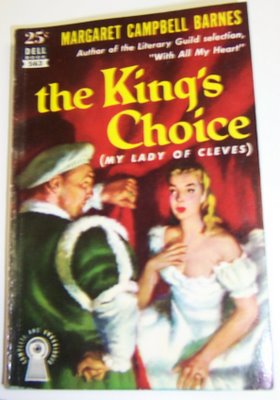
Nice, isn't it? This book actually credits the cover artist: George Mayers. In the front matter, it also lists not only the publisher, but its president and two of its vice presidents--in case, I guess, a reader didn't think he'd gotten his quarter's worth and wanted to go straight to the top.

Nice, isn't it? This book actually credits the cover artist: George Mayers. In the front matter, it also lists not only the publisher, but its president and two of its vice presidents--in case, I guess, a reader didn't think he'd gotten his quarter's worth and wanted to go straight to the top.
Sunday, August 20, 2006
A New Novel About Marie Antoinette
Having last blogged about two recent historical novels, I’m going to do myself one better today and blog about one that hasn’t been released yet: Abundance: A Novel of Marie Antoinette by Sena Jeter Naslund. It’s to be released in October, so naturally, I’m looking at an advance reader’s edition.
Abundance is told in the first person by Marie Antoinette, and though it doesn’t purport to be a journal, it’s told in a journal-like fashion, with the events unfolding as the queen experiences them rather than in retrospect. From what I can tell (it’s not my period by any means), it’s well researched, and it’s sympathetic toward Marie Antoinette without minimizing her weaknesses. The other members of the royal family are rendered nicely too, especially Louis XVI. (For those who are wondering, Axel von Fersen is very much a presence here, though the queen’s relationship with him is a chaste one.)
In many historical novels about well-known figures, authors tend to jump from one Big Event to another, serving history while at the same time slighting character. Naslund tends to move in the opposite direction. While she covers all of the usual set pieces of Marie Antoinette’s life—her husband’s difficulty in consummating their marriage, her reluctance to acknowledge the Comtesse du Barry, her public childbirth, the Affair of the Necklace—Naslund tends to focus more closely on her more everyday, mundane interactions with her family and friends, at least until the revolution overtakes all normalcy. I especially liked the queen’s reminiscences about the hippotamus and rhinoceros in her childhood home, the scene where the royal family witnesses the launch of a hot air balloon, and the later scene where the queen is served “fruit” that turns out to be small balloons. (Through a later scene where another balloon launch ends in tragedy, Naslund neatly inserts a sense of impending disaster for the royal court as well.)
Once fate overtakes the royal family, Naslund conveys the increasing terror of their lives powerfully. Though she doesn’t give us an eyewitness view of the horror of the massacre of the Swiss Guard, the laconic way in which the queen recounts the event is chillingly effective in its very brevity: “It required only two carriages to carry away those of us who remained alive of the court of Louis XVI.”
I did find some things bothersome here. The dialogue is sometimes stilted to the point of being comical: “'Those red spots on your fair cheeks suggest measles,'” Marie Antoinette’s dear friend the Comte de Polignac tells her at one point. This may be to show the artificiality of court life, but if it is, it’s not done consistently; the same friend speaks to Marie Antoinette quite naturally at other times.
More problematic for me was this passage in the first chapter of Abundance, at which point the book nearly became airborne:
I’m sure there must be some reason for this paragraph—which all but screams, “Look, Ma, I’m writing literary fiction!”—but I'll be blessed if I can see it; all I could think of was that clear child’s educational toy called “The Human Body” and then that old song “Dry Bones” (“The knee bone connected to the thigh bone!”). Fortunately, creative-writing-class passages such as this are relatively few and far between, especially in the latter part of the novel. I'm quoting this paragraph, in fact, only because it almost made me stop reading this book, and I'm glad I persevered.
In short, this is a book the merits of which far outweigh its flaws. Give it a try.
Abundance is told in the first person by Marie Antoinette, and though it doesn’t purport to be a journal, it’s told in a journal-like fashion, with the events unfolding as the queen experiences them rather than in retrospect. From what I can tell (it’s not my period by any means), it’s well researched, and it’s sympathetic toward Marie Antoinette without minimizing her weaknesses. The other members of the royal family are rendered nicely too, especially Louis XVI. (For those who are wondering, Axel von Fersen is very much a presence here, though the queen’s relationship with him is a chaste one.)
In many historical novels about well-known figures, authors tend to jump from one Big Event to another, serving history while at the same time slighting character. Naslund tends to move in the opposite direction. While she covers all of the usual set pieces of Marie Antoinette’s life—her husband’s difficulty in consummating their marriage, her reluctance to acknowledge the Comtesse du Barry, her public childbirth, the Affair of the Necklace—Naslund tends to focus more closely on her more everyday, mundane interactions with her family and friends, at least until the revolution overtakes all normalcy. I especially liked the queen’s reminiscences about the hippotamus and rhinoceros in her childhood home, the scene where the royal family witnesses the launch of a hot air balloon, and the later scene where the queen is served “fruit” that turns out to be small balloons. (Through a later scene where another balloon launch ends in tragedy, Naslund neatly inserts a sense of impending disaster for the royal court as well.)
Once fate overtakes the royal family, Naslund conveys the increasing terror of their lives powerfully. Though she doesn’t give us an eyewitness view of the horror of the massacre of the Swiss Guard, the laconic way in which the queen recounts the event is chillingly effective in its very brevity: “It required only two carriages to carry away those of us who remained alive of the court of Louis XVI.”
I did find some things bothersome here. The dialogue is sometimes stilted to the point of being comical: “'Those red spots on your fair cheeks suggest measles,'” Marie Antoinette’s dear friend the Comte de Polignac tells her at one point. This may be to show the artificiality of court life, but if it is, it’s not done consistently; the same friend speaks to Marie Antoinette quite naturally at other times.
More problematic for me was this passage in the first chapter of Abundance, at which point the book nearly became airborne:
While my ladies flutter like bright butterflies around me, I glance at my naked body, a slender worm. Louis Auguste and I must be much the same, as all humans are really much the same, except for the difference of sex. We all have two legs—mine are slender—supporting a torso; two arms sprout on either side of a bodily cabinet, which contains the guts and bladder in the lower compartment and the heaving lungs and heart in the upper section. In between, for women, is the chamber called the womb. From the trunk, a neck rises up like a small lookout tower whose finial is the head.
I’m sure there must be some reason for this paragraph—which all but screams, “Look, Ma, I’m writing literary fiction!”—but I'll be blessed if I can see it; all I could think of was that clear child’s educational toy called “The Human Body” and then that old song “Dry Bones” (“The knee bone connected to the thigh bone!”). Fortunately, creative-writing-class passages such as this are relatively few and far between, especially in the latter part of the novel. I'm quoting this paragraph, in fact, only because it almost made me stop reading this book, and I'm glad I persevered.
In short, this is a book the merits of which far outweigh its flaws. Give it a try.
Friday, August 18, 2006
Two 2006 Reviews: Juana 'n' Jane
In addition to the reviews I do on this blog, I've also been doing some reviews for The Historical Novels Review. Here are a couple that appeared in the recently released August 2006 issue. (Reviewers there have a word limit, so you'll find these reviews more concise than many on my blog.)
The Last Queen
C. W. Gortner, Two Bridges Press, 2006
The Last Queen is the story of Juana “the Mad” of Castile, daughter to Isabel and Fernando and sister to Catherine of Aragon. Spanning the period from 1492 to 1509, The Last Queen is a gripping story of passion, intrigue, and betrayal.
The novel is narrated by Juana herself, looking back at her past from a span of decades. Gortner’s choice of narrative styles was a good one, for it allows the reader to experience events as Juana experiences them, without knowing whom can be trusted. The final betrayal of Juana, shocking to her, is even more shocking to us.
Juana here is not a madwoman, but an isolated, proud, and increasingly desperate one who is as determined to claim her throne as others are to keep her off it. Her story, which in less skilled hands could have been a dreary, didactic tale of male oppression and female victimization, is saved from being so by Juana’s voice, one that is candid, dry, sharply observant, and totally lacking in self-pity.
Gortner avoids falling into “historical novel speak,” rendering his dialogue in modern English peppered with the occasional Spanish phrase. The novel reads quickly, and although the events going on around Juana are complex, Gortner finds a happy middle ground between overwhelming readers with too much background information and bewildering them with too little.
Readers who appreciate author’s notes will find an informative one here, though I would have found it more helpful if Gortner, having told the reader that he took certain liberties with characters, time, and place, was more specific as to what these liberties were. This single quibble aside, this was an exceptionally good read about an intriguing, wronged woman.
Plain Jane: A Novel of Jane Seymour
Laurien Gardner, Jove, 2006
Young Jane Seymour is stunned when she overhears her parents discussing her future: as they consider Jane too plain to attract a husband, they will send her to a nunnery—at least when they can find one that won’t demand too high an offering. Jane vows to prove them wrong about this bleak prospect. She does so, spectacularly.
Unlike the earlier novels in this series, where ladies in waiting are major characters, Plain Jane focuses on Jane. Gardner’s Jane is an opportunist in the positive sense of the word, able to seize upon what life offers her and to make the best of it, whether it be an invitation to join the court or a chance to marry the king. The reader can’t blame her for pursuing the latter option, for the Anne Boleyn portrayed here is thoroughly disagreeable, sometimes to the point of caricature. Henry VIII, by contrast, is more complex: kindly to Jane most of the time, he is capable of turning viciously on her when she seems to him to be meddling in his affairs.
The writing style here is somewhat choppy. There are long stretches of one- or two-sentence paragraphs, which I found distracting. More problematic was the fact that Gardner at times carries the theme of plainness versus beauty too far. It seems simplistic, for instance, to ascribe Anne Boleyn’s downfall to her being so “deceived by her long reign of beauty” that she fails to understand Henry. On the whole, however, I found this novel to be an engaging portrait of a determined woman.
The Last Queen
C. W. Gortner, Two Bridges Press, 2006
The Last Queen is the story of Juana “the Mad” of Castile, daughter to Isabel and Fernando and sister to Catherine of Aragon. Spanning the period from 1492 to 1509, The Last Queen is a gripping story of passion, intrigue, and betrayal.
The novel is narrated by Juana herself, looking back at her past from a span of decades. Gortner’s choice of narrative styles was a good one, for it allows the reader to experience events as Juana experiences them, without knowing whom can be trusted. The final betrayal of Juana, shocking to her, is even more shocking to us.
Juana here is not a madwoman, but an isolated, proud, and increasingly desperate one who is as determined to claim her throne as others are to keep her off it. Her story, which in less skilled hands could have been a dreary, didactic tale of male oppression and female victimization, is saved from being so by Juana’s voice, one that is candid, dry, sharply observant, and totally lacking in self-pity.
Gortner avoids falling into “historical novel speak,” rendering his dialogue in modern English peppered with the occasional Spanish phrase. The novel reads quickly, and although the events going on around Juana are complex, Gortner finds a happy middle ground between overwhelming readers with too much background information and bewildering them with too little.
Readers who appreciate author’s notes will find an informative one here, though I would have found it more helpful if Gortner, having told the reader that he took certain liberties with characters, time, and place, was more specific as to what these liberties were. This single quibble aside, this was an exceptionally good read about an intriguing, wronged woman.
Plain Jane: A Novel of Jane Seymour
Laurien Gardner, Jove, 2006
Young Jane Seymour is stunned when she overhears her parents discussing her future: as they consider Jane too plain to attract a husband, they will send her to a nunnery—at least when they can find one that won’t demand too high an offering. Jane vows to prove them wrong about this bleak prospect. She does so, spectacularly.
Unlike the earlier novels in this series, where ladies in waiting are major characters, Plain Jane focuses on Jane. Gardner’s Jane is an opportunist in the positive sense of the word, able to seize upon what life offers her and to make the best of it, whether it be an invitation to join the court or a chance to marry the king. The reader can’t blame her for pursuing the latter option, for the Anne Boleyn portrayed here is thoroughly disagreeable, sometimes to the point of caricature. Henry VIII, by contrast, is more complex: kindly to Jane most of the time, he is capable of turning viciously on her when she seems to him to be meddling in his affairs.
The writing style here is somewhat choppy. There are long stretches of one- or two-sentence paragraphs, which I found distracting. More problematic was the fact that Gardner at times carries the theme of plainness versus beauty too far. It seems simplistic, for instance, to ascribe Anne Boleyn’s downfall to her being so “deceived by her long reign of beauty” that she fails to understand Henry. On the whole, however, I found this novel to be an engaging portrait of a determined woman.
Tuesday, August 15, 2006
A Little Night Rambling
I finally overcame my Inner Cheapskate and signed up for a paid account on Library Thing, which allowed me to list all of my books instead of being limited to 200. (Interested in looking at my shelves? I'm boswellbaxter there.) I've still got a few things--most of my books about Dickens, for instance--to get on there, but I'd say well over two-thirds of my books are listed now.
It's not as impressive a list as it would have been about fifteen years ago, because repeated moves and a shortage of space have caused me to be pretty ruthless about culling my collection. Sometimes I've wished I hadn't given a book up, especially when it's one that's not readily available in libraries. For the most part, though, I haven't missed what I've gotten rid of--a lot of books, such as the couple I had by Virginia Woolf, had a certain snob appeal but were gathering dust because having read them once, I didn't have the slightest interest in reading them again. Other books I gave up because although I enjoyed them for a while, my tastes changed to the point that I no longer had any desire to re-read them.
There's a little group of books that I've had since the 1970's, however, mostly young adult books that I read when I was in my early teens. Some of them are by authors who are still known, such as M. E. Kerr, and others are by ones who have long since vanished into the shadowlands of Amazon, such as Leona Klipsch. I've dragged them up and down the East Coast for thirty years, and I still like to re-read portions of them from time to time. I suppose one might call these comfort books, which is odd because my adolescence was a time I couldn't wait to outgrow and a time about which I'm not at all nostalgic. All of them were reasonably well written, but a couple of them, like the Klipsch book (Treasure Your Love), were quite formulaic--nice girl falls in with mean clique, starts turning mean, comes to senses, asserts individuality, drops out of mean clique, and wins approval of nice boy who's been waiting for her to drop said mean clique. (Wasn't that the plot of the recent movie Mean Girls? I guess some things never change.)
Anyway, I really can't explain why I've held on to these books, but I'd be scrambling to replace them if they were ever lost.
Book culling has also been on my mind because I recently signed up at PaperBackSwap.com. (Because all mailing is calculated at United States media mail rates, it's currently available only to those areas served by the United States Postal Service.) It's a pretty good deal--you list books, pay the postage to ship them to members who request them, and earn credits that you can use to have books shipped to you by other members. I've already shipped five and am waiting for three to arrive, so it seems a cheap and pleasant way to move unwanted books off one's shelves and replace them with books one wants. I haven't had much luck finding the obscure historical fiction that I lean toward, but I've found a couple of things that I've been wanting. It's also fun just to see what shows up as newly listed--I've seen both Pamela Anderson and Henry James make an appearance.
Now that I've achieved my lifetime goal of using "Pamela Anderson" and "Henry James" in the same sentence, I'll retire for the evening. Toodles.
It's not as impressive a list as it would have been about fifteen years ago, because repeated moves and a shortage of space have caused me to be pretty ruthless about culling my collection. Sometimes I've wished I hadn't given a book up, especially when it's one that's not readily available in libraries. For the most part, though, I haven't missed what I've gotten rid of--a lot of books, such as the couple I had by Virginia Woolf, had a certain snob appeal but were gathering dust because having read them once, I didn't have the slightest interest in reading them again. Other books I gave up because although I enjoyed them for a while, my tastes changed to the point that I no longer had any desire to re-read them.
There's a little group of books that I've had since the 1970's, however, mostly young adult books that I read when I was in my early teens. Some of them are by authors who are still known, such as M. E. Kerr, and others are by ones who have long since vanished into the shadowlands of Amazon, such as Leona Klipsch. I've dragged them up and down the East Coast for thirty years, and I still like to re-read portions of them from time to time. I suppose one might call these comfort books, which is odd because my adolescence was a time I couldn't wait to outgrow and a time about which I'm not at all nostalgic. All of them were reasonably well written, but a couple of them, like the Klipsch book (Treasure Your Love), were quite formulaic--nice girl falls in with mean clique, starts turning mean, comes to senses, asserts individuality, drops out of mean clique, and wins approval of nice boy who's been waiting for her to drop said mean clique. (Wasn't that the plot of the recent movie Mean Girls? I guess some things never change.)
Anyway, I really can't explain why I've held on to these books, but I'd be scrambling to replace them if they were ever lost.
Book culling has also been on my mind because I recently signed up at PaperBackSwap.com. (Because all mailing is calculated at United States media mail rates, it's currently available only to those areas served by the United States Postal Service.) It's a pretty good deal--you list books, pay the postage to ship them to members who request them, and earn credits that you can use to have books shipped to you by other members. I've already shipped five and am waiting for three to arrive, so it seems a cheap and pleasant way to move unwanted books off one's shelves and replace them with books one wants. I haven't had much luck finding the obscure historical fiction that I lean toward, but I've found a couple of things that I've been wanting. It's also fun just to see what shows up as newly listed--I've seen both Pamela Anderson and Henry James make an appearance.
Now that I've achieved my lifetime goal of using "Pamela Anderson" and "Henry James" in the same sentence, I'll retire for the evening. Toodles.
Friday, August 11, 2006
Those Wacky, Witchy, Plantagenets
As promised (c'mon, I know you've been tapping your fingers in anticipation), here's my review of My Philippa by Maureen Peters. My copy came all the way from Tasmania, and judging from its almost pristine condition except for sundry library markings, it'd been sitting quietly on the shelves of the library there for some time before being withdrawn and finding its way to eBay.
My Philippa, of course, is about Edward III's queen, Philippa of Hainault, who's probably best known for pleading with her husband to spare the lives of the Burghers of Calais. It's typical of the oddity of this book that this famous incident is mentioned only in passing here.
Narrated by Philippa herself, this book covers Philippa's life from her marriage to Edward III to the beginning of his affair with Alice Perrers. The book has a very domestic quality about it; for the most part, the plot just revolves around Philippa's sometimes frustrating marriage (Edward III is a skirt-chaser) and her growing family. Despite Philippa's being relegated to the background, I found the book agreeable enough to read; Philippa's narrative voice has a refreshingly tart tone, and the narrative moves forward at a brisk pace.
There are a couple of odd features to this book. Peters ties together several characters by their adherence to the Old Religion--Roger Mortimer, Queen Isabella (slightly), Joan of Kent, and Edward III himself. Thus, Joan's famous garter is the Badge of the Snake Priestess, as Queen Isabella helpfully points out, and the Order of the Garter is equivalent to two covens. I'm not sure of the source of this link between the Order of the Garter and witchcraft, but it's not original to Peters; Evelyn Eaton in The King Is a Witch used the witchcraft theory on a much more elaborate scale, forcing Edward III to periodically look about for a Substitute Victim to keep him safely above ground. In Peters's case, what could be an interesting, albeit historically dubious, angle fizzles out, for Peters doesn't develop the witchcraft plot line much, but contents herself with having Bad Things happen whenever Joan of Kent appears on the scene.
The other peculiar aspect of the book is its portrayal of Edward III's son Lionel, Duke of Clarence, as being feeble-minded, albeit in a very charming manner. (Speaking of his desire to marry his sweetheart, Elizabeth de Burgh, the adult Lionel explains, "She is very clever and will read aloud to me in the evenings and I will give her rides on my horse.") I don't know of anything that supports this depiction of Lionel; it certainly seems inconsistent with his later career as royal lieutenant in Ireland. (And Lionel as an adult hardly had to ask permission to marry Elizabeth de Burgh, having been betrothed to her since childhood.)
All in all, I found this a peculiar little book, eccentric yet strangely likable. Its main appeal, though, will be to those who read all things Plantagenet.
My Philippa, of course, is about Edward III's queen, Philippa of Hainault, who's probably best known for pleading with her husband to spare the lives of the Burghers of Calais. It's typical of the oddity of this book that this famous incident is mentioned only in passing here.
Narrated by Philippa herself, this book covers Philippa's life from her marriage to Edward III to the beginning of his affair with Alice Perrers. The book has a very domestic quality about it; for the most part, the plot just revolves around Philippa's sometimes frustrating marriage (Edward III is a skirt-chaser) and her growing family. Despite Philippa's being relegated to the background, I found the book agreeable enough to read; Philippa's narrative voice has a refreshingly tart tone, and the narrative moves forward at a brisk pace.
There are a couple of odd features to this book. Peters ties together several characters by their adherence to the Old Religion--Roger Mortimer, Queen Isabella (slightly), Joan of Kent, and Edward III himself. Thus, Joan's famous garter is the Badge of the Snake Priestess, as Queen Isabella helpfully points out, and the Order of the Garter is equivalent to two covens. I'm not sure of the source of this link between the Order of the Garter and witchcraft, but it's not original to Peters; Evelyn Eaton in The King Is a Witch used the witchcraft theory on a much more elaborate scale, forcing Edward III to periodically look about for a Substitute Victim to keep him safely above ground. In Peters's case, what could be an interesting, albeit historically dubious, angle fizzles out, for Peters doesn't develop the witchcraft plot line much, but contents herself with having Bad Things happen whenever Joan of Kent appears on the scene.
The other peculiar aspect of the book is its portrayal of Edward III's son Lionel, Duke of Clarence, as being feeble-minded, albeit in a very charming manner. (Speaking of his desire to marry his sweetheart, Elizabeth de Burgh, the adult Lionel explains, "She is very clever and will read aloud to me in the evenings and I will give her rides on my horse.") I don't know of anything that supports this depiction of Lionel; it certainly seems inconsistent with his later career as royal lieutenant in Ireland. (And Lionel as an adult hardly had to ask permission to marry Elizabeth de Burgh, having been betrothed to her since childhood.)
All in all, I found this a peculiar little book, eccentric yet strangely likable. Its main appeal, though, will be to those who read all things Plantagenet.
Thursday, August 10, 2006
Reay Tannahill Redux , and a Nod Toward the News
With all the things going on the world today and these past few weeks, it's occurred to me at times that this blog is a bit insular--rather like that Dorothy Parker short story "From the Diary of a New York Lady: During Days of Horror, Despair, and World Change," but without all the cocktails. However, I decided when I started this blog to leave politics to the political bloggers, and God knows there's enough of them without me putting my bit in.
So good job, UK, in catching those terrorists, and now back to historical fiction. (And at least one can still carry books on airplanes.)
Having enjoyed The Seventh Son, I toted Reay Tannahill's Fatal Majesty to the beach with me this weekend. It's about Mary, Queen of Scots, and I liked it even better than The Seventh Son. It's written in a similar style, with a very dry, sardonic tone to the narration.
Fatal Majesty switches back and forth between the English court and the Scottish court, and has a very wide cast of characters--wide enough, in fact, to be rather confusing for someone who isn't intimately familiar with the main players of the time. Most of the characters act entirely in their own self-interest, like so many spiders spinning their webs, and it is the convergence of these webs that eventually engulfs and destroys Mary.
Though Tannahill is sympathetic toward Mary, one gets a sense of distance, especially in the latter half of the novel. Indeed, Tannahill's favorite character seems to be Mary's Secretary of State, Lethington, which gives rise to what I thought was the novel's major flaw: once Lethington makes his final exit, Tannahill becomes far less engaged with her material, making the last fifty pages a bit of chore to get through. Tannahill covers thirty years in those fifty pages, and although there's a lot of intrigue packed in those years and pages, I found myself skimming. Worse, Mary herself appears only occasionally in them. That may have been to drive home the point that she was little more than the pawn of others during that time, but I would have liked to have seen more of Mary nonetheless. Still, this is a 450-plus-page novel, and the pleasure of reading the first 400 pages, packed full of excellent characterizations and dry wit, more than makes up for the relative weakness of the last fifty pages.
Coming soon: My Philippa by Maureen Peters.
Below: Onslow, the King of the End Table
So good job, UK, in catching those terrorists, and now back to historical fiction. (And at least one can still carry books on airplanes.)
Having enjoyed The Seventh Son, I toted Reay Tannahill's Fatal Majesty to the beach with me this weekend. It's about Mary, Queen of Scots, and I liked it even better than The Seventh Son. It's written in a similar style, with a very dry, sardonic tone to the narration.
Fatal Majesty switches back and forth between the English court and the Scottish court, and has a very wide cast of characters--wide enough, in fact, to be rather confusing for someone who isn't intimately familiar with the main players of the time. Most of the characters act entirely in their own self-interest, like so many spiders spinning their webs, and it is the convergence of these webs that eventually engulfs and destroys Mary.
Though Tannahill is sympathetic toward Mary, one gets a sense of distance, especially in the latter half of the novel. Indeed, Tannahill's favorite character seems to be Mary's Secretary of State, Lethington, which gives rise to what I thought was the novel's major flaw: once Lethington makes his final exit, Tannahill becomes far less engaged with her material, making the last fifty pages a bit of chore to get through. Tannahill covers thirty years in those fifty pages, and although there's a lot of intrigue packed in those years and pages, I found myself skimming. Worse, Mary herself appears only occasionally in them. That may have been to drive home the point that she was little more than the pawn of others during that time, but I would have liked to have seen more of Mary nonetheless. Still, this is a 450-plus-page novel, and the pleasure of reading the first 400 pages, packed full of excellent characterizations and dry wit, more than makes up for the relative weakness of the last fifty pages.
Coming soon: My Philippa by Maureen Peters.
Below: Onslow, the King of the End Table

Wednesday, August 09, 2006
In Which I Try the One Book Meme
Marg tagged me for this one, but Boswell being the publicity hound that he is, he insisted on my posting his interview first. Anyway, without further ado:
One Book....That Changed Your Life
Probably A Tale of Two Cities. I'd read classics before that, but more out of a sense of obligation and without ever becoming very emotionally involved in what I was reading. The book made me realize that a book could be both entertaining and enduring, and it ended up taking me in a lot of directions--educational and literary--that I might not have gone in otherwise.
One Book....That You've Read More Than Once
I've read a lot of books more than once, though these days I tend to re-read snippets of books rather than whole books. I'll say Mansfield Park by Jane Austen, one of my favorites.
One Book....That You'd Want on a Desert Island
The Complete Works of William Shakespeare. A bit of everything--tragedy, history, comedy--to keep me going while I wait to be rescued.
One Book....That Made You Laugh
Anne Tyler's Saint Maybe. The scene where Ian's nieces and nephews try to fix him up with one of their teachers is hilarious.
One Book....That Made You Cry.
I can't think of a book that's made me actually shed tears, but there are many that have made my eyes well up, especially at the end. The last paragraph of Middlemarch is one that always does this, even though the book as a whole isn't one of my all-time favorites.
One Book....That You Wish Had Been Written
The book Charlotte Bronte was working on at the time of her death.
One Book....That You Wish Had Never Been Written
Can I count Anais Nin's diaries as one book? One of the most tedious evenings of my life was spent at a poetry reading where one of the presenters, for reasons best known to himself, decided to read from them instead of from his own work.
One Book....That You Are Currently Reading
Anne, the Rose of Hever by Maureen Peters. A very odd book which ties Anne Boleyn's death to the Old Religion.
One Book....You've Been Meaning to Read
Nigel Tranter's The Bruce Trilogy. I toted this book to the UK and back in 2004 but never read it (the atmosphere in tourist class just isn't conducive to long tomes), and it's been sitting on my shelf ever since calling my name. I guess sooner or later I should answer it.
I never was good at tag, so anyone who wants to join in can do so.
One Book....That Changed Your Life
Probably A Tale of Two Cities. I'd read classics before that, but more out of a sense of obligation and without ever becoming very emotionally involved in what I was reading. The book made me realize that a book could be both entertaining and enduring, and it ended up taking me in a lot of directions--educational and literary--that I might not have gone in otherwise.
One Book....That You've Read More Than Once
I've read a lot of books more than once, though these days I tend to re-read snippets of books rather than whole books. I'll say Mansfield Park by Jane Austen, one of my favorites.
One Book....That You'd Want on a Desert Island
The Complete Works of William Shakespeare. A bit of everything--tragedy, history, comedy--to keep me going while I wait to be rescued.
One Book....That Made You Laugh
Anne Tyler's Saint Maybe. The scene where Ian's nieces and nephews try to fix him up with one of their teachers is hilarious.
One Book....That Made You Cry.
I can't think of a book that's made me actually shed tears, but there are many that have made my eyes well up, especially at the end. The last paragraph of Middlemarch is one that always does this, even though the book as a whole isn't one of my all-time favorites.
One Book....That You Wish Had Been Written
The book Charlotte Bronte was working on at the time of her death.
One Book....That You Wish Had Never Been Written
Can I count Anais Nin's diaries as one book? One of the most tedious evenings of my life was spent at a poetry reading where one of the presenters, for reasons best known to himself, decided to read from them instead of from his own work.
One Book....That You Are Currently Reading
Anne, the Rose of Hever by Maureen Peters. A very odd book which ties Anne Boleyn's death to the Old Religion.
One Book....You've Been Meaning to Read
Nigel Tranter's The Bruce Trilogy. I toted this book to the UK and back in 2004 but never read it (the atmosphere in tourist class just isn't conducive to long tomes), and it's been sitting on my shelf ever since calling my name. I guess sooner or later I should answer it.
I never was good at tag, so anyone who wants to join in can do so.
Monday, August 07, 2006
Meet the Author: Boswell
Some dogs can heel, some can play fetch. But how many dogs can write books? Not very many, I warrant. But Boswell, being an exceptional canine altogether, has just published his first book, with help from my daughter Bethany and Blurb.com.
Boswell has graciously agreed to take some time from his busy schedule to talk to me about his new venture.
Q: Boswell, how was writing your first book?
A: I would describe it as a cathartic experience, really. It helped a great deal in coming to terms with my greatest enemies—the bathtub and the vacuum cleaner—both of which are pictured within these pages.
By the way, why are there so many words that start with c-a-t and not so many that start with d-o-g? I smell a conspiracy.
Q: No, you smell dinner. Can you describe your book for us?
A: It’s a book about me and my times—the people and cats I live with, my typical day, the things I enjoy doing. Really, it’s the essence of my life as a dog, distilled into a few short pages.
Q: What gave you the idea to write a book?
A: At first, I just wanted to make the cats jealous. But then I realized that I had a unique, dogly voice of my own that was just crying out, begging to be heard, as opposed just to begging for leftovers.
And I've still made the cats jealous.
Q: Where can I buy it?
A: On Blurb.com. Not on Amazon or anything like that, which is just as well because if my Amazon ranking was better than Mom’s, she’d get all miffed and probably quit playing ball with me.
Q: No, I wouldn’t.
A: Yes, you would.
Q: Anyway, Boswell, what’s your next project?
A: I don’t know. I’ve been thinking about maybe venturing into historical fiction. Dad read a book about Robert E. Lee told from the viewpoint of his horse, and Mom read a book about Shakespeare told from the viewpoint of his dog, so perhaps I’ll go for a book about Mary, Queen of Scots told from the viewpoint of her dog. Or Anne Boleyn told from the viewpoint of her dog. Or maybe a book about the Knights Templar told from the viewpoint of their dogs. I think that’s the most promising project—Dogs of the Templars.
Q: That last one sounds highly marketable.
A: I know. I just need a good agent.
Q: If you find one, will you introduce me to him or her?
A: If you're a bit more generous with the leftovers from now on, Mom.

Friday, August 04, 2006
Would You Like to Come to My Place and See My Suit of Armor?
I was reading "God Squad," a syndicated column by Marc Gellman and Thomas Hartman, this morning and was struck by this question from a reader: "My daughter just started dating a guy who told her he was a Templar Knight."
Well, you can't say the guy doesn't have an original pickup line. (The God Squad suggested that the daughter might want to find another boyfriend.)
On the historical fiction front, I'm reading The Ivy Crown by Mary Luke, about Katherine Parr. It's well written, but it's proceeding at an extremely leisurely pace--I'm over 100 pages into it, and Katherine Parr's still not married her second husband! At the moment, she's in the periphery of the events happening over at court and has very little to do than to give her opinions on various matters and dispense good advice to her friends. Thomas Seymour shows up once in a while to get poor Kate's heart afluttering. At least he doesn't tell her that he's a Templar Knight.
Coming soon: a chance to meet a very special author.
Well, you can't say the guy doesn't have an original pickup line. (The God Squad suggested that the daughter might want to find another boyfriend.)
On the historical fiction front, I'm reading The Ivy Crown by Mary Luke, about Katherine Parr. It's well written, but it's proceeding at an extremely leisurely pace--I'm over 100 pages into it, and Katherine Parr's still not married her second husband! At the moment, she's in the periphery of the events happening over at court and has very little to do than to give her opinions on various matters and dispense good advice to her friends. Thomas Seymour shows up once in a while to get poor Kate's heart afluttering. At least he doesn't tell her that he's a Templar Knight.
Coming soon: a chance to meet a very special author.
Tuesday, August 01, 2006
The Joys of eBay, and Tudor Bunnies
One of my many weaknesses is eBay. A few years ago, doubtless as a reaction to turning a Certain Age, I began buying old Barbie dolls there, but this got a bit on the expensive side, not to mention the crowded side. So I’ve changed my eBay habits a bit, and now I bid mostly on books. I’ve got quite a few things there, historical fiction and otherwise, that I wouldn’t have gotten elsewhere.
Unless I’m looking for a particular book, I’ll usually just type in a search term and see what turns up. With a term like “Anne Boleyn,” that’s not a problem; almost everything that shows up is somehow related to the English queen, though as we shall soon see, sometimes in rather peculiar ways. On the other hand, “Edward II” can pull up things about the English king, but also DVD’s by a band called Edward II and the Red Hot Polkas and a line of women’s clothing (why not men’s clothing? seems a natural). “Gaveston” often brings up items relating to Galveston, Texas. And “Despenser” pulls in quite a few sellers who misspelled “dispenser.” These items raise some interesting mental pictures:
Of course, it’s easy enough to avoid results like these by limiting the search to books, but it’s not quite as much fun. And one time in one of my general searches, I came across a cast-metal figure of Hugh le Despenser’s son Hugh (d. 1349), dressed in armor and riding a destrier, which would have looked lovely perched on my hard drive. I duly put a bid in, but sadly, I was sniped. The jerk probably thought he was bidding on a toilet tissue paper holder.
In any case, did you know that Royal Doulton makes a set of figures called "Bunnykins" that include Henry VIII and all his wives? That's fate for you--divorced, beheaded, died, divorced, beheaded, survived, but all made into cute little bunny figurines.
Unfortunately, I don’t think Royal Doulton has a Bunnykins figure for Edward II or his favorites. Or for any of the Plantagenet kings. Someone clearly needs to get cracking on this. Or should I say hopping?
Unless I’m looking for a particular book, I’ll usually just type in a search term and see what turns up. With a term like “Anne Boleyn,” that’s not a problem; almost everything that shows up is somehow related to the English queen, though as we shall soon see, sometimes in rather peculiar ways. On the other hand, “Edward II” can pull up things about the English king, but also DVD’s by a band called Edward II and the Red Hot Polkas and a line of women’s clothing (why not men’s clothing? seems a natural). “Gaveston” often brings up items relating to Galveston, Texas. And “Despenser” pulls in quite a few sellers who misspelled “dispenser.” These items raise some interesting mental pictures:
New Dinosaurs floating in blue liquid Soup Despenser
Deer Buck Antler Toilet Tissue Paper Holder Despenser
Of course, it’s easy enough to avoid results like these by limiting the search to books, but it’s not quite as much fun. And one time in one of my general searches, I came across a cast-metal figure of Hugh le Despenser’s son Hugh (d. 1349), dressed in armor and riding a destrier, which would have looked lovely perched on my hard drive. I duly put a bid in, but sadly, I was sniped. The jerk probably thought he was bidding on a toilet tissue paper holder.
In any case, did you know that Royal Doulton makes a set of figures called "Bunnykins" that include Henry VIII and all his wives?
 That's fate for you--divorced, beheaded, died, divorced, beheaded, survived, but all made into cute little bunny figurines.
Unfortunately, I don’t think Royal Doulton has a Bunnykins figure for Edward II or his favorites. Or for any of the Plantagenet kings. Someone clearly needs to get cracking on this. Or should I say hopping?
Subscribe to:
Posts (Atom)