I’ve been reading Michael Hicks’ Anne Neville: Queen to Richard III, a biography that has excited much outrage among Ricardians, mainly for its description of Richard III as a “serial incestor.”
Hicks’ description is based on Richard’s marriage to Anne, his sister-in-law, and his supposed plans to marry Elizabeth of York, his niece. Although, as Hicks points out, a papal dispensation for Richard and Anne’s marriage has been discovered very recently, it addressed their relationship as cousins, not their relationship as brother-in-law and sister-in-law through the previous marriage of Richard’s brother George to Anne’s sister Isabel. By not having sought to address this relationship, Hicks writes, Richard and Anne were essentially living in sin and bastardizing their son. Though Hicks does “deplore the immortality of the match,” as he puts it, he does later acknowledge that the marriage was “the best possible outcome for Anne,” in light of her precarious circumstances at the time.
I’m no expert in canon law, so I can only say that Hicks’ statement that a dispensation would have been needed to cover the in-law relationship seems correct, especially in light of the fact that Henry VIII would later obtain a dispensation to marry his sister-in-law Catharine of Aragon. (In any case, those who believe that Richard III would not have possibly married Anne without a proper dispensation, thereby jeopardizing the future of his heirs, seem to have no difficulty at all believing that Edward IV married Elizabeth Woodville while he was still married to Eleanor Butler, thereby jeopardizing the succession to the throne.) It may be, however, that Richard and Anne believed that the dispensation they received was adequate.
Richard’s next act of incest, according to Hicks, was his intent to marry his niece. Evidence of this proposed marriage comes from a letter supposedly written by Elizabeth of York herself, now lost, and chronicle evidence that Richard publicly denied wishing to marry Elizabeth. As no marriage was actually contracted, however, and there is no reason to think that Richard would have risked marrying his niece without getting a dispensation, the description of him as a “serial incestor” does seem overwrought. So too does the strange comment in the epilogue that Anne “experienced high society and lots of parties, two husbands, fashionable and expensive clothes, plenty of sex, child-bearing, and lots of admiration and deference.” Though this comment should be taken in context, that of Hicks’ statement that Anne had a “full life,” he has no way of knowing that Anne with her one child had “plenty of sex,” and neither do we. In any case, the sex she had was within the context of marriage, or in what Anne probably thought was a valid marriage. Whoever Anne was—and Hicks reminds the reader frequently that not much is known about her—she was probably not the Paris Hilton-like creature that this passage implies.
Nonetheless, this book is worth reading. Hicks diligently draws together what is known about Anne’s life, and he attempts to consider events as Anne must have seen them from her point of view, though he’s hampered in this effort by the lack of historical detail about Anne and the scanty records of her everyday life. He’s fair-minded, as a reading of the whole book reveals, and those who focus in on his controversial and sensational remarks alone are doing Hicks, and Anne, a disservice.
Wednesday, June 28, 2006


Saturday, June 24, 2006
Confessions of a Peeper: A New Poll
I have a confession: When I read a novel, I peep at the ending very early on, sometimes even before I buy the novel or check it out from the library. It doesn't matter what type of novel it is (even mysteries are not immune); it doesn't matter whether I'm enjoying it or not; it doesn't matter whether I'm going to finish it or not; it doesn't matter whether it's 200 pages or 800 pages. I'll peep regardless.
Clearly, I would have had a rough time of it during the days of serial publication, where I'd have to wait my turn just like everyone else to see whether Little Nell died.
I'm sure I can't be the only person with this shameful secret, but I've yet to hear someone else confess to it. So how about it? Take the new poll on the right and help determine how many of us there really are. It's anonymous, so don't worry--if you answer "Always" or "Sometimes," the Anti-Spoiler Police won't come and get you. (At least, they haven't come for me yet.)
Speaking of polls, dog people won my last poll about two to one.
Clearly, I would have had a rough time of it during the days of serial publication, where I'd have to wait my turn just like everyone else to see whether Little Nell died.
I'm sure I can't be the only person with this shameful secret, but I've yet to hear someone else confess to it. So how about it? Take the new poll on the right and help determine how many of us there really are. It's anonymous, so don't worry--if you answer "Always" or "Sometimes," the Anti-Spoiler Police won't come and get you. (At least, they haven't come for me yet.)
Speaking of polls, dog people won my last poll about two to one.
Thursday, June 22, 2006
Meme Time Again: Five Folks I'd Like to Meet
Here’s an interesting meme going around that Carla, Alex, and Gabriele C among others have each picked up on: five historical people you’d like to meet (or to know more about).
This one took a bit of pondering. I excluded people I’ve written about (too likely to say, “Bimbo, you got it all wrong!") and literary figures, though I’d love to meet Charles Dickens, Charlotte Bronte, Jane Austen, and William Shakespeare. (It wouldn’t be much of a meeting, though, as I’d be standing there in gap-mouthed awe.) So here’s my five.
The Princes in the Tower. (I'll cheat and count them as one.) What actually did happen to the two of them?
Juana "the Mad." I've been reading a novel about her, and she sounds intriguing. Was she a madwoman, the victim of the ambitious men in her life, or both?
Marie Antoinette. Another historical figure about whom interpretations seem to differ widely.
Anne Boleyn. A woman who had a fascinating mixture of qualities, and whom people seem to have either hated or adored.
Edward IV. Was there a precontract with Eleanor Butler or was there not? And would he try to seduce me?
This one took a bit of pondering. I excluded people I’ve written about (too likely to say, “Bimbo, you got it all wrong!") and literary figures, though I’d love to meet Charles Dickens, Charlotte Bronte, Jane Austen, and William Shakespeare. (It wouldn’t be much of a meeting, though, as I’d be standing there in gap-mouthed awe.) So here’s my five.
The Princes in the Tower. (I'll cheat and count them as one.) What actually did happen to the two of them?
Juana "the Mad." I've been reading a novel about her, and she sounds intriguing. Was she a madwoman, the victim of the ambitious men in her life, or both?
Marie Antoinette. Another historical figure about whom interpretations seem to differ widely.
Anne Boleyn. A woman who had a fascinating mixture of qualities, and whom people seem to have either hated or adored.
Edward IV. Was there a precontract with Eleanor Butler or was there not? And would he try to seduce me?
Tuesday, June 20, 2006
More Book Hanky-Panky, and a Dark New Theory
First, as one of the hockey fans in my house has suggested that this blog is a tad too insulated from the real world:
Go 'Canes! (Who won the Stanley Cup last night, resulting in the very unusual situation of something going on in the streets of Raleigh, North Carolina, after midnight.)
Second, in response to my post about my books' remarkable ability to reproduce, Carla posted the following comment:
This seemed far too interesting to bury in the Comment area. Personally, I think that a law textbook and a historical romance might give birth to something like The Quincunx by Charles Palliser, which has some Really Bad Guys, like a romance, and a lot of wrangling over property, like a law textbook. It's also, like a law textbook, really heavy (I bought the hardcover when I was pregnant with my son and found that I couldn't bear to haul both it and him around) and very, very long. It's lacking, however, in the Gorgeous Heroine and HEA areas. But children often do lack the notable qualities of their parents.
What is multiplying on my shelf is historical fiction, which makes me think that the history books are somehow involved. It may well be that they're mating with the few historical romances in the house, which like those inside them are not necessarily adverse to serial partners.
It's possible, of course, that my books are behaving themselves, and that instead there's a conspiracy on the part of the post office and Amazon to keep sending me books. But I haven't investigated that dire scenario properly yet.
Go 'Canes! (Who won the Stanley Cup last night, resulting in the very unusual situation of something going on in the streets of Raleigh, North Carolina, after midnight.)
Second, in response to my post about my books' remarkable ability to reproduce, Carla posted the following comment:
Just occurred to me to wonder whether you can identify the culprits from population genetics, e.g if romances inexplicably proliferate then it's a fair guess the books are behaving like their protagonists (though IME most romances have a rabbit-like [or rather, dunnock-like] level of activity but a surprisingly low level of fertility). Whereas if The Law of Real Property and its fellows predominate, then lawyers must have hidden depths the rest of us can only guess at.
I wonder what the offspring of a law textbook and a historical romance might be? Anyone care to hazard a guess?
This seemed far too interesting to bury in the Comment area. Personally, I think that a law textbook and a historical romance might give birth to something like The Quincunx by Charles Palliser, which has some Really Bad Guys, like a romance, and a lot of wrangling over property, like a law textbook. It's also, like a law textbook, really heavy (I bought the hardcover when I was pregnant with my son and found that I couldn't bear to haul both it and him around) and very, very long. It's lacking, however, in the Gorgeous Heroine and HEA areas. But children often do lack the notable qualities of their parents.
What is multiplying on my shelf is historical fiction, which makes me think that the history books are somehow involved. It may well be that they're mating with the few historical romances in the house, which like those inside them are not necessarily adverse to serial partners.
It's possible, of course, that my books are behaving themselves, and that instead there's a conspiracy on the part of the post office and Amazon to keep sending me books. But I haven't investigated that dire scenario properly yet.
Sunday, June 18, 2006
A Father's Day Look at Gilbert de Clare
Having posted about Eleanor de Clare’s mum for Mother’s Day, I’m posting about her dad for Father’s Day. (Symmetry is everything.)
To put it very briefly, Gilbert de Clare (1243-1295) had a stormy relationship with both Henry III and Edward I. During the Barons’ Wars of the thirteenth century, he allied himself with Simon de Montfort, then broke with Montfort and went over to the side of the royalists. Gilbert de Clare was among the leaders of the royal forces that defeated Simon de Montfort at Evesham. Interestingly, one of the men who died with Montfort was Hugh le Despenser, whose grandson, Hugh le Despenser the younger (“name the baby” books were not on the Despenser bookshelves) eventually married Gilbert de Clare’s daughter Eleanor. One wonders if the match was arranged partially to heal wounds still left over from Evesham, though Gilbert de Clare was long dead when it took place.
Gilbert’s first marriage, to Alice de Lusignan, was evidently an unhappy one, though it produced two daughters. It was eventually annulled, and Gilbert married Edward I’s daughter Joan of Acre in 1290. Alice’s daughters, though not impoverished, were barred from inheriting their father’s lands. Despite the marriage to Joan, which produced four children in five years before ending with Gilbert's death, king and subject’s relationship remained a tense one to the very end: in the last months of Gilbert de Clare’s life, Edward I seized Glamorgan from him, restoring it to him six weeks before Gilbert’s death.
There may have been a softer side to Gilbert, however. Toward the end of 1292, he wrote to the royal chancellor to apologize for not attending the king, giving as his reason the fact that the illness of one of his young children (either his son, another Gilbert, or his newborn daughter Eleanor) had kept him in Wales longer than he had expected. This could have been a sham, of course, but one hopes it wasn’t.
A full, and very interesting, account of Gilbert and his family can be found in Michael Altschul’s A Baronial Family in Medieval England: The Clares, 1217–1314.
Like his wife, Gilbert has made it into several historical novels. Falls the Shadow, Sharon Penman’s novel about Simon de Montfort, contains what is probably the most accurate depiction of Gilbert: shown there as a young man, he’s hot-tempered, sensitive to slights, and violently anti-Semitic (a trait he sadly shared with many others of the time, however), though not without some higher principles. Jean Plaidy in Hammer of the Scots, a novel about Edward I and his family, depicts Gilbert as so softened by his marriage to Joan that he loses all interest in butting heads with the king, a portrait that doesn’t mesh with history. In Vanessa Alexander’s The Love Knot, a love story/mystery involving Joan of Acre and Ralph de Monthermer, Gilbert is dead when the book opens, but the picture of him that emerges is hardly a flattering one: he’s a hard-drinking, brutish husband who dabbles in the occult and whose sexual relations with his wife are little better than rapes. Most recently he turns up in Virginia Henley’s forthcoming Infamous, a historical romance in which Joan of Acre, who has more than adequate bases for comparison, highly approves of his prowess in bed.
With Gilbert’s shifting political allegiances, the dramatic events he was involved in, and his stormy first marriage, he really deserves a novel all to himself. Anyone game?
To put it very briefly, Gilbert de Clare (1243-1295) had a stormy relationship with both Henry III and Edward I. During the Barons’ Wars of the thirteenth century, he allied himself with Simon de Montfort, then broke with Montfort and went over to the side of the royalists. Gilbert de Clare was among the leaders of the royal forces that defeated Simon de Montfort at Evesham. Interestingly, one of the men who died with Montfort was Hugh le Despenser, whose grandson, Hugh le Despenser the younger (“name the baby” books were not on the Despenser bookshelves) eventually married Gilbert de Clare’s daughter Eleanor. One wonders if the match was arranged partially to heal wounds still left over from Evesham, though Gilbert de Clare was long dead when it took place.
Gilbert’s first marriage, to Alice de Lusignan, was evidently an unhappy one, though it produced two daughters. It was eventually annulled, and Gilbert married Edward I’s daughter Joan of Acre in 1290. Alice’s daughters, though not impoverished, were barred from inheriting their father’s lands. Despite the marriage to Joan, which produced four children in five years before ending with Gilbert's death, king and subject’s relationship remained a tense one to the very end: in the last months of Gilbert de Clare’s life, Edward I seized Glamorgan from him, restoring it to him six weeks before Gilbert’s death.
There may have been a softer side to Gilbert, however. Toward the end of 1292, he wrote to the royal chancellor to apologize for not attending the king, giving as his reason the fact that the illness of one of his young children (either his son, another Gilbert, or his newborn daughter Eleanor) had kept him in Wales longer than he had expected. This could have been a sham, of course, but one hopes it wasn’t.
A full, and very interesting, account of Gilbert and his family can be found in Michael Altschul’s A Baronial Family in Medieval England: The Clares, 1217–1314.
Like his wife, Gilbert has made it into several historical novels. Falls the Shadow, Sharon Penman’s novel about Simon de Montfort, contains what is probably the most accurate depiction of Gilbert: shown there as a young man, he’s hot-tempered, sensitive to slights, and violently anti-Semitic (a trait he sadly shared with many others of the time, however), though not without some higher principles. Jean Plaidy in Hammer of the Scots, a novel about Edward I and his family, depicts Gilbert as so softened by his marriage to Joan that he loses all interest in butting heads with the king, a portrait that doesn’t mesh with history. In Vanessa Alexander’s The Love Knot, a love story/mystery involving Joan of Acre and Ralph de Monthermer, Gilbert is dead when the book opens, but the picture of him that emerges is hardly a flattering one: he’s a hard-drinking, brutish husband who dabbles in the occult and whose sexual relations with his wife are little better than rapes. Most recently he turns up in Virginia Henley’s forthcoming Infamous, a historical romance in which Joan of Acre, who has more than adequate bases for comparison, highly approves of his prowess in bed.
With Gilbert’s shifting political allegiances, the dramatic events he was involved in, and his stormy first marriage, he really deserves a novel all to himself. Anyone game?
Thursday, June 15, 2006
Hanky-Panky in the Stacks
Now that our flooring’s down and the sofa is no longer sitting on its side in the kitchen (don’t ask), the bookshelf is full again—but over the two nights that it was empty, I observed a strange and disturbing phenomenon.
My books are reproducing amongst themselves. Yes—they’re having book sex, and as a result, they’re giving birth to more books.
There’s no other explanation for this. When I started to reshelf my books, there were far too many to fit in, so I ended up having to banish a couple of dozen to my garage, where everything that won’t fit on the shelves in the living room or in the master bedroom goes. (It’s no disgrace, by the way, for a book to be shelved in my garage. George Eliot is in my garage. Thomas Hardy is in my garage. Anne Tyler is in my garage. Sharon Penman is in my garage. Am I in my garage? Hell, no—I’m special.) And this was after we had given some of the books on the shelf to the public library.
Anyway, now that my books are back on their shelves, maybe they’ll behave themselves and stop carrying on like characters in a steamy historical romance. Either that, or their offspring will end up in the garage sharing space with The Law of Real Property, and I wouldn’t wish that on any book.
Reading note: I’ve started All Souls: A Family Story from Southie by Michael Patrick MacDonald, a memoir about growing up in a housing project in South Boston. Very good reading so far, though after James Frey I’m a little wary about memoirs. If MacDonald has dental work without anesthetic, I’m bailing.
My books are reproducing amongst themselves. Yes—they’re having book sex, and as a result, they’re giving birth to more books.
There’s no other explanation for this. When I started to reshelf my books, there were far too many to fit in, so I ended up having to banish a couple of dozen to my garage, where everything that won’t fit on the shelves in the living room or in the master bedroom goes. (It’s no disgrace, by the way, for a book to be shelved in my garage. George Eliot is in my garage. Thomas Hardy is in my garage. Anne Tyler is in my garage. Sharon Penman is in my garage. Am I in my garage? Hell, no—I’m special.) And this was after we had given some of the books on the shelf to the public library.
Anyway, now that my books are back on their shelves, maybe they’ll behave themselves and stop carrying on like characters in a steamy historical romance. Either that, or their offspring will end up in the garage sharing space with The Law of Real Property, and I wouldn’t wish that on any book.
Reading note: I’ve started All Souls: A Family Story from Southie by Michael Patrick MacDonald, a memoir about growing up in a housing project in South Boston. Very good reading so far, though after James Frey I’m a little wary about memoirs. If MacDonald has dental work without anesthetic, I’m bailing.
Tuesday, June 13, 2006
Edward III Joins the "Me Too" Meme, and It's About Time
I see that Roger Mortimer's been spouting off. (I'll be damned if I'll call him the Earl of March.) Now that my looney scribe's stopped taking pictures of her bookshelves and popping bubble wrap, I'll finally have my chance to reply.
I am: Edward III, teenage king of England.
I want: to be a real king, not Mother and Mortimer's puppet.
I wish: I got to wear my crown more often.
I hate: it when Mother and Roger Mortimer smooch in public. Get a room!
I miss: my father, in a way.
I fear: that I might turn out like my father.
I hear: that Uncle Edmund's been acting a little strange lately. What's with him?
I wonder: what Mortimer's going to get up to next.
I regret: Mother and Mortimer deposing my father, sometimes. That was sort of extreme. But at least I'm king.
I am not: stupid. Mother's not the only person in the family who can do the meek act, you know.
I dance: with Philippa, my wife. When are Mother and Mortimer going to get around to crowning her, by the way?
I sing: off key, but Philippa says it sounds lovely. She's cool.
I cry: to think of how those Scots got away from that so-called warrior Mortimer. It'd have been different if I'd been in charge.
I am not always: the type of guy who sits around brooding. I like a good joust as well as anybody, and I really enjoy working on getting an heir with Philippa. She's hot.
I made: Mother and Mortimer look pretty silly in front of the Scots when I refused to go to my sister Joan's wedding.
I write: to the Pope about what a jerk Mortimer is.
I confuse: my cousins the Bohun twins with each other. (But at least I have a good reason, unlike some dolts with the initials RM who can’t keep their daughters straight.)
I need: a plan and some good friends to help me carry it out.
I should: give Mortimer a kick in the behind the next time he walks ahead of me. Especially if I’m wearing pointy shoes.
I start: to think that it'd be fun to be King of France too.
I finish: everything on my plate because Mother tells me to do so. But not for long.
I am: Edward III, teenage king of England.
I want: to be a real king, not Mother and Mortimer's puppet.
I wish: I got to wear my crown more often.
I hate: it when Mother and Roger Mortimer smooch in public. Get a room!
I miss: my father, in a way.
I fear: that I might turn out like my father.
I hear: that Uncle Edmund's been acting a little strange lately. What's with him?
I wonder: what Mortimer's going to get up to next.
I regret: Mother and Mortimer deposing my father, sometimes. That was sort of extreme. But at least I'm king.
I am not: stupid. Mother's not the only person in the family who can do the meek act, you know.
I dance: with Philippa, my wife. When are Mother and Mortimer going to get around to crowning her, by the way?
I sing: off key, but Philippa says it sounds lovely. She's cool.
I cry: to think of how those Scots got away from that so-called warrior Mortimer. It'd have been different if I'd been in charge.
I am not always: the type of guy who sits around brooding. I like a good joust as well as anybody, and I really enjoy working on getting an heir with Philippa. She's hot.
I made: Mother and Mortimer look pretty silly in front of the Scots when I refused to go to my sister Joan's wedding.
I write: to the Pope about what a jerk Mortimer is.
I confuse: my cousins the Bohun twins with each other. (But at least I have a good reason, unlike some dolts with the initials RM who can’t keep their daughters straight.)
I need: a plan and some good friends to help me carry it out.
I should: give Mortimer a kick in the behind the next time he walks ahead of me. Especially if I’m wearing pointy shoes.
I start: to think that it'd be fun to be King of France too.
I finish: everything on my plate because Mother tells me to do so. But not for long.
Bare Naked Bookshelves

I'm not sure what's sexier, a big empty bookshelf or a bookshelf lined with books. In some ways, I think the first is more tantalizing, because it's waiting to be filled, whereas the full bookshelf may upon inspection be full of something disappointingly uninteresting, such as cookbooks (apologies to the cooks out there).
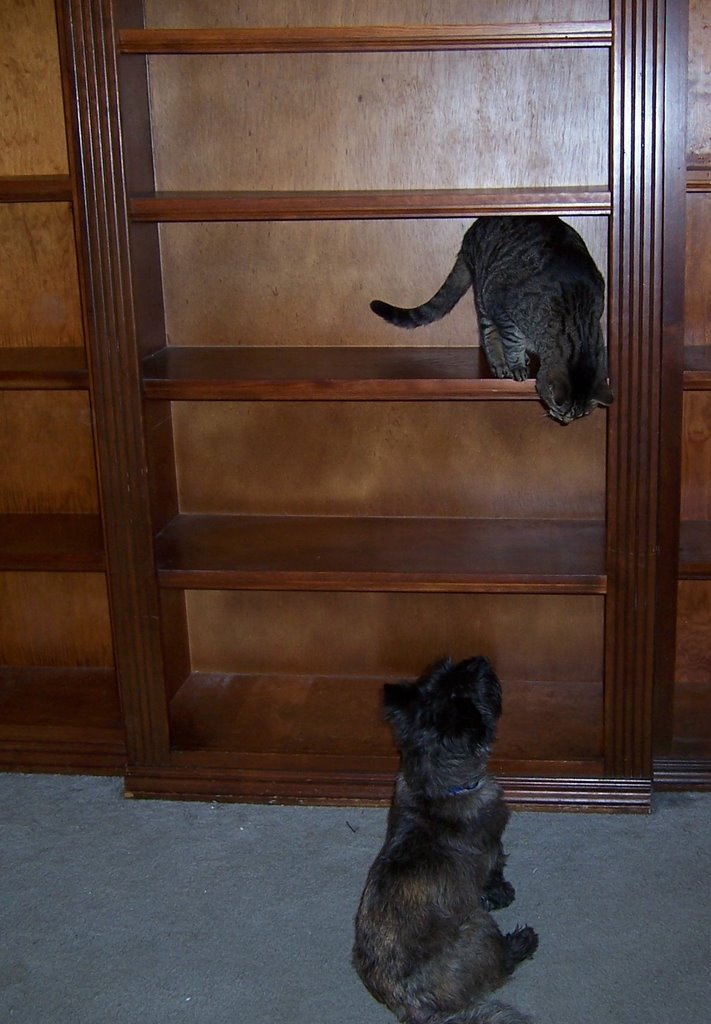
Anyway, as everything in my living room has to be moved tomorrow so that new flooring can be laid down (thanks, cats!), I thought I'd take a picture of one of the rare moments when my biggest bookshelf is absolutely free of books.
Where are the books, you might ask? Piled up in my bedroom around my work computer and in my daughter's bedroom around her desk. Contractors willing, they'll be back in their appointed places tomorrow night, and perhaps even in some logical order (Dickens on one shelf, medieval biographies on another, etc.). Well, a girl can dream, anyway, can't she?
In the meantime, it's given Boswell the dog and Onslow the youngest cat the opportunity to act the balcony scene from Romeo and Juliet. Quite the talents, aren't they?
Sunday, June 11, 2006
Feline or Fido? An Utterly Unscientific Poll
Maybe it's just me, but when I surf around to blogs or websites of other people interested in history or historical fiction, I seem to encounter more cat people than dog people, judging from the pictures people post and the comments they make. And when people comment on my own website, they quite often mention my Cats Galore page, but not the My Buddy Boswell page (my cairn terrier's page). So this makes me think, are people who like historical fiction more cat-loving people or dog-loving people?
(I myself am a cat person of long standing, as anyone who's had the misfortune to view our carpet and chairs can attest. Every item I wear bears a patina of cat hair, courtesy of the four felines who run our house. In 2001, however, I got Boswell, and he's almost made a dog person out of me. So it's a close one.)
In any case, to help resolve this burning question, please vote at the place provided in the sidebar.
Coming soon: bared bookshelves.
(I myself am a cat person of long standing, as anyone who's had the misfortune to view our carpet and chairs can attest. Every item I wear bears a patina of cat hair, courtesy of the four felines who run our house. In 2001, however, I got Boswell, and he's almost made a dog person out of me. So it's a close one.)
In any case, to help resolve this burning question, please vote at the place provided in the sidebar.
Coming soon: bared bookshelves.
Wednesday, June 07, 2006
Barnes, Bees, and Book-Buying
I’ve been reading some historical fiction over the last couple of days, but as two of the books I reviewed were for The Historical Novels Review, I can’t post those reviews here until they appear in print. (By the way, if you haven’t been to the Historical Novel Society’s website, check it out—it’s well worth a look.) I did, however, finish My Lady of Cleves, by Margaret Campbell Barnes.
My Lady of Cleves was published in 1946; it contains a dedication to “the women who lost the men they loved in the fight for freedom.” For a sixty-year-old historical novel, it’s held up remarkably well. Barnes's prose is uncluttered and easy to read, nothing purple or fusty about it.
Barnes’s characterization of Anne of Cleves is interesting and refreshing. Though there doesn’t seem to be much reason, historically, to take Henry VIII at his word in describing her as a “Flanders mare,” she’s often treated as such by novelists. Here, Anne is attractive, though not in the style that appeals to Henry, and she’s even given romantic yearnings for none other than Hans Holbein. How accurate this is I have no idea, but as the relationship isn’t depicted as having an effect on history or as giving rise to any offspring, I can live with it. Anne’s a capable woman who longs for children of her own and who satisfies her maternal instincts by mothering Henry’s brood. At the same time, she’s no saint; jealous of Hans Holbein’s mistress at one point, she takes the opportunity to sleep with Henry VIII, now on his fifth wife.
My Lady of Cleves is an appealing story of a woman who makes the best of a bad situation. There seem to be used copies readily available; pick one up if you’re a fan of Henry VIII and his womenfolk.
Meanwhile, I’ve taken a detour from historical fiction for a few days to read a new book by James Maguire called American Bee: The National Spelling Bee and the Culture of World Nerds. It’s an entertaining nonfiction book about, as you guessed, the National Spelling Bee and the young contestants who enter it. It contains an interesting history of spelling bees in America, a brief history of the development of the English language and its American version in particular, profiles of contestants, and a look at the competition itself. If you enjoyed the documentary Spellbound a couple of years back—I did—you’ll probably like this book. (Years ago, I won a sewing box for winning my fourth-grade-class spelling bee. For some reason, I felt obliged to use the box for its intended purpose. Poor Barbie never had so many sack-like garments as she did the summer after fourth grade.)
Finally (yes, I pressed the “ramble” key on my keyboard tonight), at last I broke down and ordered Michael Hicks’s biography of Anne Neville, queen to Richard III. I’ve heard negative things about the book, but from sources biased heavily against Hicks, so it’ll be interesting to see for myself what it's like.
My Lady of Cleves was published in 1946; it contains a dedication to “the women who lost the men they loved in the fight for freedom.” For a sixty-year-old historical novel, it’s held up remarkably well. Barnes's prose is uncluttered and easy to read, nothing purple or fusty about it.
Barnes’s characterization of Anne of Cleves is interesting and refreshing. Though there doesn’t seem to be much reason, historically, to take Henry VIII at his word in describing her as a “Flanders mare,” she’s often treated as such by novelists. Here, Anne is attractive, though not in the style that appeals to Henry, and she’s even given romantic yearnings for none other than Hans Holbein. How accurate this is I have no idea, but as the relationship isn’t depicted as having an effect on history or as giving rise to any offspring, I can live with it. Anne’s a capable woman who longs for children of her own and who satisfies her maternal instincts by mothering Henry’s brood. At the same time, she’s no saint; jealous of Hans Holbein’s mistress at one point, she takes the opportunity to sleep with Henry VIII, now on his fifth wife.
My Lady of Cleves is an appealing story of a woman who makes the best of a bad situation. There seem to be used copies readily available; pick one up if you’re a fan of Henry VIII and his womenfolk.
Meanwhile, I’ve taken a detour from historical fiction for a few days to read a new book by James Maguire called American Bee: The National Spelling Bee and the Culture of World Nerds. It’s an entertaining nonfiction book about, as you guessed, the National Spelling Bee and the young contestants who enter it. It contains an interesting history of spelling bees in America, a brief history of the development of the English language and its American version in particular, profiles of contestants, and a look at the competition itself. If you enjoyed the documentary Spellbound a couple of years back—I did—you’ll probably like this book. (Years ago, I won a sewing box for winning my fourth-grade-class spelling bee. For some reason, I felt obliged to use the box for its intended purpose. Poor Barbie never had so many sack-like garments as she did the summer after fourth grade.)
Finally (yes, I pressed the “ramble” key on my keyboard tonight), at last I broke down and ordered Michael Hicks’s biography of Anne Neville, queen to Richard III. I’ve heard negative things about the book, but from sources biased heavily against Hicks, so it’ll be interesting to see for myself what it's like.
Sunday, June 04, 2006
Random Thoughts, and a Driving Question
While I was in Barnes & Noble Saturday night (yes, I'm a party gal, what can I say?), I heard a little boy nearby say to his father, "But I can't pick just one!" I feel this child's pain.
Also, while driving (or being driven) on the interstate today, I briefly stopped cringing and wishing I'd updated my will long enough to observe that the car ahead of us bore the license plate NIETZSCHE. Nietzsche was driving a nondescript green sedan, too quickly for me to see the make, but it didn't look very new. Not being a student of philosophy, I'm not sure if this was an appropriate car for him to be driving or not. Anyone have any idea?
On the same lines, I've often wondered what type of car various historical figures would drive (or be driven in) if they were alive today. Anne Boleyn, for instance, strikes me as the Lexus sedan sort, whereas Henry VIII might well go for an SUV. I think Hugh le Despenser the younger would be a Hummer man, though he might well disagree. Maybe a Volkswagen Beetle for Catherine Howard, and a sensible minivan for Catharine of Aragon. Edward II might like a beat-up pickup (good for carrying around all that roofing equipment), or maybe an old Volvo. I'm still pondering what car to put Isabella of France in, though I'm leaning toward a bright red Porsche.
Thoughts?
Also, while driving (or being driven) on the interstate today, I briefly stopped cringing and wishing I'd updated my will long enough to observe that the car ahead of us bore the license plate NIETZSCHE. Nietzsche was driving a nondescript green sedan, too quickly for me to see the make, but it didn't look very new. Not being a student of philosophy, I'm not sure if this was an appropriate car for him to be driving or not. Anyone have any idea?
On the same lines, I've often wondered what type of car various historical figures would drive (or be driven in) if they were alive today. Anne Boleyn, for instance, strikes me as the Lexus sedan sort, whereas Henry VIII might well go for an SUV. I think Hugh le Despenser the younger would be a Hummer man, though he might well disagree. Maybe a Volkswagen Beetle for Catherine Howard, and a sensible minivan for Catharine of Aragon. Edward II might like a beat-up pickup (good for carrying around all that roofing equipment), or maybe an old Volvo. I'm still pondering what car to put Isabella of France in, though I'm leaning toward a bright red Porsche.
Thoughts?
Friday, June 02, 2006
Suspisious, or Suspicious, Minds
In the midst of a jolly day yesterday, I surfed over to Amazon and discovered that The Traitor's Wife had received a one-star review, or to put it more accurately, a comment. It consisted of a sentence, in which the writer stated that she was suspicious that the Alianor who had given me a five-star review was none other than yours truly. So burdened was the author by this suspicion, and so eager to share it with the reading public, she spelled it "suspision," having evidently forgotten in her haste about the modern-day convenience of spell check.
Well, to set the record straight, I am not Alianor. She lives in Europe; I live in the United States. She's younger than I am and probably much better looking. Nor am I either of the males who have kindly left Amazon reviews for me, nor I am ForeWord Magazine, nor am I any of the reviewers who are quoted on my website. Nor am I Janet Maslin or Michiko Kakutani. (Neither of them has yet weighed in on my novel, but I like to cover all my bases.) I don't have time to lead a double life; it's all I can do to work, make excuses for not writing, blog, and wait on my dog and cats.
Now, since the Amazon "reviewer" didn't have anything to say about my book itself, I can only assume that she was at a loss for words to express sufficiently her sheer disgust and revulsion. To help her, and anyone else who might find herself or himself at a loss in similar circumstances, I'm including some zingers here from the queen of book reviewers, the redoubtable Dorothy Parker*:
Well, this should be enough to get anyone started, I think.
*Quotes from The Portable Dorothy Parker, Penguin Books, 1973
Well, to set the record straight, I am not Alianor. She lives in Europe; I live in the United States. She's younger than I am and probably much better looking. Nor am I either of the males who have kindly left Amazon reviews for me, nor I am ForeWord Magazine, nor am I any of the reviewers who are quoted on my website. Nor am I Janet Maslin or Michiko Kakutani. (Neither of them has yet weighed in on my novel, but I like to cover all my bases.) I don't have time to lead a double life; it's all I can do to work, make excuses for not writing, blog, and wait on my dog and cats.
Now, since the Amazon "reviewer" didn't have anything to say about my book itself, I can only assume that she was at a loss for words to express sufficiently her sheer disgust and revulsion. To help her, and anyone else who might find herself or himself at a loss in similar circumstances, I'm including some zingers here from the queen of book reviewers, the redoubtable Dorothy Parker*:
- "I wish I could say 'rotten.' You don't know how much I need to say it." (From "Mr. [Sinclair] Lewis Lays It On with a Trowel")
- “I have yet to have an author inform me that a character is charming, and then, by that character’s deeds and conversation, convince me of that fact.” (From “These Much Too Charming People”)
- "Tonstant Weader Fwowed up." (From "Far From Well," a review of Winnie the Pooh)
- "May Heaven help you, as it assisted me, through the travelogues, the debates, and the grotesquely over-drawn figures that clutter it." (From "And Again, Mr. Sinclair Lewis.")
- "I know that Mr. Dreiser is sincere, or rather I have been told it enough to impress me. . . . But I will not--oh come on with your lightning again!--admit that sincerity is the only thing." (From "Words, Words, Words")
- "Mr. [Tiffany] Thayer's latest work is called, with that simplicity which is the gaudiest flower of pretentiousness, An American Girl. I am at a loss to comprehend why this was the selected title, since the book displays any number of American girls, all alike in seeming to be, as Henry James said of George Sand, highly accessible." (From "Not Even Funny")
Well, this should be enough to get anyone started, I think.
*Quotes from The Portable Dorothy Parker, Penguin Books, 1973
Thursday, June 01, 2006
Piles o' Books, and a Question about Opinion
The Amazon and eBay gods have been smiling upon me, as well as the library gods, so I have several historical novels to read. I'm in the middle of My Lady of Cleves by Margaret Campbell Barnes, and so far I think it's the best of her novels I've read. More to come.
I've got Two Women of Galilee by Mary Roarke teetering on my coffee table, and Myself as Witness by James Goldman (about King John) and Lionheart by Martha Rofheart are stacked on my bookshelf. I'm particularly interested in the James Goldman book. He was the author of The Lion in Winter, a play that I find immensely fun to watch. This is supposed to be a more sympathetic view of John than his portrayal in the play, though from the little skimming I've done, it doesn't appear to be a whitewash of his character.
By the way, I think most people, including myself, will be inclined to pick up a book if it's recommended by someone whose opinion they respect, but what about the opposite situation? I ask because one of the main reasons I bought the Goldman book was because a poster on a list that I read occasionally was trashing Goldman in general and The Lion in Winter in particular, and I figured that anything this particular poster disliked so much had to be worth reading. What about you folks in Blogland? Are there critics, professional or otherwise, whom you find so off-putting for whatever reason that you figure that anything they dislike has to have something going for it? (I could mention politicians and evangelists who have the same effect on me, but I'll leave that to the political bloggers.)
I've got Two Women of Galilee by Mary Roarke teetering on my coffee table, and Myself as Witness by James Goldman (about King John) and Lionheart by Martha Rofheart are stacked on my bookshelf. I'm particularly interested in the James Goldman book. He was the author of The Lion in Winter, a play that I find immensely fun to watch. This is supposed to be a more sympathetic view of John than his portrayal in the play, though from the little skimming I've done, it doesn't appear to be a whitewash of his character.
By the way, I think most people, including myself, will be inclined to pick up a book if it's recommended by someone whose opinion they respect, but what about the opposite situation? I ask because one of the main reasons I bought the Goldman book was because a poster on a list that I read occasionally was trashing Goldman in general and The Lion in Winter in particular, and I figured that anything this particular poster disliked so much had to be worth reading. What about you folks in Blogland? Are there critics, professional or otherwise, whom you find so off-putting for whatever reason that you figure that anything they dislike has to have something going for it? (I could mention politicians and evangelists who have the same effect on me, but I'll leave that to the political bloggers.)
Monday, May 29, 2006
I'm a Wrathful, Gloomy, Lustful Mouse
Probably because of thinking dark thoughts about historical novelists who don't bother to do research and about all of those hunky Scotsmen who have populated much of my recent reading:
The Dante's Inferno Test has banished you to the Fifth Level of Hell!
Here is how you matched up against all the levels:
Take the Dante Inferno Hell Test
And I don't even like cheese, except when it's well disguised on a sausage pizza:
 Some people are scared of mice while others find them cute and cuddly. As a mouse, you forage for food and manage to sneek into everything, but prefer to stay out of sight. The phrase "quiet as a mouse" isn't for nothing, however surprise one and expect a squeek! Your small size and quiet nature are partly what makes you a mouse.
You were almost a: Duckling or a Bunny
You are least like a: Bear Cub or a PuppyTake the Cute Animal Quiz
The Dante's Inferno Test has banished you to the Fifth Level of Hell!
Here is how you matched up against all the levels:
| Level | Score |
|---|---|
| Purgatory (Repenting Believers) | Low |
| Level 1 - Limbo (Virtuous Non-Believers) | Low |
| Level 2 (Lustful) | High |
| Level 3 (Gluttonous) | Moderate |
| Level 4 (Prodigal and Avaricious) | Low |
| Level 5 (Wrathful and Gloomy) | High |
| Level 6 - The City of Dis (Heretics) | Low |
| Level 7 (Violent) | Moderate |
| Level 8- the Malebolge (Fraudulent, Malicious, Panderers) | Moderate |
| Level 9 - Cocytus (Treacherous) | Low |
Take the Dante Inferno Hell Test
And I don't even like cheese, except when it's well disguised on a sausage pizza:
You Are A: Mouse!
Some people are scared of mice while others find them cute and cuddly. As a mouse, you forage for food and manage to sneek into everything, but prefer to stay out of sight. The phrase "quiet as a mouse" isn't for nothing, however surprise one and expect a squeek! Your small size and quiet nature are partly what makes you a mouse.You were almost a: Duckling or a Bunny
You are least like a: Bear Cub or a PuppyTake the Cute Animal Quiz
Will The Cup of Ghosts Be Your Cup of Tea?
I'm not generally a fan of mysteries, except for those of P. D. James, but if it's about Edward II, I'll buy it, so naturally I eagerly awaited The Cup of Ghosts by the amazingly prolific Paul Doherty (not only does he manage two or three novels a year, he's a school headmaster). It's the first of a promised series featuring Mathilde, a lady-in-waiting to Queen Isabella.
Mathilde, who has been training as a physician in Paris under the supervision of her beloved uncle, finds her world shattered when King Philip begins persecuting the Knights Templar, an order to which her uncle belongs. To save Mathilde's life, her doomed uncle sends her to the house of a friend, who in turn sends Mathilde to the household of young Princess Isabella. Sexually abused by her loutish brothers and full of hatred toward her father, Isabella regards Mathilde with suspicion at first, but becomes her devoted friend when Mathilde chases Isabella's drunken brothers out of her bedchamber. In the meantime, several people have died horribly, in and out of court, and more deaths follow when Isabella marries Edward II and travels to England. Shrewd and with a physician's eye for unnatural death, Mathilde is a natural to investigate what she realizes must be murders--and a natural target for murder herself.
I admit that as the body count grew higher and higher in this novel, my interest began to flag somewhat--I would have liked fewer corpses and more time to get to know the living. Still, there's a lot to like here. As Alianore in her review noted, Edward II and Isabella are attractively portrayed (though I doubt whether Isabella's brothers merited their portrayal here as child molesters, and incestuous ones at that). I particularly liked Mathilde. Resourceful, courageous, tough, and at the same time kindly and warmhearted, Mathilde is a heroine I look forward to seeing again.
Mathilde, who has been training as a physician in Paris under the supervision of her beloved uncle, finds her world shattered when King Philip begins persecuting the Knights Templar, an order to which her uncle belongs. To save Mathilde's life, her doomed uncle sends her to the house of a friend, who in turn sends Mathilde to the household of young Princess Isabella. Sexually abused by her loutish brothers and full of hatred toward her father, Isabella regards Mathilde with suspicion at first, but becomes her devoted friend when Mathilde chases Isabella's drunken brothers out of her bedchamber. In the meantime, several people have died horribly, in and out of court, and more deaths follow when Isabella marries Edward II and travels to England. Shrewd and with a physician's eye for unnatural death, Mathilde is a natural to investigate what she realizes must be murders--and a natural target for murder herself.
I admit that as the body count grew higher and higher in this novel, my interest began to flag somewhat--I would have liked fewer corpses and more time to get to know the living. Still, there's a lot to like here. As Alianore in her review noted, Edward II and Isabella are attractively portrayed (though I doubt whether Isabella's brothers merited their portrayal here as child molesters, and incestuous ones at that). I particularly liked Mathilde. Resourceful, courageous, tough, and at the same time kindly and warmhearted, Mathilde is a heroine I look forward to seeing again.
Sunday, May 28, 2006
Better than the Beach, Almost
This being Memorial Day weekend, I would normally be at the beach, but as our family was away last weekend, it seemed better for all concerned to spend this weekend at home catching up.
Instead, I sashayed down to the local university library, which is at its nicest in the summer. No pesky undergraduates hogging the tables, speaking at a volume generally best reserved for rock concerts and sporting events. Just me and a few other stray grown-ups and stacks and stacks and stacks of books. I get trembly just thinking about it.
Anyway, while I was there I picked up Michael Prestwich's Armies and Warfare in the Middle Ages: The English Experience. It's not a new book--it was first published in 1995--but it's not one that I'd come across before. In the little time I've had to read selected portions of it, I'm finding it extremely useful for research purposes. There are chapters on "The Logistics of War," "The Navy," "Siege Warfare," and "Battle," among many others, all geared to inteligent readers who nonetheless don't have a thorough familiarity with medieval warfare. Take a look at it, especially if you're a writer struggling with a battle scene.
Instead, I sashayed down to the local university library, which is at its nicest in the summer. No pesky undergraduates hogging the tables, speaking at a volume generally best reserved for rock concerts and sporting events. Just me and a few other stray grown-ups and stacks and stacks and stacks of books. I get trembly just thinking about it.
Anyway, while I was there I picked up Michael Prestwich's Armies and Warfare in the Middle Ages: The English Experience. It's not a new book--it was first published in 1995--but it's not one that I'd come across before. In the little time I've had to read selected portions of it, I'm finding it extremely useful for research purposes. There are chapters on "The Logistics of War," "The Navy," "Siege Warfare," and "Battle," among many others, all geared to inteligent readers who nonetheless don't have a thorough familiarity with medieval warfare. Take a look at it, especially if you're a writer struggling with a battle scene.
Thursday, May 25, 2006
Happy 700th Anniversary . . .
To Hugh le Despenser the younger and Eleanor de Clare (heroine of my favorite historical novel), married on May 26, 1306. Edward I, Eleanor's grandfather, paid for the minstrels for the wedding, which took place at the king's chapel at Westminster. (This information comes from a thesis by Richard Rastall, available online here.) According to Michael Prestwich in "Royal Patronage under Edward I" in Thirteenth Century England I, Edward I also gave Eleanor nearly 29 pounds to buy jewels for the wedding, plus an additional 10 pounds for robes for her maidservants. Thirteen-year-old Eleanor's wedding dress must have been quite the thing; according to Mary Anne Everett Green in Lives of the Princesses of England, 100 pounds was paid to redeem it from the friar minors of London, who owned it as their prerequisite.
Whether the young couple consummated their marriage on their wedding night is unknown, but their eldest son was born around 1308. Needless to say, the couple, with the usual blatant lack of consideration for future historical novelists shown by medieval folk, named him Hugh.
Despite the abundant evidence for the 1306 wedding (it's also mentioned in Pierre Langtoft's chronicle), a distressing number of historians and novelists persist in having the couple's marriage take place sometime after the Battle of Bannockburn at the instigation of Edward II, presumably on the assumption that since Edward II arranged the marriages of Eleanor's sisters to his favorites, he had to have arranged Eleanor's too. It could be worse, however--at least no novelist has had Eleanor succumb to the charms of a dashing Scotsman before settling down to married life with Hugh.
Not yet, anyway.
And in any case, Hugh was a pirate, for a short time at least. Who wants a man in a kilt when you can have a man with an eyepatch?
Whether the young couple consummated their marriage on their wedding night is unknown, but their eldest son was born around 1308. Needless to say, the couple, with the usual blatant lack of consideration for future historical novelists shown by medieval folk, named him Hugh.
Despite the abundant evidence for the 1306 wedding (it's also mentioned in Pierre Langtoft's chronicle), a distressing number of historians and novelists persist in having the couple's marriage take place sometime after the Battle of Bannockburn at the instigation of Edward II, presumably on the assumption that since Edward II arranged the marriages of Eleanor's sisters to his favorites, he had to have arranged Eleanor's too. It could be worse, however--at least no novelist has had Eleanor succumb to the charms of a dashing Scotsman before settling down to married life with Hugh.
Not yet, anyway.
And in any case, Hugh was a pirate, for a short time at least. Who wants a man in a kilt when you can have a man with an eyepatch?
Wednesday, May 24, 2006
A Disappointing Look at a Controversial Queen
Thanks to Alianor, who sent me a photocopy, I just finished Alianor by Maureen Peters. (It’s not every day you get to write a sentence like that.) This is a 1984 historical novel about Eleanor of Provence, Henry III’s queen. It’s easier to find in the UK than in the US, apparently, but whether it’s pounds or dollars that are in your pocketbook, I’d keep them there in this case.
A woman who was so hated by the Londoners that they pelted stones at her ought to make a fascinating subject for fiction. Unfortunately, this novel doesn’t live up to its subject; it’s disappointingly shallow. The events of Henry III’s turbulent reign are only touched upon; for instance, although Simon de Montfort makes a few appearances, it’s only to spar verbally with Alianor, then to disappear for a few chapters until he turns up again for another sparring match. Events such as the attack on London’s Jews and Guy de Montfort’s murder of Richard of Cornwall’s son, vividly portrayed by Sharon Penman, are described only fleetingly here or ignored altogether.
The main focus of the novel, instead, is on the unconsummated love between Alianor and her brother-in-law, Richard, Earl of Cornwall. Curiously, Alianor’s wistful longings for Richard are about the only interior life she has—she’s never shown as worrying about the captivity of her son or her husband, for instance, though she's depicted as a loving mother. Though she’s portrayed as being greedy for jewels and clothing and overeager for the advancement of her family, no attempt is made to explain her motivations. There’s the occasional glimpse of tension between her and Henry, but the couple’s relationship is never explored in any depth. It’s quite typical that when Henry dies, his death is mentioned only in passing, as are the deaths of two of Alianor’s daughters.
The star-crossed-love theme here leads to a very odd scene when Eleanor de Montfort, Alianor’s widowed sister-in-law, turns up solely for the malicious pleasure of telling Alianor that Richard has died. Eleanor’s pleasure is tripled by the fact that both of Alianor’s young grandsons have just died of a fever. We should feel pity for Alianor, but there’s so little depth to her character, we don’t feel a thing (except, perhaps, indignation that Eleanor, historically in exile at France at the time, is being hauled clear across the Channel to do the author’s dirty work for her).
The most frustrating thing about this novel is that it could have been so much better. It’s certainly not badly written—there are some nice turns of phrases, including Alianor’s last spoken line, “Well, at least I kept my looks.” Alianor has retired to Amesbury priory when she utters that line, and it’s typical of the novel that we don’t have the slightest idea of why she’s there or why she hasn’t seen her family for five years before her daughter-in-law finally visits her. A good historical novel should illuminate the past; this one keeps us in the dark.
A woman who was so hated by the Londoners that they pelted stones at her ought to make a fascinating subject for fiction. Unfortunately, this novel doesn’t live up to its subject; it’s disappointingly shallow. The events of Henry III’s turbulent reign are only touched upon; for instance, although Simon de Montfort makes a few appearances, it’s only to spar verbally with Alianor, then to disappear for a few chapters until he turns up again for another sparring match. Events such as the attack on London’s Jews and Guy de Montfort’s murder of Richard of Cornwall’s son, vividly portrayed by Sharon Penman, are described only fleetingly here or ignored altogether.
The main focus of the novel, instead, is on the unconsummated love between Alianor and her brother-in-law, Richard, Earl of Cornwall. Curiously, Alianor’s wistful longings for Richard are about the only interior life she has—she’s never shown as worrying about the captivity of her son or her husband, for instance, though she's depicted as a loving mother. Though she’s portrayed as being greedy for jewels and clothing and overeager for the advancement of her family, no attempt is made to explain her motivations. There’s the occasional glimpse of tension between her and Henry, but the couple’s relationship is never explored in any depth. It’s quite typical that when Henry dies, his death is mentioned only in passing, as are the deaths of two of Alianor’s daughters.
The star-crossed-love theme here leads to a very odd scene when Eleanor de Montfort, Alianor’s widowed sister-in-law, turns up solely for the malicious pleasure of telling Alianor that Richard has died. Eleanor’s pleasure is tripled by the fact that both of Alianor’s young grandsons have just died of a fever. We should feel pity for Alianor, but there’s so little depth to her character, we don’t feel a thing (except, perhaps, indignation that Eleanor, historically in exile at France at the time, is being hauled clear across the Channel to do the author’s dirty work for her).
The most frustrating thing about this novel is that it could have been so much better. It’s certainly not badly written—there are some nice turns of phrases, including Alianor’s last spoken line, “Well, at least I kept my looks.” Alianor has retired to Amesbury priory when she utters that line, and it’s typical of the novel that we don’t have the slightest idea of why she’s there or why she hasn’t seen her family for five years before her daughter-in-law finally visits her. A good historical novel should illuminate the past; this one keeps us in the dark.
Monday, May 22, 2006
Headless Woman Cover? No, It's a Faceless Author Picture
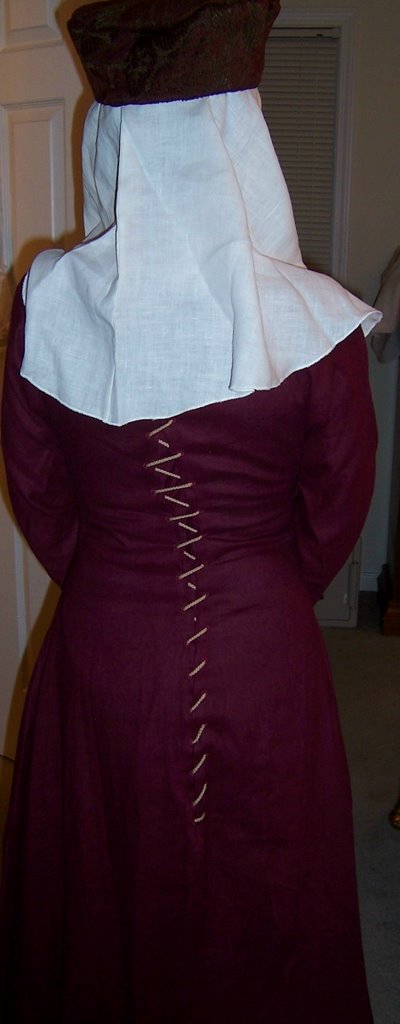
For those who have asked, here's a rearview picture of me in my dress, wimple, and hat (I'm ever so bashful). I think I'm going to replace the wimple with just a veil, since either covers my hair quite adequately and the veil is somewhat more flattering.
I know the lacing is crooked, but it takes a while to break in a good lady's maid. Maybe if Hubby keeps watching the scene from Gone With the Wind where Mammy laces up Scarlett O'Hara, he'll get better at it.
Sunday, May 21, 2006
Tickled Silver
I'm tickled pick--or make that silver--to announce that The Traitor's Wife won the silver award in the historical fiction category in ForeWord Magazine's 2005 Book of the Year Awards.
My family was kind enough to drive me to Washington, D.C., this weekend to BookExpo America, where the results were announced this Friday. They were also kind enough not to laugh too hard the following evening when I enlivened the baseball game we were attending by spilling two buckets of french fries on my lap and on the floor, then two bottles of water. (One french fry landed neatly inside one bottle of water, which I thought was quite impressive.) All of that without having had a single sip from the cute little plastic bottles of beer that were being hawked around us.
Since we're riding the self-promotion train for the moment (it won't be too much longer, I promise), I should mention again that if you live in the Raleigh, North Carolina, area or just happen to be passing through, I'll be signing copies of The Traitor's Wife at Brightleaf Books in Smithfield, NC, on Friday, June 23 from 6 to 8 p.m. As I'll be in medieval costume, with a dress dragging the floor, and have a proven record of clumsiness, there's an excellent chance I'll trip on something at some point, rather like Chevy Chase in those old "Saturday Night Live" skits. So please come.
After all, how often do you get to see a woman in fourteenth-century dress falling flat on her face?
My family was kind enough to drive me to Washington, D.C., this weekend to BookExpo America, where the results were announced this Friday. They were also kind enough not to laugh too hard the following evening when I enlivened the baseball game we were attending by spilling two buckets of french fries on my lap and on the floor, then two bottles of water. (One french fry landed neatly inside one bottle of water, which I thought was quite impressive.) All of that without having had a single sip from the cute little plastic bottles of beer that were being hawked around us.
Since we're riding the self-promotion train for the moment (it won't be too much longer, I promise), I should mention again that if you live in the Raleigh, North Carolina, area or just happen to be passing through, I'll be signing copies of The Traitor's Wife at Brightleaf Books in Smithfield, NC, on Friday, June 23 from 6 to 8 p.m. As I'll be in medieval costume, with a dress dragging the floor, and have a proven record of clumsiness, there's an excellent chance I'll trip on something at some point, rather like Chevy Chase in those old "Saturday Night Live" skits. So please come.
After all, how often do you get to see a woman in fourteenth-century dress falling flat on her face?
Subscribe to:
Posts (Atom)