Over the New Year's weekend, I went into a used bookstore on the coast and spotted A Rose for Virtue, a 1971 historical novel by Norah Lofts, waiting patiently on the shelf. I hadn't heard of this novel before, so I was delighted to pick it up and find that it was about Hortense, daughter of Josephine Bonaparte and stepdaughter (and sister-in-law) to Napoleon. I've been rather interested in Josephine and her circle ever since I read Sandra Gulland's Josephine B. trilogy.
A Rose for Virtue (named for a school prize that gets destroyed inadvertently when Hortense wears it) follows Hortense from the time of her mother and stepfather's marriage to Hortense's departure from Paris following Napoleon's final downfall. It has one of the most jaw-breaking subtitles I've seen in modern fiction: "The Very Private Life of Hortense, Stepdaughter of Napoleon I, mother of Napoleon III."
Hortense is an appealing heroine, resilient, un-self-pitying, and resourceful without ever becoming that dreaded creature of historical fiction, the Mary Sue. As the narrator, she frankly admits that she lacks her mother's easy charm, and she can be stubborn, especially when her estranged husband, Louis, is concerned. She can laugh at herself, and she has a rare gift for facing facts.
Lofts does a good job with the other characters as well. Josephine is particularly well done, and there are some nice sketches of life among the Bonapartes, one of the highlights being a particularly fractious family dinner that ends with Hortense's baby son peeing on the tablecloth.
This isn't an action-packed novel; the big events, of course, occur mostly out of Hortense's range of vision. Nonetheless, Lofts is good at evoking the emotions caused by these events, as when Hortense, urging Napoleon to flee following his return from Waterloo, gets this succinct reply: "My dear, it no longer matters."
My only real disappointment with the book was its ending. Artistically, it works, but it would have been good to see what Hortense made of her later life. As the book doesn't have an afterword--I suppose they weren't in style at the time--the reader wanting more information has to go elsewhere. And the reader will likely want this information, for Lofts makes our stay in Hortense's company a congenial one.
Sunday, January 14, 2007


Tuesday, January 09, 2007
In Which I Ponder the Subject of Queen Isabella
I do my best pondering in the shower, and today in the shower I was pondering two things: what I should blog about next, and why historians and novelists—particularly female ones—have taken such a rosy view of Edward II’s queen, Isabella, lately. Thus a blog post was born and my hair made squeaky clean, all in the course of a few minutes. You just can’t beat the shower, can you?
So why has Isabella become a feminist heroine of sorts? It’s true that she did put up with a lot during Edward II’s reign, and it’s true that she acted with courage in amassing troops and sailing to England to overthrow her husband’s despised favorites, the Despensers, without knowing how successful her enterprise would be. It’s also true that there was moral justification for her actions, given the threat the Despensers, especially Hugh the younger, posed to anyone who possessed property they coveted. So far, so good.
Once Isabella achieved her objective of overthrowing the Despensers, though, and put her son Edward III on the throne in place of his father, she is notable mainly for the greed, short-sightedness, maliciousness, and sheer stupidity she displayed. She granted herself an enormous dower and went through the considerable amount Edward II had left in his treasury with remarkable speed. She and her lover, Roger Mortimer, quickly alienated their allies, especially Henry of Lancaster, by excluding them from decision-making despite their status as members of the young king’s regency council. She entered into a hugely unpopular treaty with Scotland and wrecked any chances she might have had of reconciling the northern landholders to it by appropriating most of the reparation money from the Scots for herself. She tolerated the increasing disrespect with which Roger Mortimer treated the maturing king and seems to have done nothing to protect her own son’s interests against those of her lover. She and Mortimer duped her own brother-in-law, the Earl of Kent, into believing that Edward II was still alive, then had him executed for attempting to rescue his brother from prison. This act of tyranny was probably the last straw for Edward III and his friends, who brought Mortimer and Isabella down only months thereafter.
I’ve left out the most damning of Isabella’s actions, the murder of her husband. Even if it was directed by Mortimer without Isabella’s involvement, she nonetheless continued her relationship with him, suggesting that she felt little if any revulsion at his deed. She might have felt guilt at the end of her life, when she elected to be buried in her wedding cloak and with Edward II’s heart in her tomb. (This, of course, does not take into account the theory that Edward II was not murdered at Berkeley Castle. That’s another blog post, another day.)
Isabella also comes out rather poorly when one looks at her dealings with other females. I’ve already blogged about her forced veiling of the Despenser girls, children who had done her no harm and posed no threat to her or to the crown. Other women and girls were treated shabbily as well. About the same time the Earl of Kent was executed, Isabella and Mortimer ordered that his widow—who was nine months pregnant—be arrested, along with the couple’s children, all of whom were very young. (Among them was the two-year-old Joan of Kent, later mother to Richard II.) The order for the arrest of the Countess of Kent shows great concern for the countess’s jewels, which were to be tracked down and delivered to royal officials, and very little for the countess herself, who was to be accompanied to her new quarters only by her children and two damsels.
Alice de Lacy, the widow of Thomas, Earl of Lancaster, had been treated badly by the Despensers; thus, one would expect the victorious Isabella, who had publicly decried the Despensers’ treatment of orphans and widows, to restore her to the lands out of which she had been bullied. Instead, Roger Mortimer, undoubtedly with Isabella’s acquiescence, took over the more valuable of Alice’s Welsh estates, notably Denbigh.
Isabella’s adultery with Roger Mortimer has often been treated as a justified response to the presumed unfaithfulness of her husband the king. Even if one accepts this dubious morality—which was quite dubious in medieval England, where women were expected to be faithful wives even if their husbands strayed—Isabella’s apologists have seldom addressed the fact that Mortimer himself was married, to a woman against whom Isabella had no cause to bear a grudge. Joan de Geneville had borne Mortimer a dozen children and had suffered imprisonment for his sake by Edward II. Her reward was the destruction of her marriage at the hands of Isabella and her husband, though it could be argued that the estrangement of the Mortimers at least gave Joan a break from child-bearing, if age hadn’t done that already.
Finally, Isabella had obtained money and ships for her invasion of England by agreeing to marry the future Edward III to Philippa of Hainault. Isabella thus owed a considerable debt of gratitude toward her new daughter-in-law when she and Edward III married in 1328. Instead, Isabella delayed Philippa’s coronation until 1330, when Philippa was visibly pregnant with her first child and the matter could not be decently postponed for much longer. Philippa was also deprived of dower lands and prevented from having her own household until that time, and does not seem to have gotten her full dower until 1331, after the fall of Isabella and Mortimer.
Isabella’s defenders have largely blamed Roger Mortimer for the shortcomings of Isabella’s rule. They fail to recognize that one can’t have it both ways. If Isabella was truly dominated by Mortimer and subject to his will, her subservient role as Mortimer’s tool is hardly the stuff of which feminist icons are made. If she was his equal or his superior in power, she has to assume her share of blame for the couple’s actions.
I don’t mean by this to suggest that Isabella was devoid of all redeeming characteristics or that it’s unreasonable for a biographer or a historical novelist to take a sympathetic stance toward her. To the contrary, I think that like most people, she was a mixed bag of qualities and that circumstances worked to put her in a situation where her worst ones came to the forefront. After all, before and after the events of 1325 to 1330, she mostly conducted herself in a manner that was free from reproach. She was certainly kind to some people, like the Scottish orphan boy she provided for early in her reign; she retained some loyal friends, like Joan of Bar, to the end of her days; and she seems to have had an affectionate relationship with her younger daughter in her old age (Isabella’s old age, that is). Perhaps like so many who have found themselves suddenly in a position of power, she found it too heady a brew. And one can’t tell from the records whether she struggled with guilt and remorse, during or after the events in question.
So that brings me back to my original question: why such a blinkered view of Isabella? I don’t really have an answer (gee, thanks!), except that I think that some writers are so taken by the idea of Isabella as a strong woman avenging the wrongs done to her that they blind themselves to the more unpleasant aspects of her character.
It’s quite possible, I might add, for a novelist to make Isabella a sympathetic character without sanitizing her. Brenda Honeyman did it brilliantly in The King’s Minions and The Queen and Mortimer, and Margaret Campbell Barnes in Isabel the Fair and Hilda Lewis in Harlot Queen managed it well also. (Harlot Queen, by the way, has been reissued by Tempus Publishing, evidently through the influence of biographer/novelist Alison Weir, an admirer of Lewis’s novels.) Show us the strong, sensitive Isabella by all means—but not at the cost of pretending that the she-wolf didn’t exist.
Thursday, January 04, 2007
More on Emily Sarah Holt
In a couple of recent posts, I've mentioned the Victorian historical novelist Emily Sarah Holt. Curious, I looked on the online Oxford Dictionary of National Biography today to see if there was an entry for her, and sure enough, there was, by Barbara Brandon Schnorrenberg. I can't link to it because it's a subscription publication, but I found several things in the entry that were interesting.
First, Schnorrenberg stated that Holt was born in 1836, but that her date of death was uncertain; her last known published work was in 1904. It surprised me that the death of such a prolific writer should have apparently gone unnoticed. Perhaps that has to do with the disdain with which the intelligentsia of the early 1900's regarded popular Victorian novelists.
Second, Schnorrenberg, describing Holt's early biographical work called Memoirs of Royal Ladies, wrote, "For an introduction to such women as Ela de Rosman, Alicia de Lacy, Joan of Kent, or Constance, second wife of John of Gaunt, this work is still probably a useful starting place. The essays are documented and show a wide knowledge of the sources." That confirmed what I've thought of the few historical novels of Holt's I've read; in spite of Holt's biases and some of the decidedly peculiar conclusions she draws, her research was thorough, relying heavily on primary sources, and would put that of many a modern historical novelist to shame.
Third, Schnorrenberg, turning to Holt's many historical novels (45 by her count), describes them as intended for girls from ages ten to sixteen. If so, these nineteenth-century girls were a sophisticated lot. In the novels of hers that I've read, Holt assumes the reader has a certain grasp of history; she provides detailed historical appendices, complete with genealogies; and she's not at all adverse to footnotes. Nor would her books have met with the approval of Dickens's Mr. Podsnap, who deplored anything that might bring a blush to the cheek of the Young Person. Holt has her limits, of course. In her novel on Piers Gaveston and Edward II, In All Time of Our Tribulation, she never even hints at homosexuality, and in her account of the king's death, she allows the killers to use a table, but stops short of bringing out the red-hot poker, presumably with the idea that if the young ladies really had to know the specifics, they could ask their brothers. The Young Person would surely blush, however, at the scene where Edward II is presented with the executed Gaveston's head:
Even if the novels were intended for young girls, I suspect that they did find their way into the hands of adults, in part for the cattiness which the author often indulges in, as in this scene where Eleanor de Clare and Margaret de Clare meet at an inn: "Lastly, the sisters bade each other good night, with a kiss in which there was not much affection, except of that kind which Rouchefoucauld says is the strongest of all--that which is built upon mutual dislikes."
Finally, there's this thought by Schnorrenberg:
As the best historical novels should do. Here's to Miss Holt.
(By the way, if you're interested, here's a link to a few e-text versions of Emily Sarah Holt's works. And here's a link to a blog by the Little Professor, who's done academic work on Holt.)
First, Schnorrenberg stated that Holt was born in 1836, but that her date of death was uncertain; her last known published work was in 1904. It surprised me that the death of such a prolific writer should have apparently gone unnoticed. Perhaps that has to do with the disdain with which the intelligentsia of the early 1900's regarded popular Victorian novelists.
Second, Schnorrenberg, describing Holt's early biographical work called Memoirs of Royal Ladies, wrote, "For an introduction to such women as Ela de Rosman, Alicia de Lacy, Joan of Kent, or Constance, second wife of John of Gaunt, this work is still probably a useful starting place. The essays are documented and show a wide knowledge of the sources." That confirmed what I've thought of the few historical novels of Holt's I've read; in spite of Holt's biases and some of the decidedly peculiar conclusions she draws, her research was thorough, relying heavily on primary sources, and would put that of many a modern historical novelist to shame.
Third, Schnorrenberg, turning to Holt's many historical novels (45 by her count), describes them as intended for girls from ages ten to sixteen. If so, these nineteenth-century girls were a sophisticated lot. In the novels of hers that I've read, Holt assumes the reader has a certain grasp of history; she provides detailed historical appendices, complete with genealogies; and she's not at all adverse to footnotes. Nor would her books have met with the approval of Dickens's Mr. Podsnap, who deplored anything that might bring a blush to the cheek of the Young Person. Holt has her limits, of course. In her novel on Piers Gaveston and Edward II, In All Time of Our Tribulation, she never even hints at homosexuality, and in her account of the king's death, she allows the killers to use a table, but stops short of bringing out the red-hot poker, presumably with the idea that if the young ladies really had to know the specifics, they could ask their brothers. The Young Person would surely blush, however, at the scene where Edward II is presented with the executed Gaveston's head:
And then Edward saw before him the face that he had so dearly loved, calm with the stillness of death. . . . He flung himself on his knees by the severed head, clasped it to his bosom, poured kisses on the cold lips, and conducted himself almost like a man demented.
Even if the novels were intended for young girls, I suspect that they did find their way into the hands of adults, in part for the cattiness which the author often indulges in, as in this scene where Eleanor de Clare and Margaret de Clare meet at an inn: "Lastly, the sisters bade each other good night, with a kiss in which there was not much affection, except of that kind which Rouchefoucauld says is the strongest of all--that which is built upon mutual dislikes."
Finally, there's this thought by Schnorrenberg:
While there is certainly a didactic religious tone to her books, she was also telling a good and, so far as she could, historically accurate story. It is probable that she influenced at least as many girls as did Charlotte Yonge, and she may also have inspired in many girls an interest in history.
As the best historical novels should do. Here's to Miss Holt.
(By the way, if you're interested, here's a link to a few e-text versions of Emily Sarah Holt's works. And here's a link to a blog by the Little Professor, who's done academic work on Holt.)
Monday, January 01, 2007
Two (Maybe Three) Little Nuns
On January 1, 1327, Queen Isabella, having executed her enemies and imprisoned her husband, King Edward II, turned her attention to much smaller matters: Hugh le Despenser the younger’s little daughters. On that day, the queen issued an order that Eleanor le Despenser be packed off to Sempringham, a Gilbertine priory in Lincolnshire, and veiled as a nun “without delay.” A similar order sent Margaret to Watton, another Gilbertine priory in Yorkshire. Coming just a few weeks after the brutal execution of the girls’ father and the imprisonment of their mother, the queen’s orders completed the unraveling of the privileged existence these girls had enjoyed.
Hugh le Despenser had left four sons and five daughters behind him. Isabel, the oldest of the girls, was about fourteen. She had been married as a child to Richard Fitzalan and thereby escaped her younger sisters’ fate.
Joan had been intended to marry the Earl of Kildaire’s son, John, but he had died in 1323 or 1324, age nine. Joan herself also was veiled as a nun at Shaftesbury Abbey, but no order from Isabella appears to be extant in her case, so whether she was caught up in Isabella’s net too or was veiled for some other reason is uncertain. (It seems unlikely, though, that her parents, having arranged for her marriage, would later decide to veil her, unless some physical or mental problem had appeared after John’s death that made them consider her unsuitable for marriage. And it seems highly unlikely that Isabella would have veiled her younger sisters but left Joan alone.)
At the time of the queen’s order, Eleanor was contracted to marry Laurence Hastings, the future Earl of Pembroke; he was about seven years old. Isabella ignored this contract, and Hastings ultimately married one of the many daughters of Roger Mortimer, the queen’s lover.
Judging from a record dated March 1, 1327, in which one Thomas de Houk was forgiven a debt for having boarded Margaret for three years, Margaret was probably only about three or four at the time of her forced veiling.
Elizabeth, the youngest Despenser girl, was not veiled. She eventually would marry Maurice de Berkeley, the heir to the man in whose custody Edward II was killed in 1327. We can only speculate as to why Isabella chose not to include her in the forced veiling. Perhaps it might have been her extremely young age; assuming that Elizabeth was fairly close to the age of her future husband, she was probably no more than an infant in January 1327. It is also possible that she was in her mother’s womb at the time of the veiling of her sisters.
That the queen’s orders were carried out quickly, as instructed, is apparent from an entry in the Calendar of Memoranda Rolls dated February 23, 1327. There the prior of Sempringham obtained forgiveness for a debt of nearly forty pounds because of the charges the priory had incurred in veiling Eleanor.
Despite Isabella’s efforts, the girls were not forgotten by their family. Margaret died at Watton some time in 1337; her aunt Elizabeth de Burgh sent items to be used for her burial. Margaret may have lived in some style before her death; in 1332, the prior at Watton, having been hit up for money by Edward III, who was fund-raising for his sister's wedding, pleaded penury, offering as an excuse the large number of nuns at Watton and the necessity to maintain Margaret le Despenser. In 1337, the crown granted Eleanor twenty pounds per year, presumably at the request of her eldest brother, Hugh, who was also the recipient of royal largesse at that time. Hugh granted Joan twenty marks per year in 1343. In 1345, Hugh, aided by Queen Philippa, the Earl of Lancaster, the Earl of Derby, and the Earl of Warwick, presented a petition to the Pope to have certain privileges for Sempringham confirmed. The petition was granted. Eleanor was still living in 1351; Joan lived into the reign of Richard II, dying in 1384.
There were precedents for the queen’s command. As readers of Sharon Penman’s epic historical novel The Reckoning know, after the Welsh prince Llywelyn was slain, Edward I sent his infant daughter, Gwenllian, to Sempringham, where she was veiled and would spend the rest of her life. (Indeed, she lived until 1337, and probably encountered little Eleanor le Despenser when she was sent to Sempringham in 1327.) Following the capture and execution of Llywelyn’s brother Dafydd, Edward I had his young daughters sent to English priories, where they like their cousin Gwenllian were veiled. (Dafydd’s sons suffered a worse fate, imprisonment for life.) Edward II himself sent Roger Mortimer’s daughters and a host of other female relatives of his enemies to priories after the Battle of Boroughbridge, but never forced them to take the veil.
It is unclear what Isabella’s motivations were: expedience, caution, spite, or some combination thereof. Edward I’s decision to “disappear” the daughters of the Welsh royal family by veiling them at least had a cold-blooded logic behind it; by their lineage they would have posed a threat to the king’s dominance over Wales had they been allowed to live free and marry. The Despenser girls, however, posed no similar threat to Isabella and Mortimer. With their father dead and disgraced, they were of no political importance. They were not even potential heiresses; all their parents’ lands were in the hands of the crown at the time, and even if there had been some land in the family, there was a male heir to inherit it, with three spares as backup. In any case, if Isabella had perceived the veiling of the girls to be important as a security measure, she would surely not have let the youngest girl, Elizabeth, escape the habit. Perhaps the queen simply wanted to dispose of the girls cheaply; the expenses of their imprisoned mother, Eleanor de Clare, were being paid by the crown, and dumping her daughters into convents meant that someone else other than the crown was burdened with their care.
Oddly, in her sympathetic biography of Isabella, Alison Weir refers to the girls’ being “placed in convents while their mother was in the Tower” and states that they “later became nuns”—ignoring altogether the coercive role Isabella played in their veiling. (She also cites the pardon of their brother Hugh as an instance of Isabella’s leniency, disregarding the fact that the pardon was one in name only, since Hugh remained in prison until after Isabella and Mortimer’s downfall.) This misinterpretation of the unambiguous orders issued for Eleanor and Margaret is puzzling, to say the least, as other historians, such as Eileen Power and Frances Underwood, have mentioned them.
Long before these modern historians took note of the orders veiling the Despenser girls, however, they were duly noted in the nineteenth century by a prolific historical novelist of the time, Emily Sarah Holt, who made Margaret and Eleanor le Despenser’s confinement the subject of a novel called In Convent Walls. Like the other novels of Holt’s I’ve read, In Convent Walls is a weird mixture of sharp-eyed observation of human foibles, painstaking research, anti-Catholicism, and not-at-all-subtle Protestant evangelism, and it will probably be to few modern readers’ tastes. Still, it’s oddly comforting to see that by one nineteenth-century literary lady at least, two little medieval girls, starting the new year of 1327 by being torn from all that was familiar to them, were remembered with compassion.
Thursday, December 28, 2006
My Top Ten Historical Fiction Reads for 2006
As promised, here are my ten favorite historical fiction novels that I read in 2006. Some were published this year, others were published years ago. Here they are, in no particular order:
The Boleyn Inheritance by Philippa Gregory (Jane Rochford, Anne of Cleves, Katherine Howard)
Mary by Janis Cooke Newman (Mary Todd Lincoln)
Abundance by Sena Jeter Naslund (Marie Antoinette)
Innocent Traitor by Alison Weir (Lady Jane Grey)
Mary, Queen of Scotland and the Isles by Margaret George (Mary, Queen of Scots)
Fatal Majesty by Reay Tannahill (Mary, Queen of Scots)
The Seventh Son by Reay Tannahill (Richard III)
The Ivy Crown by Mary Luke (Katherine Parr)
The Severed Crown by Jane Lane (Charles I)
The Young and Lonely King by Jane Lane (Charles I)
Other favorites: A Lady Raised High by Laurien Gardner (Anne Boleyn), The Last Queen by C. W. Gortner (Juana the Mad), The Lord of Misrule by Eve Trevaskis (Edward II and Piers Gaveston), The Pleasures of Love by Jean Plaidy (Catherine of Braganza, reviewed on my Jean Plaidy blog), Loving Will Shakespeare by Carolyn Meyer (Anne Hathaway), Gatsby's Girl by Caroline Preston (F. Scott Fitzgerald's girlfriend Ginevra King), The Sceptre and the Rose by Doris Leslie (Catherine of Braganza), and My Lady of Cleves by Margaret Campbell Barnes (Anne of Cleves). I could add some more, but it's getting late.
Aside from reflecting my weakness for books about British royalty, what do these books have in common? Overwhelmingly, it's their depiction of character; all feature likable, yet flawed heroes and heroines. Add to that vivid, realistic dialogue and a distinct narrative voice in most cases, and I was hooked.
I may not be blogging again until after the New Year, so Happy New Year!
Tuesday, December 26, 2006
Catnip for Christmas
I promise this will be my last cute animal picture for 2006. After that, we'll move back to historical fiction. But after my daughter took this video of Baxter opening a container of catnip on Christmas day, I couldn't resist posting it:
Anyway, since many bloggers have been posting their Top 10 books for 2006, I will be following suit before the end of the year. (I'm still pondering the matter.)
On the nonfiction front, I got Eamon Duffy's Marking the Hours: English People and Their Prayers 1240-1570 for a Christmas present. For those interested in medieval history and/or religious history, I recommend it highly. Fascinating text, beautiful four-color illustrations throughout.
Monday, December 25, 2006

Saturday, December 23, 2006
Onslow the Sweater Guy
First, a housekeeping note: I just updated my template tonight. In the process, some of my newer links disappeared. I believe I restored them all, but if I've left yours out (or if you'd like me to add a link now), just let me know.
Our dog Boswell has a brother named Merritt, who is quite a bit smaller. Merritt, who lives with my parents, was kind enough to lend Boswell his red sweater for Christmas pictures, but it turned out to be way too small for him. It did, however, fit Onslow purr-fectly. (You know I couldn't resist that.)

Speaking of pictures, a high school student in Rhode Island posed for his senior yearbook photo wearing chain mail and carrying a sword. (He's a member of the Society for Creative Anachronism.) The principal, however, claimed that the sword violated the school's "zero tolerance" weapons policy, despite the fact that the school's own mascot, a patriot, totes a weapon. The matter is now in court.
Personally, I say let the kid have his sword. Trust me, it's a lot less scary than the pastel, checked, or plaid polyester suits the senior boys are wearing in my high school yearbook.
Wednesday, December 20, 2006
This Blog's Stop on the Advent Tour
We'll start this visit on Marg's and Kaliana's Advent Blog Tour with a very special guest:
In the mood for a movie this Christmas? Let me recommend Kenneth Branagh's In the Bleak Midwinter (also known as A Midwinter's Tale), about a group of actors putting on a Christmastime production of Hamlet. It's a funny, sweet story. (It is rated "R," but the rating seems way overcautious to me--there's no violence or sex, and the language isn't saltier than some of what gets on television these days.)
Read "A Christmas Carol" for the umpteenth time? Try "The Haunted Man," one of Charles Dickens's lesser known Christmas stories, this year instead.
And for our feature presentation, "Christmas 1484 With Richard III," see the post below.
Christmas 1484 with Richard III: A Playlet
Scene 1: Westminster Hall is bedecked with greenery and tapestries covered with little white boars as King Richard III and Queen Anne enter. They look around admiringly.
Anne: Isn’t it beautiful? (Coughs) I beg your pardon. And look, I’ve left a couple of places vacant just in case your nephews Edward and Richard return for Christmas from their grand tour of the Continent.
Richard: How thoughtful, my dear. (Aside) What am I going to tell her next? I can't keep them on the damn Grand Tour forever.
Scene 2: Some time later. The king and queen are mingling with their guests.
Anne: Here comes your brother’s daughter Elizabeth. I do think she's bearing up pretty well after being in sanctuary all that time, don't you? And look, Richard! Just in case the poor girl was feeling sad this Christmas I had her dress made from the same material as mine. Isn’t it beautiful?
Richard: (Eyes popping) Yes. She—er—it is.
(Elizabeth, heading toward the royal couple, passes courtiers)
Courtiers: Wowsa!
Elizabeth: (Aside) And I thought it was going to be no fun being a bastard. (Curtsies to Richard) I wish you good tidings of the season, your grace. Oh, and your grace too. (Turns to Anne) How are you feeling, your grace?
Anne: Perfectly well, thank you. (Coughs for five minutes or so) Excuse me for a few minutes.
Elizabeth: (Taking out a slip of paper from a pouch she wears at her side) I thought she’d never stop coughing. Do you know when the doctors say she’ll die? This is what I want engraved on our plate once we’re married, Dickon.
Richard: Sweetheart, I told you to keep calling me “uncle” in public.
Elizabeth: (Pouting) All right, Uncle. But what do you think about the engraving?
Richard: Beautiful. Er— Anne?
Anne: What are you showing your uncle, dear?
Elizabeth: Oh, that would spoil your surprise, your grace. (Scampers off)
Anne: What a sweet girl. We really need to find a husband for her, dear.
Richard: Oh, I’m working on it.
Anne: You think of everything.
Richard: Welcome, Lord Stanley! How goes it with your wife?
Stanley: My wife?
Richard: Yes, your wife, Margaret Beaufort. The woman you have under house arrest on my orders.
Stanley: Oh, yes, my wife. She is very well.
Richard: She doesn’t find her confinement disagreeable?
Stanley: Oh, she finds ways to pass the time.
Richard: And how is that son of hers? John, no, Edward, no, Henry. That’s it. Henry Tudor.
Stanley: Him. I have no idea. I don’t hear from him. She never hears from him. We never hear from him. Frankly, I think sometimes my wife forgets he’s even alive, he’s been abroad so long.
Richard: Indeed. Well, a merry Christmas to you, Lord Stanley. (Aside) Lying bastard.
Stanley: And a merry Christmas to you, your grace. (Aside) Not “your grace” for long if Maggie has her way. (Exits)
Richard: Oh, hello, Mother.
Cecily: Hello, dear.
Richard: Are you enjoying your Christmas?
Cecily: As much as I can since you spread that nasty rumor that I had been unfaithful to your father and that your brothers weren't his children.
Richard: Not that again. It was nothing personal, Mum. We went through this last Christmas.
Cecily: Yes, and we’ll go through it this Christmas too, and the Christmas after that, and the Christmas after that. And you know why? Because I’m your mother and I can say to you whatever I please. Even if you are the king. And don't get me started on how you got to be the king. Your dear little nephews—
Richard: Mother, how about going on pilgrimage next Christmas? I’ll pay for everything.
Scene 3: The royal bedchamber. Richard is lying alone in the royal bed. Suddenly a spirit appears, shrouded in a deep black garment that conceals all of it except for one outstretched hand. Richard stirs and wakes.
Richard: What—? (Aside) I knew that last cup of wine was a big mistake.
Spirit: I am the Ghost of Christmas Yet to Come.
Richard: The what?
Spirit: You’d understand better if you were living about 400 years later. By then, a chap named Charles Dickens— But I’ve got other visits to pay tonight. Let’s discuss Christmas Yet to Come.
Richard: Tell me, O Spirit.
Spirit: Well, to begin with, your wife is going to die. I know you’ve been expecting that, but it’s not going to work out as you planned. You’re going to have to give up your plans to marry that nubile little niece of yours.
Richard: No nubile niece!
Spirit: It goes downhill from there. She’s going to marry Henry Tudor.
Richard: Not Tudor, no! Not Tudor!
Spirit: They’re going to have sons, and one of the sons is going to have six wives.
Richard: Six wives! I can’t even marry two! Or can I? Do I get to marry anyone else? Do I get to have living children?
Spirit: Sorry, no. Now, how can I put this? Well, in your case there’s not going to be a Christmas Yet to Come. This is your last one. Hope the food was good tonight.
Richard: Spirit?
Spirit: You’re going to die in battle before the end of the coming year, and Tudor is going to take the crown. Then he gets your niece, and the son with the six wives becomes king after him. You’ll be the end of the Plantagenet dynasty.
Richard: (After a long silence) I killed the little brats for this?
Spirit: I'm afraid so. But you will fight pretty well in that last battle, aside from getting killed. That's something.
Richard: Spirit, what I can do to change this dire future?
Spirit: Not a blessed thing. Too many people are going to be making a living writing books about you and the king with the six wives. But there is an upside to all of this.
Richard: Tell me, O Spirit.
Spirit: Your reputation will be bad, and a glover’s son named William Shakespeare will make it even worse. You’ll even be depicted with a hump on your back. But after 500 years or so, it will start to get better. There will be a society devoted entirely to improving your reputation. There will be publications devoted to you. Your enemies will be slandered. You’ll be hard-pressed to find a novel about you where you aren’t the good guy. Women in particular will love you. Everyone will blame someone else for the Princes in the Tower, and people won’t even care that you executed Hastings, Rivers, Grey, Vaughan, and Haute on trumped-up charges. You’ll be everybody’s favorite dead king.
Richard: So. Tudor gets the girl and the crown, and I get the Richard III Society and the adoring women?
Spirit: Yes.
Richard: (Sighing) Well, there are tradeoffs in life, aren’t there? Merry Christmas, Spirit.
Spirit: Merry Christmas. And to all a good night.
Monday, December 18, 2006
McMansions and More
Not far from our house, a development of McMansions has begun construction, and some homes are finally available for walk-through. Being curious to see how the other half lives, my family and I went out over the weekend and walked around a couple.
No doubt about it, these houses do have lots of space. If you were mad at your relatives, you could pretty much avoid them for days at a time. In fact, your cars wouldn't even have to talk to each other, because several of these places had two garages--just in case, I suppose, your Hummer gave your Mercedes-Benz bad vibes.
Unfortunately, there was one glaring design flaw. When I entered the first house, I was transfixed by the built-in bookshelves surrounding the fireplace and indulged in some fairly serious Bookcase Lust. As I was preparing to leave the house, however, I took a last lingering look at the shelves and realized what I hadn't seen before: you couldn't fit hardbacks on these shelves. Not even trade paperbacks. The only thing that would fit on them was small knickknacks and mass-market paperbacks.
Well, that was a deal-killer for me. Where would I put my Dickens? Where would I put my Plaidys? Where would I put my hard-to-find Robert Hale titles? And where would I put The Traitor's Wife? What's the point of spending $750,000 on a house if you can't stretch out on the couch and stare admiringly at one's own book on one's own built-in bookshelves? Does that mean I'd have to take up reading Danielle Steele?
So, no McMansion for me, thank you very much, until I see one that caters to the wishes of the discerning reader. (And, of course, until I address the small matter of affording one.)
Anyway, yesterday I finished reading Jane Lane's Bridge of Sighs (which wouldn't fit on the McMansion's bookshelves either). It's about Mary Beatrice, second wife of James II. I was rather disappointed in it, especially when compared to the other Jane Lane novels I've read, the best of which have a dry wit and a deep sympathy for the main characters. There are a few good moments here, but I never felt that I knew Mary Beatrice or believed in the emotions that we were told she was feeling. I kept reading it because I knew little about the history of the time and was curious to find out what happened, but otherwise I doubt it would have held my interest.
Finally, I've signed up to do a posting for Marg and Kailana’s 2006 Advent Blog Tour. There's been a lot of nice posts so far, and I'm looking forward to reading what comes next. Mine is scheduled for December 21, and will feature Christmas of 1484 with Richard III. (If you're a diehard Ricardian without a sense of humor--not that you probably read this blog if you are--pass this one by.)
Thursday, December 14, 2006
So Why Don't I Like Fantasy? Beats Me . . .
There was a post on Carla's blog the other day about historical fantasy, and as I mentioned on the comments section there, I've never cared for fantasy. I've been trying to figure out why. It's not that I have a Gradgrindian aversion to fancy; after all, there's a miniature Christmas tree in my kitchen that opens up its mouth (yes, its mouth, cleverly concealed under its branches) and sings "Jingle Bells" when you wave a hand in front of it. It's not that I'm a religious fanatic who sees something sinister in Harry Potter; quite the contrary. But for whatever reason, fantasy, as well as science fiction, has never appealed to me.
In the end, I suppose it's like chocolate ice cream. I don't like it. I know lots of people love it. I know there are excellent varieties of it. I'll buy it for my family. I'll even make an effort to eat it now and again to be polite. I'll never attempt to dissuade someone else from eating and enjoying it. But I just plain don't like it. Give me vanilla any day.
That being said, I'm not immune entirely to fantasy, it turns out, at least not at the level of wanting to see what happens next. I volunteer at my daughter's school library shelving books once a week. I come in at the same time a second-grade class comes in for its library hour, and part of the hour, of course, is story time. So for the past few weeks, I've been listening, with the second graders, to one of the librarians read a volume in "The Magic Tree House" series. The series, from what I can tell, involves a couple of modern-day kids who go to, well, a magic tree house, and get transported back into the past. Once the kids reach the past, there's always some crisis that only they can solve.
Anyway, in this volume--I haven't caught the name--the kids have been taken back to Camelot, only to find that the denizens of the Round Table are having a perfectly miserable Christmas, evidently because the leading knights have gone missing and none of the people left have the courage to go looking for them. Our modern-day kids, being a plucky pair, immediately volunteer, and just yesterday, they located the missing knights, who have all been put under some sort of a spell that makes them dance endlessly until they dance themselves to death. When the bell rang yesterday, the kids had hit on a solution: join the dancing circle, keep from falling under the spell themselves, and pull the dancers out of the circle, thereby breaking the spell and return everyone to Camelot. Things were looking dire, though, because it appeared that the kids might not be able to resist the spell themselves . . .
I hope this is all wrapped up next week, because I really don't think I can wait until after Christmas break to find out how this all ends up.
Thursday, December 07, 2006
Philippa Gregory's Latest
I haven't read much of Philippa Gregory, and up to now, the only novel of hers that I found agreeable was The Constant Princess (and even that, I thought, was repetitive and on the politically correct side). I loathed all of the characters in The Virgin's Lover, so much that I never got past the first few chapters, and though The Other Boleyn Girl had some memorable scenes and vivid characters, the whole thing struck me as smarmy. But I'm always up for another round with Henry VIII and his wives, so I put myself on the library waiting list for The Boleyn Inheritance.
And I'm pleased to report that I enjoyed it immensely.
The Boleyn Inheritance is told by Jane, Lady Rochford, widow of the executed George Boleyn; Anne of Cleves; and Katherine "Kitty" Howard. Jane, self-justifying and self-deceiving, is obsessed with her past yet determined to do whatever she has to do in order to restore her life to its former glamour. Anne, no stupid Flanders mare but a sensible, honorable young woman who longs for freedom and respect, finds that she has exchanged the petty humiliations of her brother's court for the reign of terror of Henry's. Kitty is an airheaded teenager, with an endless capacity to push aside unpleasant realities in favor of her more satisfying preoccupations: young men, jewels, and pretty clothes. Manipulating Jane and Kitty is the sinister Duke of Norfolk, and stalking through all three women's lives is the unpredictable, increasingly tyrannical Henry VIII.
Gregory juggles the heroines' stories masterfully. Even when Anne of Cleves is relegated to the background and the machinations of the Duke of Norfolk and Jane take center stage, Anne remains to comment on what she sees around her. She, the outsider, becomes both the moral center of the novel and the narrator on which the reader can most rely for an accurate perception of events. Kitty's adolescent preoccupations and mercurial character are captured wonderfully, while Jane, morally repulsive as she is, has a normalcy about her that keeps us reading her story and wondering at her motivations.
There's a certain humor here, often quite dark, that was missing altogether in the very earnest Constant Princess. Much of this comes from Kitty's youthful blatherings ("France would be wonderful, except I cannot speak French, or at any rate only "voila!" but surely they must mostly all speak English? And if not, then they can learn?"), but the more cynical Jane Rochford contributes some memorable lines: "If she declares herself Dereham's wife, then she has not then cuckolded the king but only Dereham; and since his head is on London Bridge, he is in no position to complain."
And neither am I. Read this one.
Tuesday, December 05, 2006
To Bibliography or Not to Bibliography?
Here's an excerpt from an interesting article by Julie Bosman, "Loved His New Novel, and What a Bibliography," in today's New York Times about the practice of including bibligraphies in novels:
I'm with Mr. Vollmann. Personally, I regard a bibliography in a historical novel not as a bid for praise or as proof of labor and expertise, but simply as a tool for the reader who might be interested in reading more about the subject. I don't hold the absence of one against an author (there's none in my own book, although I do include an author's note in the book and a list of further reading on my website), but I do appreciate its inclusion. I certainly don't see its being there as pretentious or as a form of bragging. It's an aid to the reader, which the reader can either make use of or ignore.
Maybe Mr. Wood just doesn't read much commercial historical fiction, because bibliographies seem to have been quite common in it for some time. Jean Plaidy often included them in her novels (The Battle of the Queens, the one closest to hand on my bookshelf, lists 21 titles that Plaidy consulted), and King's Minions, a 1974 Brenda Honeyman novel about Edward II that I finally acquired yesterday after months of forlorn Googling, has a "Works Consulted" page. Even these now-dated bibliographies can be useful in leading readers to long-out-of-print books that may contain relevant information.
So I say, ignore Mr. Wood. Bring on the bibs (and keep the author's notes coming too, please).
“It’s terribly off-putting,” said James Wood, the literary critic for The New Republic. “It would be very odd if Thomas Hardy had put at the end of all his books, ‘I’m thankful to the Dorset County Chronicle for dialect books from the 18th century.’ We expect authors to do that work, and I don’t see why we should praise them for that work. And I don’t see why they should praise themselves for it.”
Traditionally confined to works of nonfiction, the bibliography has lately been creeping into novels, rankling critics who call it a pretentious extension of the acknowledgments page, which began appearing more than a decade ago and was roundly derided as the tacky literary equivalent of the Oscar speech. Purists contend that novelists have always done research, particularly in books like “Madame Bovary” that were inspired by real-life events, yet never felt a bibliography was necessary.
And many present-day writers like Thomas Pynchon, most recently in “Against the Day,” put extensive historical research into their novels without citing sources or explaining methods.
But some novelists defend the bibliography, pointing out that for writers who spend months or years doing research for historical novels, a list of sources is proof of labor and expertise. . . .
Of course some fiction writers have always tacked on bibliographies, as William T. Vollmann has done since his first book, “You Bright and Risen Angels,” published in 1987. Mr. Vollmann initially did it because the book was first published in Britain, and he wasn’t sure how many sources he was expected to cite according to British laws, he said.
But now, Mr. Vollmann says, he does it as a service to readers. “I think it’s nice for a reader to have the information available,” he said. “Let’s say somebody gets interested in a character, or is disbelieving of something I had a character do. He can look in the back of the book.” . . .
I'm with Mr. Vollmann. Personally, I regard a bibliography in a historical novel not as a bid for praise or as proof of labor and expertise, but simply as a tool for the reader who might be interested in reading more about the subject. I don't hold the absence of one against an author (there's none in my own book, although I do include an author's note in the book and a list of further reading on my website), but I do appreciate its inclusion. I certainly don't see its being there as pretentious or as a form of bragging. It's an aid to the reader, which the reader can either make use of or ignore.
Maybe Mr. Wood just doesn't read much commercial historical fiction, because bibliographies seem to have been quite common in it for some time. Jean Plaidy often included them in her novels (The Battle of the Queens, the one closest to hand on my bookshelf, lists 21 titles that Plaidy consulted), and King's Minions, a 1974 Brenda Honeyman novel about Edward II that I finally acquired yesterday after months of forlorn Googling, has a "Works Consulted" page. Even these now-dated bibliographies can be useful in leading readers to long-out-of-print books that may contain relevant information.
So I say, ignore Mr. Wood. Bring on the bibs (and keep the author's notes coming too, please).
Thursday, November 30, 2006
Two Wives and a Girlfriend
I got my copy of the Historical Novels Review today. It's a great publication for readers and writers of historical fiction, and in case you're new to this blog, I contribute some reviews to it. So without further ado, here are three of my reviews from the November 2006 issue: Mary by Janis Cooke Newman (about Mary Tood Lincoln), Gatsby's Girl by Caroline Preston (F. Scott Fitzgerald's old flame), and Loving Will Shakespeare by Carolyn Meyer (Anne Hathaway). I enjoyed each of them very much.
Mary: A Novel
Janis Cooke Newman
Committed to the Bellevue Place Sanitarium by her eldest son in 1875, Mary Todd Lincoln begins to write the story of her life in order to pass her sleepless nights and to keep herself sane—and also to gain the love of her cold-natured son. As Mary reflects upon her past, she also makes new acquaintances in the present, notably that of Minnie Judd, a fellow sanitarium inmate.
Minnie is starving herself in order to win the love of her indifferent husband, and Mary soon recognizes a kindred spirit in the young woman, for Mary’s life has also been an elusive quest for love, thwarted sometimes by death, sometimes by the frigidity of those whose affections she seeks to gain. Minnie’s quest, however, is doomed to defeat, while Mary’s ultimately ends in self-discovery.
Mary, however, is far more than just an account of a woman’s search for love. The novel is also a story of the Lincoln marriage, a mutually loving one marked in turn by defeat and triumph, by shared happiness and shared tragedy. Both Lincoln and Mary are vividly drawn characters, but Mary, as the center of the novel, is inevitably the more so. Her charm and wit are present throughout this book, but her faults—her temper, her extravagance, even on one occasion her infidelity—are amply on display. The novel is also, of course, one of a nation divided by civil war, and this gives rise to some memorable scenes, particularly a postwar visit to Richmond where the Lincolns get very different receptions from black Southerners and from white Southerners.
Moving and with an almost palpable compassion for its subject, yet clear-eyed and even humorous at times, this is a book I will be re-reading.
Gatsby’s Girl: A Novel
Caroline Preston
In 1915, F. Scott Fitzgerald met a society girl, Ginevra King, with whom he had a brief romance before she lost interest in him. Gatsby’s Girl, with a Ginevra Perry as the heroine, is loosely based on this episode in Fitzgerald’s life; the author, as she explains in a detailed, informative historical note, has purposely altered characters and events.
Dazzled by a handsome aviator-in-training at a party, fickle Ginevra wastes no time in ridding herself of Fitzgerald, a “silly college boy” with a pronounced taste for highballs who “’writes,’ plays dress-up, and is flunking geometry.” Five years later, Ginevra, married and a mother, realizes that her spurned suitor has become famous and that a female character in his new novel bears a distinct resemblance to herself. From that point on, Ginevra’s and Fitzgerald’s lives will occasionally intersect and parallel each other, with sometimes surprising results.
With Fitzgerald and Ginevra’s romance over, I wondered at first whether Ginevra, the narrator, was going to be able to carry the rest of Gatsby’s Girl by herself. I needn’t have worried, however, for Ginevra turns out to be more than simply a shallow debutante. As she faces an unhappy marriage, a mentally ill child, and the consequences of her own recklessness with increasing maturity, sensitivity, and self-awareness, she gains the reader’s respect. Gatsby’s Girl is an engaging and absorbing novel in which the heroine proves wrong her old boyfriend’s declaration, “There are no second acts in American lives.”
Loving Will Shakespeare
Carolyn Meyer
Just before the plague returns to England, seven-year-old Agnes (Anne) Hathaway and her family are invited to a christening by friends: John and Mary Shakespeare, who have just had a son, William. From that point on, Anne’s and Will’s lives will constantly intersect, even when the pair are miles apart.
Despite the title, this appealing novel is not so much the story of Anne and Will’s courtship and marriage as it is of Anne’s coming of age, though the budding playwright is never very far offstage and the love story does assume prominence in the latter part of the book. Growing up as a yeoman farmer’s daughter, Anne, the narrator, is an ordinary girl but by no means a dull one. She must cope with her difficult stepmother and half-sister, the temptations posed by men, the deaths of loved ones, worries over friends who choose to practice Catholicism, and her increasing fear of spinsterhood, and she does so with resourcefulness and good humor. All of this plays out against the vividly rendered backdrop of life in Elizabethan England: the once-in-a-lifetime excitement of a royal progress, the annual May Day and Yuletide feasts, the periodic visitations of plague and sweating sickness, the daily business of running a farm. These elements make this an engrossing story, one that should appeal to adults as well as to the teens for whom it is intended. Ages 12 and up.
Wednesday, November 29, 2006
A Medieval Love Story: Joan of Acre and Ralph de Monthermer
We had a dark post last week, so here's a switch: a medieval love story with a happy ending.
One of the more unlikely romances in the late thirteenth century was that between Joan of Acre, daughter of King Edward I, and Ralph de Monthermer, son of the Lord Knows Who. For Ralph, a squire in Joan's household, was of such obscure origins that his parentage is unknown.
Joan of Acre was born in 1272 in Acre, or Akko, in what is now Israel. Her parents, Eleanor of Castile and the future Edward I, had gone there on crusade. Joan was soon sent to her maternal grandmother in Castile, where she remained until 1278. Her father, now King of England, had plans to marry her to Hartman, son of the King of the Romans, but the young man died in a shipwreck in 1282 before the couple could marry. Undaunted, Edward I soon began searching around for another suitable husband. Soon he lit on one: Gilbert de Clare, Earl of Gloucester. Gilbert de Clare, probably the most powerful baron in England at the time and one whose relations with the king had long been stormy. Gilbert had the disadvantage of already having a wife, Alice de Lusignan, but the couple had long been estranged, and in 1285, the marriage was annulled. In 1290, after drawn-out negotiations and the obtaining of a papal dispensation, eighteen-year-old Joan was finally married to forty-six-year-old Gilbert. Before Gilbert's death in December 1295, the couple efficiently produced four children: Gilbert, Eleanor, Margaret, and Elizabeth.
Joan has taken hard knocks at the hands of both historians and novelists. Mary Anne Everett Green in her Lives of the Princesses of England characterizes her as a neglectful mother and a "giddy princess," and other Victorian-era historians, along with many novelists, have acquiesced in this judgment. There seems to be little evidence to support this with regard to her motherhood; though Edward I did arrange for Joan's son Gilbert to live at court when he was seven, this was hardly an atypical arrangement for a noble boy who was also the king's grandson. As for Joan's giddiness, Michael Altschul has commented on the "marked ability" with which Joan controlled the Clare lands after Gilbert's death. There is certainly no evidence that supports the picture of Joan that is painted by romance novelist Virginia Henley, who depicts her as a promiscuous young woman ready to jump into bed with any willing knight.
What can be said about Joan, however, was that she had spirit and willfulness. During her parents' absence in Gascony, when Joan was in her early teens, she became involved in a dispute with the treasurer of her household and refused to accept money from him; her father had to pay her debts when he returned to England. After her marriage, she left court to be alone with her new husband at his manors, to the displeasure of her father, who in reprisal seized seven robes that had been made for her. When her younger brother, the future Edward II, became estranged from Edward I, Joan offered to lend him her seal.
Among the squires in Gilbert de Clare's vast household was one Ralph de Monthermer. Nothing is known of his background, but he soon caught the eye of his widowed mistress, who sent him to her father to be knighted. Sometime at the beginning of 1297, the couple were secretly married.
Edward I, cheerfully ignorant of this match, had meanwhile been searching around for another husband for his daughter, and it is safe to say that Monthermer was not one of the candidates. His words when he heard the rumors about his daughter's attraction to her squire are unrecorded, and in any case are probably best left to the imagination. He seized Joan's estates and formally announced his daughter's betrothal to the Count of Savoy in March 1297. Joan, however, had become "conscious that she was in a situation which would render the disclosure of her marriage inevitable," as Green delicately puts it, and she apparently broke the news of the marriage to her father, who promptly clapped Monthermer into prison at Bristol Castle.
Either before informing her father of her marriage, or after Monthermer had been put into prison--the accounts vary--Joan sent her little daughters to visit their grandfather the king in hopes that they would soften his mood. Evidently, though, more was needed than just the youthful antics of the three Clare sisters. After a great deal of discussion at court about the matter, Joan, as the chronicles report, was at last allowed to plead for herself before her father, at which time she is said to have told the king that as it was no disgrace for an earl to marry a poor woman, it was not blameworthy for a countess to advance a capable young man. This defense is said to have pleased Edward I, though it is probable that Joan's pregnancy, which would have been visible at the time of this exchange in July 1297, also convinced the king to accept the situation. He restored most of Joan's lands to her and pardoned Monthermer, who from November 1297 onward was referred to as the Earl of Gloucester. In the meantime, the couple's first child, named Mary, had been born. She was followed by three others: Thomas, Edward, and Joan.
Ralph soon found himself busy fighting Scots for his new father-in-law, which brought him quickly into favor with the king. In 1301, Edward I restored Tonbridge and Portland to Ralph and Joan in consideration of Ralph's good services in Scotland. Ralph also was on cordial terms with young Prince Edward, who frequently wrote to him. Joan too was friendly with her much younger brother Edward, even offering him her seal when Edward was estranged from his father.
On April 23, 1307, Joan of Acre died. Some Internet sources claim that she died in childbirth--unfortunately, hardly an implausible scenario--but none that I have seen mention a source for this information. Neither Green, Altschul, nor Frances Underwood specify a cause for her death. She was only thirty-five. Ralph was probably not present, being engaged in Scotland at the time. Joan was buried at the priory of Clare in Suffolk. According to Underwood, Osbern Bokenham, a friar there, relayed the odd story that in 1359, Elizabeth de Burgh, Joan's last surviving Clare daughter, inspected her mother's body and found the corpse to be intact. Bokenham also reported that miracles were said to occur at Joan's tomb, including the healing of toothache, back pain, and fever.
Edward I, who ordered that masses be said for his daughter, was himself in poor health; he died in July 1307. Having been styled an earl in right of his wife, Ralph lost his title shortly after her death; Joan and Gilbert de Clare's son, another Gilbert, became the next Earl of Gloucester. The new king, Edward II, granted Ralph five thousand marks for his surrender of the Clare lands to Gilbert, then still a minor. Though his importance had been much diminished, he remained active in Edward II's reign, holding positions such as keeper of the forest south of Trent, and seems to have been neutral or on the king's side during the latter's disputes with his barons. In 1314, he was taken prisoner at Bannockburn but was treated as an honored guest by Robert Bruce, who allowed him to return to England without having to pay a ransom. A story goes that years before, Monthermer, having gotten wind of a plan of Edward I to capture Bruce while he was in London, had sent him coins bearing the king's head and a pair of spurs as a hint that he should slip away. Bruce, having profited from the hint, later remembered this good deed when Monthermer became his prisoner.
Around November 1318, Monthermer made another runaway match, this time to Isabel de Hastings, a widow. Whatever motivated the match, it was an opportune one for Ralph, for Isabel was a member of the Despenser family. Her father, Hugh le Despenser the elder, had long been loyal to Edward II; her brother, Hugh le Despenser the younger, was rapidly becoming Edward II's most trusted advisor (and possibly, his lover). Monthermer, a contemporary of the elder Despenser, was probably at least twenty years older than his new bride. Because the couple had married without the king's license, Isabel's dower lands were seized, but the couple were pardoned the next year in exchange for paying a fine of a thousand marks, which was remitted in 1321.
In 1324, Edward II showed his displeasure with his queen, Isabella, by reducing her household. Among the changes made were that the royal daughters, Eleanor and Joan, were put into Ralph and Isabel's care. Although the timing suggests that Edward II was motivated in part by hostility toward Queen Isabella, it was also typical to give royal children households of their own. The girls and their new guardians stayed at Marlborough Castle.
Ralph died on April 5, 1325, aged sixty-three, and was buried in the Grey Friars' church at Salisbury. The timing of his death was also opportune: it spared him from having to choose whether to remain loyal to Edward II or to support Queen Isabella and Roger Mortimer, who overthrew the king in 1326. Ralph's connection with the Despenser family might have been a fatal one had he elected to side with the king. The king and queen's daughters remained with the widowed Isabel until October 1326, when Queen Isabella was reunited with them at Bristol Castle, where they and Hugh le Despenser the elder were staying. Isabel was presumably at the castle with her charges and may have had the misfortune of seeing her father's surrender to Isabella and Mortimer and his execution the following day. Her brother was executed less than a month later.
Isabel herself does not seem to have been punished by the new rulers, although in June 1328, she acknowledged a debt of nearly three hundred pounds to Queen Isabella. Whether this was a real debt stemming out of her care of the queen's children or whether she was forced to make the acknowledgment to avoid the wrath of the queen's regime is unknown.
Ralph and Isabel had apparently had no surviving children. Ralph's two sons by Joan of Acre, Thomas and Edward, were on good enough terms with the new regime to be knighted in 1327, but Thomas later joined Henry, Earl of Lancaster's rebellion against Queen Isabella and Mortimer, while Edward became entangled with the Earl of Kent, Edward II's half-brother, who had plotted to release Edward II, whom he believed to be still alive, from captivity. The earl, who had likely been entrapped into the plot by Queen Isabella and Mortimer, was beheaded in 1330 for his fraternal loyalty, but Edward de Monthermer got off more lightly, being imprisoned in Winchester Castle at the crown's expense. Fortunately for Edward, Mortimer's days were numbered; he was seized by Edward III in October 1330 and hanged the following month. Edward de Monthermer's lands were restored to him in December 1330. Thomas, who had been fined for his role in Lancaster's rebellion, had his fine remitted in January 1331.
Edward de Monthermer, who had taken part in Edward III's wars but who had fallen ill, came to live with his half-sister Elizabeth de Burgh in 1339 and died before February 1340. He was buried near Joan of Acre; Elizabeth de Burgh, who took charge of his funeral, had his tomb made. Ralph and Joan's younger daughter, Joan, became a nun at Amesbury; their older daughter, Mary, wed the Earl of Fife. Thomas de Monthermer married Margaret, the widow of Henry Teyes, and died in 1340 at the sea battle of Sluys. His daughter, Margaret, married John de Montacute, the younger son of William de Montacute, Earl of Salisbury. John and Margaret's son, John, later succeeded to the earldom of Salisbury. From him would descend Warwick the Kingmaker and his daughter Anne, queen to Richard III. It was an impressive lineage for Ralph de Monthermer, the obscure squire who had married a princess.
Friday, November 24, 2006
680 Years Ago Today in Hereford
Today is the 680th anniversary of the death of Hugh le Despenser the younger. I'm too lazy to write a proper blog entry about it. Instead, here's the scene as I wrote it in The Traitor's Wife. (It's not dinnertime fare.)
Leybourne and Stanegrave and their men had made Hugh’s journey to Hereford as miserable as Isabella and Mortimer could have wished. Lest any dozing village miss the fine sight of Hugh le Despenser chained to a mangy horse, a drummer and a trumpeter had been put at the head of the procession to announce his arrival well in advance. This was the cue for villagers to throw anything they could find at Hugh, and at Simon de Reading as well. Hardly anyone knew who the latter was, of course, but as he too was in chains, everyone realized that he had to be associated with Hugh, and his presence made the proceedings twice as fun and provided some consolation for those whose aim was too unsure to hit Hugh himself.
But the true festivities started when the troops, trailed by an ever-increasing crowd of citizens eager to see Hugh hang, reached the outskirts of Hereford, where they were met by a contingent of the queen’s men coming from the city, led by Jean de Hainault and Thomas Wake. There, to the delight of the crowd, Hugh and Simon were dragged off their horses and stripped naked, then redressed in tunics bearing their coats of arms reversed. With the help of a clerk, whose Latin was needed for the purpose, the words from the Magnificat “He has put down the mighty from their seat and hath exalted the humble” were etched into Hugh’s bare shoulders. His chest bore psalm verses beginning, “Why dost thou glory in malice, thou that art mighty in iniquity?” Thus decorated, and wearing a crown of nettles, he was put back on his horse. Then, to the blare of trumpets and drums, accompanied by the howling of the spectators, he was led into the city with Simon de Reading forced to march in front of him bearing his standard reversed. As there were only so many horse droppings that could be found to throw at the captives, the enterprising were selling eggs for that purpose.
Zouche had hoped to miss these proceedings. He had retrieved the records, and the little treasure that could be found, from Swansea, and had delivered his load to the queen two days before. But having made good time to Hereford, he could not leave once the execution had been scheduled. Thus, he was standing in the market square, near the queen, Mortimer, and the Duke of Aquitaine [the future Edward III], when Hugh and Simon, so covered in filth that they resembled scarecrows more than men, were brought there for trial.
Isabella, still clad in widow’s weeds, wore a look of resignation as William Trussell stepped forth to read the charges against Hugh. Only Mortimer, making no attempt to hide his own satisfaction, saw the sparkle in her eyes.
***
At what passed for his trial, Hugh’s mind wandered from the past to the present, sometimes lucidly, sometimes not. There were many charges against him, some true enough, some with a bit of truth to them, some so patently absurd that it was a wonder Trussell could keep a straight face. Piracy. Returning to England after his banishment. Procuring the death of the saintly Lancaster after imprisoning him on false charges. Executing other men who had fought against the king at Boroughbridge on false charges. Forcing the king to fight the Scots. Abandoning the queen at Tynemouth. (That again, Hugh thought.) Making war on the Christian Church. Disinheriting the king by inducing him to grant the earldom of Winchester to his father and the earldom of Carlisle to Harclay. Bribing persons in France to murder the queen and her son… He drifted off into a world where his death was not imminent, and when he was shaken back to the here and now once more, Trussell was still going on, perhaps beginning to bore those assembled a little. Trussell himself must have sensed this, for he sped through the last few charges (leading the king out of his realm to his dishonor and taking with him the treasure of the kingdom and the Great Seal) before he slowed his voice dramatically for what all were anticipating: his sentence. Though no one could have possibly been surprised by it, least of all Hugh himself, there were nonetheless appreciative gasps as Trussell, all but smacking his lips, informed Hugh what was to be done with him.
“Hugh, you have been judged a traitor since you have threatened all the good people of the realm, great and small, rich and poor, and by common assent you are also a thief. As a thief you will hang, and as a traitor you will be drawn and quartered, and your quarters will be sent throughout the realm. And because you prevailed upon our lord the king, and by common assent you returned to the court without warrant, you will be beheaded. And because you were always disloyal and procured discord between our lord the king and our very honorable lady the queen, and between other people of the realm, you will be disemboweled, and then your entrails will be burnt. Go to meet your fate, traitor, tyrant, renegade. Go to receive your own justice, traitor, evil man, criminal!”
***
At Hereford Castle, to which Hugh was dragged by four horses, a gallows fifty feet high had been erected. “Just for you!” said one of the men who untied him from his hurdle and hauled him toward the gallows. “Ain’t we the special one, now?”
Simon de Reading, having been drawn behind the usual two horses, was hung on a smaller gallows. Hugh, propped up between his guards because one of his ankles would not allow him to bear any weight on it, shakily crossed himself and whispered a prayer for Simon’s soul.
When he was twelve he had had to have a tooth drawn. His father, always anxious for him, had told him as he lay miserably in the barber’s chair, “Get a pleasant picture in your mind, son, and fix it there. It’ll take your mind off it as it happens.” He’d obeyed, fixing first on his new horse, then, more satisfyingly, on a buxom village maiden he’d long admired, and it had worked, at least to the extent that it’d taken his mind off his tooth until the barber actually yanked it. Eleanor, after the birth of their first son, had told him that her midwife had given her similar advice when her labor pains became intense. “She said, ‘Think of something you enjoy doing, and imagine yourself doing it,’ so I thought of making love to you. Isn’t that terrible? But it helped.”
He thought of his wedding night. He was nineteen years old and pulling the sheets off his skittish little bride, chosen for him by the great King Edward himself, and he had been the happiest creature in the world. She was lovely and sweet and all his, and it had not yet occurred to him to want anything more.
He’d been guilty of no greater sin back then than poaching the occasional deer, and if he had died at that time, there would have been no cheering. Perhaps someone might have even wept for him. If he’d just taken life as it came to him his old father would be nodding off in a comfortable chair by a roaring fire now and his wife would be welcoming some pretty heiress as their son Hugh’s new bride. His son Edward would be mooning over some wench and the rest of his children would be playing some absurd game. The king would be on his throne, taking the purely disinterested advice that Hugh could have offered him but never did.
He’d truly loved them all, and he’d brought them all to ruin. It was by far his worst sin. Why had not Trussell included that in his thunderings?
He prayed for forgiveness, perhaps audibly enough to be overheard by those surrounding him, for there was scornful laughter. Then a man in black appeared beside him. Of the faces that surrounded him, his was the only one that showed no hatred on it. It showed nothing, in fact; the man was simply following his trade. Hugh hoped he was reasonably good at it; Arundel’s executioner, as the queen’s men had delighted in informing him, had been a rank amateur who had taken twenty strokes to sever the earl’s head. He slid his rings off his fingers and handed them to his executioner. “Go to it,” he said tonelessly.
***
To separate them from the increasingly boisterous crowd, a little stand had been erected near the gallows for the queen and her son and the higher nobility. Still wearing a look of patient, slightly pained endurance, Isabella watched as Despenser, wearing nothing but his crown of nettles, was lifted aloft. Zouche, standing a few feet off with the queen’s other leaders, glanced at young Edward’s face but could read nothing in it.
After dangling in the air a short time, Hugh was lowered to a platform below the gallows, next to which a good-sized fire had been lit. For a moment, he lay still, much to the crowd’s dismay; then, after a few slaps from the executioner, he started to cough and gasp and opened his eyes. The executioner, satisfied that his charge was as awake as he was going to get, nodded to a boy who like a surgeon’s apprentice was standing nearby with several knives and an ax. The boy handed over the smallest of the knives, and the executioner bent to his work.
Despenser let out a strangled cry, and the executioner held up Hugh’s genitals. Amid the cheers and jests, Isabella’s smile was too slight to be detected as they quivered in the air. After dropping them in the fire (“Listen to ’em sizzle!” a spectator shouted happily. “Like bacon!”), the executioner took a larger knife and opened Hugh’s abdomen. Hugh moaned and turned his head back and forth, then grew quiet. He was motionless when his heart was plucked out and thrown into the fire.
The boy handed over the ax. “Behold the head of a traitor!”
The crowd shrieked with sheer joy, and men clapped each other on the backs and shoulders as if they had personally caught the king’s chamberlain and brought him to justice. As the head, which was to be sent to London, was carefully put aside, Zouche found that he could not watch Hugh’s blood-covered body being cut into four pieces. Instead, he stared at the ring on his right hand as he twirled it round and round.
Thursday, November 23, 2006
Thanksgiving Stuff
Happy Thanksgiving, everyone! I've been asked to make my specialty for dinner at my folks' house. As you can see, this will involve quite some slaving over the stove:

Actually, before you start dissing Stove Top Stuffing (which I'm afraid I prefer to most homemade stuffing--I'm so perverse), bear in mind that one of its chief inventors was a woman, Ruth Siems, who died just last year. So every forkful of Stove Top you have this Thanksgiving is, in a sense, your tribute to the strides women have made over the years.
Besides, it's damn tasty. Really.
Tuesday, November 21, 2006
The Reluctant Queen and the Bored Blogger
For my recent birthday, I got an Amazon gift certificate. Thrifty girl that I am, I spent most of it on used books, and my acquisitions have been rolling in gradually over the past couple of weeks.
First to arrive was a 1962 historical novel, The Reluctant Queen by Molly Costain Haycraft, about Henry VIII's sister Mary (not to be confused with The Reluctant Queen by Jean Plaidy, about Richard III's queen, Anne Neville). Haycraft, as you might know or have guessed, was the daughter of popular historian and novelist Thomas Costain.
Unfortunately, this book didn't give me much bang for my birthday buck. About two-thirds of the novel, which ends with Mary's marriage to Charles Brandon, is concerned with Mary's life before she marries the French king, and although there are a few nice scenes between Mary and her brother, the main focus--the developing love affair between Mary and Charles Brandon--just isn't that interesting. It's the usual story--the lovers get jealous of each other's admirers, have a tiff or two, realize their love, declare their love, and then are separated by mean Harry. Once Mary becomes Queen of France, the book doesn't improve much, though I had a glimpse of hope when little Anne Boleyn appeared on the scene. Unfortunately, her appearance was only a cameo one, as was Jane Seymour's. Even the lecherous Francis doesn't liven up the novel as much as he should. Charles Brandon must have been quite the charmer, but it doesn't come through here, I'm afraid. He and Mary are personable and attractive, but not much more than that, and as a result the book just never lit up for me.
I've read two other books by Haycraft, King's Daughters, about the daughters of Edward I and especially his daughter Elizabeth, and The Lady Royal, about Isabella, daughter of Edward III, and found them to be more entertaining than this one. Perhaps the difference lies in that these books dealt with relatively obscure people, and thus weren't retreading familiar ground, whereas Mary and Brandon's story has been told many times, requiring anyone who writes about them yet again to display more pizazz than was exhibited here.
All in all, a pleasant enough love story, but not something I'd recommend tracking down except for lovers of all things Tudor.
Speaking of which, I'm debating whether to buy the forthcoming Philippa Gregory novel or just to wait my turn at the library. Those who have read it seem to prefer it over her earlier novels, which I didn't really care for, so perhaps I'll take the plunge.
Sunday, November 19, 2006
Shame, Shame!

That's what happens if you buy too many books at the booksale during the week and your family goes to Williamsburg, Virginia, the following weekend.
Meanwhile, at Hollywood Cemetery in Richmond, Virginia, Boswell the dog had a sobering encounter:

Tuesday, November 14, 2006
Buckingham's Wife, and Some Very Stylish Queens
Today I finished reading Hilda Lewis's Wife to Great Buckingham, a 1959 novel about Catherine Manners, wife to George Villiers. This is the second book by Lewis I've read, the first being Harlot Queen, about Isabella, wife to Edward II.
Harlot Queen was written in the third person, and I wish this novel had been also. Catherine is the narrator, and unfortunately, she never really came to life for me. She showed some promise in the early part of the novel, dealing with her youth, and she became almost interesting in the last chapter of the novel, dealing with her second marriage, but in the long stretch in between she was little more than a reporter of other people's doings. This could have worked, I suppose, in some circumstances, but I don't think it did here.
A big problem for me was that although Catherine often professes her love for Buckingham (and in real life, I believe she was quite fond of him, and he of her), we see very little of the two as a couple, and on the few occasions when we do, we see little of their affection in evidence. On the few occasions when the two hold a conversation, it might as well be one between business associates as one between a married couple.
Historically, this novel seems rather eccentric. As Lewis would have it, the main cause of Buckingham's undoing was his hopeless love for the Queen of France, which drives him into an unpopular war and Lewis's prose into the realm of the purple: "'His passion burns him like a fire. He starves for the sight of her. I tell you he cries out her name in his sleep.'"
Add to this a tedious subplot involving Catherine's adulterous sister-in-law and her persecution by the Villiers family, and I admit I was doing some heavy-duty skimming toward the end.
Sadly, I don't know much about the real-life Catherine Manners, but the online Oxford Dictionary of National Biography article about her by Jane Ohlmeyer indicates that she was an interesting woman, one in need of a better novel than this.
On a happier note, this is one of my finds at the book sale on Monday. Check out the nicely contrasting queens--brunette Blanche of Castile in pink, blond Isabella of Angouleme in blue. Not to mention Isabella's bangs (fringe, I think, to some of you) and the big pointy hennins that these thirteenth-century trendsetters have acquired a couple of centuries beforehand.
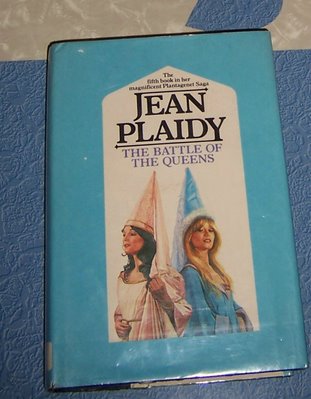
Harlot Queen was written in the third person, and I wish this novel had been also. Catherine is the narrator, and unfortunately, she never really came to life for me. She showed some promise in the early part of the novel, dealing with her youth, and she became almost interesting in the last chapter of the novel, dealing with her second marriage, but in the long stretch in between she was little more than a reporter of other people's doings. This could have worked, I suppose, in some circumstances, but I don't think it did here.
A big problem for me was that although Catherine often professes her love for Buckingham (and in real life, I believe she was quite fond of him, and he of her), we see very little of the two as a couple, and on the few occasions when we do, we see little of their affection in evidence. On the few occasions when the two hold a conversation, it might as well be one between business associates as one between a married couple.
Historically, this novel seems rather eccentric. As Lewis would have it, the main cause of Buckingham's undoing was his hopeless love for the Queen of France, which drives him into an unpopular war and Lewis's prose into the realm of the purple: "'His passion burns him like a fire. He starves for the sight of her. I tell you he cries out her name in his sleep.'"
Add to this a tedious subplot involving Catherine's adulterous sister-in-law and her persecution by the Villiers family, and I admit I was doing some heavy-duty skimming toward the end.
Sadly, I don't know much about the real-life Catherine Manners, but the online Oxford Dictionary of National Biography article about her by Jane Ohlmeyer indicates that she was an interesting woman, one in need of a better novel than this.
On a happier note, this is one of my finds at the book sale on Monday. Check out the nicely contrasting queens--brunette Blanche of Castile in pink, blond Isabella of Angouleme in blue. Not to mention Isabella's bangs (fringe, I think, to some of you) and the big pointy hennins that these thirteenth-century trendsetters have acquired a couple of centuries beforehand.

Monday, November 13, 2006
Cheap Books, and Lots of Them
Warning: this post contains graphic descriptions of large quantities of books at cheap prices.
I volunteered at my county library's annual book sale today and helped unbox books and arrange them on tables. Before you commend me for my civic-mindedness, remember the Big Perk here: first dibs on the books (500,000 under one roof, according to the newspaper) before they go on sale to the public.
I've been to this sale before, but always as a customer and always on the weekend, after the best books had been grabbed by the early birds. By contrast, the scene today was almost pornographic: a former discount department store lined front to back, side to side, with tables of books, many of them very lightly read. Volunteers got to grab paperbacks for 50 cents (including trade paperbacks) and hardbacks for two bucks.
I get the shivers just remembering it.
I didn't find anything truly obscure (no $700 Hale books here, I'm afraid), but I did find a lot of things on my wish list. Among others, I brought home several of Alison Weir's biographies, five Jean Plaidys, a copy of Stella Tillyard's Aristocrats that appeared never to have been read, a copy of Jane Dunn's Elizabeth and Mary that also looked pristine, and a copy of Dorothy Dunnett's King Hereafter that will probably take me years before I get around to reading it but nonetheless is adding a certain respectability to my shelf tonight.
I'm due to go back Friday, but I'm seriously tempted to go back tomorrow. (Did I mention I get to wear a sexy orange T-shirt with VOLUNTEER on it?)
It was rather funny to see what tables people gravitated to. General Fiction (including historical fiction, which, alas, does not have its own table) attracted a great many unpackers, as did the Juvenile, History, and Biography tables. When I left in the early afternoon, the Horror tables hadn't been touched yet (evidently too scary an experience). Strangely, the Romance tables also had yet to be unpacked. Maybe the romance readers showed up in the afternoon, after a morning of luxuriating in their king-size beds.
Some more thoughts:
I personally unpacked six copies of Bill Clinton's autobiography, and there were another dozen or so on the Presidents table the last time I looked. Most of them were pristine ex-library copies, suggesting that whoever decided that each branch needed multiple copies needs to reconsider the next time a President writes a book.
The books were sorted before they were sent over for unpacking. The sorters were evidently of two minds about James Frey's A Million Little Pieces. Of the dozen or so copies I noticed, half were in fiction, the other half in biography. (There wasn't a special table for Rip-Offs.) You can get a copy for 50 cents if you really want one, but this is one I'd save for Bag or Box day (Sunday), where you can get it even cheaper.
Speaking of memoirs, there were a lot of them (presumably genuine) on the Biography table. In fact, it seems that everyone in whom I'm not the least bit interested has written one.
Finally, almost every fifth book I unpacked for the Biography table had something to do with Princess Diana. This made me think either (1) there cannot possibly be anything left to say about Princess Diana or (2) I should get cracking and try to find something to say about Princess Diana.
Friday, November 10, 2006
Something Shady Going On Here
In my never-ending quest for seriously obscure novels about Edward II, a Google search led me to a list of historical novels that appeared to be from the early 20th century. There, I found one called In the Shadow of the Crown by a mysterious person called "Bidden."
An Amazon search revealed no book by Bidden of this name. I knew, of course, that Jean Plaidy's recently reissued historical novel by that name (about Mary Tudor) would turn up. What I wasn't expecting, however, was how many others did:
Shadow of the Crown by Craig Mills
Shadow of the Crown by Susan Bowden
Crown of Shadows (Coldfire Trilogy, Final Volume) by C. S. Friedman
The Crown and the Shadow: The Story of Françoise d'Aubigné, Marquise de Maintenon by Pamela Hill
Shadow of the Crown: A Story of Malta by Ivy May Bolton
Crown of Shadows: An Anti-historical Play by Rodolfo Usigli
(Sadly, there's no description for this last entry, so I'm--appropriately enough--in the dark as to what an anti-historical play is.)
To make matters even shadier, Nicholas Carter also wrote a series called Shadow on the Crown. Not to be outdone, Ulverscroft reprinted a number of historical novels about royal figures. It called this large-print series Shadows of the Crown
So, plenty of shady characters here. But where's Bidden?
Wednesday, November 08, 2006
Wacky Wednesday
We had a lot of fun in our house last night with Romance by You, a site that lets you create a personalized romance novel by inputting answers into various categories (name of heroine, hair color, name of hero, etc.). To get an entire book, you have to pay (personally, I think it's a clever gift idea), but you can generate some sample excerpts online. I especially enjoyed the Medieval Passion book, which allows customers to enter their pet's name as well as those of human characters. Naturally, I entered Boswell's name, and the resulting excerpt, where Boswell showed a great interest in pork rinds and napping, caught his personality uncannily well, I thought. (My daughter put in Tim Gunn and Heidi Klum of "Project Runway" as her hero and heroine, which generated plenty of giggles at home.)
Moving on to a totally unrelated topic, this quiz answered one of those questions that has always puzzled me:
As I'm a subway aficionado, I was quite pleased with these results. The New York subway would have suited me fine also.
Moving on to a totally unrelated topic, this quiz answered one of those questions that has always puzzled me:
You're the London Underground!
Once the benchmark for the industry you work in, now you've
been through a very difficult experience. This has made people less likely
to spend time with you and even afraid of you in some cases. In future, it
might be best to not respond to your own fear with threats of shootings.
Regardless, you remain a staple in your community and even a new symbol of
hope. You may soon be as popular as the Fire Department of New
York.
Take the Trains and Railroads Quiz
at RMI Miniature Railroads.

As I'm a subway aficionado, I was quite pleased with these results. The New York subway would have suited me fine also.
Monday, November 06, 2006
Living in a Barbie World
Today I got a card from eBay thanking me for seven years of doing business with it, which reminded me of my first eBay purchase: Francie, Barbie's Mod cousin, issued in the mid-1960's. This happened around my 40th birthday, an event that in my mother's case inspired her to dye her hair blond and acquire a canary. I'd look pretty silly as a blonde, and a canary wouldn't last long around our four cats, so I ended up going on eBay and acquiring one of my favorite childhood dolls, which led to more acquisitions. Here's Francie on the left with Barbie in the center and Stacey (Barbie's British friend)on the right:

I don't buy many Barbies these days, but before I eased up I had succeeded in replacing many of my childhood dolls, all of which had been stolen from my parents' house years ago. (Barbie thieves, there's a little pink circle in hell meant especially for you.) I bought new Barbies too, including this Barbie and Midge, who feature on my website redressed in other Barbie clothes as two of my characters, Queen Isabella and Eleanor de Clare. (Isabella's the blond Barbie, Eleanor the redheaded Midge.)

So what does this have to do with historical fiction, you might ask? Only this: I credit Barbie with my development as a writer, for long before I could write stories on paper, I was enacting them using Barbie and her friends, who became characters in an ongoing drama that lasted well into my 11th year. As my female dolls greatly outnumbered my male dolls, this occasionally affected my storylines--but just as with historical fiction you have to work within the known facts, with the Barbie world, you have to work within there being only so many Kens to go around.
I don't buy many Barbies these days, but before I eased up I had succeeded in replacing many of my childhood dolls, all of which had been stolen from my parents' house years ago. (Barbie thieves, there's a little pink circle in hell meant especially for you.) I bought new Barbies too, including this Barbie and Midge, who feature on my website redressed in other Barbie clothes as two of my characters, Queen Isabella and Eleanor de Clare. (Isabella's the blond Barbie, Eleanor the redheaded Midge.)
So what does this have to do with historical fiction, you might ask? Only this: I credit Barbie with my development as a writer, for long before I could write stories on paper, I was enacting them using Barbie and her friends, who became characters in an ongoing drama that lasted well into my 11th year. As my female dolls greatly outnumbered my male dolls, this occasionally affected my storylines--but just as with historical fiction you have to work within the known facts, with the Barbie world, you have to work within there being only so many Kens to go around.
Thursday, November 02, 2006
A Very Brief Appreciation of William Styron, and Another Jane Lane
I was sorry to read last night that William Styron had died. I have to admit that I found his Lie Down in Darkness a bit overwrought, and I can't remember if I ever read The Confessions of Nat Turner, but I thought Sophie's Choice was a wonderful novel, with one of the best closing lines I've ever read: "This was not judgment day--only morning. Morning: excellent and fair."
I was fortunate enough to see William Styron speak at my college many years ago. He spoke a little bit about himself, saying that he was "not glib," and he read a very funny chapter from Sophie's Choice, where the callow hero Stingo, going to date a Jewish girl for the first time, is much taken aback to find that her father is a worldly art collector instead of the pious, insular Old World figure Stingo had expected. Indeed, perhaps one of the best achievements of Sophie's Choice is the ease with which the tragedy of Sophie is blended with Stingo's often comic misadventures. (The earliest pages, where Stingo describes his job as a slush-pile reader for a publisher, are among the funniest I've ever read.)
So, a morning toast to the memory of William Styron.
On another note, I finished reading The Young and Lonely King, a 1969 historical novel by Jane Lane, last week. Just a word in case anyone decides to reissue this novel; it may have one of the worst titles I've ever seen. Not only does it lack shelf appeal ("Wow! A novel about a young king! And he's lonely!"), it also is the sort of title that likely will lead anyone seeing it in a reader's hand to conclude that the reader isn't a barrel of fun either. (Passenger on airplane seeing fellow passenger holding The Young and Lonely King: "Well, at least she probably won't talk throughout the whole flight.")
Title aside, I enjoyed this novel about Charles I. Unlike The Severed Crown, which was told by multiple narrators, this is a third-person narration that begins with Charles I's childhood and ends at a high point in his life; the birth of a son to Henrietta Maria. Not action-packed, it's essentially a story of Charles's developing character and centers around his relationships: with his parents, his siblings, his friend Buckingham, and finally with his temperamental wife. Lane has a sardonic, yet compassionate narrative voice and a sharp eye for character; James I is especially memorable. There's even a rather sweet love story here: that between Charles I and Henrietta Maria, who start their marriage as an ill-matched pair and eventually fall deeply in love with each other. The scene where Henrietta Maria goes to comfort her husband after the death of Buckingham and says her first English words to him is especially good--moving, but not mawkish.
All in all, a book that whet my appetite for more Jane Lane.
By the way, you'll notice a new poll in the sidebar. Did Richard III kill the little princes, or did someone else do the deed? Or were they not killed at all? You decide.
Sunday, October 29, 2006
At the Movies
This weekend I saw the Sofia Coppola movie Marie Antoinette. An interesting movie, but all in all a disappointment.
Visually, this is a gorgeous movie--beautiful interior and exterior shots and exquisite costuming. Even the various yippy little dogs that chew the scenery (and the furniture) seem to have been chosen very carefully.
The use of rock music here has been quite controversial, but I didn't find it offputting--it mostly is used as a backdrop for scenes such as raucous parties and therefore seemed quite fitting. Period music, especially opera, is also used to good effect.
There are some very clever scenes here, such as the one where Louis XVI and Marie Antoinette's brother Joseph discuss the facts of life while a caged elephant intrudes his trunk into their presence, and some rather droll ones, like the one where Marie Antoinette and her girlfriends, dressed in expensively simple frocks and having had some tea out of china that could probably have fed a family of six for a year, solemnly read Rousseau.
Most of the movie is devoted to Marie Antoinette's awkward position at Versailles, where she's ridiculed by courtiers for not producing an heir and lectured by her mother via mail for not doing more to get the reluctant Louis in the mood. After, it's no wonder the poor girl just wants to have fun.
Unfortunately, once the marriage finally produces a child (albeit of the wrong sex) and Marie Antoinette abandons the party scene for the simple life at the Petit Trianon, the film seems to lose its focus. Axel Fersen, an old acquaintance from Marie Antoinette's champagne days, arrives on the scene, and the two have a fling. After this, the years fly by. A son is born, a child dies, rude writings start to appear about Marie Antoinette, the queen sends away her friends for their own safety, the mob comes to Versailles, and the film ends. All of this takes place in the film's last twenty minutes or so, which feel like a coda to the earlier part of the movie. With so much time given to the young Marie Antoinette and so little given to the older woman, the film felt disjointed in the extreme, and the affecting last scene, a shot of the ransacked royal bedroom, couldn't make up for the relative emptiness of the last part of the movie.
All in all, a film like one of the pastries that are consumed in it: pleasant in the eating but in the end leaving the viewer wishing she'd had something more substantial.
Subscribe to:
Posts (Atom)