As we know thanks to Sarah, Philippa Gregory is set to write three novels set during the Wars of the Roses: The White Queen, The White Princess, and The Red Queen. Gregory's popularity can't help but aid other historical novelists publishing about the Wars of the Roses in finding readers, so with that in mind, I'm planning some novels of my own. Here are just a few:
Knights in White Satin
A mix-up by a royal clerk leaves Henry VI's troops scrambling for armor at the last minute, and Henry doesn't even notice.
Red Roses for a Blue Lady
After the Battle of Barnet, Somerset tries as best he can to cheer up Margaret of Anjou.
Better Dead Than Red
Before heading out to battle at Tewkesbury, Edward, George, and Richard enter into a suicide pact if things don't turn out as they've planned.
The White Stuff
To his horror, Edward IV discovers that even kings can get dandruff.
The White Bore
Since becoming king, Richard III's had a lot on his mind, and Anne starts to realize that he just hasn't been a lot of fun lately.
Red Letter Day
Nothing makes the exiled Henry Tudor happier than receiving a letter from Mum.
The Red in the Black
Thanks to Henry VII's new treasurer, the crown is solvent once again.
Red, White, and Blue
With nothing to fight about after the Battle of Stoke, Yorkists and Lancastrians alike are down in the dumps.
Sunday, April 29, 2007


Thursday, April 26, 2007
A New Blog Announcement, and Some Therapeutic Ranting
At the suggestion of Deborah Homsher, autor of The Rising Shore--Roanoke, a few of us historical novelists who are self-published have banded together to bring you a new blog, Yesterday Revisited. Check it out! Deborah's already been posting, and the other members will soon be following suit.
Speaking of yesterday, Wednesday for me was sort of a microcosm of what this entire month has shaped up to be so far. I went over to the bookstore closest to us in the expectation that it would have Jean Plaidy's The Queen's Secret, which came out Tuesday, and not only did they not have it, the single copy they had on order wouldn't be in for a week or so. (And these guys wonder why Amazon's stock is going up? I'd have it in my hands today probably if I'd ordered online.) Then on the way home from this fruitless errand, I almost got rear-ended (on purpose) by some cell-phone-using redneck in a pickup truck who decided that I wasn't traveling fast enough for him. (If my sense of humor was in better tune today, I could probably comment on the incongruity of having a redneck chatting away on his Blackberry, but I'm not sure I'm up to it.)
Speaking of yesterday, Wednesday for me was sort of a microcosm of what this entire month has shaped up to be so far. I went over to the bookstore closest to us in the expectation that it would have Jean Plaidy's The Queen's Secret, which came out Tuesday, and not only did they not have it, the single copy they had on order wouldn't be in for a week or so. (And these guys wonder why Amazon's stock is going up? I'd have it in my hands today probably if I'd ordered online.) Then on the way home from this fruitless errand, I almost got rear-ended (on purpose) by some cell-phone-using redneck in a pickup truck who decided that I wasn't traveling fast enough for him. (If my sense of humor was in better tune today, I could probably comment on the incongruity of having a redneck chatting away on his Blackberry, but I'm not sure I'm up to it.)
Sunday, April 22, 2007
A Snippet and the Order of the Garter
At Windsor Castle, Will, now the Earl of Salisbury, preened in his new robe, powdered with little blue garters. "How do you like it, sister?"
"It suits you well," Bess said absently, though she was not even looking at her brother but at her wedding ring. Recalling herself, she added, "Particularly with your new beard."
Will grinned and stroked it.
Bess had a habit these days of talking to Hugh in her head, and she’d had a fine conversation with him about the king’s ridiculous new scheme, which as far as Bess could tell was simply another excuse for men to dress up in matching robes and joust. “Order of the Garter?” she had asked Hugh. “Could he have found a sillier name?”
“Order of the Breech-cloth,” Hugh had suggested. Then, "Now, now, Bess. Remember the motto. Honi soit qui mal y pense."
Bess scowled. Yet she could not deny that if Hugh had been alive and wearing one of the silly garters on his leg, she’d probably not found it ridiculous at all.
See? I really am writing something else, and that was an excerpt to prove it.
Elizabeth de Montacute and her brother William, of course, are speaking of the founding of the Order of the Garter. Enduring as the order has been, its origins are peculiarly obscure.
The long-cherished story, of course, is that while dancing, the lovely Countess of Salisbury (either Joan the Fair Maid of Kent or her mother-in-law, Katherine de Montacute) lost her garter, to her great embarrassment. Edward III gallantly came to her rescue, holding the garter aloft and proclaiming to all and sundry, "Honi soit qui mal y pense." ("Shame on he who thinks ill of it.") Thereafter, the king put the garter and his comment to good use when he decided to form a highly selective chivalric order. Recent historians, those killjoys, have cast doubt on this story and even on whether women wore garters at all in the 1340's (though I find this latter point unconvincing; surely they had to have something with which to hold up their hose). Instead, they've suggested, the motto refers to those who thought ill of Edward III's claim to the French throne, the garter to an item of knightly apparel. Ian Mortimer, whose biography of Edward III, The Perfect King, contains a thorough discussion of the Order of the Garter (and to whom this modest blog post is heavily indebted), also points out that Edward III had worn pearl garters in the 1330's and that Henry of Grosmont, later Duke of Lancaster, had a liking for them as well.
If that's not bad enough, no one's sure exactly when the order originated. Though at one time it was held to have its origins in the Round Table festivities of 1344, the current consensus seems to be that the order was founded sometime in 1348 and that its first assembly took place on April 23, 1349, at Windsor Castle. To confuse things just a little more, in 1348 there also seems to have been a Companionship of the Garter for the Black Prince and his friends. As Ian Mortimer suggests, Edward III may well have borrowed the idea, and even the motto, from his son, or perhaps from the garter-loving Henry of Grosmont.
Ian Mortimer also makes another important point: the April 23, 1349, ceremony took place while the Black Death was still ravaging England, killing perhaps a third of its population. Those who made the journey to the inaugural tournament at Windsor, including the king himself, did so at a time when the instinct of many must have been to huddle on their estates in a state of despair. Thus, as Mortimer points out, the founding of the order should perhaps be seen as a morale-building measure on the part of the king, a proclamation of "business as usual" (p. 264).
What is clear, at least, are the identities of the twenty-six founding members, most of whom had some connection with the king's French campaigns. The precise criteria for admission, however, is (you won't be surprised to hear) obscure. Probably a number of factors were involved. Though several earls or future earls were among the founding members, high rank, though helpful, didn't ensure inclusion: for instance, Richard Fitzalan, the third Earl of Arundel and a very wealthy man, was never a member. Young William de Montacute, the second Earl of Salisbury, whom we met at the opening of this post, was at the beginning of his career and was probably included mainly as a tribute to his late father, the William de Montacute who had orchestrated Edward III's seizure of Roger Mortimer. Other men, quite obscure today, were simply members of the king's household or that of his son the Black Prince
One particularly interesting inclusion was that of the young Roger Mortimer, grandson of the executed Earl of March—another sign of Edward III's admirable refusal to hold men responsible for the misdeeds of their forebears. I like to think that Hugh le Despenser, son of the notorious Hugh le Despenser the younger, might also have been awarded the garter due to his military achievements in France, but if Edward III had had him in mind as a choice in 1348, Hugh's death in February 1349 forestalled any such plans. His heir and nephew Edward, however, was made a Knight of the Garter in 1361.
Wednesday, April 18, 2007
My Friend the Semicolon; And Its Relation the Comma
I love semicolons; I really, really do.
What prompted this revelation is a discussion that I've been having at the day job. (Yes, the glamour of my day job overwhelms even me at times.)
Regardless of the outcome of the work discussion, I'll continue in my admiration and esteem for the semicolon. I don't think that it was ever discussed much in English composition in my grade school; it's a punctuation mark I pretty much began using on my own. I have to guard against overusing it in my writing; because one can have too much of a good thing.
Thinking about the semicolon has made me consider its more common and humble relation, the comma, and its role in the death of Edward II. The legend propagated by Geoffrey Baker, familiar to those who know Marlowe's play, is that Adam of Orleton, the Bishop of Hereford, acting on behalf of Mortimer and Isabella, sent an unpunctuated message to Edward's jailers at Berkeley Castle reading, Edwardum occidere nolite timere bonum est. The message could be interpreted in two ways, depending upon where the reader chose to insert a comma. Placing the comma after "timere" produces: "Do not fear to kill Edward, it is a good thing," while slipping the comma back after "nolite" produces, "Do not kill Edward, it is good to be afraid."
Instructive as this legend is in the "Eats, Shoots, and Leaves" tradition, it's been disproved for some time. Orleton was out of the country at the time and had fallen out of favor with Isabella and Mortimer, and he in any case would hardly have been likely to send a written message so incriminating. Evidently, Baker lifted the comma story from a thirteenth-century incident recounted by Matthew Paris.
Nonetheless, the comma story continues to appear, usually in historical novels but occasionally even in nonfiction. I submit that it's because these are the type of shenanigans one expects of a comma. The noble semicolon, on the other hand, behaves itself; no skulduggery for it.
What prompted this revelation is a discussion that I've been having at the day job. (Yes, the glamour of my day job overwhelms even me at times.)
Regardless of the outcome of the work discussion, I'll continue in my admiration and esteem for the semicolon. I don't think that it was ever discussed much in English composition in my grade school; it's a punctuation mark I pretty much began using on my own. I have to guard against overusing it in my writing; because one can have too much of a good thing.
Thinking about the semicolon has made me consider its more common and humble relation, the comma, and its role in the death of Edward II. The legend propagated by Geoffrey Baker, familiar to those who know Marlowe's play, is that Adam of Orleton, the Bishop of Hereford, acting on behalf of Mortimer and Isabella, sent an unpunctuated message to Edward's jailers at Berkeley Castle reading, Edwardum occidere nolite timere bonum est. The message could be interpreted in two ways, depending upon where the reader chose to insert a comma. Placing the comma after "timere" produces: "Do not fear to kill Edward, it is a good thing," while slipping the comma back after "nolite" produces, "Do not kill Edward, it is good to be afraid."
Instructive as this legend is in the "Eats, Shoots, and Leaves" tradition, it's been disproved for some time. Orleton was out of the country at the time and had fallen out of favor with Isabella and Mortimer, and he in any case would hardly have been likely to send a written message so incriminating. Evidently, Baker lifted the comma story from a thirteenth-century incident recounted by Matthew Paris.
Nonetheless, the comma story continues to appear, usually in historical novels but occasionally even in nonfiction. I submit that it's because these are the type of shenanigans one expects of a comma. The noble semicolon, on the other hand, behaves itself; no skulduggery for it.
Friday, April 13, 2007
Geraldus Redux
I don't know if you overseas readers have noticed this, but we in the United States have been awfully apologetic lately. We've had a radio host apologizing for making racist remarks, we've had the president of the World Bank apologize for getting his special lady friend a handsome raise, and we've had our president apologize to Walter Reid hospital patients. In my corner of the country, we've had a district attorney apologize for pressing rape charges against three innocent men, and our state house has apologized for slavery, following the example of our neighbor Virginia's apology for slavery. We're just a sorry bunch these days, it seems.
Anyway, in light of all these apologies, I was pleased to find an especially timely manuscript in what scholars now know as the Geraldus de Springerus archives. It appears that Geraldus, believing the last appearance of Isabella and a very special surprise guest to have been popular amongst the audience, invited the pair back in an attempt to stage a reconciliation between them. The discovery of this particular transcript is particularly exciting: it suggests that the medieval concept of a "loveday," wherein disputes could be settled amicably out of court, had permeated a much wider range of affairs than previously thought. One can only wonder at what further discoveries lurk in these archives.
Geraldus: Good afternoon, ladies and gentlemen. I'm pleased to introduce again our most gracious lady, the Dowager Queen Isabella, and, er--
Edward: King Edward the Second.
Isabella: You cannot call yourself the king. You are a humble monk now.
Edward: I'm very well aware of that, my dear. You reminded me of that twice backstage.
Isabella: After all, you resigned your crown.
Edward: If you call that farce a resignation.
Geraldus: If I may. Your graces, let's face it. Neither of you is getting any younger.
Edward: I beg to differ. I've never felt healthier. All of this fresh air, and exercise, and—
Isabella: We know. You were born to be a peasant.
Edward: Maybe you ought to get outdoors a bit yourself, my dear. You're looking a little peaked.
Isabella: I am not. (Consults hand mirror)
Geraldus: Your graces. Both of you look wonderful. Absolutely wonderful. But as I said, time is passing. As my people told your people, it's time to put the past behind you and apologize to each other. You've each come prepared, I believe.
Isabella (Pulls out a long sheet of parchment): I certainly have.
Edward: That's what you want to apologize for? All that? Really, my dear, it's not necessary.
Isabella: Don't be silly. These are the things I wanted you to apologize for. It's a checklist.
Edward: Oh.
Isabella: Item one. There's the time you gave Gaveston my wedding jewels.
Edward: Oh, come. They suited him and not you. You were a skinny little girl of twelve and he was—magnificent. (Sighs longingly)
Isabella: Oh, for God's sake, get your mind out of your crotch and attend to item two.
Edward: All right. Item two.
Isabella: You ignored me after the coronation.
Edward: You had all of your irritating French relatives to sit with, didn't you? Besides, you got to talk to them about the jewels.
Isabella: All right. We will skip item two for now. Item three—
Edward: If you're going to claim I abandoned you to the Scots, I'm leaving.
Isabella: No, no. But I did forget Bannockburn, come to think of it.
Edward: I have to apologize to you for Bannockburn?
Isabella: It was a great blow to my pride as a queen.
Edward: Oh, all right. (Aside) God forbid we should injure her precious pride as a queen.
Isabella: I heard that. Back to item three. Hugh le Despenser the elder.
Edward: Hugh the elder? What did he ever do to you?
Isabella: He spawned Hugh the younger, which accounts for items four to one hundred.
Edward (Sadly, to audience): She just never did understand poor dear Hugh.
Isabella: Oh, I understood him all right. Well. Are you ready to apologize?
Edward: I suppose. (Stiffly) My most gracious lady, I humbly beg your pardon.
Isabella: I accept your humble apology.
Geraldus: Now, that's real progress.
Edward: Her turn! Let's talk about my deposition. And your killing my friends, and your trying to kill me, and Mortimer, and your locking me up, and your keeping the children from me, and—
Isabella: You never did have an orderly mind, did you? Well, let's get this over with. My gracious lord, I humbly beg your pardon.
Edward: Oh, come on. If that's humility, I'm the king of France.
Isabella: They wouldn't have you as the king of France.
Edward: Oh, Lord. (To audience) Now we're going to hear about the glories of France. And you wonder why we only had four children together? We're lucky we had that many.
Isabella: Oh, just accept my apology so we can get out of here.
Geraldus: Your grace, you could stand to look a bit more humble, in my opinion.
Isabella: Which no one asked you for, did they?
Edward: Oh, she still has her touch with the common people, doesn't she? (To audience) Tell us. Which queen do you like better? Isabella or Philippa?
Audience (Roaring): Philippa!
Edward: That nice, sweet lady. Always a kind word for everyone.
Isabella: How dare—
Edward: So gracious. So loyal. So merciful. The way she begged for those burghers in Calais—
Audience: Ahhh!
Isabella: Are we going to spend the rest of the afternoon talking about that irritating Hainaulter woman, or are you going to accept my apology?
Edward: Now I think she owes our dear Philippa an apology for that, don't you?
Isabella: Damn it, I came here to apologize to you, not her, and now I'm not going to apologize to either of you! (Stalks away)
Edward: Well, then, I'm going to withdraw my apology. (Shouts in Isabella's direction) She-wolf!
Isabella (From offstage): Sodomite!
Geraldus: Well. Sometimes people just aren't ready to let go of the past, it seems. Folks, join us next week for "Ten Pilgrimage Scams to Avoid."
Audience Member: Wait. She didn't make a sincere apology, and he withdrew his apology. Shouldn't we get our money back?
Geraldus: No. You'll just have to accept my humble apology for that, I guess.
Anyway, in light of all these apologies, I was pleased to find an especially timely manuscript in what scholars now know as the Geraldus de Springerus archives. It appears that Geraldus, believing the last appearance of Isabella and a very special surprise guest to have been popular amongst the audience, invited the pair back in an attempt to stage a reconciliation between them. The discovery of this particular transcript is particularly exciting: it suggests that the medieval concept of a "loveday," wherein disputes could be settled amicably out of court, had permeated a much wider range of affairs than previously thought. One can only wonder at what further discoveries lurk in these archives.
Geraldus: Good afternoon, ladies and gentlemen. I'm pleased to introduce again our most gracious lady, the Dowager Queen Isabella, and, er--
Edward: King Edward the Second.
Isabella: You cannot call yourself the king. You are a humble monk now.
Edward: I'm very well aware of that, my dear. You reminded me of that twice backstage.
Isabella: After all, you resigned your crown.
Edward: If you call that farce a resignation.
Geraldus: If I may. Your graces, let's face it. Neither of you is getting any younger.
Edward: I beg to differ. I've never felt healthier. All of this fresh air, and exercise, and—
Isabella: We know. You were born to be a peasant.
Edward: Maybe you ought to get outdoors a bit yourself, my dear. You're looking a little peaked.
Isabella: I am not. (Consults hand mirror)
Geraldus: Your graces. Both of you look wonderful. Absolutely wonderful. But as I said, time is passing. As my people told your people, it's time to put the past behind you and apologize to each other. You've each come prepared, I believe.
Isabella (Pulls out a long sheet of parchment): I certainly have.
Edward: That's what you want to apologize for? All that? Really, my dear, it's not necessary.
Isabella: Don't be silly. These are the things I wanted you to apologize for. It's a checklist.
Edward: Oh.
Isabella: Item one. There's the time you gave Gaveston my wedding jewels.
Edward: Oh, come. They suited him and not you. You were a skinny little girl of twelve and he was—magnificent. (Sighs longingly)
Isabella: Oh, for God's sake, get your mind out of your crotch and attend to item two.
Edward: All right. Item two.
Isabella: You ignored me after the coronation.
Edward: You had all of your irritating French relatives to sit with, didn't you? Besides, you got to talk to them about the jewels.
Isabella: All right. We will skip item two for now. Item three—
Edward: If you're going to claim I abandoned you to the Scots, I'm leaving.
Isabella: No, no. But I did forget Bannockburn, come to think of it.
Edward: I have to apologize to you for Bannockburn?
Isabella: It was a great blow to my pride as a queen.
Edward: Oh, all right. (Aside) God forbid we should injure her precious pride as a queen.
Isabella: I heard that. Back to item three. Hugh le Despenser the elder.
Edward: Hugh the elder? What did he ever do to you?
Isabella: He spawned Hugh the younger, which accounts for items four to one hundred.
Edward (Sadly, to audience): She just never did understand poor dear Hugh.
Isabella: Oh, I understood him all right. Well. Are you ready to apologize?
Edward: I suppose. (Stiffly) My most gracious lady, I humbly beg your pardon.
Isabella: I accept your humble apology.
Geraldus: Now, that's real progress.
Edward: Her turn! Let's talk about my deposition. And your killing my friends, and your trying to kill me, and Mortimer, and your locking me up, and your keeping the children from me, and—
Isabella: You never did have an orderly mind, did you? Well, let's get this over with. My gracious lord, I humbly beg your pardon.
Edward: Oh, come on. If that's humility, I'm the king of France.
Isabella: They wouldn't have you as the king of France.
Edward: Oh, Lord. (To audience) Now we're going to hear about the glories of France. And you wonder why we only had four children together? We're lucky we had that many.
Isabella: Oh, just accept my apology so we can get out of here.
Geraldus: Your grace, you could stand to look a bit more humble, in my opinion.
Isabella: Which no one asked you for, did they?
Edward: Oh, she still has her touch with the common people, doesn't she? (To audience) Tell us. Which queen do you like better? Isabella or Philippa?
Audience (Roaring): Philippa!
Edward: That nice, sweet lady. Always a kind word for everyone.
Isabella: How dare—
Edward: So gracious. So loyal. So merciful. The way she begged for those burghers in Calais—
Audience: Ahhh!
Isabella: Are we going to spend the rest of the afternoon talking about that irritating Hainaulter woman, or are you going to accept my apology?
Edward: Now I think she owes our dear Philippa an apology for that, don't you?
Isabella: Damn it, I came here to apologize to you, not her, and now I'm not going to apologize to either of you! (Stalks away)
Edward: Well, then, I'm going to withdraw my apology. (Shouts in Isabella's direction) She-wolf!
Isabella (From offstage): Sodomite!
Geraldus: Well. Sometimes people just aren't ready to let go of the past, it seems. Folks, join us next week for "Ten Pilgrimage Scams to Avoid."
Audience Member: Wait. She didn't make a sincere apology, and he withdrew his apology. Shouldn't we get our money back?
Geraldus: No. You'll just have to accept my humble apology for that, I guess.
Thursday, April 12, 2007
Gloucester, Greed, and Granny: Richard III and the Countess of Oxford
Here's a scenario for you: You're a widow in your sixties, in ill health and living in a nunnery. Your husband and eldest son have been executed as traitors. Your second son is busy trying to overthrow the king. Your son's lands have been forfeit to the crown. A vigorous young man of twenty, a duke who happens also to be the king's favorite brother, barges into the room and demands that you give him your own lands. What do you do?
If you're Elizabeth de Vere, Countess of Oxford, the king is Edward IV, and the young man is Richard, Duke of Gloucester, later to be Richard III, you release your lands.
Born in about 1410 as Elizabeth Howard, the countess was married to John de Vere, the twelfth Earl of Oxford. The family was loyal to Henry VI, and after Edward IV became king, the pro-Lancastrian activities of the earl and his eldest son resulted in both being executed in 1462. Elizabeth herself was kept under house arrest for a short time before being released by the king. Edward IV then made overtures to Elizabeth's second son, twenty-year-old John, allowing him to assume the title of earl and to officiate as chamberlain at Elizabeth Woodville's coronation in 1465. John was also allowed to marry Margaret, a younger sister of Richard Neville, Earl of Warwick, known as Warwick the Kingmaker. This was perhaps a mistake, for when Warwick rebelled against Edward IV, his brother-in-law John de Vere, whose sympathies probably always had been with his dead father and brother and their cause, joined him. During Henry VI's brief resumption of the throne, the Earl of Oxford had the satisfaction of presiding over the trial and execution of John Tiptoft, Earl of Worcester, the man who had sentenced Oxford's father and brother to death.
Oxford was at the Battle of Barnet in 1471, where the Earl of Warwick died and the Yorkists scored a victory. John de Vere fled to Scotland and continued to plot against the Yorkist government. By 1473, he had turned to piracy. His luck ran out in 1474, when he was captured and imprisoned. (He finally escaped in 1484, hooked up with Henry Tudor, and was one of the commanders of the forces that defeated Richard III at Bosworth Field.) Edward IV granted the bulk of the Earl of Oxford's estates to Richard, Duke of Gloucester, in 1471. (Though Richard's loyalty to his brother the king during Edward IV's lifetime is often praised, the fact that it was also amply rewarded with real estate tends to be overlooked.)
In the meantime, in December 1472, the thirteenth Earl of Oxford's mother was living in a nunnery at Stratford le Bow. Whether she had been confined there because of her son's activities or whether she had gone there to be nursed, as aging or infirm ladies often did, is unclear. Though her son's estates had been forfeited by his treason, the Countess of Oxford still had a number of lands of her own inheritance. She had taken the precaution of enfeoffing them by use, so that she could devise them by will. In such an arrangement, the feoffees held the lands not for their own benefit and were required to convey them according to Elizabeth's wishes.
Richard, however, had considered his collection of Oxford estates and decided to complete it. Around Christmastime of 1472, he, along with what must have been a suitably intimidating number of retainers, barged into the countess's lodgings in the nunnery and told Elizabeth that he had been given custody of her and her lands. The old lady was made to hand over the keys to her coffers, which were searched by Gloucester's men.
Richard's men, having presumably met with little resistance by the nuns, then hauled the countess off to Stepney, where Gloucester's household was staying in the house of Thomas Vaughan. (Gloucester repaid Vaughan's hospitality ill in 1483 by executing him at the time he seized the throne.) There, Elizabeth was confined to a chamber until she agreed to sign over her lands to Gloucester. The countess sent for one of her feoffees, Henry Robson, and said that if she did not sign over her lands to Gloucester, he would send her to Middleham, a journey the old lady doubted she could survive considering her old age and "the grett colde which thenne was of Frost and snowe." She added that she was grateful to have the lands which now would save her life. Meanwhile, the countess's confessor, a Master Baxter, was being bullied by Gloucester's crony Thomas Howard, who called him a false priest and a hypocrite, evidently because Baxter, another feoffee of the countess's, appeared to be having misgivings about the proposed transaction.
The countess was next moved to Walbroke, where she was again placed among Richard's men. (In dragging the countess from hostile setting to hostile setting, young Gloucester demonstrated a sophisticated knowledge of interrogation techniques that is quite at odds with Paul Murray Kendall's picture of him during this period of his life as an idealistic youth longing only to escape from court to the moors of northern England.) There, she apparently signed the release. Robson added his seal out of "ferying the same duke." The releases were made in January 1473.
The countess, who had already told Robson that "she was sory that she for savying her lyff had disheritt her heires," returned eventually to the nunnery, where by early 1474 she had died. Before her death, she asked a former servant who came to visit to remind her son John that she had released her estates out of fear.
Not all of the feoffees, however, had cooperated in sealing the release. William Paston was one of the holdouts, despite Gloucester's attempt to bring pressure on him via Robson, who had been commanded to tell Paston that a refusal would "cost hym that he loved best." Despite this heavy-handed message, Gloucester resorted in 1473 to gentler tactics: a suit in chancery against the feoffees. Not surprisingly, the chancellor ordered Paston to make the release.
In the chancery suit, heard in 1474 after the countess's death, Richard claimed that Elizabeth had agreed to a release of the lands in return for an annuity of 500 marks (a mark was 2/3 of a pound), the payment of 240 pounds in debts, the promotion of a son studying at Cambridge to benefices, and "dyvers benefaites, costes, and charges" in aid of the countess, her children, and her grandchildren. Michael Hicks, who has looked at the whole sordid transaction thoroughly, found nothing to indicate that Richard actually carried out any of these promises. Even if he did keep his part of the bargain, he must have known at the time he entered into it that the elderly countess was unlikely to require the annuity for very long. For Richard's part, he received 28 manors, which James Ross in a study of the Oxford estates reported brought in an income of about 600 pounds per annum.
Richard's supporters have often praised his piety, but it was Elizabeth who was the hapless source of some of the duke's most notable gift-giving. Richard gave the countess's manor of Foulmere to Queen's College, Cambridge, in 1477, with the proviso that prayers be said for a number of people, living and dead. Gloucester was considerate enough to include Elizabeth's and her husband's in the list of those souls who were to receive prayers. Richard also gave some of the countess's manors to St. George's Chapel at Windsor and to his collegiate foundation at Middleham.
Following Richard III's death at Bosworth, Elizabeth's son Oxford, an ally of Henry VII, succeeded in having Parliament annul the releases made by the countess. In 1495, worried that his title to his mother's lands might someday be impugned, Oxford procured depositions from six witnesses, including William Paston and Henry Robson, who gave their recollection of the events of 1472-73. As Hicks and others have been careful to point out, the witnesses had been picked by Oxford and thus were not likely to give testimony hostile to his cause. Nonetheless, the depositions, which have been reproduced by Hicks, do not read as having been rehearsed; the deponents often state that they have forgotten names, places, times, or particulars, as would be expected after over twenty years had passed. And the undeniable fact that Richard was forced to resort to chancery proceedings to get some feoffees to release the lands (from which they did not personally benefit) is a strong indication that these men believed that their countess had been fleeced.
In his pro-Ricardian book Royal Blood, Bertram Fields, a lawyer, attempts to clear his client Richard of the charges of coercion. He argues that Edward IV had already turned over the countess's wealth to Richard, so that in effect Gloucester was doing the countess a service by compensating her for her loss. In fact, the lands Edward IV had turned over to his brother were those of the countess's son, not the countess herself. Richard would have hardly had to go to the trouble of getting the countess and her feoffees to release her lands if they had nothing to release in the first place. Fields also heaps scorn on the countess's "fear of the cold weather at Middleham," stating that the place was "hardly the equivalent of being put on the rack" and that it was "preferable to a return to the convent." This argument disregards the fact that the journey from London to Middleham in the north would have been a formidable one for an elderly, ailing lady in the winter. It also ignores the fact that the lady's threatened stay at Middleham would have been that of a prisoner, far away from her friends and retainers in the south.
Fields, however, does deserve credit for mentioning the episode of the countess and her lands, which is more than some other pro-Richard writers have done. Paul Murray Kendall, whose biography of Richard III is virtually holy writ for the most devoted followers of the king, omits the incident altogether. Perhaps because of this, Ricardian novelists, who tend to rely on Kendall's romanticized view of Richard instead of the more critical works of Charles Ross or A. J. Pollard, have overwhelmingly followed suit in ignoring this unseemly land-grabbing by their hero. The sole exception I've come across is Reay Tannahill in The Seventh Son, who also is one of the few novelists who depicts the dispossession of Richard's mother-in-law, Anne Beauchamp, from her estates by her sons-in-law Richard and George.
If you'd like to read more about this episode—where in relieving a widow of the burden of her lands, Richard seems to have taken some cues from his wife's fourteenth-century ancestor, Hugh le Despenser the younger—the most detailed account is in Michael Hicks' collection of his articles, Richard III and His Rivals: Magnates and Their Motives in the Wars of the Roses. A. J. Pollard also comments on it in his Richard III and the Princes in the Tower, as do Charles Ross in his biography of Richard III and Desmond Seward in The Wars of the Roses. James Ross discusses the estates themselves in "Richard, Duke of Gloucester, and the De Vere Estates, 1462-85," an essay published in the 2005 volume of The Ricardian, the scholarly journal of the Richard III Society. Reading these sources, it's difficult not to conclude that when Richard wanted something, he wasn't about to let anything—be it a defenseless old lady or his two young nephews—stand in his way.
If you're Elizabeth de Vere, Countess of Oxford, the king is Edward IV, and the young man is Richard, Duke of Gloucester, later to be Richard III, you release your lands.
Born in about 1410 as Elizabeth Howard, the countess was married to John de Vere, the twelfth Earl of Oxford. The family was loyal to Henry VI, and after Edward IV became king, the pro-Lancastrian activities of the earl and his eldest son resulted in both being executed in 1462. Elizabeth herself was kept under house arrest for a short time before being released by the king. Edward IV then made overtures to Elizabeth's second son, twenty-year-old John, allowing him to assume the title of earl and to officiate as chamberlain at Elizabeth Woodville's coronation in 1465. John was also allowed to marry Margaret, a younger sister of Richard Neville, Earl of Warwick, known as Warwick the Kingmaker. This was perhaps a mistake, for when Warwick rebelled against Edward IV, his brother-in-law John de Vere, whose sympathies probably always had been with his dead father and brother and their cause, joined him. During Henry VI's brief resumption of the throne, the Earl of Oxford had the satisfaction of presiding over the trial and execution of John Tiptoft, Earl of Worcester, the man who had sentenced Oxford's father and brother to death.
Oxford was at the Battle of Barnet in 1471, where the Earl of Warwick died and the Yorkists scored a victory. John de Vere fled to Scotland and continued to plot against the Yorkist government. By 1473, he had turned to piracy. His luck ran out in 1474, when he was captured and imprisoned. (He finally escaped in 1484, hooked up with Henry Tudor, and was one of the commanders of the forces that defeated Richard III at Bosworth Field.) Edward IV granted the bulk of the Earl of Oxford's estates to Richard, Duke of Gloucester, in 1471. (Though Richard's loyalty to his brother the king during Edward IV's lifetime is often praised, the fact that it was also amply rewarded with real estate tends to be overlooked.)
In the meantime, in December 1472, the thirteenth Earl of Oxford's mother was living in a nunnery at Stratford le Bow. Whether she had been confined there because of her son's activities or whether she had gone there to be nursed, as aging or infirm ladies often did, is unclear. Though her son's estates had been forfeited by his treason, the Countess of Oxford still had a number of lands of her own inheritance. She had taken the precaution of enfeoffing them by use, so that she could devise them by will. In such an arrangement, the feoffees held the lands not for their own benefit and were required to convey them according to Elizabeth's wishes.
Richard, however, had considered his collection of Oxford estates and decided to complete it. Around Christmastime of 1472, he, along with what must have been a suitably intimidating number of retainers, barged into the countess's lodgings in the nunnery and told Elizabeth that he had been given custody of her and her lands. The old lady was made to hand over the keys to her coffers, which were searched by Gloucester's men.
Richard's men, having presumably met with little resistance by the nuns, then hauled the countess off to Stepney, where Gloucester's household was staying in the house of Thomas Vaughan. (Gloucester repaid Vaughan's hospitality ill in 1483 by executing him at the time he seized the throne.) There, Elizabeth was confined to a chamber until she agreed to sign over her lands to Gloucester. The countess sent for one of her feoffees, Henry Robson, and said that if she did not sign over her lands to Gloucester, he would send her to Middleham, a journey the old lady doubted she could survive considering her old age and "the grett colde which thenne was of Frost and snowe." She added that she was grateful to have the lands which now would save her life. Meanwhile, the countess's confessor, a Master Baxter, was being bullied by Gloucester's crony Thomas Howard, who called him a false priest and a hypocrite, evidently because Baxter, another feoffee of the countess's, appeared to be having misgivings about the proposed transaction.
The countess was next moved to Walbroke, where she was again placed among Richard's men. (In dragging the countess from hostile setting to hostile setting, young Gloucester demonstrated a sophisticated knowledge of interrogation techniques that is quite at odds with Paul Murray Kendall's picture of him during this period of his life as an idealistic youth longing only to escape from court to the moors of northern England.) There, she apparently signed the release. Robson added his seal out of "ferying the same duke." The releases were made in January 1473.
The countess, who had already told Robson that "she was sory that she for savying her lyff had disheritt her heires," returned eventually to the nunnery, where by early 1474 she had died. Before her death, she asked a former servant who came to visit to remind her son John that she had released her estates out of fear.
Not all of the feoffees, however, had cooperated in sealing the release. William Paston was one of the holdouts, despite Gloucester's attempt to bring pressure on him via Robson, who had been commanded to tell Paston that a refusal would "cost hym that he loved best." Despite this heavy-handed message, Gloucester resorted in 1473 to gentler tactics: a suit in chancery against the feoffees. Not surprisingly, the chancellor ordered Paston to make the release.
In the chancery suit, heard in 1474 after the countess's death, Richard claimed that Elizabeth had agreed to a release of the lands in return for an annuity of 500 marks (a mark was 2/3 of a pound), the payment of 240 pounds in debts, the promotion of a son studying at Cambridge to benefices, and "dyvers benefaites, costes, and charges" in aid of the countess, her children, and her grandchildren. Michael Hicks, who has looked at the whole sordid transaction thoroughly, found nothing to indicate that Richard actually carried out any of these promises. Even if he did keep his part of the bargain, he must have known at the time he entered into it that the elderly countess was unlikely to require the annuity for very long. For Richard's part, he received 28 manors, which James Ross in a study of the Oxford estates reported brought in an income of about 600 pounds per annum.
Richard's supporters have often praised his piety, but it was Elizabeth who was the hapless source of some of the duke's most notable gift-giving. Richard gave the countess's manor of Foulmere to Queen's College, Cambridge, in 1477, with the proviso that prayers be said for a number of people, living and dead. Gloucester was considerate enough to include Elizabeth's and her husband's in the list of those souls who were to receive prayers. Richard also gave some of the countess's manors to St. George's Chapel at Windsor and to his collegiate foundation at Middleham.
Following Richard III's death at Bosworth, Elizabeth's son Oxford, an ally of Henry VII, succeeded in having Parliament annul the releases made by the countess. In 1495, worried that his title to his mother's lands might someday be impugned, Oxford procured depositions from six witnesses, including William Paston and Henry Robson, who gave their recollection of the events of 1472-73. As Hicks and others have been careful to point out, the witnesses had been picked by Oxford and thus were not likely to give testimony hostile to his cause. Nonetheless, the depositions, which have been reproduced by Hicks, do not read as having been rehearsed; the deponents often state that they have forgotten names, places, times, or particulars, as would be expected after over twenty years had passed. And the undeniable fact that Richard was forced to resort to chancery proceedings to get some feoffees to release the lands (from which they did not personally benefit) is a strong indication that these men believed that their countess had been fleeced.
In his pro-Ricardian book Royal Blood, Bertram Fields, a lawyer, attempts to clear his client Richard of the charges of coercion. He argues that Edward IV had already turned over the countess's wealth to Richard, so that in effect Gloucester was doing the countess a service by compensating her for her loss. In fact, the lands Edward IV had turned over to his brother were those of the countess's son, not the countess herself. Richard would have hardly had to go to the trouble of getting the countess and her feoffees to release her lands if they had nothing to release in the first place. Fields also heaps scorn on the countess's "fear of the cold weather at Middleham," stating that the place was "hardly the equivalent of being put on the rack" and that it was "preferable to a return to the convent." This argument disregards the fact that the journey from London to Middleham in the north would have been a formidable one for an elderly, ailing lady in the winter. It also ignores the fact that the lady's threatened stay at Middleham would have been that of a prisoner, far away from her friends and retainers in the south.
Fields, however, does deserve credit for mentioning the episode of the countess and her lands, which is more than some other pro-Richard writers have done. Paul Murray Kendall, whose biography of Richard III is virtually holy writ for the most devoted followers of the king, omits the incident altogether. Perhaps because of this, Ricardian novelists, who tend to rely on Kendall's romanticized view of Richard instead of the more critical works of Charles Ross or A. J. Pollard, have overwhelmingly followed suit in ignoring this unseemly land-grabbing by their hero. The sole exception I've come across is Reay Tannahill in The Seventh Son, who also is one of the few novelists who depicts the dispossession of Richard's mother-in-law, Anne Beauchamp, from her estates by her sons-in-law Richard and George.
If you'd like to read more about this episode—where in relieving a widow of the burden of her lands, Richard seems to have taken some cues from his wife's fourteenth-century ancestor, Hugh le Despenser the younger—the most detailed account is in Michael Hicks' collection of his articles, Richard III and His Rivals: Magnates and Their Motives in the Wars of the Roses. A. J. Pollard also comments on it in his Richard III and the Princes in the Tower, as do Charles Ross in his biography of Richard III and Desmond Seward in The Wars of the Roses. James Ross discusses the estates themselves in "Richard, Duke of Gloucester, and the De Vere Estates, 1462-85," an essay published in the 2005 volume of The Ricardian, the scholarly journal of the Richard III Society. Reading these sources, it's difficult not to conclude that when Richard wanted something, he wasn't about to let anything—be it a defenseless old lady or his two young nephews—stand in his way.
Sunday, April 08, 2007
My Thinking Blogger Awards

I'm in a quandary, because Alianore and Tanzanite have kindly nominated me for a Thinking Blogger Award (which started here), and I'm having a very difficult time narrowing my own awards to five choices.
I'll first have to return the favor and nominate Alianore all over again, because I love reading about all things related to Edward II. It was an utter delight to me when I first discovered her blog, and it's still the first I check every morning. (By the way, most of the conversations I have about Edward II run thusly: Me: "It's about Edward II." Them: "Isn't he the one who married Wallis Simpson?")
Reading the Past, Sarah Johnson's blog is a treasure trove of information for readers of historical fiction, with industry news, reviews, and posts that are just plain fun.
Tea at Trianon by Elena Maria Vidal is full of fascinating posts, especially those about Marie Antoinette and her contemporaries, and I've learned a great deal from reading it. Truly a thinking woman's blog.
Nan Hawthorne's The Blue Lady Tavern is one of the more clever writer's blogs I've come across. I always enjoy stopping by for a mug.
The fifth? It's too hard to pick just one, but I'm going to go for Carla's, because I first ran across it on a day I was feeling really lousy in a number of ways, and it cheered me up immensely.
There's many other worthy blogs on the sidebar here. Don't know what I did without them all, really!
Wednesday, April 04, 2007
Mr. Darcy's Diary: A Review
Given my choice of Jane Austen heroes, I lean more toward Captain Wentworth or Mr. Knightley than Fitzwilliam Darcy. But all three have their good points, so I was content to while away a couple of hours in the company of Mr. Darcy, courtesy of Amanda Grange in Mr. Darcy's Diary, published in the UK in 2005 and recently released in the United States by Sourcebooks.
Mr. Darcy's Diary begins at about the time that Darcy rescues his young sister from the fortune-hunting Wickham and ends not long after his marriage to Elizabeth Bennet. (If you consider these spoilers, you clearly aren't the target audience for this novel. Go read Pride and Prejudice and the rest of the Austen novels immediately. Then read them all over again. Then you're ready to try the retellings.)
As is proper, Grange doesn't attempt the impossible task of competing with the Divine Jane, but tells Darcy's story in her own style, with charm and a gentle wit. While her characters are true to Austen's creations, a couple of surprises lurk, only adding to the reader's pleasure.
The well-known scenes between Elizabeth and Darcy are here, of course, and I found that the novel dragged a little at such points, with the retelling suffering in comparison to the original. Fortunately, there are plenty of entirely fresh scenes, such as the ones where Mrs. Bennet decides to serve Darcy sauces and where Darcy tries to make small talk with a dimwitted heiress, in which Grange's own humor and warmth shine, making this an amusing and diverting read for Austen fans.
Mr. Darcy's Diary begins at about the time that Darcy rescues his young sister from the fortune-hunting Wickham and ends not long after his marriage to Elizabeth Bennet. (If you consider these spoilers, you clearly aren't the target audience for this novel. Go read Pride and Prejudice and the rest of the Austen novels immediately. Then read them all over again. Then you're ready to try the retellings.)
As is proper, Grange doesn't attempt the impossible task of competing with the Divine Jane, but tells Darcy's story in her own style, with charm and a gentle wit. While her characters are true to Austen's creations, a couple of surprises lurk, only adding to the reader's pleasure.
The well-known scenes between Elizabeth and Darcy are here, of course, and I found that the novel dragged a little at such points, with the retelling suffering in comparison to the original. Fortunately, there are plenty of entirely fresh scenes, such as the ones where Mrs. Bennet decides to serve Darcy sauces and where Darcy tries to make small talk with a dimwitted heiress, in which Grange's own humor and warmth shine, making this an amusing and diverting read for Austen fans.
Sunday, April 01, 2007
The Mystery of the Princes in the Tower Solved
Poring over the Latin manuscript of Sir Thomas More's History of King Richard III, in which More squarely lays the blame for the murder of the Princes in the Tower on Richard III, cryptographers have made a shocking discovery as to the Princes' real cause of death.
Five-year-old Thomas More himself was the killer.
The tragedy occurred when young Thomas, visiting the Tower with his father, who had legal business there, encountered the young Princes shooting on the grounds. When Edward offered to let Thomas have a turn, Thomas's arrow went awry, landing in Edward's back. When Richard ran over to help his brother, Thomas, thinking Edward IV's eldest son was "playing dead," took a second shot—fatally wounding Richard as well.
"He was a great humanist, but a lousy archer," concludes a professor at Cambridge University, who preferred to speak anonymously until the whole amazing story is published in a scholarly journal.
But why, knowing his own guilt, did Thomas smear Richard III's name? Explains the professor, "He was so shocked at what he had accidentally done, he was in denial, as we might say now. For years, he probably did really convince himself that Richard III did it. Then something—we don't know what—caused him to recover his lost memories, and he remembered what had really happened. But he'd written such a compelling tale, he really didn't want to change it, so instead he added this coded confession, knowing that someday the code would be broken. Took us long enough, didn't it? But we did get a damn good Shakespeare play out of it, you'll have to admit."
Though the team of cryptographers have remained close-lipped as to the precise details of the code, it appears that More took the Latin version of the manuscript with him to the Tower during his imprisonment there by Henry VIII. There, he made revisions that to the untrained eye appear to be superficial changes but that in reality formed a sophisticated code in which he confessed his guilt. "He had a lot of time on his hands," explained the professor.
Why was young More never punished for his actions? "He ran off, and when the guards came across the bodies and realized what had happened, they were afraid they'd be accused of negligence and lose their heads, so they buried the bodies quickly and started rumors that the boys had been smothered by the king's agents. It was a really successful cover-up for such rank amateurs. Goes to show that there's hope for us all, doesn't it?"
Asked to comment, an official with the Richard III Society said, "On the one hand, it's complete vindication; on the other, it pretty much puts us out of business, doesn't it? I think I'll go down to the local and have a pint or two."
Five-year-old Thomas More himself was the killer.
The tragedy occurred when young Thomas, visiting the Tower with his father, who had legal business there, encountered the young Princes shooting on the grounds. When Edward offered to let Thomas have a turn, Thomas's arrow went awry, landing in Edward's back. When Richard ran over to help his brother, Thomas, thinking Edward IV's eldest son was "playing dead," took a second shot—fatally wounding Richard as well.
"He was a great humanist, but a lousy archer," concludes a professor at Cambridge University, who preferred to speak anonymously until the whole amazing story is published in a scholarly journal.
But why, knowing his own guilt, did Thomas smear Richard III's name? Explains the professor, "He was so shocked at what he had accidentally done, he was in denial, as we might say now. For years, he probably did really convince himself that Richard III did it. Then something—we don't know what—caused him to recover his lost memories, and he remembered what had really happened. But he'd written such a compelling tale, he really didn't want to change it, so instead he added this coded confession, knowing that someday the code would be broken. Took us long enough, didn't it? But we did get a damn good Shakespeare play out of it, you'll have to admit."
Though the team of cryptographers have remained close-lipped as to the precise details of the code, it appears that More took the Latin version of the manuscript with him to the Tower during his imprisonment there by Henry VIII. There, he made revisions that to the untrained eye appear to be superficial changes but that in reality formed a sophisticated code in which he confessed his guilt. "He had a lot of time on his hands," explained the professor.
Why was young More never punished for his actions? "He ran off, and when the guards came across the bodies and realized what had happened, they were afraid they'd be accused of negligence and lose their heads, so they buried the bodies quickly and started rumors that the boys had been smothered by the king's agents. It was a really successful cover-up for such rank amateurs. Goes to show that there's hope for us all, doesn't it?"
Asked to comment, an official with the Richard III Society said, "On the one hand, it's complete vindication; on the other, it pretty much puts us out of business, doesn't it? I think I'll go down to the local and have a pint or two."
Friday, March 30, 2007
A Beaut of a Cover
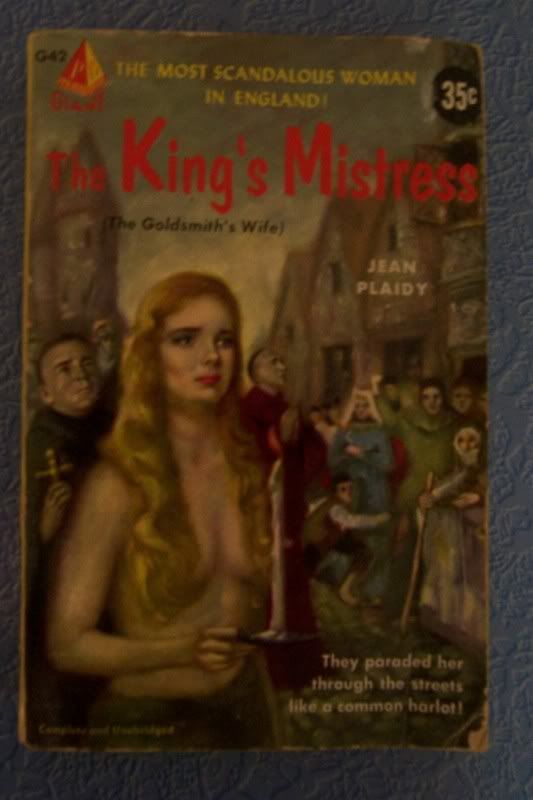
Now, if Jean Plaidy's name wasn't on the cover of this 1952 paperback (a Pyramid Books Giant), would you have guessed who wrote it? Be honest, now.
The front cover isn't the only fun thing about this historical novel (about Jane Shore, of course). The back cover teases us with "From the king's boudoir to a prison for prostitutes!" Inside, there's a short biographical note stating that Jean Plaidy became "a best-selling novelist after successive steps as a secretary, rare gem salesman and housewife."
The back contains even more treats. For those who didn't have the nerve to walk into a bookstore, the publisher offered order coupons to order titles such as Cage of Lust ("The stark human drama of a love-starved young girl's passion and torment for her own father"), Teen-Age Vice! ("Inspired by J. Edgar Hoover of the F.B.I., this book rips the veil off the vice racket, juke joint binges, cabins for the night, prisons that pervert, the smut peddlers, lonely heart clubs"), and The Moonstone by Wilkie Collins. No, I don't see the connection between Wilkie Collins and Teen-Age Vice! either, except that in 1952 they each cost 35 cents, plus 5 cents for postage and handling.
Things get even cheaper on the previous page, with 25-cent offerings such as French Doctor ("His lady patients tempted him!"), Palm Beach Apartment ("Strange love story of a young girl and her benefactor!"), Farm Girl ("In the city--they would have called her a juvenile delinquent!), The Divided Path ("The story of a homosexual!"), and Blonde Mistress ("Daring expose of illicit love!). Somehow, Guy de Maupassant squeezed his way onto this page with The House of Madame Tellier and Other Stories, which merited the feeble blurb of "An exciting collection by the famous French storyteller!" Coming between Chain Gang ("Our most brutal prison system!) and Swamp Girl ("She had to choose between white man and black!"), poor Maupassant didn't stand a chance.
Thursday, March 29, 2007
Hilda Lewis's Wife to Charles II
Not that long ago, I posted on Wife to Great Buckingham, a novel by Hilda Lewis. (You can look here to find some brief comments on her book about Queen Isabella, Harlot Queen--look for "Portraits of the She-Wolf" in the February/March 2007 issue.) I enjoyed Harlot Queen, but found Wife to Great Buckingham to be tedious, so I wasn't sure what to expect when I read Wife to Charles II, a 1965 novel that, like Harlot Queen, has recently been reissued by Torc, an imprint of Tempus Publishing.
Wife to Charles II, naturally, is about Catherine of Braganza, and is told in the third person. Most of the events are seen from Catherine's point of view, though occasionally the narrator will report on events at which Catherine wasn't present, such as the goings-on at Parliament, or listen in on a conversation between other characters.
This novel could have stood some judicious cutting, I think, particularly in the first half. Charles II takes a new mistress. Catherine is bothered by it and talks to her ladies about it. Charles II takes another mistress. Catherine is bothered by it and talks to her ladies again. Catherine frets about her inability to carry a child to term and wishes that Charles paid her more attention. After a while, this becomes wearying to the reader as well as to Catherine. Only with the arrival of the Popish Plot does the novel pick up its pace.
Lewis's prose style, though not what I'd call purple, takes a bit of getting used to. It's quite dramatic, and sadly, it's also devoid of humor, which is a liability as far as historically witty characters such as Charles II and Nell Gwyn are concerned. On the plus side, Lewis makes us share Catherine's and Charles's frustration and anger as the so-called Popish Plot holds the nation in thrall. There are some good set pieces here, such as the trial of Stafford and Charles II's deathbed.
The most fully realized character in this novel is Charles II himself, who for all of his faults comes across as being genuinely likable. Catherine herself is done well, her flashes of spirit saving her from the thankless role as put-upon wife. The rest of the characterizations are less than successful, and in some cases border on caricature. The only thing vivid in Lewis's presentation of Titus Oates is his physical description. Other villains in the novel, like Shaftesbury, don't even get that much. With the exception of Nell, who's curiously colorless, Charles II's mistresses are depicted as so hateful and greedy that it's impossible to understand what Charles sees in them, other than good looks. We certainly don't see any of the charm they must have exuded. Monmouth is another character who should have been interesting, but wasn't. We never get a hint of his motivations for acting as he does.
So should you read this novel? I liked it more than I disliked it, but I'd have to say on the whole that it's a mixed bag. I enjoyed the depiction of the relationship between Charles II and Catherine, and I give Lewis points for not glamorizing Charles II's adultery at the expense of making Catherine into a shrew or a cipher. Lewis also depicts the terrors of the Popish Plot period with verve and outrage, and her Charles II is well rounded and sympathetic. I just wish Lewis had found a way to champion Catherine's cause without sacrificing the complexity of her other characters.
Wife to Charles II, naturally, is about Catherine of Braganza, and is told in the third person. Most of the events are seen from Catherine's point of view, though occasionally the narrator will report on events at which Catherine wasn't present, such as the goings-on at Parliament, or listen in on a conversation between other characters.
This novel could have stood some judicious cutting, I think, particularly in the first half. Charles II takes a new mistress. Catherine is bothered by it and talks to her ladies about it. Charles II takes another mistress. Catherine is bothered by it and talks to her ladies again. Catherine frets about her inability to carry a child to term and wishes that Charles paid her more attention. After a while, this becomes wearying to the reader as well as to Catherine. Only with the arrival of the Popish Plot does the novel pick up its pace.
Lewis's prose style, though not what I'd call purple, takes a bit of getting used to. It's quite dramatic, and sadly, it's also devoid of humor, which is a liability as far as historically witty characters such as Charles II and Nell Gwyn are concerned. On the plus side, Lewis makes us share Catherine's and Charles's frustration and anger as the so-called Popish Plot holds the nation in thrall. There are some good set pieces here, such as the trial of Stafford and Charles II's deathbed.
The most fully realized character in this novel is Charles II himself, who for all of his faults comes across as being genuinely likable. Catherine herself is done well, her flashes of spirit saving her from the thankless role as put-upon wife. The rest of the characterizations are less than successful, and in some cases border on caricature. The only thing vivid in Lewis's presentation of Titus Oates is his physical description. Other villains in the novel, like Shaftesbury, don't even get that much. With the exception of Nell, who's curiously colorless, Charles II's mistresses are depicted as so hateful and greedy that it's impossible to understand what Charles sees in them, other than good looks. We certainly don't see any of the charm they must have exuded. Monmouth is another character who should have been interesting, but wasn't. We never get a hint of his motivations for acting as he does.
So should you read this novel? I liked it more than I disliked it, but I'd have to say on the whole that it's a mixed bag. I enjoyed the depiction of the relationship between Charles II and Catherine, and I give Lewis points for not glamorizing Charles II's adultery at the expense of making Catherine into a shrew or a cipher. Lewis also depicts the terrors of the Popish Plot period with verve and outrage, and her Charles II is well rounded and sympathetic. I just wish Lewis had found a way to champion Catherine's cause without sacrificing the complexity of her other characters.
Wednesday, March 28, 2007
I Can See Clearly Now (And Ramble Too)
I picked up my new glasses today, in a new prescription, and I'm seeing all sorts of little letters I couldn't see before. So bring on the wee footnotes, folks--I'm ready.
The optometrist's office is conveniently located in the same shopping plaza as my favorite book-and-mortar bookstore, so naturally I went there afterward, eager to try out my new specs. One of the few authors of contemporary literary fiction I like has a new book out, so my intent was to buy it and start reading my new acquisition at lunch.
That's not, however, how things worked out. First, I looked at the price (over $25) and the size of the book (about 200 pages), and got an instant case of tight pursestrings. I don't mind paying a little extra for a small-press book, a university-press book, or a self-published book, realizing as I do the economics involved, but this novel was published by a big New York house. Worse yet, the historical novel that was on the table beside it was being sold for the same price, but was about 300 pages longer--and was published by the same big New York house. Having just spent Major Bucks on my glasses, I couldn't quite bring myself to spring for the historical novel either, but if I had, at least I would have thought that I was getting my money's worth in word count if nothing else.
I might have overcome my Inner Cheapskate had I flipped through the book and been engrossed by what I saw, but my flip-through was rather discouraging. It seemed that the author was rehashing a plot he had used in an earlier novel--a clever rehash, but still a rehash.
Most important, however, I found that I just couldn't muster up the interest to buy a novel set in contemporary times. It would have probably been different had the author been Anne Tyler or P. D. James, mind you, but this novel just didn't exert enough force to pull me out of the past. So I let it sit there. I may well change my mind if the money tree blooms or when the book is discounted or comes out in paperback, but for now, I'm sticking with historical fiction--which is what I ended up buying today.
So why has contemporary fiction lost so much of its appeal to me? Part of it, I think, is that so many of the characters in contemporary fiction, particularly women's fiction, strike me as self-absorbed or trivial. Another reason, I suppose, is some form of escapism. Even though historical fiction might deal with some very grim events, they're events that are safely in the past. Given a choice between reading a novel about the Hundred Years' War and the current wars in the Middle East, I'd take the former any day. I suppose the elements of time and distance also play a part--I'd rather read a novel about adultery in Charles II's court than a novel about adultery in modern-day Hollywood or the Hamptons.
Yet another reason, though, is that a lot of contemporary novels, especially literary novels, have become too much alike and feature an increasing narrow range of themes and characters. There's the novel about a middle-aged person trying to find meaning in his or her life. There's the novel about someone trying to cope with some sort of disaster. There's the novel about someone abusing drugs or alcohol. There's the novel about bored and alienated people in the suburbs, the novel about bored and alienated people in the city. There's the novel about someone who's been sexually or physically abused as a child. There's the novel about mothers and daughters, the novel about fathers and sons. There's the novel about someone discovering his or her sexuality. There are plenty of exceptions, of course, but for the most part, when I read a review of a contemporary literary novel or flip through one at the bookstore, the words that come to mind are most often, "Been there. Done that." Perhaps, then, I'm finding in historical fiction what I'm not finding in contemporary fiction--the whole gamut of human behavior and emotions.
Thoughts?
ADDENDUM: Daphne (and Carla in her comment) have some nice thoughts here about historical fiction.
The optometrist's office is conveniently located in the same shopping plaza as my favorite book-and-mortar bookstore, so naturally I went there afterward, eager to try out my new specs. One of the few authors of contemporary literary fiction I like has a new book out, so my intent was to buy it and start reading my new acquisition at lunch.
That's not, however, how things worked out. First, I looked at the price (over $25) and the size of the book (about 200 pages), and got an instant case of tight pursestrings. I don't mind paying a little extra for a small-press book, a university-press book, or a self-published book, realizing as I do the economics involved, but this novel was published by a big New York house. Worse yet, the historical novel that was on the table beside it was being sold for the same price, but was about 300 pages longer--and was published by the same big New York house. Having just spent Major Bucks on my glasses, I couldn't quite bring myself to spring for the historical novel either, but if I had, at least I would have thought that I was getting my money's worth in word count if nothing else.
I might have overcome my Inner Cheapskate had I flipped through the book and been engrossed by what I saw, but my flip-through was rather discouraging. It seemed that the author was rehashing a plot he had used in an earlier novel--a clever rehash, but still a rehash.
Most important, however, I found that I just couldn't muster up the interest to buy a novel set in contemporary times. It would have probably been different had the author been Anne Tyler or P. D. James, mind you, but this novel just didn't exert enough force to pull me out of the past. So I let it sit there. I may well change my mind if the money tree blooms or when the book is discounted or comes out in paperback, but for now, I'm sticking with historical fiction--which is what I ended up buying today.
So why has contemporary fiction lost so much of its appeal to me? Part of it, I think, is that so many of the characters in contemporary fiction, particularly women's fiction, strike me as self-absorbed or trivial. Another reason, I suppose, is some form of escapism. Even though historical fiction might deal with some very grim events, they're events that are safely in the past. Given a choice between reading a novel about the Hundred Years' War and the current wars in the Middle East, I'd take the former any day. I suppose the elements of time and distance also play a part--I'd rather read a novel about adultery in Charles II's court than a novel about adultery in modern-day Hollywood or the Hamptons.
Yet another reason, though, is that a lot of contemporary novels, especially literary novels, have become too much alike and feature an increasing narrow range of themes and characters. There's the novel about a middle-aged person trying to find meaning in his or her life. There's the novel about someone trying to cope with some sort of disaster. There's the novel about someone abusing drugs or alcohol. There's the novel about bored and alienated people in the suburbs, the novel about bored and alienated people in the city. There's the novel about someone who's been sexually or physically abused as a child. There's the novel about mothers and daughters, the novel about fathers and sons. There's the novel about someone discovering his or her sexuality. There are plenty of exceptions, of course, but for the most part, when I read a review of a contemporary literary novel or flip through one at the bookstore, the words that come to mind are most often, "Been there. Done that." Perhaps, then, I'm finding in historical fiction what I'm not finding in contemporary fiction--the whole gamut of human behavior and emotions.
Thoughts?
ADDENDUM: Daphne (and Carla in her comment) have some nice thoughts here about historical fiction.
Thursday, March 22, 2007
The Last Justiciar
Yup, it's been a few days, but here's a meaty post to make up for it.
Long before his son and grandson became embroiled in the disputes between king and nobility during the reign of Edward II, Hugh le Despenser (d. 1265) was a key figure in the turmoil surrounding the reign of Henry III. An adherent of Simon de Montfort who remained faithful to his cause until the very last, he was the last justiciar of England, and his death on the field of Evesham was the beginning of the ill fortune that would plague subsequent generations of Despenser lords, all of whom would die violently, young, or both.
Hugh le Despenser was born in about 1223. His father (d. 1238), who needless to say was also named Hugh, was associated with Earl Ranulf of Chester; J. R. Maddicott indicates that he was probably the earl's hereditary steward. After his father's death, Hugh received several gifts from Henry III: two casks of wine in 1245, timber in 1247 and 1249, and free warren on a Rutland estate in 1253. In 1255 he was appointed constable of Horston, a royal castle, and in 1257 he accompanied Henry III's brother Richard of Cornwall to Aachen, where Richard was crowned King of the Romans.
It was Hugh's friendship with Simon de Montfort, however, that would shape Hugh's future. Hugh and Simon are first mentioned together in 1256, when Edmund de Lacy and William Longespee were arranging the marriage of their children, a task so complicated that each father appointed a team of negotiators to act on his behalf. Hugh le Despenser and Simon de Montfort were two of the three men on Lacy's side. By 1259, the relationship between Hugh and Simon had evidently become a close one, though Simon, born around 1208, was about fifteen years older than Hugh. Simon made his will in 1259, naming his wife and eldest son as the primary executors and Hugh le Despenser, Peter de Montfort, and Arnold du Bois as associate executors. (All the men named, save for Arnold du Bois, whose health kept him out of battle, died with Simon at Evesham.)
In the meantime, growing baronial discontent with Henry III forced the king to accept an arrangement under which the state of the realm would be "put in order, corrected, and reformed" by a group of twenty-four men, twelve from the king's side and twelve from the barons' side. The twenty-four men met at the Oxford Parliament in 1258, with Simon de Montfort and Hugh le Despenser among the twelve men chosen to represent the barons. The result, the Provisions of Oxford, would be the bane of Henry III's existence for the next seven years.
At Oxford, Hugh le Despenser and eleven other men were chosen to negotiate with the king's council "on behalf of the whole community of the land in the common business" during future Parliaments. What was to be of more significance to Despenser, however, was the revival of the office of justiciar, effectively abolished in 1234 by Henry III when he dismissed its current holder, Stephen of Seagrave. The justiciar's office was essentially a hybrid of administrative and judicial tasks; C. H. Knowles describes it as being established "to superintend the royal administrative machine, to remedy failures of justice, and to meet the need for a vice-regal authority in England when the monarch was visiting his continental lands." Hugh Bigod, whose brother Roger was the Earl of Norfolk and the marshal of England, was chosen to fill the revived office of justiciar.
By October 1260, Simon de Montfort had become a central figure in government. One of the actions of that month's Parliament was to replace the three chief royal officials: the chancellor, the treasurer, and the justiciar. Hugh le Despenser was elected as justiciar, against Henry III's wishes. Part of his duties was to try cases, which he did that ensuing fall and winter.
Despenser had also married at some time during this period. His wife was Aline Bassett, daughter of Philip Bassett. Bassett, like Hugh, had been involved in the reform movement, but he would eventually side with the king. Aline was unquestionably a good deal younger than her new husband; though her exact age is unknown. Postmortem inquisitions at the time of her father's death in 1271 give various ages for her, putting her birth year in 1241, 1245, 1247, or 1249. The last date, at least, is rather unlikely, since on March 1, 1261, Aline gave birth to a son, Hugh, who would be known in Edward II's reign as Hugh le Despenser the elder. Despenser seems to have had three daughters as well, but genealogists have puzzled over whether all three were the children of Aline. Possibly Despenser had been married and widowed before his marriage to Aline; in 1238, the king had permitted him to marry as his friends thought best, and it would have been strange had he waited twenty years or so to make his first marriage.
Henry III had chafed over the appointments of Despenser and the new chancellor and treasurer, complaining that they were "wholly ignorant of their offices." This was only one in a string of grievances by Henry against his council, which he claimed was treating him as its ward. By May 1261 Henry had regained control of his kingdom. He replaced a number of officials, among them Despenser, who lost both the justiciarship and his position of keeper of the Tower. To add insult to injury, Hugh was replaced as justiciar by his own father-in-law, Philip Basset.
The next several years would see several shifts of power. In July 1263, with Montfort once again in control, Despenser was reappointed as justiciar. Montfort stood on very shaky ground, however, and by early 1264, the King of France, having agreed to arbitrate between the royalists and the Monfortians, issued an award, known as the Mise of Amiens, that was entirely in favor of Henry III.
Montfort and his followers reacted furiously. Montfort's sons led attacks against Henry's supporters in the Welsh march—Montfort was laid up with a broken leg—and in March 1264, Despenser himself led a mob of Londoners in attacking Richard of Cornwall's manor at Isleworth. It was the Jewish community in London, however, that suffered the most in the spring of 1264. In April, a group of Londoners, led by Despenser's own brother-in-law, attacked the London Jews, killing hundreds and looting their property. The loot went into the hands of Montfort's supporters. Even in medieval England, where anti-Semitism was the norm, the massacre of the Jews shocked some chroniclers. The mayor of London and Despenser, however, did manage to save some of the Jews from the mob, and Despenser, who was in charge of the Tower, gave the survivors shelter there. He and the mayor may have been motivated more by a desire to restore order than humanitarian feelings, but at least they came out of the episode with more credit than some of Montfort's other supporters.
By this time the nation was in a state of civil war, which culminated in May 1264 at the Battle of Lewes. Montfort and his men were outnumbered, but were the victors. Among the many royalist prisoners taken was Philip Basset, who refused to surrender while he could still stand and suffered over twenty wounds before being captured by his son-in-law Hugh le Despenser. With Henry III now a figurehead, it was probably at Despenser's instigation that several weeks later, the king made granted venison and conies to the imprisoned Basset.
Though Henry III and his eldest son, the Lord Edward, were in Montfort's custody, Montfort's position was still not a secure one. Eleanor of Provence, Henry III's energetic queen, had gone abroad and raised a mercenary force. With the threat of invasion looming, Despenser was given responsibility for defending the Norfolk, Suffolk, and Essex coastline. At the same time, Montfort negotiated with a papal legate and with Louis IX of France; Despenser was one of those entrusted with the negotiations. They proved fruitless, but the queen's invasion never materialized, apparently because Eleanor of Provence ran out of funds to pay her mercenaries. For a short period, it seemed that the Monfortian government was secure.
Then things unraveled quickly. The young, wealthy Earl of Gloucester, Gilbert de Clare, defected from Montfort's camp in March 1265 after personal and policy differences arose. Despenser and others tried to resolve the dispute, but to no avail, and the situation only worsened in May when the Lord Edward escaped from custody via a ruse of trying out a fast horse. The future Edward I, allied now with Gilbert de Clare and the lords of the Welsh march, was a force to be feared.
Edward's troops and Montfort's troops, Despenser among them, spent the summer of 1265 moving around the Welsh marches. Montfort, planning to meet his son Simon's troops, arrived in Evesham on August 4, 1265, where Montfort's barber, who had climbed the abbey tower, spotted Edward's troops approaching from all sides.
Realizing that he was trapped, Montfort urged his closest allies to flee while there was time. To Despenser he is reported to have said, "My lord Hugh, consider your great age and look to saving yourself; consider the fact that your counsel can still be of great value to the whole country, for you will leave behind hardly anyone of such great value and worth." Hugh replied, "My lord, my lord, let it be. Today we shall all drink from one cup, just as we have in the past."
What followed was the slaughter of Montfort's troops. Hugh fell before Montfort did, dying by the thrust of a dagger, apparently at the hand of Roger Mortimer. Montfort, his horse having been killed beneath him, fought mightily but was at last killed by the king's men, who proceeded to dismember his corpse. A manuscript illustration shows Montfort's headless body, arms and feet severed, lying by Despenser's body.
Hugh's body and that of Montfort's eldest son, Henry, along with Montfort's torso, were taken to Evesham Abbey for burial by the foot of the steps leading to the high altar. Funeral services were held for all three men by the monks of Evesham.
Back in London, Hugh's widow, Aline, had been left in charge of the Tower and the royal prisoners lodged there. (Eerily, in 1326, the soon-to-be-widowed Eleanor de Clare, the wife of Aline's grandson, Hugh le Despenser the younger, would be left by her husband in a similar position at the Tower.) Hearing of the disaster at Evesham, Aline freed the prisoners, surrendered the Tower to the king's men, and sought out the protection of her father, who had evidently been freed from prison at some earlier point. Her decision to flee, while it lacked the grandeur of the defiance of Montfort's widow, who held Dover Castle against the king until October, was a sensible one for a young woman, probably barely out of her teens, with a four-year-old son and other small children in her care. Philip Basset used his influence with the restored Henry III to see that his daughter was well taken care of: thanks to his efforts, the Despenser lands passed to Aline's son intact. By 1271, Aline had remarried, probably at her father's arrangement. Her second husband, Roger Bigod, was the son of the justiciar who had preceded Despenser and the heir to the earldom of Norfolk. Aline thus became a countess, but documents suggests that she retained an affection for her first husband; she styled herself, "Aline le Despenser, Countess of Norfolk." She died in 1281.
At Evesham Abbey, the body of Simon de Montfort, which was reputed to work miracles, attracted pilgrims. Hugh's body was also credited with healing the blind and the crippled. Evesham Abbey was largely destroyed during the dissolution, though its Bell Tower, erected centuries after Evesham, and some fragments remain. Stained-glass windows in nearby St. Lawrence's church depict Montfort, Despenser, and others taking their last communion before battle.
Despenser's death at Evesham would have repercussions in the fourteenth century; according to the Vita Edwardi Secundi, his grandson, Hugh le Despenser the younger, was determined to avenge his grandfather's death upon Roger Mortimer, grandson of the man who had slain the justiciar at Evesham. The killing at Evesham was also a precursor of the ill fate that was to dog the family for the next century. Despenser's son and grandson were executed in 1326; another descendant, Thomas le Despenser, was beheaded by a Bristol mob in 1400. Hugh le Despenser (d. 1349) and his nephew Edward both enjoyed successful military careers, but died in their prime, Hugh possibly of the plague. Richard le Despenser, heir to Thomas, died in his teens. One hopes that Hugh the justiciar, knowing as he stood in Evesham Abbey that August 4, 1265, would be his last day on earth, was spared a glimpse into the future.
(Historical fiction note: Hugh the justiciar is a minor character in Sharon Penman's Falls the Shadow. He also has a few lines in Feona J. Hamilton's Belaset's Daughter, a novel about an English Jewish family set in 1264.)
Long before his son and grandson became embroiled in the disputes between king and nobility during the reign of Edward II, Hugh le Despenser (d. 1265) was a key figure in the turmoil surrounding the reign of Henry III. An adherent of Simon de Montfort who remained faithful to his cause until the very last, he was the last justiciar of England, and his death on the field of Evesham was the beginning of the ill fortune that would plague subsequent generations of Despenser lords, all of whom would die violently, young, or both.
Hugh le Despenser was born in about 1223. His father (d. 1238), who needless to say was also named Hugh, was associated with Earl Ranulf of Chester; J. R. Maddicott indicates that he was probably the earl's hereditary steward. After his father's death, Hugh received several gifts from Henry III: two casks of wine in 1245, timber in 1247 and 1249, and free warren on a Rutland estate in 1253. In 1255 he was appointed constable of Horston, a royal castle, and in 1257 he accompanied Henry III's brother Richard of Cornwall to Aachen, where Richard was crowned King of the Romans.
It was Hugh's friendship with Simon de Montfort, however, that would shape Hugh's future. Hugh and Simon are first mentioned together in 1256, when Edmund de Lacy and William Longespee were arranging the marriage of their children, a task so complicated that each father appointed a team of negotiators to act on his behalf. Hugh le Despenser and Simon de Montfort were two of the three men on Lacy's side. By 1259, the relationship between Hugh and Simon had evidently become a close one, though Simon, born around 1208, was about fifteen years older than Hugh. Simon made his will in 1259, naming his wife and eldest son as the primary executors and Hugh le Despenser, Peter de Montfort, and Arnold du Bois as associate executors. (All the men named, save for Arnold du Bois, whose health kept him out of battle, died with Simon at Evesham.)
In the meantime, growing baronial discontent with Henry III forced the king to accept an arrangement under which the state of the realm would be "put in order, corrected, and reformed" by a group of twenty-four men, twelve from the king's side and twelve from the barons' side. The twenty-four men met at the Oxford Parliament in 1258, with Simon de Montfort and Hugh le Despenser among the twelve men chosen to represent the barons. The result, the Provisions of Oxford, would be the bane of Henry III's existence for the next seven years.
At Oxford, Hugh le Despenser and eleven other men were chosen to negotiate with the king's council "on behalf of the whole community of the land in the common business" during future Parliaments. What was to be of more significance to Despenser, however, was the revival of the office of justiciar, effectively abolished in 1234 by Henry III when he dismissed its current holder, Stephen of Seagrave. The justiciar's office was essentially a hybrid of administrative and judicial tasks; C. H. Knowles describes it as being established "to superintend the royal administrative machine, to remedy failures of justice, and to meet the need for a vice-regal authority in England when the monarch was visiting his continental lands." Hugh Bigod, whose brother Roger was the Earl of Norfolk and the marshal of England, was chosen to fill the revived office of justiciar.
By October 1260, Simon de Montfort had become a central figure in government. One of the actions of that month's Parliament was to replace the three chief royal officials: the chancellor, the treasurer, and the justiciar. Hugh le Despenser was elected as justiciar, against Henry III's wishes. Part of his duties was to try cases, which he did that ensuing fall and winter.
Despenser had also married at some time during this period. His wife was Aline Bassett, daughter of Philip Bassett. Bassett, like Hugh, had been involved in the reform movement, but he would eventually side with the king. Aline was unquestionably a good deal younger than her new husband; though her exact age is unknown. Postmortem inquisitions at the time of her father's death in 1271 give various ages for her, putting her birth year in 1241, 1245, 1247, or 1249. The last date, at least, is rather unlikely, since on March 1, 1261, Aline gave birth to a son, Hugh, who would be known in Edward II's reign as Hugh le Despenser the elder. Despenser seems to have had three daughters as well, but genealogists have puzzled over whether all three were the children of Aline. Possibly Despenser had been married and widowed before his marriage to Aline; in 1238, the king had permitted him to marry as his friends thought best, and it would have been strange had he waited twenty years or so to make his first marriage.
Henry III had chafed over the appointments of Despenser and the new chancellor and treasurer, complaining that they were "wholly ignorant of their offices." This was only one in a string of grievances by Henry against his council, which he claimed was treating him as its ward. By May 1261 Henry had regained control of his kingdom. He replaced a number of officials, among them Despenser, who lost both the justiciarship and his position of keeper of the Tower. To add insult to injury, Hugh was replaced as justiciar by his own father-in-law, Philip Basset.
The next several years would see several shifts of power. In July 1263, with Montfort once again in control, Despenser was reappointed as justiciar. Montfort stood on very shaky ground, however, and by early 1264, the King of France, having agreed to arbitrate between the royalists and the Monfortians, issued an award, known as the Mise of Amiens, that was entirely in favor of Henry III.
Montfort and his followers reacted furiously. Montfort's sons led attacks against Henry's supporters in the Welsh march—Montfort was laid up with a broken leg—and in March 1264, Despenser himself led a mob of Londoners in attacking Richard of Cornwall's manor at Isleworth. It was the Jewish community in London, however, that suffered the most in the spring of 1264. In April, a group of Londoners, led by Despenser's own brother-in-law, attacked the London Jews, killing hundreds and looting their property. The loot went into the hands of Montfort's supporters. Even in medieval England, where anti-Semitism was the norm, the massacre of the Jews shocked some chroniclers. The mayor of London and Despenser, however, did manage to save some of the Jews from the mob, and Despenser, who was in charge of the Tower, gave the survivors shelter there. He and the mayor may have been motivated more by a desire to restore order than humanitarian feelings, but at least they came out of the episode with more credit than some of Montfort's other supporters.
By this time the nation was in a state of civil war, which culminated in May 1264 at the Battle of Lewes. Montfort and his men were outnumbered, but were the victors. Among the many royalist prisoners taken was Philip Basset, who refused to surrender while he could still stand and suffered over twenty wounds before being captured by his son-in-law Hugh le Despenser. With Henry III now a figurehead, it was probably at Despenser's instigation that several weeks later, the king made granted venison and conies to the imprisoned Basset.
Though Henry III and his eldest son, the Lord Edward, were in Montfort's custody, Montfort's position was still not a secure one. Eleanor of Provence, Henry III's energetic queen, had gone abroad and raised a mercenary force. With the threat of invasion looming, Despenser was given responsibility for defending the Norfolk, Suffolk, and Essex coastline. At the same time, Montfort negotiated with a papal legate and with Louis IX of France; Despenser was one of those entrusted with the negotiations. They proved fruitless, but the queen's invasion never materialized, apparently because Eleanor of Provence ran out of funds to pay her mercenaries. For a short period, it seemed that the Monfortian government was secure.
Then things unraveled quickly. The young, wealthy Earl of Gloucester, Gilbert de Clare, defected from Montfort's camp in March 1265 after personal and policy differences arose. Despenser and others tried to resolve the dispute, but to no avail, and the situation only worsened in May when the Lord Edward escaped from custody via a ruse of trying out a fast horse. The future Edward I, allied now with Gilbert de Clare and the lords of the Welsh march, was a force to be feared.
Edward's troops and Montfort's troops, Despenser among them, spent the summer of 1265 moving around the Welsh marches. Montfort, planning to meet his son Simon's troops, arrived in Evesham on August 4, 1265, where Montfort's barber, who had climbed the abbey tower, spotted Edward's troops approaching from all sides.
Realizing that he was trapped, Montfort urged his closest allies to flee while there was time. To Despenser he is reported to have said, "My lord Hugh, consider your great age and look to saving yourself; consider the fact that your counsel can still be of great value to the whole country, for you will leave behind hardly anyone of such great value and worth." Hugh replied, "My lord, my lord, let it be. Today we shall all drink from one cup, just as we have in the past."
What followed was the slaughter of Montfort's troops. Hugh fell before Montfort did, dying by the thrust of a dagger, apparently at the hand of Roger Mortimer. Montfort, his horse having been killed beneath him, fought mightily but was at last killed by the king's men, who proceeded to dismember his corpse. A manuscript illustration shows Montfort's headless body, arms and feet severed, lying by Despenser's body.
Hugh's body and that of Montfort's eldest son, Henry, along with Montfort's torso, were taken to Evesham Abbey for burial by the foot of the steps leading to the high altar. Funeral services were held for all three men by the monks of Evesham.
Back in London, Hugh's widow, Aline, had been left in charge of the Tower and the royal prisoners lodged there. (Eerily, in 1326, the soon-to-be-widowed Eleanor de Clare, the wife of Aline's grandson, Hugh le Despenser the younger, would be left by her husband in a similar position at the Tower.) Hearing of the disaster at Evesham, Aline freed the prisoners, surrendered the Tower to the king's men, and sought out the protection of her father, who had evidently been freed from prison at some earlier point. Her decision to flee, while it lacked the grandeur of the defiance of Montfort's widow, who held Dover Castle against the king until October, was a sensible one for a young woman, probably barely out of her teens, with a four-year-old son and other small children in her care. Philip Basset used his influence with the restored Henry III to see that his daughter was well taken care of: thanks to his efforts, the Despenser lands passed to Aline's son intact. By 1271, Aline had remarried, probably at her father's arrangement. Her second husband, Roger Bigod, was the son of the justiciar who had preceded Despenser and the heir to the earldom of Norfolk. Aline thus became a countess, but documents suggests that she retained an affection for her first husband; she styled herself, "Aline le Despenser, Countess of Norfolk." She died in 1281.
At Evesham Abbey, the body of Simon de Montfort, which was reputed to work miracles, attracted pilgrims. Hugh's body was also credited with healing the blind and the crippled. Evesham Abbey was largely destroyed during the dissolution, though its Bell Tower, erected centuries after Evesham, and some fragments remain. Stained-glass windows in nearby St. Lawrence's church depict Montfort, Despenser, and others taking their last communion before battle.
Despenser's death at Evesham would have repercussions in the fourteenth century; according to the Vita Edwardi Secundi, his grandson, Hugh le Despenser the younger, was determined to avenge his grandfather's death upon Roger Mortimer, grandson of the man who had slain the justiciar at Evesham. The killing at Evesham was also a precursor of the ill fate that was to dog the family for the next century. Despenser's son and grandson were executed in 1326; another descendant, Thomas le Despenser, was beheaded by a Bristol mob in 1400. Hugh le Despenser (d. 1349) and his nephew Edward both enjoyed successful military careers, but died in their prime, Hugh possibly of the plague. Richard le Despenser, heir to Thomas, died in his teens. One hopes that Hugh the justiciar, knowing as he stood in Evesham Abbey that August 4, 1265, would be his last day on earth, was spared a glimpse into the future.
(Historical fiction note: Hugh the justiciar is a minor character in Sharon Penman's Falls the Shadow. He also has a few lines in Feona J. Hamilton's Belaset's Daughter, a novel about an English Jewish family set in 1264.)
Saturday, March 17, 2007
Wolf! Wolf!
Last night, I was browsing on Amazon and noticed that Virginia Henley's forthcoming romance, Notorious, had its description posted. Notorious, set in 14th-century England during the reign of Edward II, features a heroine named Brianna, whose love interest is Wolf Mortimer, son of the Roger Mortimer who's been mentioned on this blog.
Don't start Googling, folks. Roger Mortimer did some dreadful things, but naming a son "Wolf" was not one of them.
So what's with these names? Are romance readers really put off by heroines and heroes with monikers that suit the times they live in? It doesn't seem so; I trolled through Romance Reviews Today and found that most of the historical romances there had protagonists with reasonably authentic-sounding names (though there were some groaners too).
For what it's worth for you marketing people out there, un-period names scare me off. Here are a couple of romances set in the nineteenth century that I wouldn't read on a dare, even though they sound strangely familiar somehow:
Moving on, in the always popular Prove Me Wrong department, my rambles brought me today to a romance novel with a plot that revolves around a nearsighted, glasses-wearing heroine, Love Is Blind by Lynsay Sands. There's hope for us spec-wearers yet.
Don't start Googling, folks. Roger Mortimer did some dreadful things, but naming a son "Wolf" was not one of them.
So what's with these names? Are romance readers really put off by heroines and heroes with monikers that suit the times they live in? It doesn't seem so; I trolled through Romance Reviews Today and found that most of the historical romances there had protagonists with reasonably authentic-sounding names (though there were some groaners too).
For what it's worth for you marketing people out there, un-period names scare me off. Here are a couple of romances set in the nineteenth century that I wouldn't read on a dare, even though they sound strangely familiar somehow:
Fine-eyed, spirited Raven Bennett disliked proud, arrogant Brayden Darcy, her new neighbor, from the start . . .
Try as he might, brooding, mysterious Blake Rochester could not take his mind off his daughter's governess, Jade Eyre . . .
Moving on, in the always popular Prove Me Wrong department, my rambles brought me today to a romance novel with a plot that revolves around a nearsighted, glasses-wearing heroine, Love Is Blind by Lynsay Sands. There's hope for us spec-wearers yet.
Tuesday, March 13, 2007
A Few Short Reviews
I've been busy readin' books and writin' reviews for the next issue of the Historical Novels Review, so I haven't had much chance to blog lately. So here are my reviews that have already appeared in the February 2007 issue. They are from areas outside of my usual preoccupations, as you can tell. Perhaps some of you might want to pick them up.
Mozart’s Sister
Nancy Moser, Bethany House, 2006, $12.99, pb, 336pp, 0764201239
Nannerl Mozart, a talented musician in her own right, is used to being overshadowed by her brother, Wolfgang. Nonetheless, she struggles with envy and frustration—particularly when as a young girl, she realizes that her gender, rather than her musical gifts, will shape her destiny.
As the story of a woman cheated of the opportunities enjoyed by her brother, Mozart’s Sister, narrated by Nannerl, could have made for depressing reading. Instead, it’s a moving story of a woman who must cope with often difficult circumstances while doing her best to build a satisfactory life for herself.
The novel did feel a bit unbalanced to me—there’s a great deal about Nannerl’s childhood and years as a single woman, while comparatively little of the book is given over to her married life. This made an epiphany Nannerl experiences feel somewhat forced and abrupt; it was also odd, in light of the dramatic opening scene, not to see more of the emotional impact Mozart’s death had on his sister. These minor flaws, however, are countered by the novel’s strengths: its characterizations, especially that of Leopold Mozart, who turns out to be more complex and sympathetic than the stage parent he appears to be at the beginning; Moser’s deftness at portraying the shifting relationships within the Mozart family; and Nannerl herself, a good but realistically flawed woman born in the wrong time.
Mama Fela’s Girls
Ana Baca, University of New Mexico Press, 2006, $24.95, hb, 318pp, 0826340237
Mama Fela’s Girls is a multi-generational tale in a fresh setting: Santa Lucίa, a small town in New Mexico in 1934. The generations of the Romero family are Mama Fela, an aging seamstress; her daughter, Cita, who longs to pursue a career as an artist; her daughter-in-law, Graciela, a schoolteacher who is also her family’s main breadwinner; and her granddaughter, little Cipriana, who loves Shirley Temple movies. Their good points and flaws are all well rendered, and their dialogue is convincing and natural, even down to the Spanish phrases these Mexican-American characters use on occasion.
The male characters are somewhat less successful than the female ones; with a couple of exceptions, most seemed unsatisfactory in some way, being either absent, undependable, or worse. Given the novel’s title, I wasn’t surprised that the female characters overshadowed the men, but I would have liked to have seen some more strong male characters alongside the many strong female ones. That, however, is purely a personal preference.
Though the settings are completely different and the plots and writing styles have little in common, Mama Fela’s Girls kept reminding me of A Tree Grows in Brooklyn, another novel about a family dominated by strong females. Perhaps that’s because what is at the heart of both novels is family life, with its attendant frustrations and joys. Indeed, much of the action of Mama Fela’s Girls involves characters who must choose between staying in the family circle and leaving it. In this debut novel, Baca excels at presenting both the conflict and the tightly knit family that gives rise to it.
The Green Glass Sea
Ellen Klages, Viking, 2006, $16.99/C$22.50, hb, 324pp, 0670061344
In 1943, Dewey Kerrigan, nearly eleven, finds herself on a train headed toward New Mexico to join her father, a mathematician who has been working on what Dewey can describe only as “secret stuff.” Dewey is bound for a place called “the Hill”—Los Alamos—that is populated by scientists and mathematicians and their families, all working on a mysterious project known only as the gadget, one that everyone hopes will end the war.
The Green Glass Sea (the reason for the title becomes clear only in the last chapter) has many strands running through it. In part, it’s about the budding friendship between two outsiders: Dewey, who reads The Boy Mechanic and who is building her own radio, and her belligerent, artistic classmate Suze Gordon. In part, it’s a tale of how Dewey copes with loss. In part, it’s a celebration of intelligence and nonconformity. In part, it’s a story of the World War II home front (the scene where Dewey hears of the death of FDR is particularly moving). And in part, it’s a story of how the adults of Los Alamos put in long hours and make sacrifices to create their gadget—with a success that exhilarates some and terrifies others.
Crisply and compassionately written, with period details (like Mrs. Gordon’s chain-smoking) that light up the story without overwhelming it, this is an excellent novel that adults might want to borrow from their children. I’m looking forward to the sequel.
Flushed: How the Plumber Saved Civilization
W. Hodding Carter, Atria Books, 2006, $24.00/C$33.00, hb, 241pp, 0743474082
If you have some disposable income, Flushed, Hodding Carter’s tribute to the “humble plumber,” is a fun, yet informative, way to spend it. And you won’t feel that your money has gone to waste—except, of course, that it has, in a sense.
Flushed begins and ends with Carter’s tribute to the Toto Washlet S300, an electronic toilet seat that serves as a bidet. In between, we learn about the marvels of Roman plumbing, take a tour of the London sewer, skip across the pond to a waste treatment facility at Boston Harbor, read Rabelais on wiping methods (the finicky may want to choose another book for mealtime reading), study the evolution of the modern toilet, meet some plumbers, and go to a plumbing trade show. You have to like a book where Robert the Bruce, Thomas Jefferson, William Butler Yeats, and Tobias Smollett all get a mention, along with a Japanese children’s book called Everyone Poops.
Convenient to hold while seated, entertaining, and easy to digest, Flushed makes for fine bathroom reading.
Mozart’s Sister
Nancy Moser, Bethany House, 2006, $12.99, pb, 336pp, 0764201239
Nannerl Mozart, a talented musician in her own right, is used to being overshadowed by her brother, Wolfgang. Nonetheless, she struggles with envy and frustration—particularly when as a young girl, she realizes that her gender, rather than her musical gifts, will shape her destiny.
As the story of a woman cheated of the opportunities enjoyed by her brother, Mozart’s Sister, narrated by Nannerl, could have made for depressing reading. Instead, it’s a moving story of a woman who must cope with often difficult circumstances while doing her best to build a satisfactory life for herself.
The novel did feel a bit unbalanced to me—there’s a great deal about Nannerl’s childhood and years as a single woman, while comparatively little of the book is given over to her married life. This made an epiphany Nannerl experiences feel somewhat forced and abrupt; it was also odd, in light of the dramatic opening scene, not to see more of the emotional impact Mozart’s death had on his sister. These minor flaws, however, are countered by the novel’s strengths: its characterizations, especially that of Leopold Mozart, who turns out to be more complex and sympathetic than the stage parent he appears to be at the beginning; Moser’s deftness at portraying the shifting relationships within the Mozart family; and Nannerl herself, a good but realistically flawed woman born in the wrong time.
Mama Fela’s Girls
Ana Baca, University of New Mexico Press, 2006, $24.95, hb, 318pp, 0826340237
Mama Fela’s Girls is a multi-generational tale in a fresh setting: Santa Lucίa, a small town in New Mexico in 1934. The generations of the Romero family are Mama Fela, an aging seamstress; her daughter, Cita, who longs to pursue a career as an artist; her daughter-in-law, Graciela, a schoolteacher who is also her family’s main breadwinner; and her granddaughter, little Cipriana, who loves Shirley Temple movies. Their good points and flaws are all well rendered, and their dialogue is convincing and natural, even down to the Spanish phrases these Mexican-American characters use on occasion.
The male characters are somewhat less successful than the female ones; with a couple of exceptions, most seemed unsatisfactory in some way, being either absent, undependable, or worse. Given the novel’s title, I wasn’t surprised that the female characters overshadowed the men, but I would have liked to have seen some more strong male characters alongside the many strong female ones. That, however, is purely a personal preference.
Though the settings are completely different and the plots and writing styles have little in common, Mama Fela’s Girls kept reminding me of A Tree Grows in Brooklyn, another novel about a family dominated by strong females. Perhaps that’s because what is at the heart of both novels is family life, with its attendant frustrations and joys. Indeed, much of the action of Mama Fela’s Girls involves characters who must choose between staying in the family circle and leaving it. In this debut novel, Baca excels at presenting both the conflict and the tightly knit family that gives rise to it.
The Green Glass Sea
Ellen Klages, Viking, 2006, $16.99/C$22.50, hb, 324pp, 0670061344
In 1943, Dewey Kerrigan, nearly eleven, finds herself on a train headed toward New Mexico to join her father, a mathematician who has been working on what Dewey can describe only as “secret stuff.” Dewey is bound for a place called “the Hill”—Los Alamos—that is populated by scientists and mathematicians and their families, all working on a mysterious project known only as the gadget, one that everyone hopes will end the war.
The Green Glass Sea (the reason for the title becomes clear only in the last chapter) has many strands running through it. In part, it’s about the budding friendship between two outsiders: Dewey, who reads The Boy Mechanic and who is building her own radio, and her belligerent, artistic classmate Suze Gordon. In part, it’s a tale of how Dewey copes with loss. In part, it’s a celebration of intelligence and nonconformity. In part, it’s a story of the World War II home front (the scene where Dewey hears of the death of FDR is particularly moving). And in part, it’s a story of how the adults of Los Alamos put in long hours and make sacrifices to create their gadget—with a success that exhilarates some and terrifies others.
Crisply and compassionately written, with period details (like Mrs. Gordon’s chain-smoking) that light up the story without overwhelming it, this is an excellent novel that adults might want to borrow from their children. I’m looking forward to the sequel.
Flushed: How the Plumber Saved Civilization
W. Hodding Carter, Atria Books, 2006, $24.00/C$33.00, hb, 241pp, 0743474082
If you have some disposable income, Flushed, Hodding Carter’s tribute to the “humble plumber,” is a fun, yet informative, way to spend it. And you won’t feel that your money has gone to waste—except, of course, that it has, in a sense.
Flushed begins and ends with Carter’s tribute to the Toto Washlet S300, an electronic toilet seat that serves as a bidet. In between, we learn about the marvels of Roman plumbing, take a tour of the London sewer, skip across the pond to a waste treatment facility at Boston Harbor, read Rabelais on wiping methods (the finicky may want to choose another book for mealtime reading), study the evolution of the modern toilet, meet some plumbers, and go to a plumbing trade show. You have to like a book where Robert the Bruce, Thomas Jefferson, William Butler Yeats, and Tobias Smollett all get a mention, along with a Japanese children’s book called Everyone Poops.
Convenient to hold while seated, entertaining, and easy to digest, Flushed makes for fine bathroom reading.
Thursday, March 08, 2007
Ramblings on Spectacles
I went to have my eyes examined the other day and was greeted with the usual joy in the optometry department, since my prescription isn't the lenses-in-one-hour type but a high-powered one that sets my wallet to groaning.
One of the many reasons I've never been a fan of romance novels is because (if the covers are any indication of the contents), women with glasses simply don't exist in their universe. Admittedly, I may be dead wrong about this, since I've read very few contemporary romances, but I suspect that I'm right, at least in the case of the vast majority of books in this genre. One reason, I guess, is that glasses simply don't make for very good love scenes. They have a tendency to get in the way during kissing, especially if (God forbid) both parties are wearing them, and once things get steamy, lines like "She placed her glasses on the nightstand," just don't have the appeal of, "She let her negligee slide to the floor." (OK, I know that's not very steamy by modern standards. But this is a family-friendly blog.)
Romantic movies are equally inhospitable to those of us in glasses land. If a glasses-wearer appears at all in a lead role, it's most often as a mousy woman who gets transformed into a beauty, usually through the simple expedient of getting a decent hairstyle and--of course--getting rid of her glasses, the general idea being that she's wearing them to hide from the world, not for any mundane reason such as being able to see.
Though glasses-wearers have pretty much been exiled from the world of romance, there is a place for them in historical fiction, at least. I was delighted to find when researching The Traitor's Wife that one character, the ill-fated Bishop Stapeldon, owned a pair of spectacles, then a relatively newfangled device, at least in the West. I couldn't resist including a scene where the bishop, talking to a colleague, gestures with his spectacles.
Us spectacle-wearers have to stick together, after all.
One of the many reasons I've never been a fan of romance novels is because (if the covers are any indication of the contents), women with glasses simply don't exist in their universe. Admittedly, I may be dead wrong about this, since I've read very few contemporary romances, but I suspect that I'm right, at least in the case of the vast majority of books in this genre. One reason, I guess, is that glasses simply don't make for very good love scenes. They have a tendency to get in the way during kissing, especially if (God forbid) both parties are wearing them, and once things get steamy, lines like "She placed her glasses on the nightstand," just don't have the appeal of, "She let her negligee slide to the floor." (OK, I know that's not very steamy by modern standards. But this is a family-friendly blog.)
Romantic movies are equally inhospitable to those of us in glasses land. If a glasses-wearer appears at all in a lead role, it's most often as a mousy woman who gets transformed into a beauty, usually through the simple expedient of getting a decent hairstyle and--of course--getting rid of her glasses, the general idea being that she's wearing them to hide from the world, not for any mundane reason such as being able to see.
Though glasses-wearers have pretty much been exiled from the world of romance, there is a place for them in historical fiction, at least. I was delighted to find when researching The Traitor's Wife that one character, the ill-fated Bishop Stapeldon, owned a pair of spectacles, then a relatively newfangled device, at least in the West. I couldn't resist including a scene where the bishop, talking to a colleague, gestures with his spectacles.
Us spectacle-wearers have to stick together, after all.
Monday, March 05, 2007
Ten Reasons to Write Historical Fiction
1. If your hero is riddled with angst, it'll be because someone is trying to overthrow him, not because he is having a mid-life crisis.
2. There is seldom a need to have one character say to another, "I'll be there for you," "I'm conflicted," or, "You're just not meeting my needs."
3. Your heroine can be slightly plump yet not obsessed about losing weight.
4. The heroine, if she works at all, need not work in the publishing industry.
5. War, revolution, disease, infant mortality, and childbed fever allow you to kill off your characters with mad abandon when they start to get on your nerves.
6. You can buy all sorts of books in your field of interest and tell your spouse that they are for research purposes.
7. Your heroine can wear just plain shoes, not Jimmy Choos.
8. You will not have to write 400 pages about a woman who is juggling her family and her career.
9. If you get a lot of facts wrong, you can shrug off your critics on the ground that all fact is the biased distortion of (a) male chroniclers, (b) Tudor historians, (c) the victors, (d) the Church, (e) all or any combination of the above.
10. Your hero can be manly, wise, just, brave, strong, sensitive, and studly to boot, especially if he is Richard III.
2. There is seldom a need to have one character say to another, "I'll be there for you," "I'm conflicted," or, "You're just not meeting my needs."
3. Your heroine can be slightly plump yet not obsessed about losing weight.
4. The heroine, if she works at all, need not work in the publishing industry.
5. War, revolution, disease, infant mortality, and childbed fever allow you to kill off your characters with mad abandon when they start to get on your nerves.
6. You can buy all sorts of books in your field of interest and tell your spouse that they are for research purposes.
7. Your heroine can wear just plain shoes, not Jimmy Choos.
8. You will not have to write 400 pages about a woman who is juggling her family and her career.
9. If you get a lot of facts wrong, you can shrug off your critics on the ground that all fact is the biased distortion of (a) male chroniclers, (b) Tudor historians, (c) the victors, (d) the Church, (e) all or any combination of the above.
10. Your hero can be manly, wise, just, brave, strong, sensitive, and studly to boot, especially if he is Richard III.
Wednesday, February 28, 2007
Where Have I Been?
I haven't been blogging much lately, but I've an excellent excuse--I've been working on a short story, set in 13th-century England, that I submitted to Amazon Shorts. It hasn't yet been accepted for publication (from I what I've read, it usually takes a few weeks to hear something, and acceptance isn't a sure thing), but I'm hopeful. The heroine, Aline le Despenser, is the mother of Hugh le Despenser the elder, and was mentioned in a scene in The Traitor's Wife.
Amazon Shorts, if you're not familiar with the concept, are electronic documents of 2,000 to 10,000 words that can be downloaded for 49 cents, after which they can be stored on one's computer. They can also be printed for those who prefer not to do their reading online.
I didn't see all that many historical fiction offerings in Amazon Shorts, though my search could hardly be called exhaustive. There are some nonfiction Shorts from some well-known historical fiction authors, notably Margaret George (on Helen of Troy) and Bernard Cornwell (an autobiographical piece).
I won't go much into Aline's life here, because that would spoil the story (which if not accepted by Amazon will be posted on my website), but here's an interesting tidbit: she was daughter to one justiciar of England, wife to another, and daughter-in-law to another. Through her marriage to Roger Bigod, she became the Countess of Norfolk. A letter from her appears in Anne Crawford's Letters of Medieval Women.
I've gotten to be quite interested in the thirteenth century, and am seriously considering setting a full-length novel during the Barons' Wars. Sharon Penman, of course, set Falls the Shadow during this conflict, but with so many fascinating people living at that time, there's still plenty of less explored territory left for the rest of us. So we shall see!
This, incidentally, is the first short story I've written since college. The last one, which I dearly hope I had the sense to destroy, was about a college student who picks up a guy at a laundromat. (Yes, I spent a lot of time hanging around laundromats myself in college. Yup, I too think it was a wise move to switch to historical fiction.) Its one saving grace, probably, was that it had no sex scenes.
Amazon Shorts, if you're not familiar with the concept, are electronic documents of 2,000 to 10,000 words that can be downloaded for 49 cents, after which they can be stored on one's computer. They can also be printed for those who prefer not to do their reading online.
I didn't see all that many historical fiction offerings in Amazon Shorts, though my search could hardly be called exhaustive. There are some nonfiction Shorts from some well-known historical fiction authors, notably Margaret George (on Helen of Troy) and Bernard Cornwell (an autobiographical piece).
I won't go much into Aline's life here, because that would spoil the story (which if not accepted by Amazon will be posted on my website), but here's an interesting tidbit: she was daughter to one justiciar of England, wife to another, and daughter-in-law to another. Through her marriage to Roger Bigod, she became the Countess of Norfolk. A letter from her appears in Anne Crawford's Letters of Medieval Women.
I've gotten to be quite interested in the thirteenth century, and am seriously considering setting a full-length novel during the Barons' Wars. Sharon Penman, of course, set Falls the Shadow during this conflict, but with so many fascinating people living at that time, there's still plenty of less explored territory left for the rest of us. So we shall see!
This, incidentally, is the first short story I've written since college. The last one, which I dearly hope I had the sense to destroy, was about a college student who picks up a guy at a laundromat. (Yes, I spent a lot of time hanging around laundromats myself in college. Yup, I too think it was a wise move to switch to historical fiction.) Its one saving grace, probably, was that it had no sex scenes.
Friday, February 23, 2007
Guest Historical Spam
Nan Hawthorne and Gabriele C. have unearthed some historical spam of their own, as they mentioned in the comments section of the previous post. It seemed a pity to bury these exciting new discoveries in the comments, so here they are. (Spam seems to have been around longer than hitherto realized.)
Richard the Lionhearted
Your Kind Assitance Is Sought
I am Mr. Sal A. Din. My emirs have collected an unprecedented amount of dinars for a good cause and I need someone to come and get it and take it back to a good, secure exchequer.
I will send you enough marks to cover your expenses if you can pick up the gold at Acre by summer of 1191.
Edward I
YOU ARE ALREADY APPROVED!!!!!! Need money for a war with, say, Scotland? London Jewry Lenders Association has the loan you need, any amount, guaranteed! Evcen if you have thrown us out of your country, just bring us back and we'll write that check today!
Nan Hawthorne
Blue Lady Tavern
________________
Germanicus must have missed an email.
Want to become Emperor? We have the Mutineering Legions TM Package: three on the Rhine and three on the Danube for you to take and kick uncle Tiberius off his ivory chair in the Palatine.
And the special offer only valid until June 14 AD: The German rebels are willing to make a treaty with you, becuase Arminius doesn't like Tiberius, either. You can even get some Cheruscian cavalry.
Gabriele C.
Richard the Lionhearted
Your Kind Assitance Is Sought
I am Mr. Sal A. Din. My emirs have collected an unprecedented amount of dinars for a good cause and I need someone to come and get it and take it back to a good, secure exchequer.
I will send you enough marks to cover your expenses if you can pick up the gold at Acre by summer of 1191.
Edward I
YOU ARE ALREADY APPROVED!!!!!! Need money for a war with, say, Scotland? London Jewry Lenders Association has the loan you need, any amount, guaranteed! Evcen if you have thrown us out of your country, just bring us back and we'll write that check today!
Nan Hawthorne
Blue Lady Tavern
________________
Germanicus must have missed an email.
Want to become Emperor? We have the Mutineering Legions TM Package: three on the Rhine and three on the Danube for you to take and kick uncle Tiberius off his ivory chair in the Palatine.
And the special offer only valid until June 14 AD: The German rebels are willing to make a treaty with you, becuase Arminius doesn't like Tiberius, either. You can even get some Cheruscian cavalry.
Gabriele C.
Wednesday, February 21, 2007
Historical Spam
I have a mailbox on my website, which collects its fair share of spam. Most of the spammers seem to be under the impression that I require a great deal of medication to keep me going from day to day, though in fact the only being in our household who has a prescription is Ginny the cat, who takes Prozac. And she gets hers from the vet.
So this morning as I was deleting my spam, I thought to myself, What if historical figures got spam? And so--yes--another blog post was born.
Anne Boleyn
Frustrated because no matter how hard you try, you can’t produce a male heir? Don’t worry, try Heir-Be-Here! Tested on hordes of the lower classes, this revolutionary new product guarantees a living boy within nine months of the first application.
Try it today. Don’t delay.
Queen Isabella
Lonely? Neglected by your husband? Don’t sit at home and pity yourself. Try our dating service, Lusty Lords. You’ll find plenty of REAL MEN to choose from. Just put a hood over that pretty head of yours and come on by to our headquarters in the Tower.
Richard III
Need to find missing persons? Our staff of trained investigators can do the job! Engage our services today and get our two-for-one special!
Margaret Beaufort
Are you a mother who wants the very best for your son? Then you’ll want to get this fine educational toy, I Can Be King, to stimulate your son’s imagination and ambition. Comes with miniature soldiers, horses, vessels, subjects, a well-connected bride, papal dispensations, and everything else your son needs to start his very own kingdom.
Edward IV
Are you having performance problems these days? This is a common problem for all aging men and can be easily rectified with our amazing product, Splendik. Take a dose right before you have your lady friend over and you’ll be thrilled with the results! So will she!
Skeptical? Just listen to what Will H. said about our product: “I took Splendik and it changed my life! Now even my best friend wants the luscious babes I get!”
So this morning as I was deleting my spam, I thought to myself, What if historical figures got spam? And so--yes--another blog post was born.
Anne Boleyn
Frustrated because no matter how hard you try, you can’t produce a male heir? Don’t worry, try Heir-Be-Here! Tested on hordes of the lower classes, this revolutionary new product guarantees a living boy within nine months of the first application.
Try it today. Don’t delay.
Queen Isabella
Lonely? Neglected by your husband? Don’t sit at home and pity yourself. Try our dating service, Lusty Lords. You’ll find plenty of REAL MEN to choose from. Just put a hood over that pretty head of yours and come on by to our headquarters in the Tower.
Richard III
Need to find missing persons? Our staff of trained investigators can do the job! Engage our services today and get our two-for-one special!
Margaret Beaufort
Are you a mother who wants the very best for your son? Then you’ll want to get this fine educational toy, I Can Be King, to stimulate your son’s imagination and ambition. Comes with miniature soldiers, horses, vessels, subjects, a well-connected bride, papal dispensations, and everything else your son needs to start his very own kingdom.
Edward IV
Are you having performance problems these days? This is a common problem for all aging men and can be easily rectified with our amazing product, Splendik. Take a dose right before you have your lady friend over and you’ll be thrilled with the results! So will she!
Skeptical? Just listen to what Will H. said about our product: “I took Splendik and it changed my life! Now even my best friend wants the luscious babes I get!”
Subscribe to:
Posts (Atom)