As some of you might know, there's a website called Historical Tweets. Here are a few of my own contributions to this worthy endeavor. Have you got some? (Messages have to be 140 characters or less.)
Edward II:
Found someone to fill the void in my heart. Hugh’s OK with the rowing too. Wonder if anyone would fuss if I gave him some land in Wales.
Isabella:
Going to France to spend some time with the family and make a few business contacts. Sweet!
Edward IV:
Waiting for Hastings to show up with yet another widow wanting me to help her with her dower rights. Yawn. Will get rid of her quickly.
Richard III:
Those pesky bastards are out of the way, the northerners just can’t get enough of me, and Anne and the kid are fine. Yeah! I’m the man!
Henry Tudor:
Getting ready to go to England. Love Mum but wish she wouldn’t keep nagging me to bring lots of warm clothes and raingear. It's August!
Thomas More:
Really getting fed up with the Richard III book; think I’ll start another project. Agent says there’s not that much interest in him anyway.
Sunday, June 28, 2009


Thursday, June 25, 2009
Thomas Vaughan, Executed June 25, 1483
On June 25, 1483, three men died at the command of Richard, Duke of Gloucester, who would become Richard III the next day. All three were intimately associated with Edward V: Anthony Woodville, his maternal uncle; Richard Grey, his half-brother; and Thomas Vaughan, his chamberlain. You can read about their execution here and about Richard Grey here.
All three men's deaths were tragic and most likely amounted to nothing less than judicial murder, but Thomas Vaughan's fate is particularly sad. A Welshman who was granted denizenship in 1443, he entered royal service as early as 1446, long before Richard III was even born. Though Vaughan had initially served Henry VI, he joined the Yorkists in 1459 and from then on was unshakably faithful to the House of York and to Edward IV.
In 1471, Edward IV, having been restored to power, made Vaughan the chamberlain of his infant son, Edward. It was a position that Vaughan would hold for the rest of his life, and one that would prove fatal to him. Vaughan carried his charge in his arms on state occasions, such as the welcoming of Louis of Gruuthuse to England, and was knighted alongside young Edward in 1475.
Vaughan was not only an administrator but an experienced soldier, who had fought in several battles and who had been captured by French pirates in 1461. Had Vaughan been involved in a plot to ambush Gloucester, as Richard and his present-day admirers have claimed, he and the troops who formed Edward V's escort would have surely been on guard as they waited at Stony Stratford for Richard and the rest of the party from Northampton to arrive. Instead, Vaughan's arrest on April 30, 1483, seems to have been accomplished by Gloucester almost effortlessly.
Vaughan, who must have been in his sixties--he is described by the Crowland Chronicler as "an aged knight"--was probably a grandfather figure to young Edward. Now this relationship was brutally severed by Gloucester. One hopes that at least the twelve-year-old king was spared the sight of the man who had served him since infancy being hauled off in chains.
Richard sent Vaughan to Pontefract Castle. As Mancini reports, Gloucester wanted Vaughan, Richard Grey, and Anthony Woodville to be executed straightaway, but the council refused "because there appeared no certain case as regards the ambushes, and even had the crime been manifest, it would not have been treason, for at the time of the alleged ambushes he was neither regent nor did he hold any other public office." Soon, however, Gloucester would be able to dispense with the council, having made himself king. With the crown safely within Richard's grasp, Vaughan and the rest were executed at Pontefract after either no trial at all or a mockery of one.
Hall's Chronicle gives a scaffold speech to Vaughan in which he speaks of a prophecy that "G" would destroy Edward IV's children. Vaughan then adds, "I appeal to the high tribunal of God for this wrongful murder and our true innocence," and advises Sir Richard Ratcliffe (who died at the Battle of Bosworth), "I die in the right, beware you die not in the wrong." How authentic this speech is cannot be determined, but one hopes that this faithful old Yorkist died proudly. He was buried in the Chapel of St. John the Baptist at Westminster Abbey, where part of his memorial brass survives. Whether the burial took place in 1483 or after Richard's own death is unknown.
Vaughan had a grown stepson, George Brown, who joined the rebellion of October 1483 against Richard III. Sadly, he was captured and executed, but Brown's own stepson, Edward Poynings, fled abroad and survived to have a successful career under Henry VII and Henry VIII. Poynings also had a busy private life: he had seven illegitimate children when he died in 1521.
Sources:
C. A. J. Armstrong, ed., The Usurpation of Richard III. Oxford: Clarendon Press, 1969 (2d. ed.).
Calendar of Patent Rolls.
Steven G. Ellis, ‘Poynings, Sir Edward (1459–1521)’, Oxford Dictionary of National Biography, Oxford University Press, 2004 [http://www.oxforddnb.com/view/article/22683, accessed 25 June 2009].
Louise Gill, Richard III and Buckingham's Rebellion. Gloucestershire: Sutton, 2000.
R. A. Griffiths, ‘Vaughan, Sir Thomas (d. 1483)’, Oxford Dictionary of National Biography, Oxford University Press, Sept 2004; online edn, Jan 2008 [http://www.oxforddnb.com/view/article/28147, accessed 25 June 2009].
Hall's Chronicle.
Rosemary Horrox, Richard III: A Study in Service. Cambridge: Cambridge University Press, 1991.
Nicholas Pronay and John Cox, eds., The Crowland Chronicle Continuations, 1459–1486. London: Richard III and Yorkist History Trust: 1986.
All three men's deaths were tragic and most likely amounted to nothing less than judicial murder, but Thomas Vaughan's fate is particularly sad. A Welshman who was granted denizenship in 1443, he entered royal service as early as 1446, long before Richard III was even born. Though Vaughan had initially served Henry VI, he joined the Yorkists in 1459 and from then on was unshakably faithful to the House of York and to Edward IV.
In 1471, Edward IV, having been restored to power, made Vaughan the chamberlain of his infant son, Edward. It was a position that Vaughan would hold for the rest of his life, and one that would prove fatal to him. Vaughan carried his charge in his arms on state occasions, such as the welcoming of Louis of Gruuthuse to England, and was knighted alongside young Edward in 1475.
Vaughan was not only an administrator but an experienced soldier, who had fought in several battles and who had been captured by French pirates in 1461. Had Vaughan been involved in a plot to ambush Gloucester, as Richard and his present-day admirers have claimed, he and the troops who formed Edward V's escort would have surely been on guard as they waited at Stony Stratford for Richard and the rest of the party from Northampton to arrive. Instead, Vaughan's arrest on April 30, 1483, seems to have been accomplished by Gloucester almost effortlessly.
Vaughan, who must have been in his sixties--he is described by the Crowland Chronicler as "an aged knight"--was probably a grandfather figure to young Edward. Now this relationship was brutally severed by Gloucester. One hopes that at least the twelve-year-old king was spared the sight of the man who had served him since infancy being hauled off in chains.
Richard sent Vaughan to Pontefract Castle. As Mancini reports, Gloucester wanted Vaughan, Richard Grey, and Anthony Woodville to be executed straightaway, but the council refused "because there appeared no certain case as regards the ambushes, and even had the crime been manifest, it would not have been treason, for at the time of the alleged ambushes he was neither regent nor did he hold any other public office." Soon, however, Gloucester would be able to dispense with the council, having made himself king. With the crown safely within Richard's grasp, Vaughan and the rest were executed at Pontefract after either no trial at all or a mockery of one.
Hall's Chronicle gives a scaffold speech to Vaughan in which he speaks of a prophecy that "G" would destroy Edward IV's children. Vaughan then adds, "I appeal to the high tribunal of God for this wrongful murder and our true innocence," and advises Sir Richard Ratcliffe (who died at the Battle of Bosworth), "I die in the right, beware you die not in the wrong." How authentic this speech is cannot be determined, but one hopes that this faithful old Yorkist died proudly. He was buried in the Chapel of St. John the Baptist at Westminster Abbey, where part of his memorial brass survives. Whether the burial took place in 1483 or after Richard's own death is unknown.

Vaughan had a grown stepson, George Brown, who joined the rebellion of October 1483 against Richard III. Sadly, he was captured and executed, but Brown's own stepson, Edward Poynings, fled abroad and survived to have a successful career under Henry VII and Henry VIII. Poynings also had a busy private life: he had seven illegitimate children when he died in 1521.
Sources:
C. A. J. Armstrong, ed., The Usurpation of Richard III. Oxford: Clarendon Press, 1969 (2d. ed.).
Calendar of Patent Rolls.
Steven G. Ellis, ‘Poynings, Sir Edward (1459–1521)’, Oxford Dictionary of National Biography, Oxford University Press, 2004 [http://www.oxforddnb.com/view/article/22683, accessed 25 June 2009].
Louise Gill, Richard III and Buckingham's Rebellion. Gloucestershire: Sutton, 2000.
R. A. Griffiths, ‘Vaughan, Sir Thomas (d. 1483)’, Oxford Dictionary of National Biography, Oxford University Press, Sept 2004; online edn, Jan 2008 [http://www.oxforddnb.com/view/article/28147, accessed 25 June 2009].
Hall's Chronicle.
Rosemary Horrox, Richard III: A Study in Service. Cambridge: Cambridge University Press, 1991.
Nicholas Pronay and John Cox, eds., The Crowland Chronicle Continuations, 1459–1486. London: Richard III and Yorkist History Trust: 1986.
Sunday, June 21, 2009
An Interview With Me, and Playing with Bookshelves
I was pleased to see that Heather Domin has posted an interview she did with me as part of a write-up for the Historical Novels Review. Thanks, Heather! You can enjoy Heather's online serial novel, Valerian's Legion: The Soldier of Raetia, here.
My novel about Margaret of Anjou is beginning to take more of a shape. I've almost decided where I want to start it and where I want to end it, and I'm getting a sense of which historical characters will play major roles. And I found more useful sources today with a quick trip to the Duke University library!
The Duke University library, by the way, has recently been renovated, and it's quite a sight to see. It has sliding bookshelves which one operates with the push of a button, and I love pushing the buttons and watching the shelves slide apart (or together, as the case may be). Seriously cool. I should have taken a video.
My novel about Margaret of Anjou is beginning to take more of a shape. I've almost decided where I want to start it and where I want to end it, and I'm getting a sense of which historical characters will play major roles. And I found more useful sources today with a quick trip to the Duke University library!
The Duke University library, by the way, has recently been renovated, and it's quite a sight to see. It has sliding bookshelves which one operates with the push of a button, and I love pushing the buttons and watching the shelves slide apart (or together, as the case may be). Seriously cool. I should have taken a video.
Thursday, June 18, 2009
Words, Words, Words!
There's been an interesting discussion on Nan Hawthorne's blog about historical accuracy in which the question of word usage has come up. Should writers of historical fiction try to "write forsoothly"? Or simply to avoid using any words that weren't current during the period in question? Or should they stick to modern language and usage? Or should they just say to heck with it and have a medieval English heroine speaking like a 1980's American teenager, as I've seen in some romance novels?
I won't get into the whole debate here, but I'll say that in my own novels, I've stuck to modern language and usage, though I try my best to avoid anachronisms (such as "sidetracked" or "railroaded") and modern slang. (I'm sure I haven't always succeeded, though.) Part of this is purely personal preference: Certes, I feel rather silly writing "certes." But I've also a nobler reason: reader sanity.
Take, for instance, a letter by the imprisoned Thomas Howard, Duke of Norfolk, to Henry VIII in 1546 when the duke, desperate to save his head by reminding the king of his past services, asked, "Who showed His Majesty of the words of my mother-in-law, for which she was attainted of misprision but only I?" Now, when the duke refers to his "mother-in-law," he is referring to Agnes, the Dowager Duchess of Norfolk, whom we would call his stepmother. So if I were writing a novel about the duke, I would be following contemporary usage if I had him refer to Agnes as his mother-in-law, but I would also be puzzling most readers. I could add a footnote or include a glossary, I suppose, but do I really want to take the readers out of the story by having them check a reference or flip back to the glossary? In my opinion, in a novel, it's easier for all concerned to simply let Norfolk refer to the old duchess as his stepmother and be done with it. (Probably after being incriminated by the duke, the duchess had her own way of referring to him, but medieval cursing is beyond the scope of this post.)
With regard to family relationships, one sees other contemporary usages that can confuse. In her 1480 will, for instance, Anne Neville, the Duchess of Buckingham, refers to her "daughter Richmond" and to her "sonne of Buckingham." The reader unversed in contemporary usage might well assume that the duchess is referring to her daughter and to her son; in fact, she is referring to her daughter-in-law Margaret Beaufort, the Countess of Richmond, and to her grandson Harry, Duke of Buckingham. Having the duchess stick to contemporary usage might well result in reader loss of hair, and I have no financial interest in the wig industry. Therefore, in my novel, I let the duchess use modern terms: "daughter-in-law" for Margaret and "grandson" for Harry. Just thank me when your beautician admires your full crop of hair.
Other differences in usage can lead to rather more amusing consequences. It's safe to say that when Jean Plaidy titled a novel Gay Lord Robert, she didn't anticipate the modern snickers that would ensue. I myself remember reading a novel by Betty Smith, set, I think, back in the 1940's, when the heroine boasted about "making love" to her husband in public. Now, the heroine was an extrovert, but not that much of an extrovert, so naturally this made my seventeen-year-old self perk up with excitement. Quickly, though, I discovered that what the heroine meant by "making love" was no more than what my high school principal termed "a display of affection." Still, though, the modern association the term has with "sexual intercourse" might make it risky to use in a historical novel.
Which brings me to yet another Duke of Norfolk, John Howard. In 1485, while preparing to resist the invasion of Henry Tudor, he wrote a letter to John Paston urging him to bring "seche company of tall men" to meet him. He signed the letter, "Yower lover." Now, no one would seriously suggest, I think, that John Howard and John Paston were "lovers" in the sense in which we would use the word; such fulsome language was not unusual in the fifteenth century, especially when one had a favor to ask. But in a novel, would I have a man use this language when addressing another man? Only if I did intend the reader to believe that they were lovers in the modern sense or only if I were prepared to add a great deal of explanatory context.
Did John Howard's appeal succeed, by the way? Nope. When the Battle of Bosworth was fought, John Paston was not there.
I won't get into the whole debate here, but I'll say that in my own novels, I've stuck to modern language and usage, though I try my best to avoid anachronisms (such as "sidetracked" or "railroaded") and modern slang. (I'm sure I haven't always succeeded, though.) Part of this is purely personal preference: Certes, I feel rather silly writing "certes." But I've also a nobler reason: reader sanity.
Take, for instance, a letter by the imprisoned Thomas Howard, Duke of Norfolk, to Henry VIII in 1546 when the duke, desperate to save his head by reminding the king of his past services, asked, "Who showed His Majesty of the words of my mother-in-law, for which she was attainted of misprision but only I?" Now, when the duke refers to his "mother-in-law," he is referring to Agnes, the Dowager Duchess of Norfolk, whom we would call his stepmother. So if I were writing a novel about the duke, I would be following contemporary usage if I had him refer to Agnes as his mother-in-law, but I would also be puzzling most readers. I could add a footnote or include a glossary, I suppose, but do I really want to take the readers out of the story by having them check a reference or flip back to the glossary? In my opinion, in a novel, it's easier for all concerned to simply let Norfolk refer to the old duchess as his stepmother and be done with it. (Probably after being incriminated by the duke, the duchess had her own way of referring to him, but medieval cursing is beyond the scope of this post.)
With regard to family relationships, one sees other contemporary usages that can confuse. In her 1480 will, for instance, Anne Neville, the Duchess of Buckingham, refers to her "daughter Richmond" and to her "sonne of Buckingham." The reader unversed in contemporary usage might well assume that the duchess is referring to her daughter and to her son; in fact, she is referring to her daughter-in-law Margaret Beaufort, the Countess of Richmond, and to her grandson Harry, Duke of Buckingham. Having the duchess stick to contemporary usage might well result in reader loss of hair, and I have no financial interest in the wig industry. Therefore, in my novel, I let the duchess use modern terms: "daughter-in-law" for Margaret and "grandson" for Harry. Just thank me when your beautician admires your full crop of hair.
Other differences in usage can lead to rather more amusing consequences. It's safe to say that when Jean Plaidy titled a novel Gay Lord Robert, she didn't anticipate the modern snickers that would ensue. I myself remember reading a novel by Betty Smith, set, I think, back in the 1940's, when the heroine boasted about "making love" to her husband in public. Now, the heroine was an extrovert, but not that much of an extrovert, so naturally this made my seventeen-year-old self perk up with excitement. Quickly, though, I discovered that what the heroine meant by "making love" was no more than what my high school principal termed "a display of affection." Still, though, the modern association the term has with "sexual intercourse" might make it risky to use in a historical novel.
Which brings me to yet another Duke of Norfolk, John Howard. In 1485, while preparing to resist the invasion of Henry Tudor, he wrote a letter to John Paston urging him to bring "seche company of tall men" to meet him. He signed the letter, "Yower lover." Now, no one would seriously suggest, I think, that John Howard and John Paston were "lovers" in the sense in which we would use the word; such fulsome language was not unusual in the fifteenth century, especially when one had a favor to ask. But in a novel, would I have a man use this language when addressing another man? Only if I did intend the reader to believe that they were lovers in the modern sense or only if I were prepared to add a great deal of explanatory context.
Did John Howard's appeal succeed, by the way? Nope. When the Battle of Bosworth was fought, John Paston was not there.
Wednesday, June 17, 2009
Love Me, Love My Author?
I have a confession to make: I've never read a novel by Dorothy Dunnett. I've never even tried. I do, however, have a copy of King Hereafter in my book annex, otherwise known as my garage. But that's the closest I've come to reading her.
One reason I suspect I've let King Hereafter sit forlornly in the garage is the overzealousness of some of Dunnett's readers, who take the decided opinion that if you don't care for Dunnett's works, you must be simply too dense to grasp her wit and subtlety. I saw this phenomenon recently on a Yahoo group where an avid fan declared loftily that those who like historical romance will not like Dunnett, whereas those who like historical fiction will. In other words, if you don't like Dunnett, it must be because you're an intellectual lightweight who should stick to reading novels with lead characters named "Vixen" and "Blade." Or maybe just to coloring books.
Now, it's natural, I suppose, when one is wildly enthusiastic about an author, to try to win as many converts as possible. But deriding the tastes of those who don't share yours doesn't have the desired effect. In fact, it can even backfire on the hapless author: if a writer's fans are jerks, it's too easy to suppose that her books appeal to jerks, and to pass them by accordingly.
This sort of zealotry is by no means confined to Dunnett admirers, of course, and it's by no means confined to fans of authors either: readers who dislike an author can be just as intolerant of differing opinions. In this case, a unsuspecting reader will offer the name of an author for discussion, only to be greeted with a curt "Ooh! How can you like her? She's awful."
But it's getting late and Boswell is getting tired, so let's get back to Dunnett. Tell me what your favorite Dunnett novel is. Tell me who your favorite Dunnett character is. Tell me what you like about her novels. Tell me why I might like her novels. Quote some good bits to me. But don't tell me that if I read her and don't like her, it means my brain is full of mush. Because stubborn cuss that I am, all that does is make me reach for a novel by someone else--and goodness knows, there's no shortage of alternatives.
One reason I suspect I've let King Hereafter sit forlornly in the garage is the overzealousness of some of Dunnett's readers, who take the decided opinion that if you don't care for Dunnett's works, you must be simply too dense to grasp her wit and subtlety. I saw this phenomenon recently on a Yahoo group where an avid fan declared loftily that those who like historical romance will not like Dunnett, whereas those who like historical fiction will. In other words, if you don't like Dunnett, it must be because you're an intellectual lightweight who should stick to reading novels with lead characters named "Vixen" and "Blade." Or maybe just to coloring books.
Now, it's natural, I suppose, when one is wildly enthusiastic about an author, to try to win as many converts as possible. But deriding the tastes of those who don't share yours doesn't have the desired effect. In fact, it can even backfire on the hapless author: if a writer's fans are jerks, it's too easy to suppose that her books appeal to jerks, and to pass them by accordingly.
This sort of zealotry is by no means confined to Dunnett admirers, of course, and it's by no means confined to fans of authors either: readers who dislike an author can be just as intolerant of differing opinions. In this case, a unsuspecting reader will offer the name of an author for discussion, only to be greeted with a curt "Ooh! How can you like her? She's awful."
But it's getting late and Boswell is getting tired, so let's get back to Dunnett. Tell me what your favorite Dunnett novel is. Tell me who your favorite Dunnett character is. Tell me what you like about her novels. Tell me why I might like her novels. Quote some good bits to me. But don't tell me that if I read her and don't like her, it means my brain is full of mush. Because stubborn cuss that I am, all that does is make me reach for a novel by someone else--and goodness knows, there's no shortage of alternatives.
Monday, June 15, 2009
Monday Update
Last week was a pretty miserable one for me, between spending one night in the emergency room with a relative, having to replace the water heater for the second time in two years, and not having the fun of attending the Historical Novel Society conference, so I sorely needed some cheering up yesterday with a productive trip to the library. And it was productive! Not only did I find almost everything on Margaret of Anjou that I came for, the library staff very kindly intercepted one journal for me just before it went into processing to go into storage. God only knows how long it would have taken to retrieve from the black hole of processing it if I'd come a day later.
As you might have gathered, I've pretty much honed in for Margaret of Anjou for my next novel. She's gotten a lot of bad press, much of it undeserved (for instance, contrary to accounts by Shakespeare and by some recent historical novelists, the latter of whom should certainly know better, she wasn't even at the Battle of Wakefield, where the Duke of York was killed). So now it's just a matter of getting started.
On a historical fiction note, if you're a Jean Plaidy fan or want to know more about her novels, do check out Historical Tapestry, which is in the midst of a "Jean Plaidy Season." There's been some great posts there lately, including a priceless one by Daphne about some cover art. Check out the one for The Goldsmith's Wife (Jane Shore) in particular! I'll be doing a guest post there next week sometime.
Oh, and I'd like to welcome Joan Szechtman to blogdom with Random Thoughts of an Accidental Author! Joan is a fellow member of the Richard III Society. It can get lonely blogging about the fifteenth century, so I'm glad to have another fellow traveler (albeit one who likes Richard III rather better than I do) out here!
As you might have gathered, I've pretty much honed in for Margaret of Anjou for my next novel. She's gotten a lot of bad press, much of it undeserved (for instance, contrary to accounts by Shakespeare and by some recent historical novelists, the latter of whom should certainly know better, she wasn't even at the Battle of Wakefield, where the Duke of York was killed). So now it's just a matter of getting started.
On a historical fiction note, if you're a Jean Plaidy fan or want to know more about her novels, do check out Historical Tapestry, which is in the midst of a "Jean Plaidy Season." There's been some great posts there lately, including a priceless one by Daphne about some cover art. Check out the one for The Goldsmith's Wife (Jane Shore) in particular! I'll be doing a guest post there next week sometime.
Oh, and I'd like to welcome Joan Szechtman to blogdom with Random Thoughts of an Accidental Author! Joan is a fellow member of the Richard III Society. It can get lonely blogging about the fifteenth century, so I'm glad to have another fellow traveler (albeit one who likes Richard III rather better than I do) out here!
Thursday, June 11, 2009
A Despenser at Dunstable, 1334
One of the fun things about using a lesser-known historical figure as a subject of a novel is that when you run into something about him--anything--you're absolutely delighted. So a while back when I saw in Collectanea topographica & genealogica, Vol. IV (on Google Books) that the hero of my soon-to-be-reissued second novel, Hugh and Bess, was recorded as being at a tournament at Dunstable in 1334, I was thrilled, even though the tidbit never made it into the novel.
After resisting the forces of Queen Isabella and Roger Mortimer at Caerphilly Castle until the spring of 1327, Hugh le Despenser had been imprisoned and had only emerged in July 1331, when he was about 23. Hugh was granted permission in April 1332 to go on pilgrimage to Santiago. In July 1333, he was among the English troops who won a great victory over the Scots at Halidon Hill. Hugh's performance there had evidently pleased Edward III, who as a reward for his services extended some grants of land from an indefinite duration to him to hold until he inherited his mother’s lands.
Nonetheless, as the son and grandson of two of the most hated men in England, both of who had been gruesomely executed in 1326, Hugh must have still been somewhat of a social outcast. For him, then, being allowed to participate in the Dunstable tournament, held in January 1334, must have meant a great deal. It might have even been his first tournament: Edward II had discouraged them, and when Isabella and Mortimer held them in the early years of Edward III's reign, Hugh was a prisoner. The fact that Hugh's father had tourneyed at Dunstable in 1309, when the present Hugh was just a baby, must have also made the occasion a poignant one.
Besides Hugh, the Dunstable tournament included about 135 knights, including a mysterious chap named "Sir Lionel," who turned out to be Edward III himself. Another knight who was present, William de Montacute, would have a special connection with Hugh a few years later: Hugh would marry his daughter Elizabeth in 1341.
After resisting the forces of Queen Isabella and Roger Mortimer at Caerphilly Castle until the spring of 1327, Hugh le Despenser had been imprisoned and had only emerged in July 1331, when he was about 23. Hugh was granted permission in April 1332 to go on pilgrimage to Santiago. In July 1333, he was among the English troops who won a great victory over the Scots at Halidon Hill. Hugh's performance there had evidently pleased Edward III, who as a reward for his services extended some grants of land from an indefinite duration to him to hold until he inherited his mother’s lands.
Nonetheless, as the son and grandson of two of the most hated men in England, both of who had been gruesomely executed in 1326, Hugh must have still been somewhat of a social outcast. For him, then, being allowed to participate in the Dunstable tournament, held in January 1334, must have meant a great deal. It might have even been his first tournament: Edward II had discouraged them, and when Isabella and Mortimer held them in the early years of Edward III's reign, Hugh was a prisoner. The fact that Hugh's father had tourneyed at Dunstable in 1309, when the present Hugh was just a baby, must have also made the occasion a poignant one.
Besides Hugh, the Dunstable tournament included about 135 knights, including a mysterious chap named "Sir Lionel," who turned out to be Edward III himself. Another knight who was present, William de Montacute, would have a special connection with Hugh a few years later: Hugh would marry his daughter Elizabeth in 1341.
Monday, June 08, 2009
Richard Grey, Elizabeth Woodville's Second Son
Richard Grey was the younger of Elizabeth Woodville’s two sons by her first husband, Sir John Grey, who died at the second battle of St. Albans on February 17, 1461. Richard’s birth date is unknown, although his older brother, Thomas Grey, was probably born around 1455, according to the inquisition postmortem of his uncle Richard Woodville.
On May 14, 1475, Richard was made a Knight of the Bath, alongside his older brother and his royal half-brothers as well as his uncle Edward Woodville. Another new Knight of the Bath was Thomas Vaughan, chamberlain to Edward, Prince of Wales. Not only would Richard Grey and Thomas Vaughan be knighted together, they would also be executed together just eight years later.
In the same year of his knighting, Richard began to take on responsibilities. He was named to commissions of the peace in Herefordshire on July 4, 1475, November 10, 1475, and June 7, 1476. Rosemary Horrox suggests that he became associated with the Prince of Wales’ household at Ludlow during this period. Also in 1476, Richard was nominated as a Knight of the Garter (interestingly, by Lord William Hastings), but lost out to his older brother, Thomas.
Richard was prominent at the tournament that followed the marriage of his young half-brother, the Duke of York, to Anne Mowbray in 1478. He and his retinue were garbed in blue and tawny; his three horses sported crimson cloth of gold and tissue.
Grey was made constable of Chester Castle on February 10, 1479. Sometime in 1479, Richard was appointed to a commission of oyer and terminer in Wales to investigate crimes committed by John Herbert. In the 1480’s Richard continued to serve on commissions for the king. He was appointed to commissions of oyer and terminer on July 24, 1482, August 24, 1482, and on March 18, 1483, and to commissions of the peace in Berkshire (February 13, 1483), Buckinghamshire (February 13, 1483), Essex (February 12, 1483), Herefordshire (November 28, 1481), Northamptonshire (February 13, 1483), and Oxfordshire (February 18, 1483). On December 7, 1481, he was appointed to inquire into escapes of felons within the county of Southampton. Grey was made the constable and steward of Wallingford on September 3, 1482.
Grey acquired a number of lands during the last year or so of his life. On April 24, 1482, he was granted Kidwelly in tail male. Edward IV expanded his stepson’s landholdings at the Parliament of 1483, where he and his male heirs were granted the manors of Rochford, Leigh, Paglesham and Foulness in Essex; the manors of Thorpe Waterville, Aldwinkle, Achurch, Chelveston and Caldecote in Northampton; the manor of Ardington in Berkshire; and the manor of Barford St Martin in Wiltshire. Elizabeth Woodville paid the king 2,000 marks for this grant, which was part of a larger transaction involving the lands of the Lancastrian Henry Holland, Duke of Exeter. Exeter and his former wife Anne, sister of Edward IV, were dead, as was their only daughter, but Anne by her second husband, Thomas St. Leger, had another daughter, who had been made the Exeter heiress and who was intended to marry a son of Thomas Grey, though the arrangement was canceled when Richard III came to the throne. The lands Richard Grey acquired were valued at 500 marks a year.
As in the case of his uncles Richard and Edward, there is no trace of a marriage being sought for Richard Grey. Perhaps the granting of the lands to him in 1483 would have been followed in due course by a bride being found for him; after all, Grey was probably still only in his twenties.
In 1473, Edward IV had issued a series of ordinances for the Prince of Wales’ household in which he minutely prescribed the day-to-day details of the prince’s upbringing. On February 25, 1483, the king amended these ordinances, evidently, as Nicholas Orme points out, because the twelve-year-old prince was proving to have a will of his own. Edward was ordered by his father to “observe and kepe theis articles before written touching his person” and to “ne take upon him to give, write, sende or commande any thinge without thavise of the said bishop [John Alcock, then the Bishop of Worcester], lord Richard [Grey] and Erle Rivieres [Anthony Woodville].” Alcock, Grey, and Rivers were instructed that if Edward engaged in any “unprincely demeaning” or behaved contrary to the ordinances, they were to “forthwith shewe it in good manner unto him selfe to bee refourmed, and if he will not amend therby then the said bishop, lord Richard and Erle Rivieres, or one of them, shewe it unto us and to our moost dere wief the quene or unto one of us in all goodlie haste, as they will aunsuere it at theire peril and avoid our grievous displeasour.” Plainly, Richard Grey had acquired increasing importance in his half-brother’s household.
Richard Grey’s reputation has suffered much from Mancini’s comment, likely based on propaganda being put forth by Richard, Duke of Gloucester in 1483, that “although [Edward IV] had many promoters and companions of his vices, the more important and especial were three of the . . . relatives of the queen, her two sons and one of her brothers.” Richard Grey, however, could have hardly been a promoter and companion of Edward IV’s vices in the early years of his reign, when Grey was just a child. From the late 1470’s on, Grey appears to have spent much of his time in the household of the Prince of Wales at Ludlow, again not affording him much opportunity to promote Edward IV’s vices--assuming that Edward needed encouragement, which seems most unlikely. It is also notable that Edward IV, who in his ordinances proscribed unsuitable persons from coming into his heir’s presence, deemed Richard Grey morally fit to participate in the prince’s upbringing. Crowland, in contrast to Mancini, calls Grey “a very honourable knight.”
For Richard Grey, the future must have looked bright in the spring of 1483: he had been appointed to several commissions, he had a leading role in the household of his half-brother, and he had become prosperous through the acquisition of his new manors. Sadly, great changes were coming. Edward IV died on April 9, 1483. Just three weeks later, on April 30, 1483, Richard Grey, his uncle Anthony Woodville, and Thomas Vaughan, Edward V’s elderly chamberlain, were taken prisoner by Richard, Duke of Gloucester, who claimed that the men were conspiring to murder him. If Gloucester offered any proof of his allegations, it has not survived, and as we shall see, contemporaries doubted the men’s guilt.
Grey’s movements in the days before he was imprisoned are unclear. He is not named among those attending Edward IV’s funeral, but Mancini claims that he had been in London shortly before rejoining Edward V. According to Crowland, as their parties traveled toward London, Grey and Anthony Woodville met Gloucester and the Duke of Buckingham at Northampton and, after a night of pleasant conversation, journeyed to Stony Stratford where Edward V was lodged. Just outside the latter town, Grey and Woodville were arrested by Gloucester’s men. Mancini, however, has only Anthony meeting Gloucester, and has him being arrested before setting out to meet the king at his lodgings; in this version, Gloucester and Buckingham arrive at the town where Edward V is staying and then arrest Grey. Notably, none of the men arrested seems to have taken any precautions whatsoever against being captured by Gloucester, as surely they would have had they been plotting against him.
The captive Grey was taken to Middleham Castle, one of Gloucester’s strongholds, where he arrived on May 3, along with some servants and horses, and remained until Midsummer Day, when he was moved to Pontefract Castle. Gloucester’s young son, Edward, was also at Middleham at the time, but it seems unlikely that Richard Grey had more than superficial contact with the boy.
Soon after he arrived in London with Edward V, Mancini reports, Gloucester attempted to have the council agree to the execution of the three prisoners. “But this he was quite unable to achieve, because there appeared no certain case as regards the ambushes, and even had the crime been manifest, it would not have been treason, for at the time of the alleged ambushes he was neither regent nor did he hold any other public office.” This gained the men a reprieve, but only a short one. Meanwhile, Gloucester began granting out various Woodville estates, including Grey’s manor of Thorpe Waterville, which went to Francis Lovell before May 21, 1483, when the tenants were notified of the transfer.
On June 25, 1483, Grey, Rivers, and Vaughan were executed at Pontefract Castle on orders of Gloucester, who had the crown well within his grasp and thus no longer needed to bother with the council’s approval. The next day, Gloucester became King Richard III.
Crowland, who refers to the deaths of Grey and the others as “the second shedding of innocent blood” (William Hastings having been the first victim), writes that the men “were beheaded without any form of trial,” although John Rous claims that the Earl of Northumberland acted as their judge. If the men did indeed receive a trial, its outcome must have been a foregone conclusion, for on June 23, Anthony Woodville, who was being held at Sheriff Hutton, made his will. The only thing in doubt seems to have been where he was to be executed, since at the beginning of the will he asked to be buried at St. Stephens College at Westminster if he died “beyond Trent,” while in a postscript he asked to be buried with Richard Grey at Pontefract before an image of the Virgin Mary. Whether this request was honored is unknown, but in September, Richard III was presented with an expense account indicating that 46 shillings and 4 pence had been spent for Grey’s burial.
Sources:
C. A. J. Armstrong, ed., The Usurpation of Richard III. Oxford: Clarendon Press, 1969 (2d. ed.).
David Baldwin, Elizabeth Woodville: Mother of the Princes in the Tower. Gloucestershire: Sutton, 2004.
Calendar of Patent Rolls.
Letter to the Gentleman’s Magazine, pp. 377-79, October 1844.
Rosemary Horrox, ‘Grey, Sir Richard (d. 1483)’, Oxford Dictionary of National Biography, Oxford University Press, Sept 2004; online edn, Jan 2008 [http://www.oxforddnb.com/view/article/11557, accessed 6 June 2009]
Rosemary Horrox, Richard III: A Study in Service. Cambridge: Cambridge University Press, 1991.
D.E. Lowe, “The Council of the Prince of Wales and the Decline of the Herbert Family during the Second Reign of Edward IV (1471-1483).” Bulletin of the Board of Celtic Studies, vol. 27, 1976-78, pp.278-297.
D. E. Lowe, “Patronage and Politics: Edward IV, the Wydevilles, and the Council of the Prince of Wales, 1471–83.” Bulletin of the Board of Celtic Studies, 1977.
W. C. Metcalfe, A Book of Knights Banneret, Knights of the Bath and Knights Bachelor (1885).
Arlene Okerlund, Elizabeth: England’s Slandered Queen. Gloucestershire: Tempus, 2006.
Nicholas Orme, “The Education of Edward V,” Bulletin of the Institute of Historical Research, 1984.
Lynda Pidgeon, “Antony Wydeville, Lord Scales and Rivers: Family, Friends and Affinity. Part 2.” The Ricardian (2006).
A. J. Pollard, The Worlds of Richard III. Stroud: Tempus, 2001.
Nicholas Pronay and John Cox, eds., The Crowland Chronicle Continuations, 1459–1486. London: Richard III and Yorkist History Trust: 1986.
T. B. Pugh, ‘Grey, Thomas, first marquess of Dorset (c.1455–1501)’, Oxford Dictionary of National Biography, Oxford University Press, 2004 [http://www.oxforddnb.com/view/article/11560, accessed 6 June 2009]
Anne Sutton and Livia Visser-Fuchs, “The Royal Burials of the House of York at Windsor,” The Ricardian (December 1998).
On May 14, 1475, Richard was made a Knight of the Bath, alongside his older brother and his royal half-brothers as well as his uncle Edward Woodville. Another new Knight of the Bath was Thomas Vaughan, chamberlain to Edward, Prince of Wales. Not only would Richard Grey and Thomas Vaughan be knighted together, they would also be executed together just eight years later.
In the same year of his knighting, Richard began to take on responsibilities. He was named to commissions of the peace in Herefordshire on July 4, 1475, November 10, 1475, and June 7, 1476. Rosemary Horrox suggests that he became associated with the Prince of Wales’ household at Ludlow during this period. Also in 1476, Richard was nominated as a Knight of the Garter (interestingly, by Lord William Hastings), but lost out to his older brother, Thomas.
Richard was prominent at the tournament that followed the marriage of his young half-brother, the Duke of York, to Anne Mowbray in 1478. He and his retinue were garbed in blue and tawny; his three horses sported crimson cloth of gold and tissue.
Grey was made constable of Chester Castle on February 10, 1479. Sometime in 1479, Richard was appointed to a commission of oyer and terminer in Wales to investigate crimes committed by John Herbert. In the 1480’s Richard continued to serve on commissions for the king. He was appointed to commissions of oyer and terminer on July 24, 1482, August 24, 1482, and on March 18, 1483, and to commissions of the peace in Berkshire (February 13, 1483), Buckinghamshire (February 13, 1483), Essex (February 12, 1483), Herefordshire (November 28, 1481), Northamptonshire (February 13, 1483), and Oxfordshire (February 18, 1483). On December 7, 1481, he was appointed to inquire into escapes of felons within the county of Southampton. Grey was made the constable and steward of Wallingford on September 3, 1482.
Grey acquired a number of lands during the last year or so of his life. On April 24, 1482, he was granted Kidwelly in tail male. Edward IV expanded his stepson’s landholdings at the Parliament of 1483, where he and his male heirs were granted the manors of Rochford, Leigh, Paglesham and Foulness in Essex; the manors of Thorpe Waterville, Aldwinkle, Achurch, Chelveston and Caldecote in Northampton; the manor of Ardington in Berkshire; and the manor of Barford St Martin in Wiltshire. Elizabeth Woodville paid the king 2,000 marks for this grant, which was part of a larger transaction involving the lands of the Lancastrian Henry Holland, Duke of Exeter. Exeter and his former wife Anne, sister of Edward IV, were dead, as was their only daughter, but Anne by her second husband, Thomas St. Leger, had another daughter, who had been made the Exeter heiress and who was intended to marry a son of Thomas Grey, though the arrangement was canceled when Richard III came to the throne. The lands Richard Grey acquired were valued at 500 marks a year.
As in the case of his uncles Richard and Edward, there is no trace of a marriage being sought for Richard Grey. Perhaps the granting of the lands to him in 1483 would have been followed in due course by a bride being found for him; after all, Grey was probably still only in his twenties.
In 1473, Edward IV had issued a series of ordinances for the Prince of Wales’ household in which he minutely prescribed the day-to-day details of the prince’s upbringing. On February 25, 1483, the king amended these ordinances, evidently, as Nicholas Orme points out, because the twelve-year-old prince was proving to have a will of his own. Edward was ordered by his father to “observe and kepe theis articles before written touching his person” and to “ne take upon him to give, write, sende or commande any thinge without thavise of the said bishop [John Alcock, then the Bishop of Worcester], lord Richard [Grey] and Erle Rivieres [Anthony Woodville].” Alcock, Grey, and Rivers were instructed that if Edward engaged in any “unprincely demeaning” or behaved contrary to the ordinances, they were to “forthwith shewe it in good manner unto him selfe to bee refourmed, and if he will not amend therby then the said bishop, lord Richard and Erle Rivieres, or one of them, shewe it unto us and to our moost dere wief the quene or unto one of us in all goodlie haste, as they will aunsuere it at theire peril and avoid our grievous displeasour.” Plainly, Richard Grey had acquired increasing importance in his half-brother’s household.
Richard Grey’s reputation has suffered much from Mancini’s comment, likely based on propaganda being put forth by Richard, Duke of Gloucester in 1483, that “although [Edward IV] had many promoters and companions of his vices, the more important and especial were three of the . . . relatives of the queen, her two sons and one of her brothers.” Richard Grey, however, could have hardly been a promoter and companion of Edward IV’s vices in the early years of his reign, when Grey was just a child. From the late 1470’s on, Grey appears to have spent much of his time in the household of the Prince of Wales at Ludlow, again not affording him much opportunity to promote Edward IV’s vices--assuming that Edward needed encouragement, which seems most unlikely. It is also notable that Edward IV, who in his ordinances proscribed unsuitable persons from coming into his heir’s presence, deemed Richard Grey morally fit to participate in the prince’s upbringing. Crowland, in contrast to Mancini, calls Grey “a very honourable knight.”
For Richard Grey, the future must have looked bright in the spring of 1483: he had been appointed to several commissions, he had a leading role in the household of his half-brother, and he had become prosperous through the acquisition of his new manors. Sadly, great changes were coming. Edward IV died on April 9, 1483. Just three weeks later, on April 30, 1483, Richard Grey, his uncle Anthony Woodville, and Thomas Vaughan, Edward V’s elderly chamberlain, were taken prisoner by Richard, Duke of Gloucester, who claimed that the men were conspiring to murder him. If Gloucester offered any proof of his allegations, it has not survived, and as we shall see, contemporaries doubted the men’s guilt.
Grey’s movements in the days before he was imprisoned are unclear. He is not named among those attending Edward IV’s funeral, but Mancini claims that he had been in London shortly before rejoining Edward V. According to Crowland, as their parties traveled toward London, Grey and Anthony Woodville met Gloucester and the Duke of Buckingham at Northampton and, after a night of pleasant conversation, journeyed to Stony Stratford where Edward V was lodged. Just outside the latter town, Grey and Woodville were arrested by Gloucester’s men. Mancini, however, has only Anthony meeting Gloucester, and has him being arrested before setting out to meet the king at his lodgings; in this version, Gloucester and Buckingham arrive at the town where Edward V is staying and then arrest Grey. Notably, none of the men arrested seems to have taken any precautions whatsoever against being captured by Gloucester, as surely they would have had they been plotting against him.
The captive Grey was taken to Middleham Castle, one of Gloucester’s strongholds, where he arrived on May 3, along with some servants and horses, and remained until Midsummer Day, when he was moved to Pontefract Castle. Gloucester’s young son, Edward, was also at Middleham at the time, but it seems unlikely that Richard Grey had more than superficial contact with the boy.
Soon after he arrived in London with Edward V, Mancini reports, Gloucester attempted to have the council agree to the execution of the three prisoners. “But this he was quite unable to achieve, because there appeared no certain case as regards the ambushes, and even had the crime been manifest, it would not have been treason, for at the time of the alleged ambushes he was neither regent nor did he hold any other public office.” This gained the men a reprieve, but only a short one. Meanwhile, Gloucester began granting out various Woodville estates, including Grey’s manor of Thorpe Waterville, which went to Francis Lovell before May 21, 1483, when the tenants were notified of the transfer.
On June 25, 1483, Grey, Rivers, and Vaughan were executed at Pontefract Castle on orders of Gloucester, who had the crown well within his grasp and thus no longer needed to bother with the council’s approval. The next day, Gloucester became King Richard III.
Crowland, who refers to the deaths of Grey and the others as “the second shedding of innocent blood” (William Hastings having been the first victim), writes that the men “were beheaded without any form of trial,” although John Rous claims that the Earl of Northumberland acted as their judge. If the men did indeed receive a trial, its outcome must have been a foregone conclusion, for on June 23, Anthony Woodville, who was being held at Sheriff Hutton, made his will. The only thing in doubt seems to have been where he was to be executed, since at the beginning of the will he asked to be buried at St. Stephens College at Westminster if he died “beyond Trent,” while in a postscript he asked to be buried with Richard Grey at Pontefract before an image of the Virgin Mary. Whether this request was honored is unknown, but in September, Richard III was presented with an expense account indicating that 46 shillings and 4 pence had been spent for Grey’s burial.
Sources:
C. A. J. Armstrong, ed., The Usurpation of Richard III. Oxford: Clarendon Press, 1969 (2d. ed.).
David Baldwin, Elizabeth Woodville: Mother of the Princes in the Tower. Gloucestershire: Sutton, 2004.
Calendar of Patent Rolls.
Letter to the Gentleman’s Magazine, pp. 377-79, October 1844.
Rosemary Horrox, ‘Grey, Sir Richard (d. 1483)’, Oxford Dictionary of National Biography, Oxford University Press, Sept 2004; online edn, Jan 2008 [http://www.oxforddnb.com/view/article/11557, accessed 6 June 2009]
Rosemary Horrox, Richard III: A Study in Service. Cambridge: Cambridge University Press, 1991.
D.E. Lowe, “The Council of the Prince of Wales and the Decline of the Herbert Family during the Second Reign of Edward IV (1471-1483).” Bulletin of the Board of Celtic Studies, vol. 27, 1976-78, pp.278-297.
D. E. Lowe, “Patronage and Politics: Edward IV, the Wydevilles, and the Council of the Prince of Wales, 1471–83.” Bulletin of the Board of Celtic Studies, 1977.
W. C. Metcalfe, A Book of Knights Banneret, Knights of the Bath and Knights Bachelor (1885).
Arlene Okerlund, Elizabeth: England’s Slandered Queen. Gloucestershire: Tempus, 2006.
Nicholas Orme, “The Education of Edward V,” Bulletin of the Institute of Historical Research, 1984.
Lynda Pidgeon, “Antony Wydeville, Lord Scales and Rivers: Family, Friends and Affinity. Part 2.” The Ricardian (2006).
A. J. Pollard, The Worlds of Richard III. Stroud: Tempus, 2001.
Nicholas Pronay and John Cox, eds., The Crowland Chronicle Continuations, 1459–1486. London: Richard III and Yorkist History Trust: 1986.
T. B. Pugh, ‘Grey, Thomas, first marquess of Dorset (c.1455–1501)’, Oxford Dictionary of National Biography, Oxford University Press, 2004 [http://www.oxforddnb.com/view/article/11560, accessed 6 June 2009]
Anne Sutton and Livia Visser-Fuchs, “The Royal Burials of the House of York at Windsor,” The Ricardian (December 1998).
Saturday, June 06, 2009
The Stolen Crown, and a Handy Website
Last night at about 1:00 a.m., I put the finishing touches to my Buckingham novel, now called The Stolen Crown. If all goes well, look for it in 2010 sometime!
I'm now pondering what to write about next. I think it's going to be about a Margaret: either Margaret of Anjou, Margaret Beaufort, or Margaret Pole, Countess of Salisbury. The first and third Margarets are the ones who appeal to me most as subjects. Doing a novel about Margaret of Anjou would let me write about the early period of the Wars of the Roses from a Lancastrian standpoint, which isn't done all that often and would allow me to work in some people who particularly intrigue me, such as Henry Holland, Duke of Exeter and the Beaufort clan. Margaret Pole also has a fascinating and tragic story, and would let me work in five of Henry VIII's wives plus the portly man himself. The nice thing about all three women is that their lives are well documented and that I already have a lot of the research material at hand.
Speaking of research, I've gone gaga today for this site that someone on the Historical Novel Society Yahoo group pointed out. It's from the British Library, and allows free downloads of a number of doctoral theses. The ones I've really been longing to read aren't available yet, but there's always hope! In the meantime, I managed to console myself with about a dozen others. Have fun browsing!
I'm now pondering what to write about next. I think it's going to be about a Margaret: either Margaret of Anjou, Margaret Beaufort, or Margaret Pole, Countess of Salisbury. The first and third Margarets are the ones who appeal to me most as subjects. Doing a novel about Margaret of Anjou would let me write about the early period of the Wars of the Roses from a Lancastrian standpoint, which isn't done all that often and would allow me to work in some people who particularly intrigue me, such as Henry Holland, Duke of Exeter and the Beaufort clan. Margaret Pole also has a fascinating and tragic story, and would let me work in five of Henry VIII's wives plus the portly man himself. The nice thing about all three women is that their lives are well documented and that I already have a lot of the research material at hand.
Speaking of research, I've gone gaga today for this site that someone on the Historical Novel Society Yahoo group pointed out. It's from the British Library, and allows free downloads of a number of doctoral theses. The ones I've really been longing to read aren't available yet, but there's always hope! In the meantime, I managed to console myself with about a dozen others. Have fun browsing!
Wednesday, June 03, 2009
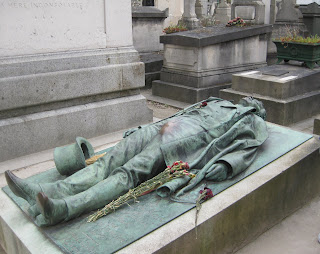
Grave Matters
Here are a couple of more pictures from my trip to Pere Lachaise Cemetery this April. Good medievalist that I am, I took a picture of Abelard and Heloise's tomb, but unfortunately, it was surrounded by scaffolding. (You can see a better picture here.)

I'm afraid I didn't catch the name of this gentleman, but he certainly looks like a morning person:

And here is the grave of Victor Noir, a French journalist who was shot by Pierre Bonaparte while trying to arrange the terms of a duel. (Some guys will do anything to avoid sitting in front of a blank sheet of paper.) Yes, a certain area is rather prominent, and it's been made more so by women who rub it for fertility.

I'm afraid I didn't catch the name of this gentleman, but he certainly looks like a morning person:

And here is the grave of Victor Noir, a French journalist who was shot by Pierre Bonaparte while trying to arrange the terms of a duel. (Some guys will do anything to avoid sitting in front of a blank sheet of paper.) Yes, a certain area is rather prominent, and it's been made more so by women who rub it for fertility.

Monday, June 01, 2009
Search Terms
It's June, and that means that it's time for May search terms!
what would happen if a divorce happened in the elizabethan era
Quite possibly, a divorce.
wife in shorts
Just ask her nicely, and I'm sure she'll oblige.
historical fiction with explicit sex
Let's get down to business, shall we?
english kings fake pregnancy
So that's where Henry VIII got that 54-inch waistline from!
take the veil convent -tibet
Nothing like getting away from it all.
edward ii anus latin
isabella from latin adultery
That's one way of making high school Latin more interesting.
search
And you shall find, but it'll take you a heck of a long time to do it that way.
snippets what do you call things with no words
There's an advanced seminar in philosophy waiting to answer this one, I'm sure.
what if a duke and duchess marries
They have little duchies.
edward ii who did the packing when he moved
Actually, it's a little-known fact that Edward II made Isabella do all of the packing when he moved. Gaveston, and later Hugh le Despenser the younger, just sat and twiddled their thumbs while poor Isabella did all of the work. So here you have it, folks--the real reason Edward II was deposed. If only he'd hired professional movers.
what would happen if a divorce happened in the elizabethan era
Quite possibly, a divorce.
wife in shorts
Just ask her nicely, and I'm sure she'll oblige.
historical fiction with explicit sex
Let's get down to business, shall we?
english kings fake pregnancy
So that's where Henry VIII got that 54-inch waistline from!
take the veil convent -tibet
Nothing like getting away from it all.
edward ii anus latin
isabella from latin adultery
That's one way of making high school Latin more interesting.
search
And you shall find, but it'll take you a heck of a long time to do it that way.
snippets what do you call things with no words
There's an advanced seminar in philosophy waiting to answer this one, I'm sure.
what if a duke and duchess marries
They have little duchies.
edward ii who did the packing when he moved
Actually, it's a little-known fact that Edward II made Isabella do all of the packing when he moved. Gaveston, and later Hugh le Despenser the younger, just sat and twiddled their thumbs while poor Isabella did all of the work. So here you have it, folks--the real reason Edward II was deposed. If only he'd hired professional movers.
Friday, May 29, 2009
Meme Time! What Would Your Characters Do?
Thanks to Gabriele, instead of spending lunchtime patiently fact-checking and proofreading the final draft of the Buckingham novel, I'm doing this meme. Pick 10 characters at random, then answer how they will react in various given situations. So here goes, courtesy of my Buckingham novel:
1. Katherine Woodville, Duchess of Buckingham
2. Anne Neville, Duchess of Gloucester, later Queen of England
3. Elizabeth Woodville, Queen of England
4. Richard Neville, Earl of Warwick
5. Henry Stafford, Duke of Buckingham
6. William, Lord Hastings
7. Edward IV
8. Robert Stillington, Bishop of Bath and Wells
9. George, Duke of Clarence
10.Richard, Duke of Gloucester, later King Richard III
4 invites 3 and 8 to dinner at their house. What happens?
Warwick says to Elizabeth Woodville, "Hey, sorry that I offed your father and your brother, but a man's gotta do what a man's gotta do, you know?" Warwick then says to Stillington, "Hey, you haven't performed any secret marriages I might want to know about, have you?" An uneasy silence descends, broken only by the arrival of a lot of meat, which fortunately keeps everyone occupied for the rest of the evening.
9 tries to get 5 to go to a strip club. What happens?
Harry agrees to George's invitation, but he really wishes that Richard was the one who was taking him. Actually, he really wishes that Richard was the one stripping. Oh, my.
You need to stay at a friend's house for a night. Who do you choose: 1 or 6?
Depended on whether I wanted to sleep in a comfy bed (Katherine) or get lucky (Hastings). Come to think of it, with Hastings I'd have a chance to do both. So, sorry, Kate--I'll have to go with Hastings. (Can you say "cougar"?)
2 and 7 are making out. 10 walks in. What is their reaction?
Having caught his wife and his brother Edward making out, Richard cries, "Ned! This is all the doing of the vile Woodvilles, isn't it? How they have corrupted you!" Then after a beat, he asks, "This does mean you're going to give me a larger share of the Warwick lands, right?"
3 falls in love with 6. 8 is jealous. What happens?
Elizabeth Woodville in love with William Hastings, and Stillington jealous! Well, Elizabeth and William poison Edward IV, in hopes of marrying, but before they can do so, jealous Stillington persuades Gloucester to cut William's head off for treason. There might be a journal article here, "The Events of 1483: A New Explanation," come to think of it . . .
4 jumps you in a dark alleyway. Who comes to your rescue: 10, 2, or 7?
Well, after Warwick jumps me, I'm not sure that his daughter Anne would be of much help, and Richard is probably too busy plotting to seize the throne to really care. So Edward IV comes to my rescue, probably in the hopes of getting lucky.
1 decides to start a cooking show. Fifteen minutes later, what is happening?
Kate very sensibly decides to call in a guest hostess, Anne, Duchess of Gloucester, who demonstrates the recipes she learned while George was hiding her in the cookshop.
3 has to marry either 8, 4, or 9. Whom do they choose?
Elizabeth Woodville has to marry Stillington, Warwick, or Clarence? She marries Stillington secretly, and they have a son, named Perkin Warbeck.
7 kidnaps 2 and demands something from 5 for 2's release. What is it?
Edward IV kidnaps Anne and tells Buckingham that he'll release her if he just shuts up about wanting his Bohun lands and some more responsibility.
Everyone gangs up on 3. Does 3 have a chance in hell?
Oh, yes! Elizabeth will just make everyone kneel before her.
Everyone is invited to 2 and 10's wedding except for 8. How do they react?
Stillington doesn't get invited to Richard and Anne's wedding? He starts a rumor that the Woodvilles intercepted his wedding invitation.
Why is 6 afraid of 7?
Hastings afraid of Edward IV? Sounds like Jane Shore was a little indiscreet about the day Jane Shore paid a visit to Hastings at the mint "just to see how the coinage is made."
1 arrives late for 2 and 10's wedding. What happens, and why were they late?
Kate is late to Richard and Anne's wedding? Well, in my novel, Kate is busy primping in hopes of getting lucky with her husband Harry and loses track of the time. Were I writing the Ricardian Novel to End All Ricardian Novels, though, Kate would be delayed by her inability to find the toad needed to cast a spell on the happy couple.
5 and 9 get roaring drunk and end up at your house. What happens?
Buckingham and Clarence get roaring drunk? Aside from ending up at my house, this actually does happen in my Buckingham novel, so I'm going to make you wait until around 2010 to find out. I'm so mean.
9 murders 2's best friend. What does 2 do to get back at them?
Clarence murders Anne's best friend? Well, Anne tells her brother-in-law Edward IV, "You know, I'm really getting tired of Clarence, aren't you? Have you ever thought of drowning him in a vat of malmsey?"
6 and 1 are in mortal peril and only one of them can survive. Does 6 save themself or 1?
Hastings and Katherine in mortal peril? Hey, Hastings is a gentleman, and he would of course save the lady. But he might try to get lucky first.
8 and 3 go camping. For some reason they forgot to bring along any food. What do they do?
Ah, Elizabeth Woodville and Stillington on a camping trip. But they did remember to bring servants, who make a quick run to the store! So pretty soon, they're happily toasting marshmallows together, never fear.
5 is in a crash and is critically injured. What does 9 do?
Clarence, seeing Harry's misfortune, calls for wine and gives a little to the injured Harry until help arrives. Then he drinks the rest himself, telling himself that he deserves a little something to calm his nerves.
1. Katherine Woodville, Duchess of Buckingham
2. Anne Neville, Duchess of Gloucester, later Queen of England
3. Elizabeth Woodville, Queen of England
4. Richard Neville, Earl of Warwick
5. Henry Stafford, Duke of Buckingham
6. William, Lord Hastings
7. Edward IV
8. Robert Stillington, Bishop of Bath and Wells
9. George, Duke of Clarence
10.Richard, Duke of Gloucester, later King Richard III
4 invites 3 and 8 to dinner at their house. What happens?
Warwick says to Elizabeth Woodville, "Hey, sorry that I offed your father and your brother, but a man's gotta do what a man's gotta do, you know?" Warwick then says to Stillington, "Hey, you haven't performed any secret marriages I might want to know about, have you?" An uneasy silence descends, broken only by the arrival of a lot of meat, which fortunately keeps everyone occupied for the rest of the evening.
9 tries to get 5 to go to a strip club. What happens?
Harry agrees to George's invitation, but he really wishes that Richard was the one who was taking him. Actually, he really wishes that Richard was the one stripping. Oh, my.
You need to stay at a friend's house for a night. Who do you choose: 1 or 6?
Depended on whether I wanted to sleep in a comfy bed (Katherine) or get lucky (Hastings). Come to think of it, with Hastings I'd have a chance to do both. So, sorry, Kate--I'll have to go with Hastings. (Can you say "cougar"?)
2 and 7 are making out. 10 walks in. What is their reaction?
Having caught his wife and his brother Edward making out, Richard cries, "Ned! This is all the doing of the vile Woodvilles, isn't it? How they have corrupted you!" Then after a beat, he asks, "This does mean you're going to give me a larger share of the Warwick lands, right?"
3 falls in love with 6. 8 is jealous. What happens?
Elizabeth Woodville in love with William Hastings, and Stillington jealous! Well, Elizabeth and William poison Edward IV, in hopes of marrying, but before they can do so, jealous Stillington persuades Gloucester to cut William's head off for treason. There might be a journal article here, "The Events of 1483: A New Explanation," come to think of it . . .
4 jumps you in a dark alleyway. Who comes to your rescue: 10, 2, or 7?
Well, after Warwick jumps me, I'm not sure that his daughter Anne would be of much help, and Richard is probably too busy plotting to seize the throne to really care. So Edward IV comes to my rescue, probably in the hopes of getting lucky.
1 decides to start a cooking show. Fifteen minutes later, what is happening?
Kate very sensibly decides to call in a guest hostess, Anne, Duchess of Gloucester, who demonstrates the recipes she learned while George was hiding her in the cookshop.
3 has to marry either 8, 4, or 9. Whom do they choose?
Elizabeth Woodville has to marry Stillington, Warwick, or Clarence? She marries Stillington secretly, and they have a son, named Perkin Warbeck.
7 kidnaps 2 and demands something from 5 for 2's release. What is it?
Edward IV kidnaps Anne and tells Buckingham that he'll release her if he just shuts up about wanting his Bohun lands and some more responsibility.
Everyone gangs up on 3. Does 3 have a chance in hell?
Oh, yes! Elizabeth will just make everyone kneel before her.
Everyone is invited to 2 and 10's wedding except for 8. How do they react?
Stillington doesn't get invited to Richard and Anne's wedding? He starts a rumor that the Woodvilles intercepted his wedding invitation.
Why is 6 afraid of 7?
Hastings afraid of Edward IV? Sounds like Jane Shore was a little indiscreet about the day Jane Shore paid a visit to Hastings at the mint "just to see how the coinage is made."
1 arrives late for 2 and 10's wedding. What happens, and why were they late?
Kate is late to Richard and Anne's wedding? Well, in my novel, Kate is busy primping in hopes of getting lucky with her husband Harry and loses track of the time. Were I writing the Ricardian Novel to End All Ricardian Novels, though, Kate would be delayed by her inability to find the toad needed to cast a spell on the happy couple.
5 and 9 get roaring drunk and end up at your house. What happens?
Buckingham and Clarence get roaring drunk? Aside from ending up at my house, this actually does happen in my Buckingham novel, so I'm going to make you wait until around 2010 to find out. I'm so mean.
9 murders 2's best friend. What does 2 do to get back at them?
Clarence murders Anne's best friend? Well, Anne tells her brother-in-law Edward IV, "You know, I'm really getting tired of Clarence, aren't you? Have you ever thought of drowning him in a vat of malmsey?"
6 and 1 are in mortal peril and only one of them can survive. Does 6 save themself or 1?
Hastings and Katherine in mortal peril? Hey, Hastings is a gentleman, and he would of course save the lady. But he might try to get lucky first.
8 and 3 go camping. For some reason they forgot to bring along any food. What do they do?
Ah, Elizabeth Woodville and Stillington on a camping trip. But they did remember to bring servants, who make a quick run to the store! So pretty soon, they're happily toasting marshmallows together, never fear.
5 is in a crash and is critically injured. What does 9 do?
Clarence, seeing Harry's misfortune, calls for wine and gives a little to the injured Harry until help arrives. Then he drinks the rest himself, telling himself that he deserves a little something to calm his nerves.
Some Recent Historical Fiction Reads
Here are reviews of mine that appeared in the February 2009 Historical Novels Review:
A Constant Heart
Siri Mitchell, Bethany House, 2008, $13.99 pb, 384pp, 9780764204319
Facing an arranged marriage to the Earl of Lytham, a stranger, seventeen-year-old Marget is reassured somewhat when her betrothed sends her an astrolabe and a romantic sonnet. Yet when Marget meets her husband at last, the earl, still embittered from his first marriage to a beautiful, unfaithful wife, is barely civil to his new countess. Life is no better at Queen Elizabeth’s court, where the newcomer Marget is shunned.
Determined to win the affection of her husband by proving herself useful to him in his frantic quest for royal favor, Marget becomes friends with Lady de Winter, who advises Marget that in order to make her way at court, Marget must obscure her natural beauty with layers of white paint. Slowly, Marget finds acceptance among the queen’s ladies—but is Lady de Winter acting in her best interests?
Mitchell vividly depicts the atmosphere of Elizabeth’s court, as poisoned by jealousy, back-biting, and intrigue as are the women who damage their looks and their health with lead paint. Her newlyweds, struggling to build a successful relationship with each other and to maintain their integrity in a setting that is hardly conducive to such goals, provide an interesting—and fresh--perspective on a familiar period.
----------
Bedlam South
Mark Grisham and David Donaldson, State Street Press, 2008, $24.95 hb, 324pp, 9780764204319
In 1863, Alabama native Dr. Joseph Bryarly reluctantly accepts an invitation from a family friend, Confederate President Jefferson Davis, to leave his post at London’s notorious Bethlem Royal Hospital to become Chief Superintendent of Wingate Asylum in Richmond, Virginia. Meanwhile, young Zeke Gibson gleefully joins the Army of Northern Virginia, where he is reunited with his older brother, Billy, a corporal. The Battle of Gettysburg, however, soon sends the Gibson brothers in separate directions, while nightmare-plagued Joseph finds that he has exchanged the living hell of London’s Bedlam for that of Richmond’s Bedlam South.
Co-written by childhood friends who utilized the novel to blend their interests in psychology and the Civil War, Bedlam South has all of the elements of a wartime epic as it moves with ease between battlefields, the asylum, gracious and humble homes, prisons, bordellos, and city streets, with episodes that show its men and women at their worst--and at their best. It’s a fast-paced and well-plotted story, with a varied and large cast of characters, sympathetic and complex protagonists, a couple of romances, and some staggering coincidences. I recommend it highly.
________________
The Ancient Ocean Blues
Jack Mitchell, Tundra Books, 2008, $9.95/C$11.99 pb, 188pp, 9780887768323
Though young Marcus Oppius Sabinus is less than thrilled when his cousin Gaius sends him on a spy mission, Marcus does find this preferable to helping Gaius in his everyday business of buying elections through bribery. Soon, therefore, he’s traveling to Athens, in the company of a Greek publisher and Marcus’s fiancée, Paulla (who stows away in hopes of improving her acquaintance with the heroic Aulus Lucinus Spurinna, not for the pleasure of Marcus’s company). Needless to say, smooth sailing does not lie ahead.
Narrated in a breezy, humorous style by Marcus, this was a fun read in which the carefully researched history went down painlessly and where the historical figures (including Gaius Oppius) easily mixed with the fictitious ones, several of whom first appeared in Mitchell’s previous novel, The Roman Conspiracy. I especially enjoyed Paulla, a connoisseur of romances who turns out to be anything but a starry-eyed romantic. Young adults, even those not normally interested in the ancient world, will find this an engaging read.
_____
Coming soon, search terms!
A Constant Heart
Siri Mitchell, Bethany House, 2008, $13.99 pb, 384pp, 9780764204319
Facing an arranged marriage to the Earl of Lytham, a stranger, seventeen-year-old Marget is reassured somewhat when her betrothed sends her an astrolabe and a romantic sonnet. Yet when Marget meets her husband at last, the earl, still embittered from his first marriage to a beautiful, unfaithful wife, is barely civil to his new countess. Life is no better at Queen Elizabeth’s court, where the newcomer Marget is shunned.
Determined to win the affection of her husband by proving herself useful to him in his frantic quest for royal favor, Marget becomes friends with Lady de Winter, who advises Marget that in order to make her way at court, Marget must obscure her natural beauty with layers of white paint. Slowly, Marget finds acceptance among the queen’s ladies—but is Lady de Winter acting in her best interests?
Mitchell vividly depicts the atmosphere of Elizabeth’s court, as poisoned by jealousy, back-biting, and intrigue as are the women who damage their looks and their health with lead paint. Her newlyweds, struggling to build a successful relationship with each other and to maintain their integrity in a setting that is hardly conducive to such goals, provide an interesting—and fresh--perspective on a familiar period.
----------
Bedlam South
Mark Grisham and David Donaldson, State Street Press, 2008, $24.95 hb, 324pp, 9780764204319
In 1863, Alabama native Dr. Joseph Bryarly reluctantly accepts an invitation from a family friend, Confederate President Jefferson Davis, to leave his post at London’s notorious Bethlem Royal Hospital to become Chief Superintendent of Wingate Asylum in Richmond, Virginia. Meanwhile, young Zeke Gibson gleefully joins the Army of Northern Virginia, where he is reunited with his older brother, Billy, a corporal. The Battle of Gettysburg, however, soon sends the Gibson brothers in separate directions, while nightmare-plagued Joseph finds that he has exchanged the living hell of London’s Bedlam for that of Richmond’s Bedlam South.
Co-written by childhood friends who utilized the novel to blend their interests in psychology and the Civil War, Bedlam South has all of the elements of a wartime epic as it moves with ease between battlefields, the asylum, gracious and humble homes, prisons, bordellos, and city streets, with episodes that show its men and women at their worst--and at their best. It’s a fast-paced and well-plotted story, with a varied and large cast of characters, sympathetic and complex protagonists, a couple of romances, and some staggering coincidences. I recommend it highly.
________________
The Ancient Ocean Blues
Jack Mitchell, Tundra Books, 2008, $9.95/C$11.99 pb, 188pp, 9780887768323
Though young Marcus Oppius Sabinus is less than thrilled when his cousin Gaius sends him on a spy mission, Marcus does find this preferable to helping Gaius in his everyday business of buying elections through bribery. Soon, therefore, he’s traveling to Athens, in the company of a Greek publisher and Marcus’s fiancée, Paulla (who stows away in hopes of improving her acquaintance with the heroic Aulus Lucinus Spurinna, not for the pleasure of Marcus’s company). Needless to say, smooth sailing does not lie ahead.
Narrated in a breezy, humorous style by Marcus, this was a fun read in which the carefully researched history went down painlessly and where the historical figures (including Gaius Oppius) easily mixed with the fictitious ones, several of whom first appeared in Mitchell’s previous novel, The Roman Conspiracy. I especially enjoyed Paulla, a connoisseur of romances who turns out to be anything but a starry-eyed romantic. Young adults, even those not normally interested in the ancient world, will find this an engaging read.
_____
Coming soon, search terms!
Tuesday, May 26, 2009
The Winner of Mistress of the Sun . . .
Is Rachel! I've sent you an email. Thanks to everyone who entered!
Monday, May 25, 2009
In Memory of a Fallen Soldier: Edward le Despenser
Edward le Despenser was the second son of Hugh le Despenser the younger and Eleanor de Clare. He was born before November 23, 1315, when Edward II issued a license for John de Cromwell and his wife, Idonia, to grant certain lands to Robert Baldock, who was to regrant them with a life estate to Idonia, with remainder interests for Hugh, his father, and Edward.
Edward’s whereabouts following the destruction of his father and grandfather at the hands of Queen Isabella and Roger Mortimer are unknown, but he was probably among the children who were imprisoned with Eleanor de Clare in the Tower from November 1326 to February 1328. Though Edward’s exact age is unknown, he was evidently too young to be considered a threat to the regime, unlike his eldest brother, Hugh, who was around 18 in 1326 and who was imprisoned until 1331.
In November 1334, Edward came into the life estates he had been granted in 1315. His lands included Essendine in Rutland. As Jane Austen noted, “It is a truth universally acknowledged, that a single man in possession of a good fortune must be in want of a wife,” and Edward proved the wisdom of this remark by finding a wife just a few months later, for he married Anne Ferrers at Groby on April 20, 1335. Anne was the sister of Henry, Lord Ferrers, who was married to Isabella de Verdon. Isabella was a daughter of Elizabeth de Burgh, Eleanor de Clare’s younger sister.
Edward’s short marriage was a fruitful one, producing four sons, Edward, Hugh, Thomas, and Henry. Edward, the eldest, who ultimately inherited the Despenser estates when his uncle Hugh died without heirs in 1349, was born at Essendine on March 24, 1336.
Like his brothers Hugh and Gilbert, Edward served in Edward III’s military campaigns. In 1338, he had a protection to serve in France with his brother-in-law Henry Ferrers. In 1342, he accompanied his brother Hugh overseas. Hugh’s forces, originally headed for Gascony, were diverted to Brest to assist the forces of the Countess of Montfort, whose side in the Breton civil war Edward III was backing. Hugh’s forces later joined the Earl of Northampton at Morlaix, where the English, badly outnumbered, achieved a victory of sorts over French troops on September 30, 1342. Unfortunately, it was Edward’s last battle: as the chronicler Murimuth notes, he was the highest-ranking English casualty there.
Though Edward was probably only in his late twenties when he died in battle, he nonetheless managed to leave a worthy legacy behind him in the shape of his four sons, two of whom, Edward and Henry, were among the most colorful characters of the late fourteenth century. Each deserves a post to himself, but the younger Edward in his short life (he died at age thirty-nine) acquired a reputation as a model of chivalry; he is the “kneeling knight” depicted at Tewkesbury Abbey. Henry, who entered the Church but never lost his taste for military activity, became known as the “Fighting Bishop of Norwich.” Thomas, who fought at Rheims, died in 1381. Hugh, who died in 1374, was survived by a son, naturally named Hugh. The younger Hugh was governor to the fourteen-year-old Henry V, but died in 1401 before he had been at his post for very long.
Through his eldest son, Edward also can claim among his direct descendants Anne, queen to Richard III.
Sources:
Christopher Allmand, Henry V
Calendar of Patent Rolls
Complete Peerage
Martyn John Lawrence, Power, Ambition and Political Rehabilitation: The Despensers, c.1281–1400 (unpublished dissertation, University of York).
Edward’s whereabouts following the destruction of his father and grandfather at the hands of Queen Isabella and Roger Mortimer are unknown, but he was probably among the children who were imprisoned with Eleanor de Clare in the Tower from November 1326 to February 1328. Though Edward’s exact age is unknown, he was evidently too young to be considered a threat to the regime, unlike his eldest brother, Hugh, who was around 18 in 1326 and who was imprisoned until 1331.
In November 1334, Edward came into the life estates he had been granted in 1315. His lands included Essendine in Rutland. As Jane Austen noted, “It is a truth universally acknowledged, that a single man in possession of a good fortune must be in want of a wife,” and Edward proved the wisdom of this remark by finding a wife just a few months later, for he married Anne Ferrers at Groby on April 20, 1335. Anne was the sister of Henry, Lord Ferrers, who was married to Isabella de Verdon. Isabella was a daughter of Elizabeth de Burgh, Eleanor de Clare’s younger sister.
Edward’s short marriage was a fruitful one, producing four sons, Edward, Hugh, Thomas, and Henry. Edward, the eldest, who ultimately inherited the Despenser estates when his uncle Hugh died without heirs in 1349, was born at Essendine on March 24, 1336.
Like his brothers Hugh and Gilbert, Edward served in Edward III’s military campaigns. In 1338, he had a protection to serve in France with his brother-in-law Henry Ferrers. In 1342, he accompanied his brother Hugh overseas. Hugh’s forces, originally headed for Gascony, were diverted to Brest to assist the forces of the Countess of Montfort, whose side in the Breton civil war Edward III was backing. Hugh’s forces later joined the Earl of Northampton at Morlaix, where the English, badly outnumbered, achieved a victory of sorts over French troops on September 30, 1342. Unfortunately, it was Edward’s last battle: as the chronicler Murimuth notes, he was the highest-ranking English casualty there.
Though Edward was probably only in his late twenties when he died in battle, he nonetheless managed to leave a worthy legacy behind him in the shape of his four sons, two of whom, Edward and Henry, were among the most colorful characters of the late fourteenth century. Each deserves a post to himself, but the younger Edward in his short life (he died at age thirty-nine) acquired a reputation as a model of chivalry; he is the “kneeling knight” depicted at Tewkesbury Abbey. Henry, who entered the Church but never lost his taste for military activity, became known as the “Fighting Bishop of Norwich.” Thomas, who fought at Rheims, died in 1381. Hugh, who died in 1374, was survived by a son, naturally named Hugh. The younger Hugh was governor to the fourteen-year-old Henry V, but died in 1401 before he had been at his post for very long.
Through his eldest son, Edward also can claim among his direct descendants Anne, queen to Richard III.
Sources:
Christopher Allmand, Henry V
Calendar of Patent Rolls
Complete Peerage
Martyn John Lawrence, Power, Ambition and Political Rehabilitation: The Despensers, c.1281–1400 (unpublished dissertation, University of York).
Saturday, May 23, 2009
Review: Henry and Clara by Thomas Mallon
On April 14, 1865, an engaged couple, Henry Rathbone and Clara Harris, accepted the Lincolns' last-minute invitation to join them in their box at Ford's Theatre. For the nation, the impact of that night's tragedy would be felt at once; for Henry and Clara, the denouement of their own private tragedy occurred years later.
Henry and Clara follows the titular couple from their childhood in Albany, New York, where Henry's widowed, ambitious mother sets her cap at Clara's widowed father, Ira Harris, whom Pauline Rathbone sees as a promising politician. A marriage soon follows, and young Henry and Clara find themselves stepbrother and stepsister. Though neither child cares much for the other's parent, Henry and Clara soon gravitate toward each other, and as they mature their feelings grow into romantic love. Before they can marry, though, they must overcome the opposition of their parents, and the outbreak of the Civil War throws yet another obstacle into their path.
There is another difficulty, one the determined and devoted Clara doesn't much want to acknowledge: Henry. For Clara, the mercurial Henry is Byronic, but the horrors of war soon disclose how fragile Henry's psyche truly is. Nonetheless, Clara, deeply in love and not willing to give up easily, presses on with her marriage plans, even after the Lincoln assassination strips yet another layer of sanity from Henry.
Though the story Henry and Clara tells is a tragic one, Mallon's wry narrative voice and his sharp eye prevent it from being a gloomy one. His characterizations are superb, with Clara, the main viewpoint character, being a particular success. Even as Clara becomes more isolated and her situation more grim, she never turns into the pathetic victim she might have become with a less skilled author.
If there's a rough patch in the novel, it's at the beginning, where the immersion into Albany politics may be too much for some readers. Persevere, though, and you'll be well rewarded. This was one of the best historical novels I've read.
Henry and Clara follows the titular couple from their childhood in Albany, New York, where Henry's widowed, ambitious mother sets her cap at Clara's widowed father, Ira Harris, whom Pauline Rathbone sees as a promising politician. A marriage soon follows, and young Henry and Clara find themselves stepbrother and stepsister. Though neither child cares much for the other's parent, Henry and Clara soon gravitate toward each other, and as they mature their feelings grow into romantic love. Before they can marry, though, they must overcome the opposition of their parents, and the outbreak of the Civil War throws yet another obstacle into their path.
There is another difficulty, one the determined and devoted Clara doesn't much want to acknowledge: Henry. For Clara, the mercurial Henry is Byronic, but the horrors of war soon disclose how fragile Henry's psyche truly is. Nonetheless, Clara, deeply in love and not willing to give up easily, presses on with her marriage plans, even after the Lincoln assassination strips yet another layer of sanity from Henry.
Though the story Henry and Clara tells is a tragic one, Mallon's wry narrative voice and his sharp eye prevent it from being a gloomy one. His characterizations are superb, with Clara, the main viewpoint character, being a particular success. Even as Clara becomes more isolated and her situation more grim, she never turns into the pathetic victim she might have become with a less skilled author.
If there's a rough patch in the novel, it's at the beginning, where the immersion into Albany politics may be too much for some readers. Persevere, though, and you'll be well rewarded. This was one of the best historical novels I've read.
Friday, May 22, 2009
Three Cheers for the BBC!
I have a Google alert set up for "Edward II," and though I get some things of interest that way, I also get a lot of worthless alerts, mostly to shopping sites. So when I saw my alert today, I thought at first it was another shopping alert. Then I looked closer and gave a great big whoop, for I see that the BBC has reissued the 1970 telecast of "Edward II" on DVD! Finally!
This telecast starred Ian McKellen as Edward II, and is an excellent adaptation of the Marlowe play. My university library of choice has an old VHS copy, which couldn't be taken off premises, so I had to watch it sitting in a carrel, wondering if some undergraduate would come up behind me during the poker scene and say, "Ewwww!" Needless to say, I'm delighted about finally being able to buy a copy of my own. I'm also delighted that the play, which is seldom produced in the US outside of major cities, will get a wider audience. (The Derek Jarman film, while interesting and well-acted, loses Marlowe's play in its emphasis on twentieth-century sexual politics.) It's the Marlowe play that got me interested in Edward II and got me to writing my own novel, so I owe this playwright a big thanks!
This telecast starred Ian McKellen as Edward II, and is an excellent adaptation of the Marlowe play. My university library of choice has an old VHS copy, which couldn't be taken off premises, so I had to watch it sitting in a carrel, wondering if some undergraduate would come up behind me during the poker scene and say, "Ewwww!" Needless to say, I'm delighted about finally being able to buy a copy of my own. I'm also delighted that the play, which is seldom produced in the US outside of major cities, will get a wider audience. (The Derek Jarman film, while interesting and well-acted, loses Marlowe's play in its emphasis on twentieth-century sexual politics.) It's the Marlowe play that got me interested in Edward II and got me to writing my own novel, so I owe this playwright a big thanks!
Thursday, May 21, 2009
Q &A with Sandra Gulland--and a Giveaway!
As part of her blog tour to celebrate the paperback release of Mistress of the Sun, the story of Louise de la Vallière, I'd like to welcome Sandra Gulland to my corner of the blogsphere! I read Sandra's Josephine Bonaparte trilogy when I was just beginning to write historical fiction. Not only did I learn quite a bit about Josephine from it, I also learned a great deal about the craft of writing. So I'm particularly pleased she's stopping by here.
SH: What drew you to the character of Louise in particular? In general, are there qualities that tend to draw you to a historical character?
SG: What initially drew me to Louise was her extraordinary horsemanship. She could stand a cantering horse. She could out-ride and out-hunt the Sun King, who was himself an amazing athlete. I wondered how this came about. Certainly, it wasn't typical of women in the 17th century (much less today). Clearly, she had spent a lot of time with the guys in the stables and out in the fields.
I have to care deeply about my main character, so the most important quality, for me, has to do with having a sympathetic nature. The other essential is that there be something unexplained, something that provokes my curiosity. With Josephine, it was the fact that her remarkable future had been foretold. For Louise de la Vallière, it was her horsemanship.
SH: I’ve seen several different covers for Mistress of the Sun. Do you have a favorite? Why?
SG: I'm crazy in love with the cover of the Canadian hardcover edition, the one with the big eyes. I think it captures Petite's innocent, yet almost hypnotic and somewhat mystical allure. Poetically, I think it gets to the heart of what the novel is about. Plus, it's so gorgeous, simply lush. It communicates that the novel is historical, without confining it only to readers of historical fiction. It has a literary appeal, as well as romantic: a great combination, in my mind. I don't think I will ever love a cover as much as I love this one.
SH: Is there a character you’d like to write about, but don’t think you ever will? Why?
SG: I'm tempted by Joan of Arc — but she's so intimidating. Plus, there would have to be a question about her I wanted to solve.
I'm also, curiously, tempted by Saint Vincent de Paul. Now that would be a challenge! I've read biographies about him, but the one story that intrigues me is that he was, apparently, very popular as a confessor to the society ladies because he would forgive every sin. Imagine the story possibilities that might open up!
SH: Other than historical fiction, is there a genre you enjoy reading in particular? As a reader, do you have any “guilty pleasures”?
SG: I like literary fiction, especially literary historical fiction. In the historical vein, I've found it difficult, lately, to read works set close to the period I'm working in. Some recent works I've read and admired (Blonde, by Oates, for example) were set in the last century.
I did read a "guilty pleasure" book recently: Twilight, by Stephenie Meyer. (Hasn't everyone read this book?) I thought it well done, but I was quite happy to return to my non-vampire world.
___
Thanks for the interview, Sandra! Now, here's your chance to win a paperback copy of Mistress of the Sun. Just leave a comment here by midnight May 25 (US EST) telling me which of Sandra's covers below is your favorite. (The winner will get the book with the second cover--the US paperback.)
Me? My favorite's the first one. I'd love to wear a dress like that, and my cats would love to shed on it.


SH: What drew you to the character of Louise in particular? In general, are there qualities that tend to draw you to a historical character?
SG: What initially drew me to Louise was her extraordinary horsemanship. She could stand a cantering horse. She could out-ride and out-hunt the Sun King, who was himself an amazing athlete. I wondered how this came about. Certainly, it wasn't typical of women in the 17th century (much less today). Clearly, she had spent a lot of time with the guys in the stables and out in the fields.
I have to care deeply about my main character, so the most important quality, for me, has to do with having a sympathetic nature. The other essential is that there be something unexplained, something that provokes my curiosity. With Josephine, it was the fact that her remarkable future had been foretold. For Louise de la Vallière, it was her horsemanship.
SH: I’ve seen several different covers for Mistress of the Sun. Do you have a favorite? Why?
SG: I'm crazy in love with the cover of the Canadian hardcover edition, the one with the big eyes. I think it captures Petite's innocent, yet almost hypnotic and somewhat mystical allure. Poetically, I think it gets to the heart of what the novel is about. Plus, it's so gorgeous, simply lush. It communicates that the novel is historical, without confining it only to readers of historical fiction. It has a literary appeal, as well as romantic: a great combination, in my mind. I don't think I will ever love a cover as much as I love this one.
SH: Is there a character you’d like to write about, but don’t think you ever will? Why?
SG: I'm tempted by Joan of Arc — but she's so intimidating. Plus, there would have to be a question about her I wanted to solve.
I'm also, curiously, tempted by Saint Vincent de Paul. Now that would be a challenge! I've read biographies about him, but the one story that intrigues me is that he was, apparently, very popular as a confessor to the society ladies because he would forgive every sin. Imagine the story possibilities that might open up!
SH: Other than historical fiction, is there a genre you enjoy reading in particular? As a reader, do you have any “guilty pleasures”?
SG: I like literary fiction, especially literary historical fiction. In the historical vein, I've found it difficult, lately, to read works set close to the period I'm working in. Some recent works I've read and admired (Blonde, by Oates, for example) were set in the last century.
I did read a "guilty pleasure" book recently: Twilight, by Stephenie Meyer. (Hasn't everyone read this book?) I thought it well done, but I was quite happy to return to my non-vampire world.
___
Thanks for the interview, Sandra! Now, here's your chance to win a paperback copy of Mistress of the Sun. Just leave a comment here by midnight May 25 (US EST) telling me which of Sandra's covers below is your favorite. (The winner will get the book with the second cover--the US paperback.)
Me? My favorite's the first one. I'd love to wear a dress like that, and my cats would love to shed on it.


Tuesday, May 19, 2009
That's One Way of Looking at It
While double-checking the facts for my Buckingham novel (it will be getting another title), I came across this little gem of a letter in the Calendar of State Papers, Milan (online here). The "enclosed copy" refers to an account of the Battle of St. Albans:
22. The Bishop of Novara, Milanese Ambassador at Rome, to Francesco Sforza, Duke of Milan.
From England we have the news which you will see by the enclosed copy. Although it is not good for those who are dead, yet it cannot fail to favour our proceedings, because it will make the French a little more cautious, as during these differences between the English, they had become great and daily became greater.
Rome, the 4th July, 1455.
[Italian.]
22. The Bishop of Novara, Milanese Ambassador at Rome, to Francesco Sforza, Duke of Milan.
From England we have the news which you will see by the enclosed copy. Although it is not good for those who are dead, yet it cannot fail to favour our proceedings, because it will make the French a little more cautious, as during these differences between the English, they had become great and daily became greater.
Rome, the 4th July, 1455.
[Italian.]
Sunday, May 17, 2009
A Woodville Meets a Boleyn
One of the fascinating things about doing historical research is seeing how people's paths cross. The William Boleyn who was appointed to a commission with Anthony Woodville in November 1482 was the grandfather of none other than Anne Boleyn:
Nov. 12. Commission to the king's kinsman Anthony, earl Ryvers, Henry Heydon, Westminster. William Boleyn, Richard Suthwell, John Fyncham, Henry Spylman and James Hoberd, certain dissentions having arisen between William Lumnour on the one part and Thomas Brygge of Manyngton, co. Norfolk, 'gentilman,' and Margaret his wife on the other, to summon the parties and other persons and examine them and put their examinations in writing and to enquire by inquest into certain felonies, murders, trespasses and offences committed by the said Thomas and Margaret Brygge late the wife of William Lumnour and to certify thereon to the king and council in the quinzaine of Midsummer next.
[Patent Rolls, 1476-1485]
It's probably safe to say that if this commission actually had a chance to meet, its members would have never predicted that Anthony would be dead in less than eight months and that William's as-yet-unborn granddaughter would end up as queen of England!
Nov. 12. Commission to the king's kinsman Anthony, earl Ryvers, Henry Heydon, Westminster. William Boleyn, Richard Suthwell, John Fyncham, Henry Spylman and James Hoberd, certain dissentions having arisen between William Lumnour on the one part and Thomas Brygge of Manyngton, co. Norfolk, 'gentilman,' and Margaret his wife on the other, to summon the parties and other persons and examine them and put their examinations in writing and to enquire by inquest into certain felonies, murders, trespasses and offences committed by the said Thomas and Margaret Brygge late the wife of William Lumnour and to certify thereon to the king and council in the quinzaine of Midsummer next.
[Patent Rolls, 1476-1485]
It's probably safe to say that if this commission actually had a chance to meet, its members would have never predicted that Anthony would be dead in less than eight months and that William's as-yet-unborn granddaughter would end up as queen of England!
Subscribe to:
Posts (Atom)